

« The Song of God—Volume 1, chapters 1-6
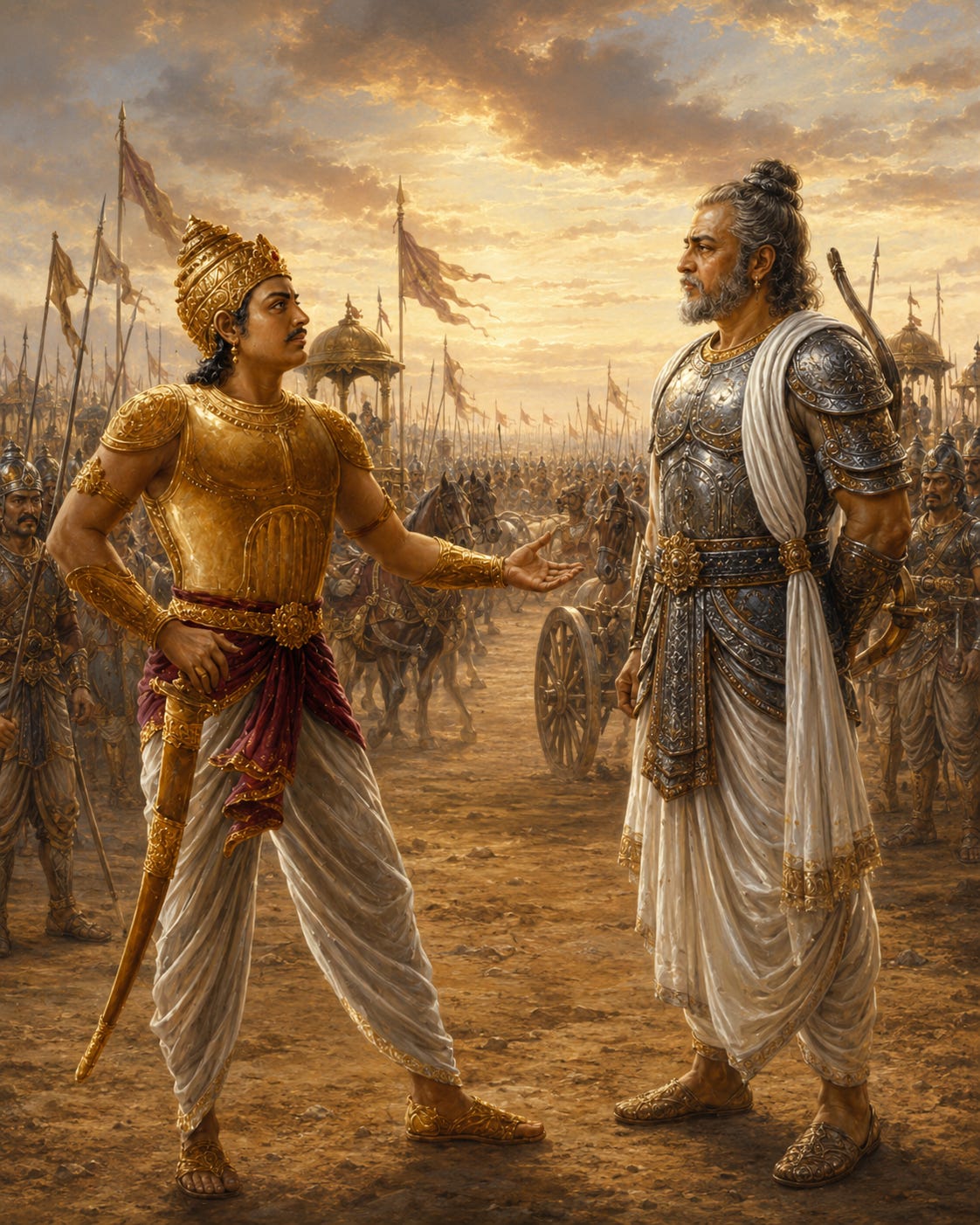
The political game before the battle (Bg 1.10 and 1.11)
Even in front of his guru, Duryodhana continues to manage the situation politically. He first tries to influence Drona, securing his full commitment. Then, he must also praise Bhīṣma, without minimizing his teacher. In doing so, however, he creates a third problem: now he must also praise the other generals, without minimizing either Bhīṣma or Drona. His words reveal his political skill, but also his insecurity: even surrounded by powerful generals and a vast army, he knows that victory is not certain.
Text 10: aparyāptam tad asmākam, balam bhīṣmābhirakṣitam
paryāptam tv idam eteṣām, balam bhīmābhirakṣitam
Our strength is immeasurable, and we are perfectly protected by Grandfather Bhīṣma, whereas the strength of the Pāṇḍavas, carefully protected by Bhīma, is limited.
Text 11: ayaneṣu ca sarveṣu, yathā-bhāgam avasthitāḥ
bhīṣmam evābhirakṣantu, bhavantaḥ sarva eva hi
All of you must now give full support to Grandfather Bhīṣma, as you stand at your respective strategic points of entrance into the phalanx of the army.
Both Droṇācārya and Bhīṣma were important generals in the army, and, being a politician, Duryodhana did not want to displease either of them. He thus used a clever construction to praise both at the same time, using the sentence “aparyāptam tad asmākam balam bhīṣmābhirakṣitam” in verse ten.
The word aparyāptam has a double meaning, meaning “insufficient” or “inadequate” but also “immeasurable” or “limitless”, depending on the context. In this way, his sentence simultaneously means “Our strength is immeasurable because we are protected by Bhīṣma” and “Our strength is insufficient because we are protected by Bhīṣma”. When Bhīṣma heard this sentence, he took the first meaning and was therefore encouraged. Droṇācārya, on the other hand, took the second meaning, understanding that Duryodhana was glorifying him by minimizing the capacity of his rival. By his rhetorical tricks, Duryodhana was thus capable of simultaneously satisfying both.
To avoid the possibility of other generals being displeased, he ordered the others to maintain their positions in the formation and thus protect Bhīṣma from all sides, giving the idea that, although powerful, Bhīṣma was old, and thus the others had the mission of protecting him. As Prabhupāda mentions in his purport, “He emphasized that Bhīṣmadeva was undoubtedly the greatest hero, but he was an old man, so everyone must especially think of his protection from all sides. He might become engaged in the fight, and the enemy might take advantage of his full engagement on one side. Therefore, it was important that other heroes not leave their strategic positions and allow the enemy to break the phalanx.”
Bhīṣma was the oldest member of the Kuru dynasty, the son of King Śāntanu and Gangā. The history is that once, Śāntanu met Gaṅgādevī, while walking on the banks of the river. Some question how Śāntanu could have married a river, but in this case it’s not about the river but the demigoddess who presides over it. It is just like the sun and Vivasvān, the solar deity. Both can be called “sun,” but there is a great difference between the solar globe and the demigod who presides over it, just as there is a difference between a king and his kingdom.
Without knowing who she was, Śāntanu immediately courted the beautiful maiden, who agreed to marry him under the condition that he would never question anything she did, whether good or bad. If he ever questioned her, she would leave immediately. Śāntanu accepted, and soon they conceived a son. However, as soon as the child was born, she took him to the river and drowned him. Bound by his promise, however, Śāntanu couldn’t do anything. The same scene was repeated with each of their next children, and each time Śāntanu was terrified but did not say anything. When she took their eighth child, he was unable to contain himself and finally questioned her about who she was and how she could kill their children so mercilessly. At that moment, Gangā finally revealed her true identity and explained the reason for her actions. The eight children were the eight Vasus, who had been cursed to take birth on earth after stealing the cow of the great sage Vasiṣṭha, a kāmadhenu who could satisfy all desires. Gangā had agreed to come to earth to become their mother and thus liberate them quickly from the curse. She had chosen Śāntanu to become their father, knowing that he would break the condition of their marriage after they were born, allowing her to return to her celestial position. Seven of the Vasus could return immediately to their celestial positions, but the chief among them, the one who had taken the cow, had to live a human life. This eighth Vasu, known as Devavrata, was taken by her to be educated and later delivered to Śāntanu as his son.
Later, Śāntanu met Satyavatī, the daughter of a local fisherman, who had been blessed by the great sage Parāśara Muni to have a divine bodily fragrance. Śāntanu immediately wanted to marry her, but when he approached her father, he demanded that her sons inherit the throne instead of Devavrata, the eldest son. Śāntanu couldn’t agree with this proposal, but when his son heard of it, he made a vow of lifelong celibacy. With this, he removed himself from the royal succession and opened the path for his father’s second marriage. For this vow, he became known as Bhīṣma, “One who has taken a terrible vow”, and received the blessing that he would die only at the time of his choosing.
During the battle of Kurukṣetra, Bhīṣma was pierced by numerous arrows shot by Arjuna, which formed a kind of bed, preventing his body from touching the ground when he fell. Still, because of the blessing, he didn’t die. He remained on this bed of arrows on the battlefield for several months, and left his body only months later at a particularly auspicious moment, in the presence of Kṛṣṇa. His glorious passing is narrated in the First Canto of Śrīmad-Bhāgavatam.
Bhīṣma was so powerful that he once fought Paraśurāma to a standstill. Paraśurāma had previously exterminated the kṣatriyas of the world twenty-one times, but still, he couldn’t defeat Bhīṣma in battle. The story is that at a certain point, Bhīṣma kidnapped Amba to marry her to his half-brother, Vicitravīrya. However, because she was already in love with Śālva, Vicitravīrya refused to marry her. Śālva, in turn, also refused because she had been kidnapped by another man. Put in such a situation, she demanded that Bhīṣma marry her, since he was the one who created the situation by kidnapping her in the first place, but he refused because of his vow of brahmacārya. She then took shelter of Paraśurāma, who, being the martial guru of Bhīṣmadeva, promised to help her. When Bhīṣma refused to marry Amba because of his vow of brahmacarya, Paraśurāma fought with him, but after Bhīṣma held his own for twenty-three days, he had to admit that he would not be able to defeat him. Amba then practiced severe austerities with the goal of killing Bhīṣma and eventually was reborn as Śikhaṇḍī, who joined the Pāṇḍava army and was instrumental in defeating Bhīṣmadeva.
Even though he had two wives, Ambikā and Ambālikā, Vicitravīrya died without a son, creating a succession crisis that is central to the plot of the Mahābhārata. With the bloodline of Śāntanu broken, Satyavatī revealed to Bhīṣma that she had a child with Parāśara Muni before her marriage with King Śāntanu. It happened that when she was young, she was helping her father as a boatwoman, ferrying people across the river. Once, Parāśara needed to cross the river and asked for her help. During the trip, however, he became attracted to her and promised to bless her and keep her virginity intact if she would unite with him. That’s how she got the blessing of possessing a divine bodily fragrance. Because Parāśara was a great sage, this union was not considered irreligious, and because of his blessing, it also didn’t prevent Satyavatī from marrying Śāntanu later, just as in the case of Kuntī begetting a child with the sun-god. Their union produced a divine son, Vyāsadeva, who was born instantly and quickly grew into an adult, just like a demigod. Vyāsa left shortly after his birth, but he promised his mother to come whenever she needed him.
Remembering that, she invoked Vyāsa to perform niyoga, the ancient practice in which a qualified sage would be invoked to beget a child on a widow to preserve a family line. Such unions would not be performed out of lust but as a sacred duty and would be in accordance with the path of dharma. Vyāsa accepted but warned her that he had been performing austerities for a long time, and for that reason, his appearance was frightening. Satyavatī and the two queens accepted, but when Vyāsa approached Ambikā, she became afraid and closed her eyes. This led to the birth of Dhṛtarāṣṭra, who was blind from birth. Ambālikā became pale, and this led to the birth of Pāṇḍu, who was virtuous, but of weak health. Satyavatī pressed for one more son, but this time Ambikā hid and sent a maidservant in her place, leading to the birth of Vidura. With this, Pāṇḍu inherited the throne, but with his early demise, his five sons were left fatherless and had to survive all the intrigues of Dhṛtarāṣṭra and his sons, leading to the battle of Kurukṣetra.
Main points in the purports of Śrīla Prabhupāda:
“Our strength is immeasurable, and we are perfectly protected by Grandfather Bhīṣma, whereas the strength of the Pāṇḍavas, carefully protected by Bhīma, is limited.”
a) Duryodhana calculates that his army is more powerful, being protected by Bhīṣma, a more experienced general, and considers the forces of the Pāṇḍavas, protected by Bhīma, as inferior. Duryodhana knew that only Bhīma could kill him, but he was confident in the presence of Bhīṣma, the grandfather of all Kurus.
“All of you must now give full support to Grandfather Bhīṣma, as you stand at your respective strategic points of entrance into the phalanx of the army.”
a) After praising Bhīṣma in the previous verse, he tried to adjust the situation by emphasizing the role of the other fighters, so they would not be discouraged. Bhīṣma is powerful, but the enemy could take advantage of the chaos of the battle and strike him. Everyone should therefore be attentive and protect their designated positions in the military formation.
b) Although Bhīṣma and Droṇa had affection for the Pāṇḍavas, he was confident in their support because they didn’t protest during the gambling match, when the Kauravas tried to disrobe Draupadī, despite her pleas in her helpless condition. He hoped they would act similarly in the battle.
Next: Signs of victory: the sounding of the conchshells (Bg 1.12 to 1.19)
Read the entire book:
« The Song of God—Volume 1, chapters 1-6

This is a publication for thoughtful readers who want to go deeper into Kṛṣṇa consciousness. I publish daily, trying to offer high-quality spiritual content, and all posts are available to free subscribers. If you wish, you can also choose a paid subscription to support this work.
You can also receive the updates on WhatsApp or Telegram.
If you would like to contribute further, you can find the donation links here.