

« The Song of God—Volume 1, chapters 1-6
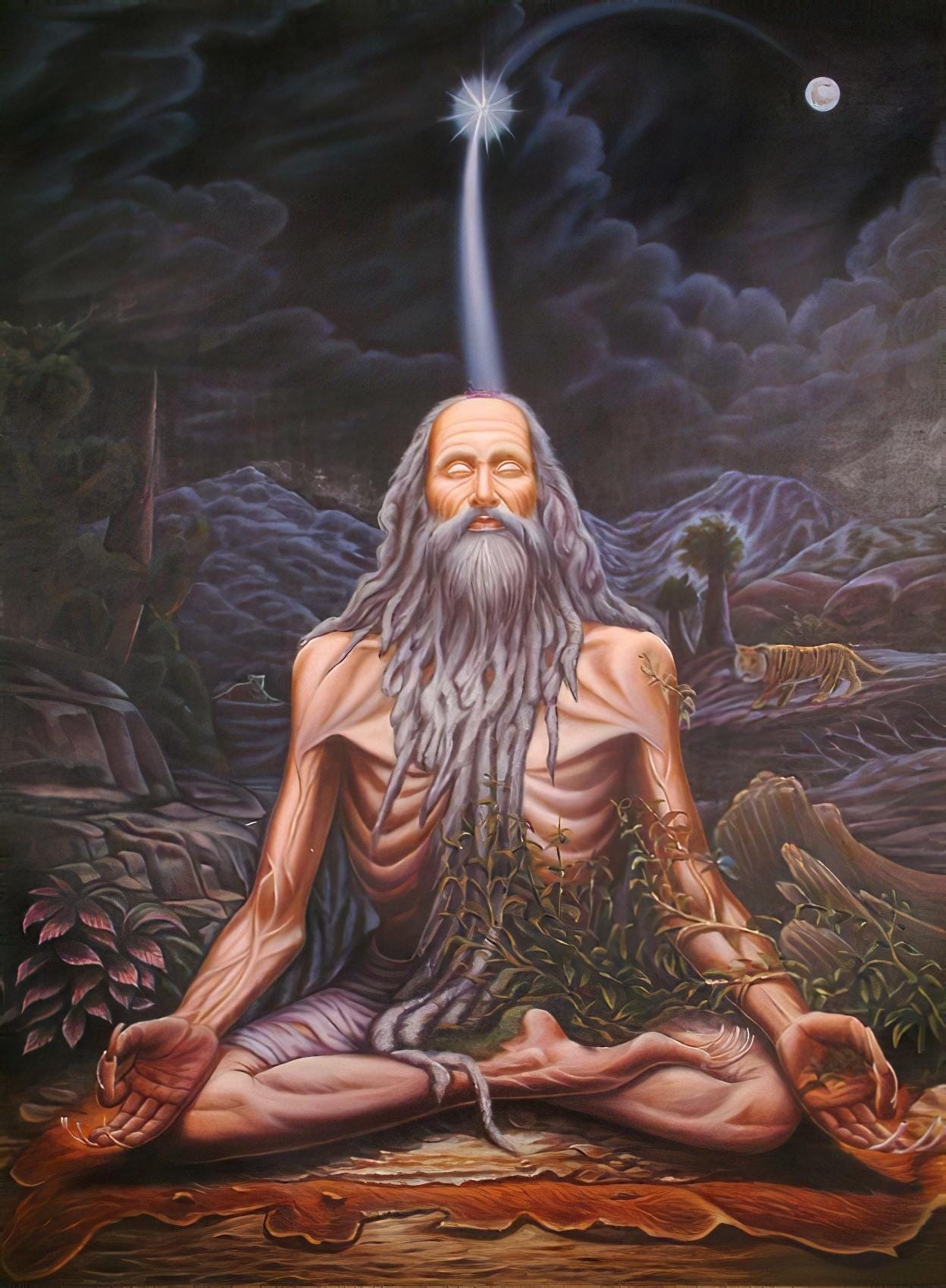
The practice of aṣṭāṅga-yoga (Bg 6.10 to 6.15)
After establishing the qualifications of an aṣṭāṅga-yogī, Kṛṣṇa will now explain the practical steps. These details reveal how demanding the process is, and how far the modern practices are from it. Even controlling the mind is not the real goal of the process. The yogī must meditate on Him within his heart, and attain His transcendental abode.
Text 10: yogī yuñjīta satatam, ātmānaṁ rahasi sthitaḥ
ekākī yata-cittātmā, nirāśīr aparigrahaḥ
A transcendentalist should always engage his body, mind and self in relationship with the Supreme; he should live alone in a secluded place and should always carefully control his mind. He should be free from desires and feelings of possessiveness.
Texts 11-12: śucau deśe pratiṣṭhāpya, sthiram āsanam ātmanaḥ
nāty-ucchritaṁ nāti-nīcaṁ, cailājina-kuśottaram
tatraikāgraṁ manaḥ kṛtvā, yata-cittendriya-kriyaḥ
upaviśyāsane yuñjyād, yogam ātma-viśuddhaye
To practice yoga, one should go to a secluded place and should lay kuśa grass on the ground and then cover it with a deerskin and a soft cloth. The seat should be neither too high nor too low and should be situated in a sacred place. The yogī should then sit on it very firmly and practice yoga to purify the heart by controlling his mind, senses and activities and fixing the mind on one point.
Texts 13-14: samaṁ kāya-śiro-grīvaṁ, dhārayann acalaṁ sthiraḥ
samprekṣya nāsikāgraṁ svaṁ, diśaś cānavalokayan
praśāntātmā vigata-bhīr, brahmacāri-vrate sthitaḥ
manaḥ saṁyamya mac-citto, yukta āsīta mat-paraḥ
One should hold one’s body, neck and head erect in a straight line and stare steadily at the tip of the nose. Thus, with an unagitated, subdued mind, devoid of fear, completely free from sex life, one should meditate upon Me within the heart and make Me the ultimate goal of life.
Text 15: yuñjann evaṁ sadātmānaṁ, yogī niyata-mānasaḥ
śāntiṁ nirvāṇa-paramāṁ, mat-saṁsthām adhigacchati
Thus practicing constant control of the body, mind and activities, the mystic transcendentalist, his mind regulated, attains to the kingdom of God [or the abode of Kṛṣṇa] by cessation of material existence.
In the previous section, Kṛṣṇa described the qualifications of the yogī. One starts by controlling the mind by the practice of the rules and regulations of the eightfold system (yama and niyama), as well as āsanas, and prāṇāyāma, working without attachment. Then, when the mind is finally controlled, one can progress into the process of meditation, giving up all material desires, becoming satisfied by knowledge and realization, and eventually coming to the transcendental stage, seeing friends, and enemies, saints and sinners with equal vision.
As explained, all these qualities are also developed by the bhakti-yogī; the goals are the same for both processes. What is different is that the devotee follows a much easier and more natural path. If the direct process of bhakti-yoga is so much better, why is it that Kṛṣṇa recommends aṣṭāṅga-yoga in this chapter? Kṛṣṇa describes the process of meditation exactly for us to understand how difficult it is. This is not modern yoga for health and relaxation. It is a strict process. He then presents to us the direct path of bhakti-yoga in chapters seven to twelve, teaching us to always remember Him and never forget Him.
The first prerequisite is that the yogī should live alone, in a secluded place, such as a forest or a cave. In the path of karma-yoga, it does not matter if one is a householder; everyone can learn how to serve Kṛṣṇa. In the aṣṭāṅga-yoga process, however, one has to leave home and go to live alone. There is no way to practice meditation while living in a city and working a regular nine-to-five job.
Ordinary social life agitates the mind. It forces us into conversations, associations, planning, and problem-solving that naturally draw our consciousness outward. Only seclusion in a natural environment can produce the delicate mental state that allows one to remain in trance for long periods of time. Without it, yoga becomes a farce.
This process of meditation can also only be practiced by one who is a complete celibate. This does not mean to just abstain from sexual intercourse, but from everything connected with it, including thoughts and words. As explained by Yājñavalkya: karmaṇā manasā vācā, sarvāvasthāsu sarvadā, sarvatra maithuna-tyāgo, brahmacaryaṁ pracakṣate. “The vow of brahmacarya is meant to help one completely abstain from sex indulgence in work, words and mind – at all times, under all circumstances and in all places.”
If one cannot withdraw the mind from thoughts about sex life, his meditation will be easily broken by the smallest agitation, just like in the case of Saubhari Muni, who abandoned his meditation to marry the 50 daughters of King Māndhātā after merely seeing fish copulating, or Viśvāmitra Muni, who became attracted simply by hearing the sound of Menakā’s ankle bells.
This is another point in which this process of meditation differs from the direct path of devotional service. In the yogic process, there is no strong engagement for the mind; therefore, one can easily go astray, even by hearing the footsteps of a woman, what to say of being engaged in sex life. In the process of devotional service, however, one may remain as a householder and still develop attraction for Kṛṣṇa by following the process of action in Kṛṣṇa consciousness already described. Because the process is more powerful, the requirements are more flexible.
Kṛṣṇa also emphasizes the goal of this process of meditation: yogī yuñjīta satatam ātmānaṁ. The dictionary meaning of this sentence is that the yogī should constantly discipline himself. Prabhupāda, however, calls our attention to the higher meaning, in the context of everything Kṛṣṇa has explained up to here: one should fix oneself (body, mind and soul) in Kṛṣṇa consciousness, in relationship with the Supreme. It is not about emptying the mind of all thoughts or imagining oneself as one with Brahman as fantasized nowadays. Kṛṣṇa has three aspects: Brahman, Paramātmā, and Bhagavān. A yogī meditates according to his level of realization, but the ultimate goal is to become absorbed in transcendental loving service.
As Prabhupāda explains:
“Kṛṣṇa is realized in different degrees as Brahman, Paramātmā and the Supreme Personality of Godhead. Kṛṣṇa consciousness means, concisely, to be always engaged in the transcendental loving service of the Lord. But those who are attached to the impersonal Brahman or the localized Supersoul are also partially Kṛṣṇa conscious, because the impersonal Brahman is the spiritual ray of Kṛṣṇa and the Supersoul is the all-pervading partial expansion of Kṛṣṇa. Thus the impersonalist and the meditator are also indirectly Kṛṣṇa conscious. A directly Kṛṣṇa conscious person is the topmost transcendentalist because such a devotee knows what is meant by Brahman and Paramātmā. His knowledge of the Absolute Truth is perfect, whereas the impersonalist and the meditative yogī are imperfectly Kṛṣṇa conscious.”
This explains the conclusion Kṛṣṇa gives later in the chapter: the greatest yogī is the one who sees himself as always connected with Kṛṣṇa, and renders transcendental loving service unto Him. In other words, the greatest yogī is the devotee who is always engaged in Kṛṣṇa consciousness. If one can accept the simple and sublime process of devotional service, there is no need to practice aṣṭāṅga-yoga as a separate process.
The next instructions are that the yogī should move to a sacred place (śucau deśe), such as Prayāga, Mathurā, Vṛndāvana, Hṛṣīkeśa, and Hardwar, and live there in seclusion. He should make his āsana, or sitting place, by spreading a layer of kuśa grass and covering it with a deerskin. The deerskin is not just for comfort; it has the function of protecting against snakes and crawling creatures that would otherwise disturb his meditation. On top of it, one should spread a soft cloth, creating an āsana that is not too hard nor too comfortable, not too high, but also not too low. One should then sit, keeping the mind under control and focusing his meditation on the Lord according to his level of realization.
Next, Kṛṣṇa describes the process of meditation itself: “One should hold one’s body, neck and head erect in a straight line and stare steadily at the tip of the nose. Thus, with an unagitated, subdued mind, devoid of fear, completely free from sex life, one should meditate upon Me within the heart and make Me the ultimate goal of life.”
In the true process of yoga, the meditation is performed with the eyes partially open. The yogī learns to focus the vision on the tip of the nose, which allows one to meditate while keeping the eyes half-open, without becoming distracted. The advantage is that one can meditate for long periods without falling asleep. The words mat-paraḥ again emphasize the object of meditation: the yogī should see Kṛṣṇa as the ultimate goal of life, and practice his meditation with the goal of achieving Him.
Many yogīs practice yoga with the goal of achieving mystical perfections. Similarly, in modern times, many practice āsanas or even prāṇāyāma with the goal of improving health or dealing with stress. This is not yoga, but material activity. Others practice yoga with the goal of merging into the Supreme. This is also a form of liberation, but is not the real goal.
As revealed by Kṛṣṇa, cessation of material existence does not lead to a void; the ultimate goal is His personal abode. This is revealed by the words śāntiṁ nirvāṇa-paramāṁ, mat-saṁsthām adhigacchati, in text 6.15.
Māyāvādīs usually translate this passage as “he attains the peace that culminates in nirvāṇa, and is established in Brahman.” Prabhupāda, however, calls our attention to the higher meaning of the passage: The perfect yogī attains peace because he is elevated to the kingdom of God, the abode of Kṛṣṇa, by cessation of material existence. This is revealed by the construction “mat-saṁsthām”. Saṁsthām means resting place, condition, foundation. The word mat, however, puts it in relationship to Kṛṣṇa. Mat-saṁsthām means, thus, the spiritual world, the abode of Kṛṣṇa. That’s the final destination achieved by the perfect yogī.
Main points in the purports of Śrīla Prabhupāda:
“A transcendentalist should always engage his body, mind and self in relationship with the Supreme; he should live alone in a secluded place and should always carefully control his mind. He should be free from desires and feelings of possessiveness.”
a) Kṛṣṇa is realized in three aspects: Brahman, Paramātmā, and Bhagavān, the personal aspect. One who reaches the Bhagavān stage is always engaged in devotional service. This is the topmost realization.
b) Because Brahman and Paramātmā are also aspects of Kṛṣṇa, the impersonalist and the yogī are also indirectly Kṛṣṇa conscious, but they are imperfect, for their knowledge is limited. All are encouraged to continue their practice and grow their realization, but a devotee is already in a superior stage, because he knows the real meaning of Brahman and Paramātmā.
c) Real samādhi, or trance, is to always think of Kṛṣṇa and never forget Him. For this, a yogī is recommended to live in a secluded place, renounced, careful, and free from all disturbances. However, all of these are perfectly executed in Kṛṣṇa consciousness, because the direct process of bhakti brings self-sacrifice. A devotee is not attached to anything, because he accepts everything in relation to Kṛṣṇa. On the other hand, renouncing everything without understanding how things are related to Kṛṣṇa is incomplete.
d) In this spirit, a pure devotee remains always transcendental. He is free from all material hankering, accepting or rejecting things according to their usefulness in Kṛṣṇa consciousness. He remains alone, in the sense he avoids the association of people who are not Kṛṣṇa conscious. He is thus the perfect yogī.
“To practice yoga, one should go to a secluded place and should lay kuśa grass on the ground and then cover it with a deerskin and a soft cloth. The seat should be neither too high nor too low and should be situated in a sacred place. The yogī should then sit on it very firmly and practice yoga to purify the heart by controlling his mind, senses and activities and fixing the mind on one point.”
a) A yogī is supposed to leave home and take shelter of a holy place where a sacred river flows to practice yoga in solitude. Yoga societies in the cities may be a good way to make money, but they are not at all suitable for the practice of yoga.
b) One who is not self-controlled cannot practice aṣṭāṅga-yoga. Nowadays, everyone is disturbed; therefore, the best means of spiritual realization for our age is chanting the holy name of the Lord. There is no other way.
“One should hold one’s body, neck and head erect in a straight line and stare steadily at the tip of the nose. Thus, with an unagitated, subdued mind, devoid of fear, completely free from sex life, one should meditate upon Me within the heart and make Me the ultimate goal of life.”
a) The goal of life is to know Kṛṣṇa. Yoga means to find Him inside the heart as Paramātmā. Without this understanding, one is just wasting his time in a useless imitation of yoga.
b) To realize Kṛṣṇa inside the heart in the process of yoga, one has to practice complete celibacy, leaving home and living alone in a secluded place, practicing the process described by Kṛṣṇa here, and avoiding all types of sense gratification.
c) In the varṇāśrama system, boys would be trained as brahmacārīs from the age of five, for, without self-control, one cannot advance in any process of yoga, be it dhyāna, jñāna, or bhakti. The difference is that the jñāna and dhyāna schools are open only for renunciants. They require complete abstinence. In the bhakti school, however, regulated householders are allowed, because the process is so powerful that one gradually loses sexual attraction due to a higher taste.
d) All fear comes from forgetfulness of our eternal relationship with Kṛṣṇa, therefore, one cannot be fearless without being fully Kṛṣṇa conscious. Proper yoga practice requires one to be fearless; therefore, perfect practice is possible only for a devotee who is Kṛṣṇa conscious. At the same time, Kṛṣṇa consciousness is the goal of the yoga process; therefore, a Kṛṣṇa conscious person is already the best of all yogīs.
“Thus practicing constant control of the body, mind and activities, the mystic transcendentalist, his mind regulated, attains to the kingdom of God [or the abode of Kṛṣṇa] by cessation of material existence.”
a) One who practices yoga for better health is no yogī. Real yoga is not meant to satisfy selfish desires; it is meant to free us from material existence. The goal is also not merging into a void; this is a myth. Cessation of material existence means to enter the abode of the Lord, the spiritual sky, where all planets are self-illuminated.
b) No one can reach Vaikuṇṭha or enter into Goloka Vṛndāvana without properly understanding Kṛṣṇa and Viṣṇu. A complete yogī is the one who can understand Kṛṣṇa. Such a devotee attains the supreme abode.
c) Since reaching the supreme abode is the perfection of the yoga process, the pure devotee who works for Kṛṣṇa is the perfect yogī, because he is always absorbed in Kṛṣṇa’s activities; he can thus overcome material existence. In contrast, those who teach yoga as merely gymnastics are fooling the innocent public.
Read the entire book:
« The Song of God—Volume 1, chapters 1-6

This is a publication for thoughtful readers who want to go deeper into Kṛṣṇa consciousness. I publish daily, trying to offer high-quality spiritual content, and all posts are available to free subscribers. If you wish, you can also choose a paid subscription to support this work.
You can also receive the updates on WhatsApp or Telegram.
If you would like to contribute further, you can find the donation links here.