

« Making Sense of the Vedic Universe, a Higher-Dimensional Reality
The process of creation starts
Up to this point, the shells of the material universes were created, the Supreme Lord entered them as Garbhodakaśāyī Viṣnu and Kṣīrodakaśāyī Viṣnu, and the material energy was activated, leading to the manifestation of the material elements. After that, the process of creating the material manifestation finally started.
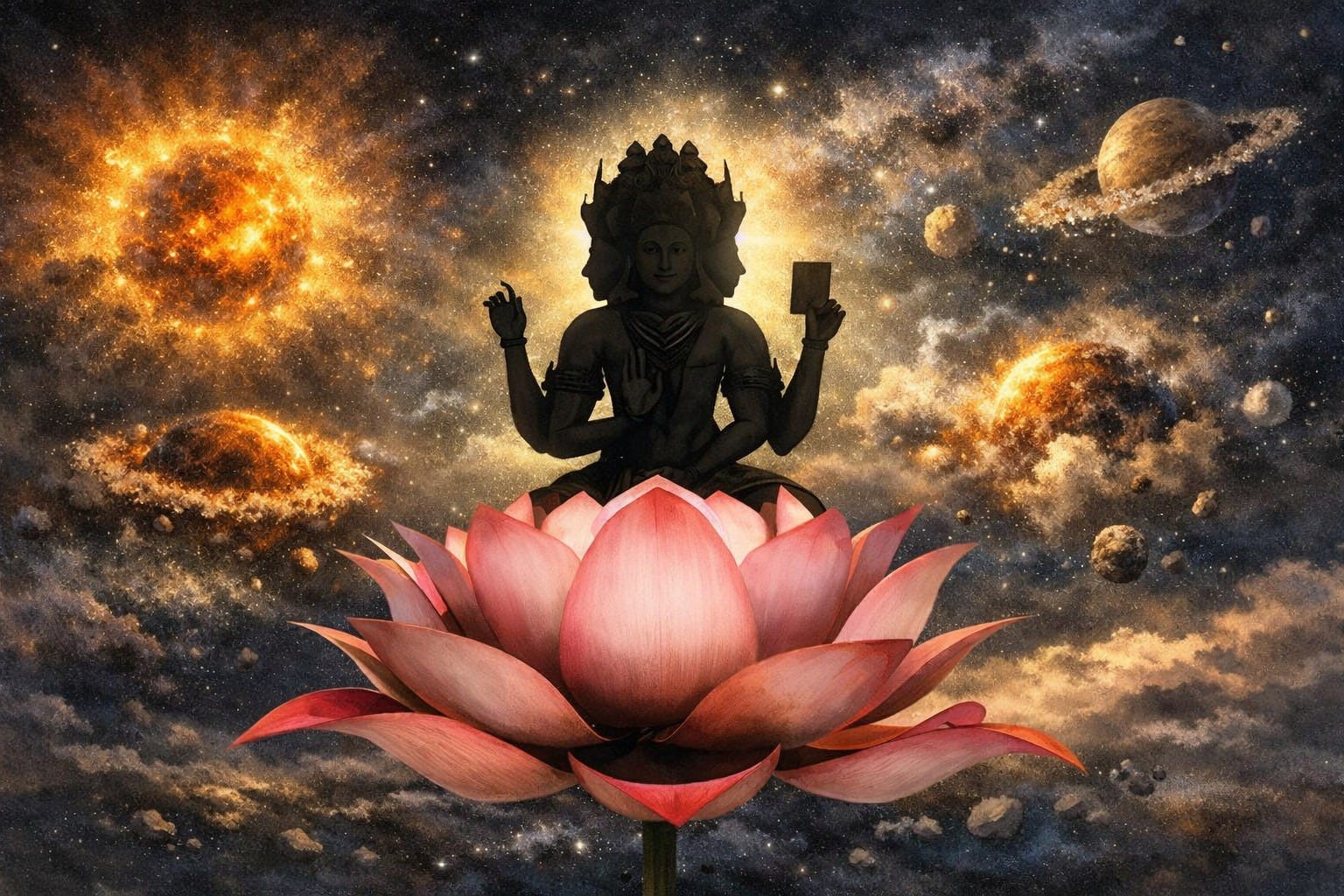
Brahmā then appeared from the navel of Lord Viṣnu, leading to the situation described in the 9th chapter of the Second Canto:
“Lord Brahmā, the first spiritual master, supreme in the universe, could not trace out the source of his lotus seat, and while thinking of creating the material world, he could not understand the proper direction for such creative work, nor could he find out the process for such creation. While thus engaged in thinking, in the water, Brahmājī heard twice from nearby two syllables joined together. One of the syllables was taken from the sixteenth and the other from the twenty-first of the sparśa alphabets, and both joined to become the wealth of the renounced order of life.
When he heard the sound, he tried to find the speaker, searching on all sides. But when he was unable to find anyone besides himself, he thought it wise to sit down on his lotus seat firmly and give his attention to the execution of penance, as he was instructed.” (SB 2.9.5-7)
Brahmā awakened in complete darkness on top of the lotus flower and was unable to trace the source of it. He understood he was supposed to create the universe, but could not understand what to create or how to do it. Although the subtle universal form, the blueprint of the universe, was already manifest, Brahmā could not see it.
At this point, Brahmā heard the syllables “ta” and “pa” pronounced by the Lord and engaged in meditation. Brahmā then meditated for one thousand celestial years. During this period, the creation remained dormant, as described on SB 3.6.6. At the end of this period, Brahmā was blessed with the opportunity to see the Lord and the spiritual world.
Brahmā performs his work of creation at the beginning of each of his days. In the Second Canto, the process of creation in the current day of Brahmā is described. It doesn’t necessarily happen exactly the same way in all of his days. This particular day, the Padma-kalpa, is special because it follows the total devastation that happens at the end of the first half of the life of Brahmā. Normally, when Brahmā awakens at the beginning of his day, the process is simpler because the material elements, as well as the upper planets (Maharloka and upwards), survive the partial devastation.
Apart from being the current day, another reason for the Śrīmad-Bhāgavatam describing the Padma-kalpa instead of some other day of Brahmā is that, on this particular day, Kṛṣṇa appears in his original form to Brahmā after his meditation. As mentioned in the Gopāla-tāpanī Upanisad, Brahmā practices devotional service for the first half of his life, repeatedly creating the universe, and finally, on the first day of the second half, the Lord agrees to reveal Himself to him and allows Brahmā to see the spiritual world.
After completing his meditation and meeting the Lord, the creation of Brahmā finally started. As described on 2.9.39, he began to re-create the universe, full with living entities, as it was previously.
At first, Brahmā had to fix the conditions of the universe so the process of secondary creation could take place. It’s mentioned that “both the lotus on which he was situated and the water on which the lotus was growing were trembling due to a strong, violent wind.”
Using his power, Brahmā could drink the wind as well as the water, fixing the situation. Now, without the disturbance of the cosmic winds and with the Garbhodaka Ocean back to its proper level, creation could take place.
The first step was to create the planets from the material elements contained in the cosmic lotus. This is described later, in the Third Canto:
“Thereafter he saw that the lotus on which he was situated was spread throughout the universe, and he contemplated how to create all the planets, which were previously merged in that very same lotus. Thus engaged in the service of the Supreme Personality of Godhead, Lord Brahmā entered into the whorl of the lotus, and as it spread all over the universe, he divided it into three divisions of worlds and later into fourteen divisions.” (SB 3.10.7-8)
Previously, the Lord created both the material elements and the subtle forms of the planets (in the Virāṭ-rūpa), and thus, factually, everything was already created by the Lord. The work of Brahmā, which looks so astonishing to us, consists of organizing the material elements into the forms conceived by the Lord.
Brahmā thus used the material elements from the lotus to create the fourteen planetary systems: 1) Satyaloka, 2) Tapaloka, 3) Janaloka, 4) Maharloka, 5) Svargaloka, 6) Bhuvarloka, 7) Bhūrloka, 8) Atalaloka, 9) Vitala-loka, 10) Sutala-loka, 11) Talātala-loka, 12) Mahātala-loka, 13) Rasātala-loka, and 14) Pātāla-loka.
The planetary systems of Atala, Vitala, Sutala, Talātala, Mahātala, Rasātala, and Pātāla are the lower planets, where the demons live. The intermediate planets, including earth, form Bhūrloka, while Svargaloka is the celestial planetary system where the demigods live. Bhuvarloka is the space in between. That’s the place for Siddhas, Cāraṇas, and Vidyādharas, as well as Rakshasas and other subtle beings. They are in the middle, considered higher than human beings but lower than the demigods.
All these different planetary systems up to Svargaloka are destroyed at the end of each day of Brahmā and recreated at the beginning of the next day.
Still higher are the planetary systems of Maharloka, Janaloka, Tapoloka, and Satyaloka, inhabited by great sages. These sages are, in general, above the feuds between demigods and demons and engage their time in advanced devotional service. For that reason, these planetary systems are not destroyed at the end of the day of Brahmā, surviving until the end of the parārdha (the first or second half of his life).
Read the whole book:
« Making Sense of the Vedic Universe, a Higher-Dimensional Reality
This is a publication for thoughtful readers who want to go deeper into Kṛṣṇa consciousness. I publish daily, trying to offer high-quality spiritual content, and all posts are available to free subscribers. If you wish, you can also choose a paid subscription to support this work.
You can also receive the updates on WhatsApp or Telegram.
If you would like to contribute further, you can find the donation links here.