

Subscribe to receive new articles by e-mail. It’s free, but if you like, you can pledge a donation:
As a body of literature, the Vedas are very difficult to understand, and many passages appear to contradict each other. Modern scholars interpret it as evidence that the Vedas are simply a collection of disconnected books written by different individuals over a few centuries, sharing a common culture. If we accept the explanation of the Vedas themselves, however, the answer is different. The Vedas address various topics from different points of view because different books are written for different classes of people. Therefore, somewhere Viṣnu is declared as the supreme and in another Śiva. Somewhere, fruitive sacrifices are recommended, and somewhere the cultivation of knowledge. Some passages recommend the performance of duties, and others the renunciation of the same duties, and so on.
These apparent conclusions, however, are not difficult to understand when we understand the goal behind them. Just to give you an example of how it can be simultaneously easy and difficult to understand passages from the Vedas:
At the beginning of chapter three of the Bhagavad-gītā, Arjuna is confused. Why is Kṛṣṇa telling him to fight in the war if He just mentioned in chapter two that intelligence is better than fruitive work?
Arjuna is more qualified than any of us. Still, he became confused when Kṛṣṇa explained to him.
The central point in Arjuna’s misunderstanding is that the word “buddhi” means “intelligence,” and the term “buddhi-yoga” mentioned several times by Kṛṣṇa in chapter two can thus be understood as the process of using our intelligence. If we take it in this way, the meaning of the verses of the whole second half of the second chapter becomes unclear. That’s how Arjuna understood it.
Let’s take 2.49, for example:
dūreṇa hy avaraṁ karma, buddhi-yogād dhanañ-jaya
buddhau śaraṇam anviccha, kṛpaṇāḥ phala-hetavaḥ
When we read the Bhagavad-gītā As It Is, we get everything explained. Prabhupāda follows the conclusions of the text and translates buddhi-yoga as devotional service, giving us the clear meaning. Thus, the translation for the verse is given as:
“O Dhanañjaya, keep all abominable activities far distant by devotional service, and in that consciousness surrender unto the Lord. Those who want to enjoy the fruits of their work are misers.”
The point in the verse is thus to avoid the fight but to renounce one’s selfish interests and fight in a spirit of renunciation, as an offering to Kṛṣṇa.
If, however, we take buddhi-yoga as simply the process of using our intelligence, the meaning of the verse changes completely. It becomes:
“O Dhanañjaya, using your intelligence, keep all abominable activities far distant. Take refuge in this intelligence. Those who want to enjoy the fruits of their work are misers.”
The term buddhi-yoga is central to the meaning of the verse, and thus, by misunderstanding this term, the entire meaning of the verse changes. Now, instead of fighting in devotional consciousness, the conclusion appears to be that he should use his deliberation to avoid the fight. This misunderstanding then cascades into the following verses, creating even more misunderstandings.
In 2.51, for example, when Kṛṣṇa mentions karma-jaṁ buddhi-yuktā hi, phalaṁ tyaktvā manīṣiṇaḥ, the correct meaning is:
“By thus engaging in devotional service to the Lord, great sages or devotees free themselves from the results of work in the material world.”
However, understanding buddhi as simply “intelligence,” the meaning becomes:
“By thus using their intelligence, great sages free themselves from the results of work in the material world.”
Kṛṣṇa uses the term buddhi-yoga eight times more until the end of the second chapter; therefore, if every time the term is misinterpreted, the misunderstandings multiply. One can thus end with the idea that instead of working for Kṛṣṇa, one should use one's intelligence to avoid fruitive work and thus become free from the sinful reactions. That’s how Arjuna understood it. However, remembering that in the first half of the second chapter, Kṛṣṇa insisted that he should fight, Arjuna becomes confused, not understanding how to reconcile these two apparently contradictory instructions. He starts the third chapter thus, asking why he should engage in karma (fighting in the battle) if buddhi (using his intelligence to avoid abominable activities) is described as superior.
We have passages like this all over the Vedas. It is practically impossible for anyone not to fall into such misunderstandings, and as one progresses in one's study, the mistakes compound and multiply. As a result, the more one studies, the less one understands. Often, scholars who have studied their whole lives are the most confused.
So, now that we understand the problem, what is the solution?
Kṛṣṇa gives us the process in the Gītā itself:
tad viddhi praṇipātena, paripraśnena sevayā
upadekṣyanti te jñānaṁ, jñāninas tattva-darśinaḥ“Just try to learn the truth by approaching a spiritual master. Inquire from him submissively and render service unto him. The self-realized souls can impart knowledge unto you because they have seen the truth.”
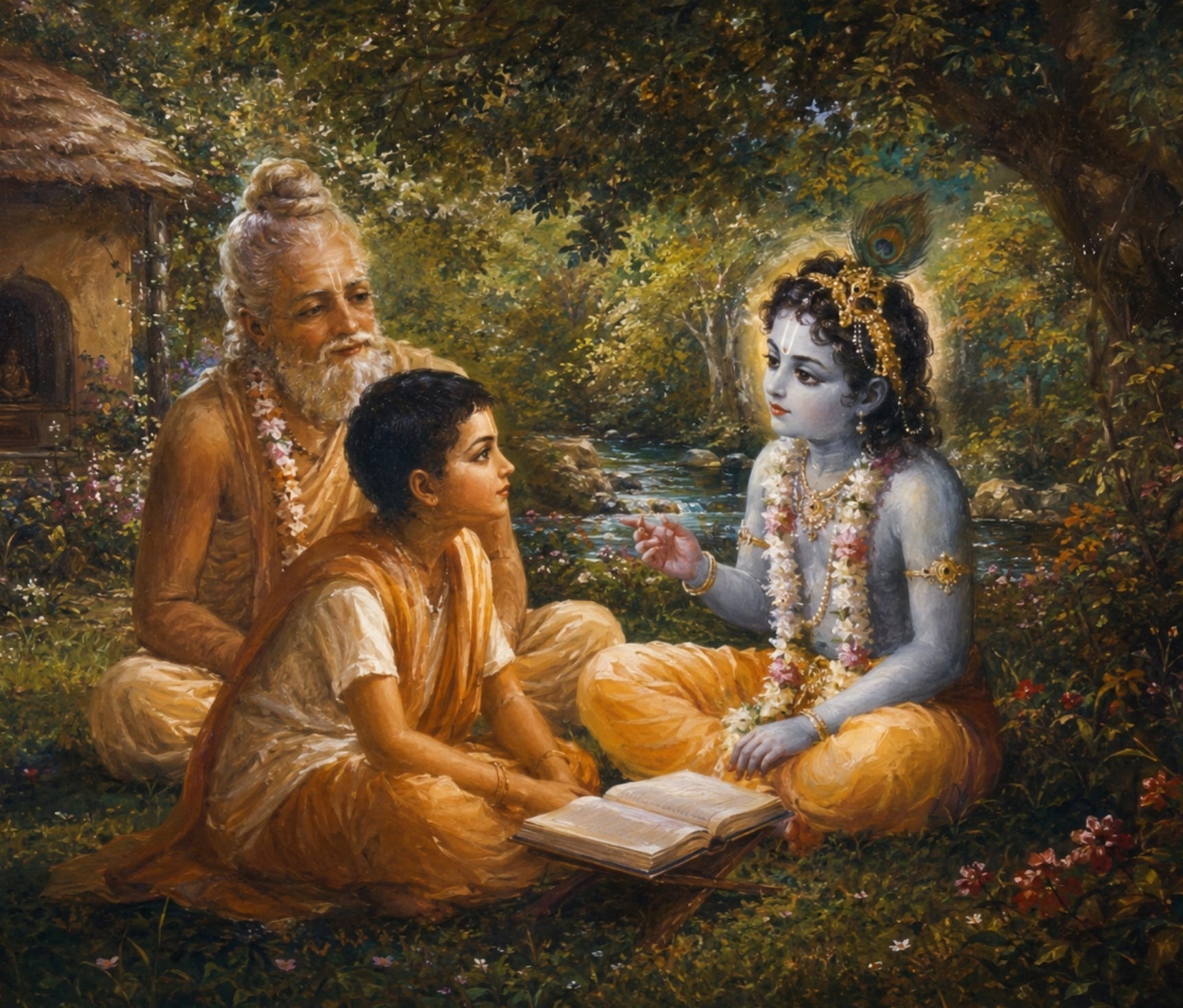
This is very logical. In all fields of human knowledge, we need to learn from people who know. Not many will accept undergoing surgery under a self-taught surgeon. Somehow, when it comes to spiritual knowledge, the most complex field, everyone thinks that they can figure it out themselves, and that’s how we become confused. If we learn from someone who knows, we can understand.
Kṛṣṇa then reveals how this process leads us to understand the inner purpose of the Vedas:
yaj jñātvā na punar moham, evaṁ yāsyasi pāṇḍava
yena bhūtāny aśeṣāṇi, drakṣyasy ātmany atho mayi“Having obtained real knowledge from a self-realized soul, you will never fall again into such illusion, for by this knowledge you will see that all living beings are but part of the Supreme, or, in other words, that they are Mine.”
The problem is that directly studying under a self-realized spiritual master is a luxury that not many of us have nowadays. Nowadays, it’s difficult to find even one devotee who has had the opportunity to study a few books directly under his spiritual master. In most cases, we are lucky if we have at all a channel where we can ask questions, even if occasionally or in written form.
That’s something that Śrila Prabhupāda could apparently foresee, because he created a system that precisely addresses this deficiency, writing books that contain all the correct conclusions from the scriptures in a format that is accessible to most people. His books can thus do much of the heavy lifting, giving us the correct framework to understand the Vedic scriptures.
The knowledge is thus widely available. The main challenge is that many don’t appreciate Prabhupāda’s books, preferring to read other, more vague commentaries. One reason for that, I believe, is that when we read Prabhupāda’s books, there is very little space for speculation and misunderstandings. The conclusions are stated in such a direct and clear way that it’s almost impossible to misunderstand. Yes, Kṛṣṇa is the Supreme Personality of Godhead (not Śiva, Durgā, or any other demigod). The ultimate goal of life is to attain love for Kṛṣṇa (it’s not achieving higher planets, merging into some impersonal light, or solving all one’s problems with the help of psychology), etc. Māyāvāda philosophy is nonsense, and many personalities whom common people usually respect were just spiritual con men who were misguiding people. The soul has an eternal relationship with Kṛṣṇa, and the goal of life is to reconnect with Him in this eternal relationship. The list goes on.
The difficulty many have is exactly that they can’t study Prabhupāda’s books without accepting such conclusions, and it is like that by design. One is forced to accept a submissive position and accept the conclusions Prabhupāda gives to study under him, the same process Kṛṣṇa prescribes in the Bhagavad-gītā. Some gladly accept this process and thus are able to continue studying his books and gradually understand Vaiṣnava philosophy, while others fail at some point and decide to go to other books that give them more space to interpret according to their personal convictions.
We can see that Prabhupāda understood well what he was doing. He didn’t want to become another popular Indian guru, giving a diluted and sweetened version of the philosophy that is palatable but ultimately useless, preferring to give the correct conclusions directly and focusing on quality followers instead of quantity. He understood that this was the way of training well-rounded devotees who understand the goal of life, instead of a sect of mental speculators.
In the Sat Sandarbhas, Śrila Jīva Gosvāmī explains how the Śrīmad-Bhāgavatam is the essence of all Vedic scriptures, and that all the other Puranas and other books of the Vedas must be interpreted according to the conclusions of the Śrīmad-Bhāgavatam if one wants to understand the truth. However, he also mentions that even the Śrīmad-Bhāgavatam can be misunderstood if one doesn’t study the text under the correct philosophical conclusions. When we study Prabhupāda’s books, all these conclusions are very clear. It’s not possible to study the Kṛṣṇa Book without understanding that Kṛṣṇa is the Supreme Personality of Godhead, for example, but if one moves to other authors, it becomes easier to misunderstand.
In this way, the path for us is to first study deeply the books from Śrila Prabhupāda (at least getting a solid understanding of the Bhagavad-gītā, Śrīmad-Bhāgavatam, Nectar of Devotion, Teachings of Lord Caitanya, etc.), getting thus a solid understanding of the conclusions of Vaiṣnava philosophy according to the original meaning of the texts, and only then gradually study other books.
The sources of the translations we study are also extremely important. When we speak about Vedic scriptures, there is no such thing as a direct translation. All translations are merged with the personal biases of the translator, and thus, choosing a translation is often a matter of choosing a person whom you trust. I generally try to stick with translations made by disciples of grand-disciples of Prabhupāda, who follow his conclusions, avoiding translations made by other scholars or from babajis who do not agree with his conclusions. Over time, I found that this is the most accurate method of finding good works. Just as a good professional is often recognized by the university where he studied, a good scholar can be recognized based on his fidelity to a bona fide school.
I personally appreciate the translations of Gopīparāṇadhana Prabhu very much, for example, because he is a devotee who has deeply studied the works of Śrila Prabhupāda and translated books following the conclusions he gives. He also translated quoted verses from the Bhāgavatam and other books according to the translations given by Prabhupāda, for example (different from other scholars, who frequently give translations that are substantially different in meaning). He is the author of the Brihad-bhagavatamrita published by the BBT, among a number of other books.
There are also a few very good works left by Godbrothers of Śrila Prabhupāda, like the translation of the Jaiva Dharma made by Śrila Bhakti Prajnana Kesava Maharaja, as well as many works by Śrila Sridhara Maharaja, for example.
Translations are, however, a playground for adults because there are all kinds of things floating around, and one has to be mature enough to select what is bona fide or not and to properly understand the books he or she is studying. Most of what we have around doesn’t properly express the message of the texts or doesn’t offer the right conclusions; therefore, spiritual teenagers can seriously hurt themselves by jumping here and there.
Go deeper:


You can also donate using Buy Me a Coffee, PayPal, Wise, Revolut, or bank transfers. There is a separate page with all the links. This helps me enormously to have time to write instead of doing other things to make a living. Thanks!