

« The Song of God—Volume 1, chapters 1-6
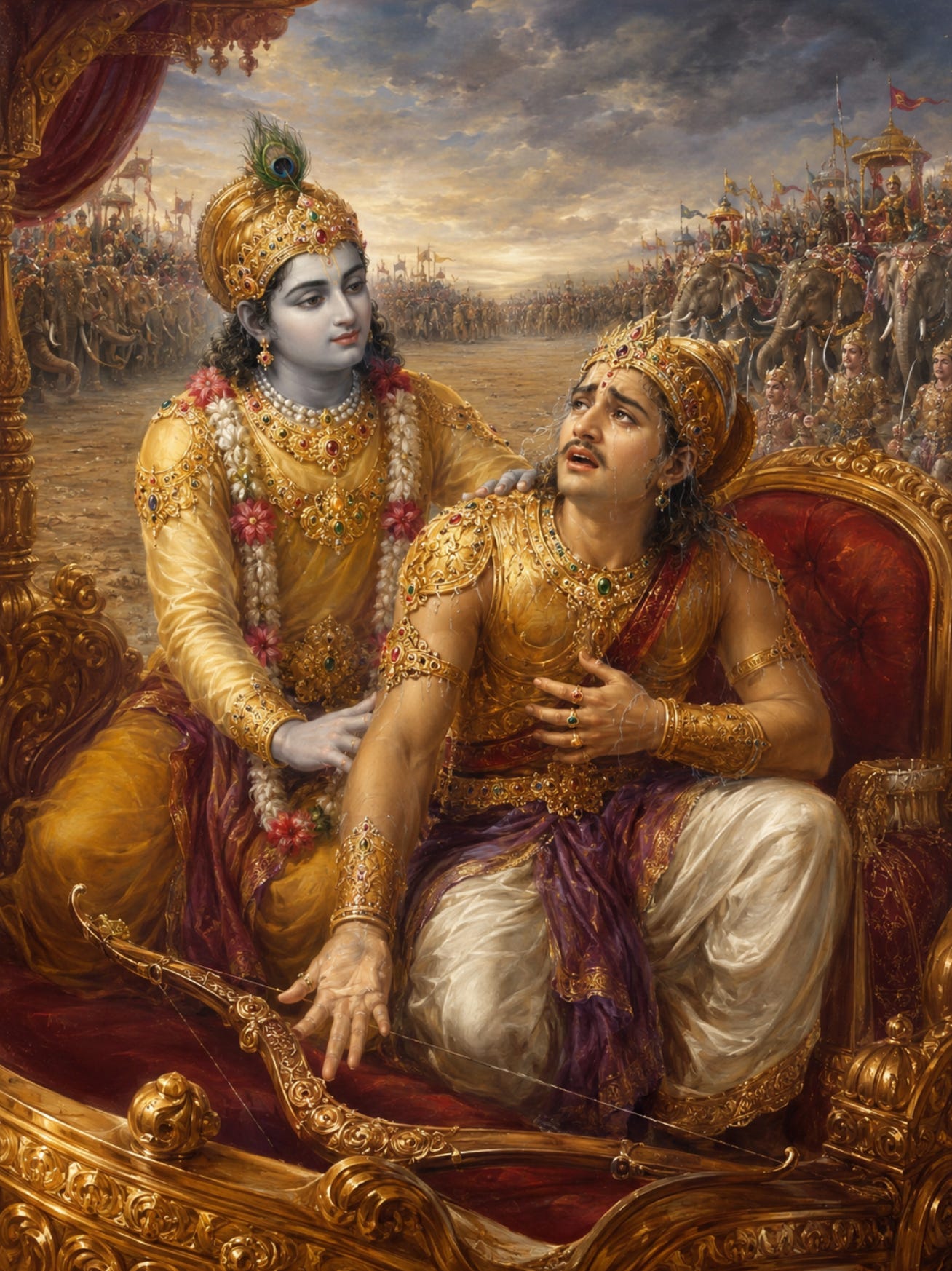
The result of material attachment (Bg 1.30)
Arjuna begins to see the whole situation through the lens of attachment and fear of misfortune. Under this mistaken conception, he starts considering what to do in terms of personal gain and loss, and thus becomes disturbed and confused about what to do. This connects with our situation in this world, where we live immersed in material attachment and anxiety, unable to find our way out.
Text 30: na ca śaknomy avasthātum, bhramatīva ca me manaḥ
nimittāni ca paśyāmi, viparītāni keśava
I am now unable to stand here any longer. I am forgetting myself, and my mind is reeling. I see only causes of misfortune, O Kṛṣṇa, killer of the Keśī demon.
In material consciousness, we plan our actions according to the pleasant or unpleasant results they may offer. If we conclude that the results of a certain activity will be unpleasant, we hesitate to do it. The problem is that because we lack perfect knowledge, the parameters we use to calculate the results of our actions are imperfect, and thus we often make the wrong decisions.
Arjuna was seeing only the causes of misfortune, calculating that both victory and defeat in the battle would bring him grief. Defeat would mean the loss of his life, while victory would mean the death of his relatives. As he calculated, both options would bring him loss, and as a result, his mind was reeling.
Material attachment makes us afraid of losing what we have and not achieving what we desire. This fear paralyzes us and makes us act in erratic ways. At this point, Arjuna became immersed in the bodily conception of life because of material attachment, and his first instinct was to run away from the problem, abandoning the battlefield.
As a kṣatriya, Arjuna had the duty of fighting in the battle. Due to fear and attachment, however, he was inclined to neglect this duty, which would just bring him to ruin, both in material and spiritual terms. By abandoning the battlefield, Arjuna would be condemned to a life of poverty, without a kingdom to manage and thus sustain himself. He would betray his brothers and the soldiers who trusted his leadership, and his social prestige would be destroyed. He would also be condemned to suffer the karmic results of neglecting his duty. However, before receiving the knowledge of the Bhagavad-gītā, he was unable to consider all of this.
As a pure devotee and eternal associate of the Lord, there is no possibility for Arjuna to fall under the clutches of material energy. The doubts he showed were due to the will of the Lord, who wanted to temporarily put Arjuna in illusion so He could speak the Bhagavad-gītā to him. The will of a pure devotee like Arjuna is completely dovetailed with the desires of the Lord, and if He wants, anyone can be put into illusion. Even Lord Śiva fell under the charms of Mohinī Mūrti, as described in the Śrīmad-Bhāgavatam. However, both the illusion of Lord Śiva and Arjuna happened due to the expansion of the internal potency of the Lord, and not due to the influence of māyā.
In the following verses, Arjuna describes his reasons for considering not fighting in the war. The moral arguments Arjuna gives here are strong and are based on general principles given in the scriptures. Kṛṣṇa, however, brings the discussion to a much higher level in the second chapter, going much further than ordinary dharma, and thus explaining the ultimate goal of life. Ordinary social duties recommended in the Vedas are important for all human beings, but the ultimate dharma is to serve the Lord. This great secret is gradually explained through the chapters of the Gītā.
Main points in the purport of Śrīla Prabhupāda:
“I am now unable to stand here any longer. I am forgetting myself, and my mind is reeling. I see only causes of misfortune, O Kṛṣṇa, killer of the Keśī demon.”
a) Arjuna was so impatient that he felt unable to remain on the battlefield. This was also due to material attachment, which leads to fear and loss of mental equilibrium.
b) He calculated that he would lose both in victory and in defeat (since defeat would mean his death, and victory would mean the death of his relatives). Seeing only frustration ahead, he questioned why he was there.
c) Arjuna was showing ignorance of his real interest as a soul and becoming immersed in material attachment, concerned about his own material welfare. This was, however, due to Kṛṣṇa’s will.
Next: Arjuna’s reasons for not fighting (Bg 1.31 to 1.39)
Read the entire book:
« The Song of God—Volume 1, chapters 1-6

This is a publication for thoughtful readers who want to go deeper into Kṛṣṇa consciousness. I publish daily, trying to offer high-quality spiritual content, and all posts are available to free subscribers. If you wish, you can also choose a paid subscription to support this work.
You can also receive the updates on WhatsApp or Telegram.
If you would like to contribute further, you can find the donation links here.