

« Making Sense of the Vedic Universe, a Higher-Dimensional Reality
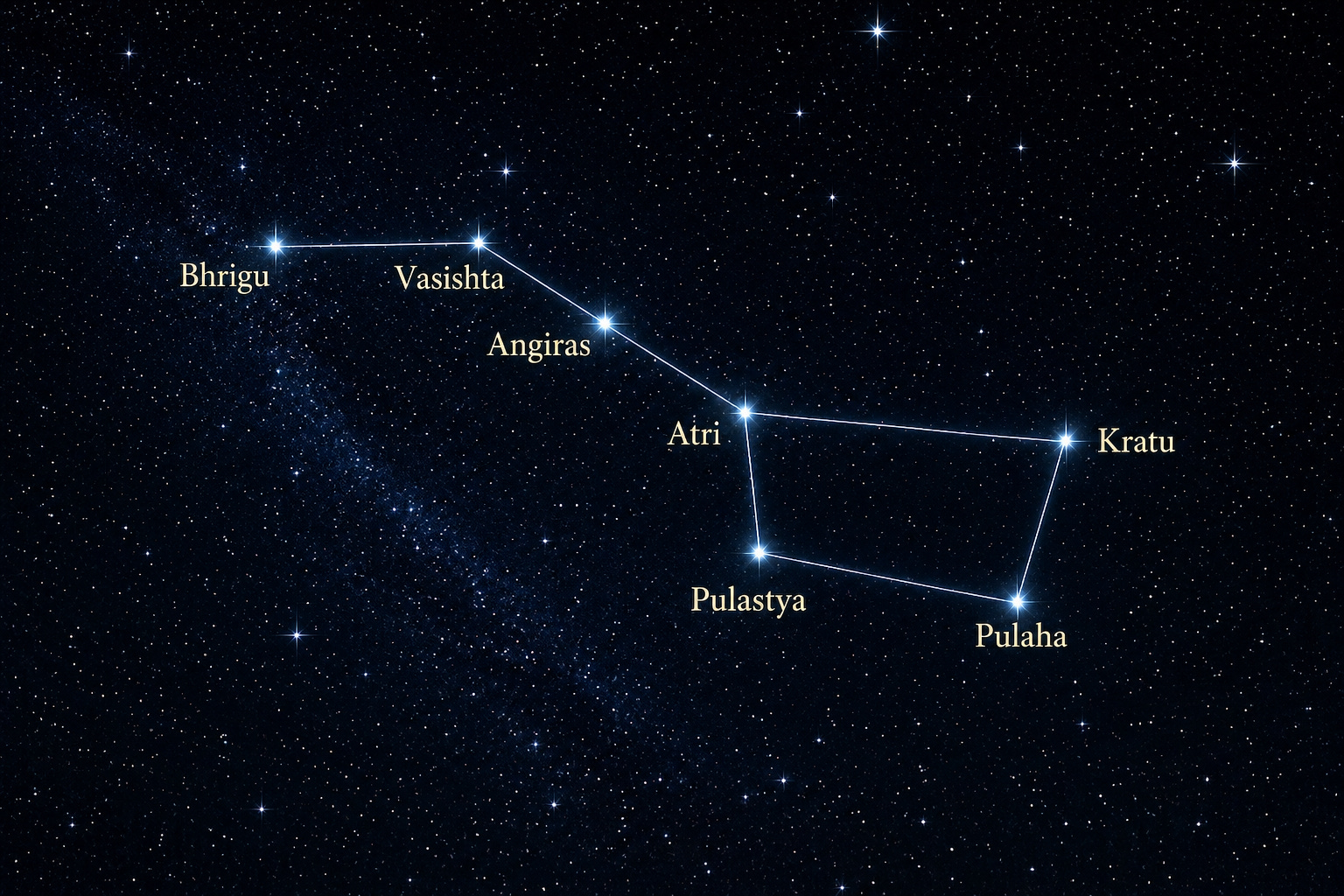
The Saptarṣi, the seven great sages
In his purport to SB 4.28.10, Śrila Prabhupāda mentions that, “From the Vedic history of creation, we can understand that the first living creature was Lord Brahmā, who created the seven great sages and other Prajāpatis to increase the universal population. Thus every living entity, according to karma, his past desires and activities, gets a particular type of body, from that of Brahmā to that of a microbe or germ in stool.”
Here he mentions the seven great sages (Saptarṣi), who, together with Daksa and the Manus, are considered the main Prajāpatis. From the Śrīmad-Bhāgavatam, we receive details about the history of Daksa, but the seven sages are mentioned much more sparingly.
The original seven great sages were Marīci, Atri, Aṅgirā, Pulastya, Pulaha, Kratu, and Bhṛgu, seven of the direct sons of Brahma, who resided in the seven stars below Dhruvaloka. In his Sat-Sandarbha, Śrila Jīva Goswami mentions that each team of seven sages executes their functions as Prajāpatis for an entire manvantara. At the end of this period, the seven sages are promoted to Janaloka, where they live until the final devastation of the universe.
Our universe is divided into 14 levels of planetary systems, going from Pātālaloka to Brahmaloka. The seven lower planetary systems are inhabited by demons; the next, Bhū-Mandala, is inhabited by human beings; Bhuvarloka is inhabited by subtle beings (the Yakṣas and Rākṣasas) as well as lower demigods such as the Gandharvas, and Svargaloka is inhabited by demigods. All these 10 planetary systems are affected by the devastation at the end of each manvantara and are completely destroyed at the end of each day of Brahma. The other planetary systems, Maharloka, Janaloka, Tapoloka, and Satyaloka, are created once at each of the two halves of the day of Brahma and exist until the complete devastation of the universe.
What happens when the seven sages are promoted to Janaloka at the end of the manvantara? A new team takes charge, just like in the case of the main demigods. It’s mentioned (SB 8.13.15-16) that some of the great personalities mentioned in the Mahabharata, such as Paraśurāma, Aśvatthāmā, Kṛpācārya, and Vyāsadeva, are currently engaged in meditation in Badarīkāśrama, preparing themselves to assume posts among the seven sages in the next manvantara, just like Bali Maharaja is waiting to assume the post of Indra. One could question how human beings such as Aśvatthāmā and Kṛpācārya can become Prajāpatis without changing their bodies, but the main question is not the body but their consciousness. Once the consciousness is purified, the body can also be purified.
The first group of seven sages are direct sons of Brahma (just like Daksa, Nārada, the four Kumāras, and Svāyambhuva Manu), but the Prajāpatis in the next manvantaras are descendants of them. In his first birth, Daksa was the son of Brahma, but in his second birth, he was born out of the Pracetas, who were acting as human kings.
In this way, different personalities take the roles of Prajāpatis in the different manvantaras, repopulating the lower planetary systems when needed. At the end of the current day of Brahma, the ones who qualify will be promoted to the highest planetary systems (Janaloka, Tapoloka, and Satyaloka), where they will live until the final devastation of the universe. After such a long life, the ones who qualify will be able to finally attain liberation and reach the spiritual planets.
One could also question how the Prajāpatis, who are evolved human beings living in the higher planetary systems, can give birth to lower animals and plants, which have entirely different bodily structures. Saramā, for example, gave birth to tigers and lions, although neither she nor her husband are felines. How does this work? The point the Vedas explain is that more evolved beings have the capacity to generate less evolved beings (like a Prajāpati generating a tiger), but the opposite doesn’t happen. Life in the universe starts thus from the most evolved being, Brahma, who in turn generates slightly less evolved beings (the Prajāpatis), who in turn generate all the other less evolved species of life. This is something that can be observed even on our planet. Human beings can manipulate less evolved organisms using selective breeding, artificial insemination, and genetic manipulation. A human being can clone a sheep or create a GMO soy seed, for example, but will never be capable of producing a demigod.
We can see that this is essentially the opposite of what is believed in the modern evolution theory, which says that lower forms of life gradually produce more evolved forms, starting with inanimate matter somehow producing very simple unicellular organisms, which in turn gradually evolve into more complex species, culminating with human beings. One may have a different opinion, but I, personally, believe that the description of the Vedas makes more sense.
Another possible objection is to my use of the word “evolved.” When I say that human beings are more “evolved” than animals like tigers and lions, it appears that this supports the theory of evolution by Darwin, but that’s not the case. Prabhupāda makes the point that the Vedas also offer a theory of evolution; it’s just that it’s different from what Darwin wrote about. The Vedic idea is that the soul gradually evolves from unicellular organisms to plants, insects, birds, lower animals, and so on, eventually reaching the human species and demigods. In this way, when we speak about humans being more “evolved” than lower animals, we are referring to this process of spiritual evolution, where the soul transmigrates through different types of bodies, going from less evolved living beings all the way up to Brahma, the most evolved. The soul in the body of a microbe is the same in quality as the soul in the body of a demigod, but they are in different stages of spiritual evolution.
Read the whole book:
« Making Sense of the Vedic Universe, a Higher-Dimensional Reality
This is a publication for thoughtful readers who want to go deeper into Kṛṣṇa consciousness. I publish daily, trying to offer high-quality spiritual content, and all posts are available to free subscribers. If you wish, you can also choose a paid subscription to support this work.
You can also receive the updates on WhatsApp or Telegram.
If you would like to contribute further, you can find the donation links here.