

« Making Sense of the Vedic Universe, a Higher-Dimensional Reality
The size of the universe
The last two verses of the 11th chapter of the 3rd canto briefly describe the dimensions of the universe:
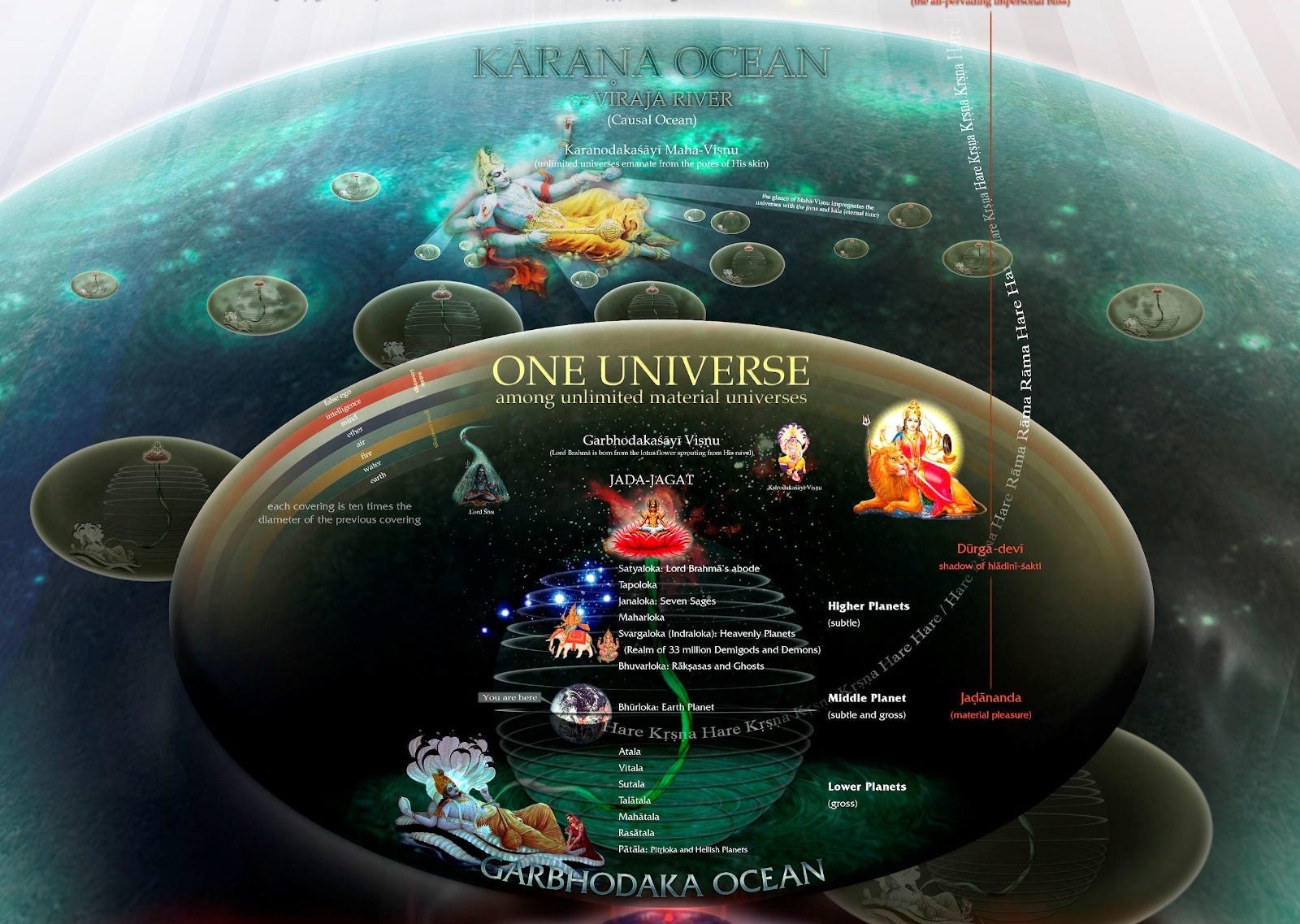
“This phenomenal material world is expanded to a diameter of four billion miles, as a combination of eight material elements transformed into sixteen further categories, within and without, as follows. The layers or elements covering the universes are each ten times thicker than the one before, and all the universes clustered together appear like atoms in a huge combination.” (SB 3.11.40-41)
Bhū-mandala, the earthly planetary system, is just 500 million yojanas (four billion miles) in diameter, a size that, if taken literally, is on the scale of the size of the solar system, according to modern astronomy. We can’t access the other parts of Bhū-mandala because these realms exist in higher dimensions, but it is described that qualified human beings from previous ages were able to access the different realms that comprise it. The same applies to the celestial planetary system, to the higher planetary systems of Maharloka, Janaloka, Tapoloka, and Satyaloka, and even the lower planetary systems where demons live. All these abodes exist in different spheres of existence that we don’t have access to. We can’t access any of these abodes by just traveling on the physical plane, like we do when we visit other countries. Accessing these abodes requires a change of consciousness. Only someone who has a level of consciousness similar to the demigods and great sages can visit their planetary systems, and even then, one has to know the proper paths to reach there. One analogy that can be made is that to visit the United States, one needs money to buy a ticket, knowledge of where the airport is, a visa, and so on. If any of these factors are not present, the trip is not possible. It is not just a matter of desire.
It is described that Arjuna could visit the celestial planets and even go all the way to the causal ocean together with Kṛṣṇa. We can understand that this was possible because Arjuna is a pure devotee. For ordinary people, none of this is possible.
Apart from the universe created by Brahmā, our universe also includes the coverings of elemental earth, water, air, fire, sky, false ego, and mahat-tattva. Each covering is ten times larger than the previous. If the measurements given in the Purāṇas are taken literally, the coverings extend to a scale of size in the same order of magnitude as what in modern astronomy is calculated as the size of our galaxy.
Although many universes exist, we are not supposed to have access to anything outside our universe. In the model of the Vedas, each universe is a completely enclosed vessel, and not even light can escape from one universe to another. It is described that even Brahmā himself was not aware of the existence of other universes until Kṛṣṇa revealed it to him by inviting all the Brahmās from other universes to a meeting, as described in the Brahmā-vimohana-līlā in the Tenth Canto.
Explaining how the observable universe, with all the stars and galaxies we see when we look at the sky, can fit in what is described as 500 million yojanas (4 billion miles) in diameter is one of the goals of this book.
My basic thesis is that because traveling to higher planetary systems demands a shift in consciousness, the distance to the higher planets, when calculated in terms of our physical scale of distances, may become practically infinitely large, since at each stage the distances are measured from the point of view of the inhabitants of that particular level.
Read the whole book:
« Making Sense of the Vedic Universe, a Higher-Dimensional Reality
This is a publication for thoughtful readers who want to go deeper into Kṛṣṇa consciousness. I publish daily, trying to offer high-quality spiritual content, and all posts are available to free subscribers. If you wish, you can also choose a paid subscription to support this work.
You can also receive the updates on WhatsApp or Telegram.
If you would like to contribute further, you can find the donation links here.