

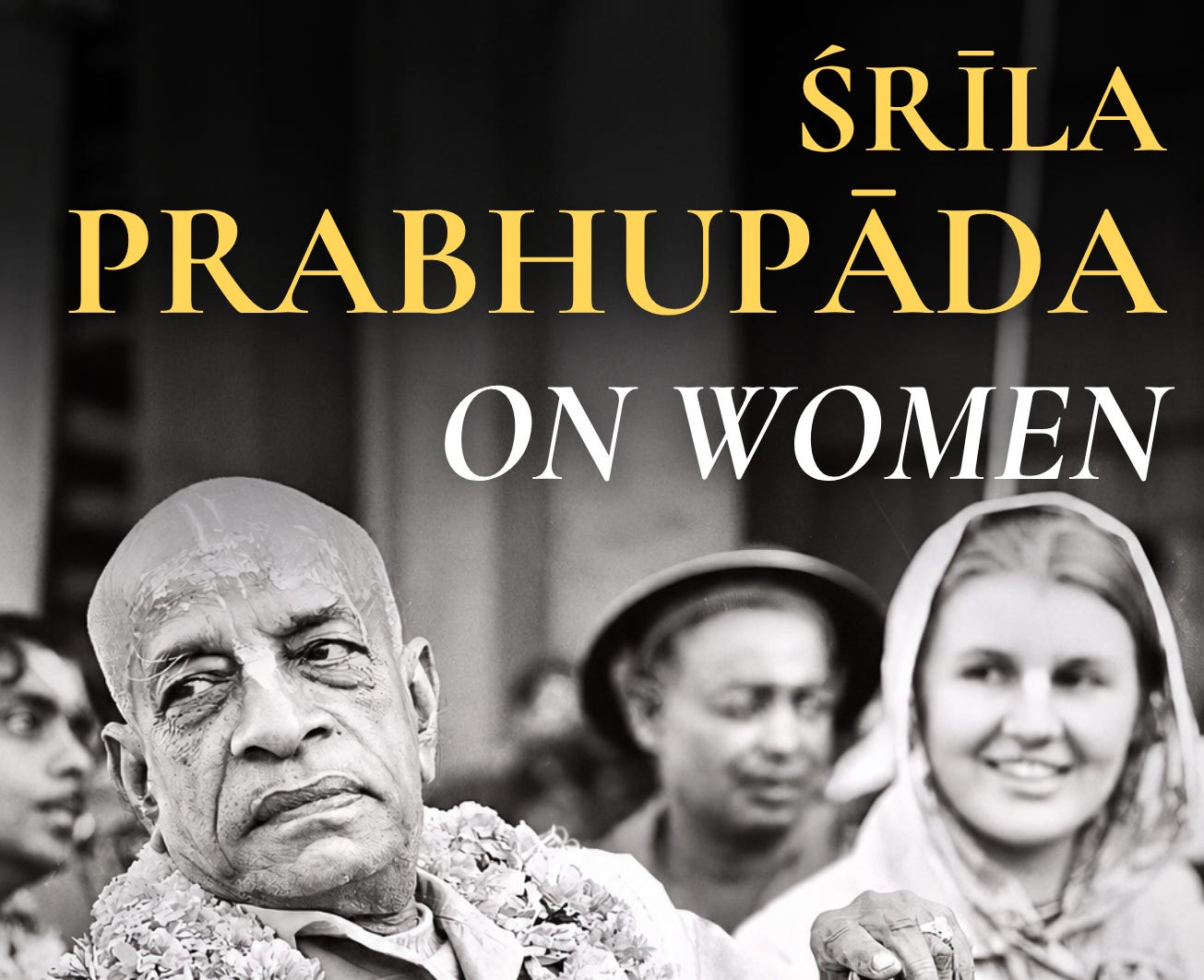
The social implications of life in the material world
Although the spiritual aspect of equality is higher, the point of social roles is behind a number of Prabhupāda’s statements concerning women. Everyone is equal on the spiritual platform, but we need purification to get there. Meanwhile, we have to learn to engage our material tendencies positively to advance in the spiritual process.
The Vedas emphasize the idea of families as the fabric of a progressive society, as we can observe in Arjuna’s concern in the first chapter of the Gītā. Families are the place where morals, values, and culture are transmitted to the next generation. Family, as an institution, however, demands cooperation. Prabhupāda adds to this principle by denouncing sexual liberation and women’s liberation as the wrong solutions for the exploitation of women.
The Vedic idea is that the more emotional nature of a woman can be better engaged when she has the opportunity of being cared for. A good father gives her emotional stability and self-confidence, a qualified husband gives her a family, and later the children give her care at the last stages of her life. Being secure in all these stages, a woman can spiritualize her emotions, going from lust, anger, and hankering, to love, care, and compassion. Men also have to go through a similar process, learning to serve and protect instead of exploit, and families play an essential role in both cases.
Modern societies often artificially try to eliminate the differences between men and women, but the Vedas acknowledge that there are intrinsic differences in terms of body and mind, beginning from the fact that women can give birth to children and men cannot. This leads to many psychological differences since a female body is biologically structured to conceive and nourish a child. While the soul is the same, the machine is different; therefore, the type of activities and roles should also be distinct if we want to have functional relationships and a workable society. When Prabhupāda speaks about differences between men and women, he is not speaking about the soul, but he is acknowledging such differences in the body and in the proper roles according to the vehicle one is driving.
There are certain social principles that are eternal, created by Kṛṣṇa Himself, and applicable to all kinds of societies, and it is not possible to create a peaceful society without taking them into account. Contemporary societies can be defined with many adjectives, but “peaceful” is certainly not one of them. In the Gītā, Kṛṣṇa defines peace as a prerequisite for happiness. If we want to achieve happiness, not only in this world, but also afterward, we should take this into account.
Relationships are a central part of the life of a woman; therefore, when the conditions are favorable, to build a family is a natural path. We can see in practice that many successful women voluntarily abandon their careers in their late thirties or early forties to get married and dedicate themselves to raising their children. Without this experience of a loving relationship with a husband and children, a woman will feel incomplete in later life.
Even when we consider women who are transcendentalists, seriously following a spiritual path, the need for relationships is usually still present. Therefore, even for them, it’s usually more natural to follow the spiritual path in family life, which is the general recommendation from the scriptures. We can observe this practically in our movement: even after chanting for many years, most ladies do not lose interest in marriage. They may suppress it, but as soon as there is an opportunity, it comes back. This is not necessarily a bad thing. If the husband is competent to give emotional support and basic material facilities, and is wise and exemplary in spiritual practice, his company can be greatly beneficial. The main question is the quality of the choice.
Modern society tries to impose on us the image of the successful solitary woman, but this is often not a good path in terms of well-being and personal satisfaction. Happiness is not in money and social status but in relationships.
In the Vedas, men are often recommended to follow the path of celibacy, which, if properly followed, can bring important spiritual benefits. In fact, as a higher spiritual principle, everyone should be attracted only to Kṛṣṇa, for that is the eternal position of the soul. Marriage is just a temporary arrangement to help to elevate us to that platform. There are also passages in the scriptures that recommend women to be celibate, like the prayers of Lakṣmī-devī in the 5th canto of Śrīmad-Bhāgavatam, and Prabhupāda also recommended women to be celibate in a few passages, like on the room conversation from July 7, 1976, Baltimore:
“Prabhupāda: If one can remain without marriage, that is first-class.
Rūpānuga: Women also?
Prabhupāda: Women also. What is the use of this material husband? Make Kṛṣṇa husband. Kṛṣṇa’s prepared to become everything—love Him as husband, love Him as son, love Him, friend. Kṛṣṇa is prepared.”
In this way, we can see that, as a philosophical principle, celibacy is recommended for everyone. The problem is just that it is rare for people to come to a platform of genuine detachment, and celibacy based on artificial repression or fear can be dangerous, as experienced in many stages of our movement.
Not many men can successfully follow it, and for women, it is considered even more difficult, for it is rare for a woman to become genuinely renounced. There are cases of ascetic women in our line, like Kṛṣṇapriyā and Viṣṇupriyā, the daughters of Ganga Narayana Chakravarti, as well as Gaṅgāmātā Gosvāminī, who was a lifelong celibate, but they are rare. Most ladies would not be attracted to the idea of living the way they were living.
Another point is that our spiritual process is based on active service. As explained by Kṛṣṇa in the Gītā (6.3), one who is on an advanced platform, may stop external action and focus on internal meditation, but until we reach a stage of full sense control, the path of advancement for us is active service. Artificial renunciation can curb this attitude of service, forcing us to spend our energy in repressing the senses instead of effectively using them in the service of Kṛṣṇa.
One who is close to the transcendental platform can work tirelessly for others without personal considerations, but for most of us this is very difficult. Unless we can find a situation where we are nourished, we tend to just get absorbed in immediate distractions and selfish goals. Sometimes we can find this nourishment in spiritual life, by finding a group of like-minded devotees, but in most cases we find it in family life. That usually becomes the place from which we can ground ourselves and work for a higher goal.
The difficulty is that peaceful family life demands a certain mindset that is incompatible with many values common in Western culture, starting with the image of the strong, independent woman. There is a reason for that.
No woman will intentionally want to be married to a weak and helpless man who will act more like a child than as a husband. Deep inside, every woman wants to get married to a strong and qualified man. The difficulty is that not many men will have these qualities from the start. What they will have is potential, that can blossom if properly nourished.
The way to cultivate such qualities in the husband is to take a supportive position so he can be encouraged to fulfill his role and act like a man, taking responsibility for the family’s maintenance and giving physical and emotional protection, thus allowing the woman to fulfill her natural role as a wife and mother. When the wife plays her proper role, she empowers the husband to also play his proper role, and thus both are benefited. The choice of the husband is still essential, but by understanding this art, a woman can get the best from the man she chose.
A woman may argue that it is not her responsibility to nourish her husband into a proper man, that he is supposed to have learned that from his parents, teachers, guru, and so on. This may be true, but the fact is that she is the one who will live with this man. As already discussed, a wife is not obliged to tolerate abuse or gross sinful behavior. Still, in an ordinary marriage, where the husband is generally sincere but imperfect, her attitude can either help him rise or make his weakness worse. If she constantly scolds him, corrects him, or assumes a superior position, the relationship can easily turn into a mother-child dynamic, which will further weaken his sense of responsibility. On the other hand, if she supports his good sides, tolerates his imperfections, respects his efforts, and encourages him to take responsibility, she can help him become steadier in his role as husband, protector, and devotee.
Most men have the need for a woman who provides them inspiration so they can work with determination and be able to achieve their potential, both in material and in spiritual affairs. As the saying goes, “Behind every great man there’s a great woman.” Men are strengthened by the affection, steadiness, and inspiration of a good wife.
By playing this supportive role, a woman provides this needed inspiration to the husband, so he can fulfill his potential. This creates a dynamic in which both are benefited. The wife is benefited by stability, protection, a good spiritual example, and so on, and the husband and children are benefited by the love and care offered by her. This is, by the way, one of the things women do much better than men: when their natural propensity is properly engaged, they are invaluable as caregivers. Without dedicated wives and mothers, there are no families, and without families, there is no civilized society. From this, we can understand the crucial role of women in any progressive society.
We can see that there are two sides to the question. The man is supposed to have certain qualifications, being kind, wise, responsible, self-controlled, etc., but the woman also has a role to play. It’s just like the difference between a house and a home. A house is supposed to provide certain facilities, but it’s the attitude of the people living there that makes it a home. Similarly, to get a husband or wife is only half of the work; we still have to do our part to make him or her a good husband or wife. Building a successful family demands a lot of effort; it does not come automatically after marriage.
Even a number of secular ladies end up coming to these conclusions, usually after one or more failed marriages. One example is Kathy Murray, a woman from the United States who gave a famous interview to the BBC, describing how she learned to be, in her words, “a surrendered wife.” These are a few excerpts from her interview, where we can see how a lady who defines herself as a feminist came, after much struggle, to many of the same conclusions:
“The first time I married I was divorced by 26. I married for the second time at 32 but soon found myself sleeping in the guest room. My husband and I fought all the time”[...] “I didn’t tell anyone I was in constant conflict with my husband. I was embarrassed, angry and resentful.”[...] “My husband often resorted to watching TV and snuggling with our pets as I’d rage at him over ignoring my needs.”[...] “I was about to end my marriage when I picked up a book called The Surrendered Wife by Laura Doyle. I mean, they don’t teach us how to be successful in marriage in school and the women in my life didn’t share the secrets either.”
“It was incredibly humbling to recognize that I had something to do with why my marriage was failing and perhaps even why my first marriage failed. But it was also empowering. I didn’t know I’d been disrespectful to my husband or even that I’d been controlling and critical.”[...] “I’ll never forget the day I first apologized to my husband for being rude for correcting him in front of the children, or the day I said “Whatever you think” when I’d previously been extremely opinionated about what he should do.”
“I had trained my husband to ask my permission for everything. And then complained about it for a year in counseling that he couldn’t make simple decisions! I relinquished control of my husband’s life, choices, and decisions and instead, I focused on my own happiness. I was no longer acting like his mother.”[...] “My kids began to notice the change in our relationship too, and as a result, their behavior improved and our home became peaceful and fun again.” (BBC, 100 Women 2016: I am a ‘surrendered wife’)
In this context, it is easy to understand statements from Śrīla Prabhupāda like this one:
“Woman Reporter: But you say women are subordinate to men.
Prabhupāda: Yes, that is also natural. Because when the husband and wife are there or the father and daughter is there, the daughter is subordinate to the father and the wife is subordinate to the husband.
Woman Reporter: What happens when women are not subordinate to men?
Prabhupāda: Then there is disruption. There is disruption, social disruption. If the woman does not become subordinate to man, then there is social disruption. Therefore, in the western countries there are so many divorce cases because the woman does not agree to become subordinate to man. That is the cause.
Woman Reporter: What advice do you have to women who do not want to be subordinate to men?
Prabhupāda: It is not my advice, but it is the advice of the Vedic knowledge that woman should be chaste and faithful to man.” (Television Interview, July 9, 1975)
Read the whole book:
« Śrīla Prabhupāda on Women
This is a publication for thoughtful readers who want to go deeper into Kṛṣṇa consciousness. I publish daily, trying to offer high-quality spiritual content, and all posts are available to free subscribers. If you wish, you can also choose a paid subscription to support this work.
You can also receive the updates on WhatsApp or Telegram.
If you would like to contribute further, you can find the donation links here.