

« The Song of God—Volume 1, chapters 1-6
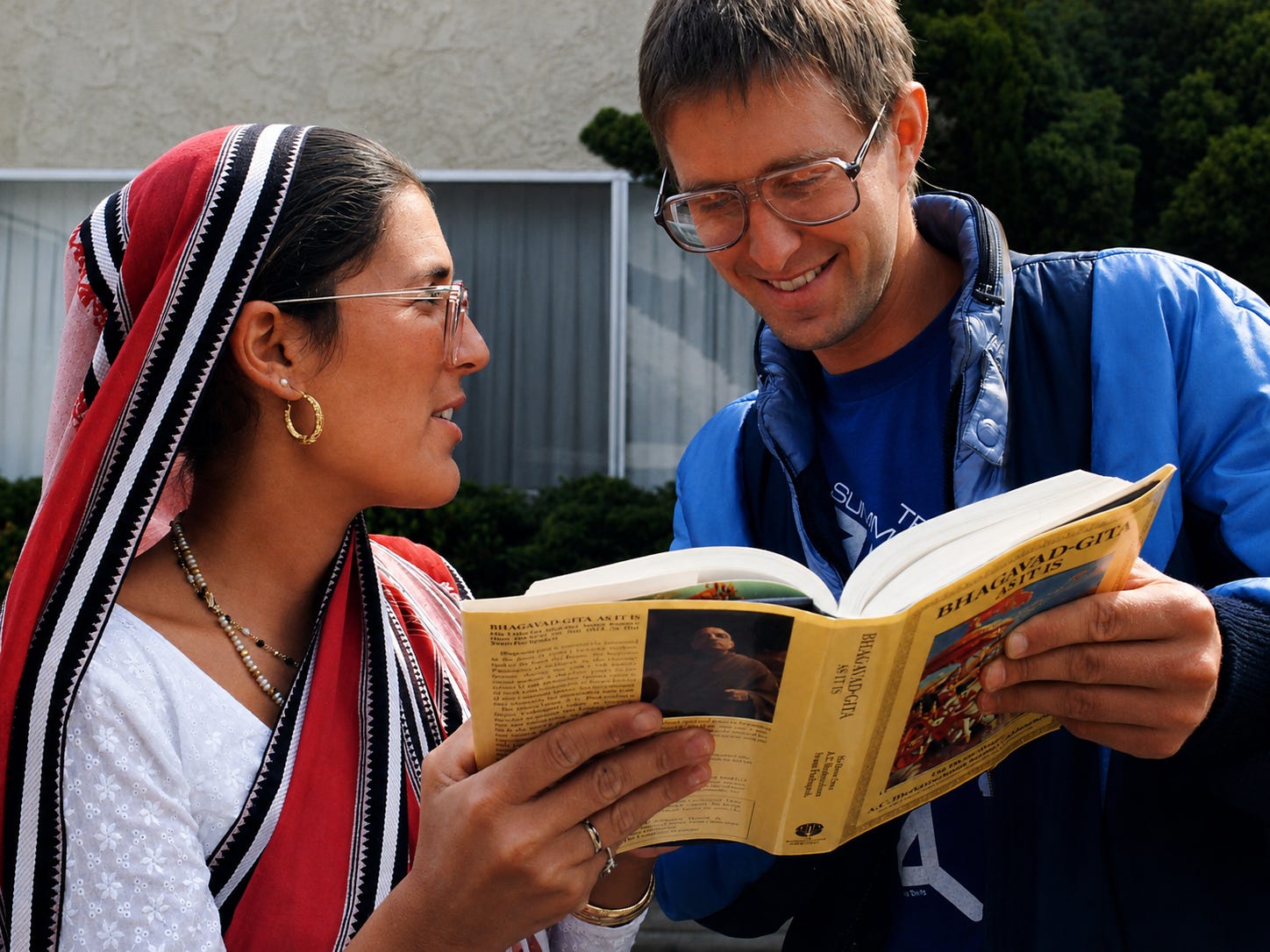
How to use this book
Understanding the Bhagavad-gītā As It Is can feel overwhelming. We may understand the explanation verse by verse as we read, but as we advance, we tend to forget what we read, and we often come to the end with just a collection of disconnected passages, without being able to fully capture the essence of the text. If you have already read the Bhagavad-gītā As It Is a few times and still feel you couldn’t penetrate the depth of the text, you are not alone.
This book is meant to be a companion to the Bhagavad-gītā As It Is by Śrīla Prabhupāda, helping you to approach it with greater clarity, appreciation, and confidence. The goal is to explain difficult points, organize the flow of ideas, connect the verses into broader topics, and make the philosophical progression of the Gītā easier to follow.
Prabhupāda organized his commentary on the Bhagavad-gītā in a system where he starts with the verses in the original Devanagari script, the way they were written by Vyasadeva. In the Devanagari script, each letter represents a sound. For example, क is ka, ग is ga, ध is dha, and so on. Most of the time, each character represents a consonant and a vowel together. For example: ka क, ke के, ki कि, ko को, ku कु. The letters representing the sounds are then combined into words, like योग (यो + ग = yoga), अर्जुन (अ + र्जु + न = Arjuna), पुरुष (पु + रु + ष = purusa), and so on. You can find a short guide to the alphabet at the end of the Bhagavad-gītā As It Is.
Learning the Devanagari alphabet is not necessary to understand the Gītā, but practicing the individual sounds of the letters can help you to better pronounce the Sanskrit verses. The reason is that, unlike English, Sanskrit is a phonetic language. In other words, each syllable in the words is written in the way it sounds. In English, we have to get used to reading each word as a unit, because trying to pronounce each syllable individually will most of the time make us grossly mispronounce it. You can try to say “is-land” instead of “island,” for example.
Sanskrit, however, was made to be pronounced syllable by syllable. We say dhar-ma, kar-ma, āt-mā, saṃ-sā-ra, and so on. Once we learn the individual sounds, even the most complicated words can be easily pronounced if we just take our time and go syllable by syllable. Studying the individual sounds of the letters that compose the Devanagari alphabet can help us with that.
Prabhupāda then gives the transliteration (the same verse represented in English letters, with diacritics), the word-for-word translation, and then the complete translation, followed by the purport. One purpose of that is to make the book more authentic since we can see for ourselves the whole process of translating the verse into English, but there is another reason for this: to allow us to go deeper into the meaning of the verses, by studying the meaning of each individual word and then how they go on together. Just like in English, the words in the verses of the Gītā (or any other scripture) have primary and secondary meanings, and the correct meaning of a word in a particular verse is dependent on the context. In the word-for-word, Prabhupāda usually gives the dictionary meaning of the words, but in the translation, words are often translated differently, because the translation takes into consideration the full context of the verse and the deeper meaning of the words, which is then explained in the purports.
In this way, this system of giving first the word-for-word and then the complete translation helps us to better understand the meaning of the verses and also serves as a crash course in Sanskrit translation. According to memories of his disciples, Prabhupāda once said that if one studies attentively the word-for-word, translation and purports of an entire chapter every day, at the end of a year, he or she will acquire a level of understanding similar to a Sanskrit scholar.
In this book, I break the chapters of the Bhagavad-gītā into groups of verses dealing with distinct topics and give additional explanations to the ideas explored by Śrīla Prabhupāda in his purports, with the idea of helping you to understand all the details of the text.
One difficulty of studying the Bhagavad-gītā is that we have to understand each individual verse, but at the same time keep track of the relationship between one verse and the others and the general flow of the text. In this book, I try to reach a compromise between these two aspects by adopting an organization into topics. Each topic includes a few verses that encompass a certain topic, so you can understand not only the meaning but also the relationship between them.
The idea is that you can read my explanations of each topic as a continuous narrative, just trying to understand the underlying logic of the different philosophical points described, and, at the same time, have the option to go deep into each topic by studying more thoroughly the purports of Śrīla Prabhupāda on the specific verses. To facilitate that, I also provide lists of points explored by Śrīla Prabhupāda in each purport after the general explanation of each topic.
Just like learning a new language, mastering the Bhagavad-gītā requires learning a huge number of philosophical concepts and the way they relate to each other. There are terms like karma, buddhi, guṇa, yajña, yoga, dharma, and bhakti, that carry meanings that are much deeper and more nuanced than the English equivalents. At the same time, there is the broader thread of Kṛṣṇa’s argument, which runs through and connects the individual verses. How can one take hold of such an intricate treatise?
There are two different strategies for learning such a huge volume of information that may work better for different types of people. One strategy is to just read, and read again, without trying to memorize specific information, and another is to go methodically, studying each topic before moving to the next.
Both strategies can work, provided you dedicate enough time to it. The main consideration should be to do what is interesting for you. If it is interesting, you will find the taste to keep studying, and eventually, you will learn. Developing taste is thus the main consideration; the specific study strategy is secondary.
In this way, when it comes to this specific book, there are two ways to use it:
a) You can just read it sequentially, to get a general understanding of the Bhagavad-gītā. Just read and let your mind remember what is important for you. No pressure. After finishing reading this book, you can try to read the Bhagavad-gītā As It Is again, and you should have a deeper understanding of it. If you repeat this process, you can gradually go deeper and deeper in the meaning of the text.
b) You can use it as a study guide, keeping the Bhagavad-gītā As It Is in hand and studying the purports of Śrīla Prabhupāda for each section thoroughly, after reading the general explanations and the lists of points I give here. By consulting the word for word while studying each individual verse and studying the purports connected with each section, you may be able to go much deeper in the meanings given by Śrīla Prabhupāda by studying them together with this work. This is a slower and more methodical way, but it can give very good results.
The Gītā is divided into three parts. Each part is divided into chapters, each chapter into sections, and each section into verses, which are interconnected on different levels. This book is organized to help with both aspects: helping you to enter the details without losing sight of the larger progression of Kṛṣṇa’s teachings.
The Bhagavad-gītā can be studied again and again, because its meaning cannot be exhausted. Kṛṣṇa is unlimited, and the Gītā describes Him and His teachings in unlimited depth. Just like the Vedānta-sūtra, the Bhagavad-gītā contains the conclusions of all Vedic literature, which is not a trivial matter. Each verse includes multiple levels of meaning, and we go deeper as we enter into the details of the text.
It is not possible for any conditioned soul to fully understand all the mysteries of the Bhagavad-gītā, but I hope this work can help you to come closer.
Next: Introduction: The conclusions of the Bhagavad-gītā
Read the entire book:
« The Song of God—Volume 1, chapters 1-6

This is a publication for thoughtful readers who want to go deeper into Kṛṣṇa consciousness. I publish daily, trying to offer high-quality spiritual content, and all posts are available to free subscribers. If you wish, you can also choose a paid subscription to support this work.
You can also receive the updates on WhatsApp or Telegram.
If you would like to contribute further, you can find the donation links here.
Hare Krishna dear Chaitanya Chandra Charan Prabhu,
my praṇāms
Jai Srila Prabhupada
Thank you so very much for this wonderful Seva to bring out a comprehensive version of Bhagvad Gita. I have gone through the structure of first six chapters.
The grouping of the verse in different sections is amazing and very meaningful.
Thank you so much again
Hare Krishna
Your Servant