


You can receive new articles directly in your inbox. Subscription is free; donations are welcome.
Some may have a little trouble with the idea of worshiping Tulasi. Why are we worshiping a plant? It goes much deeper than that.
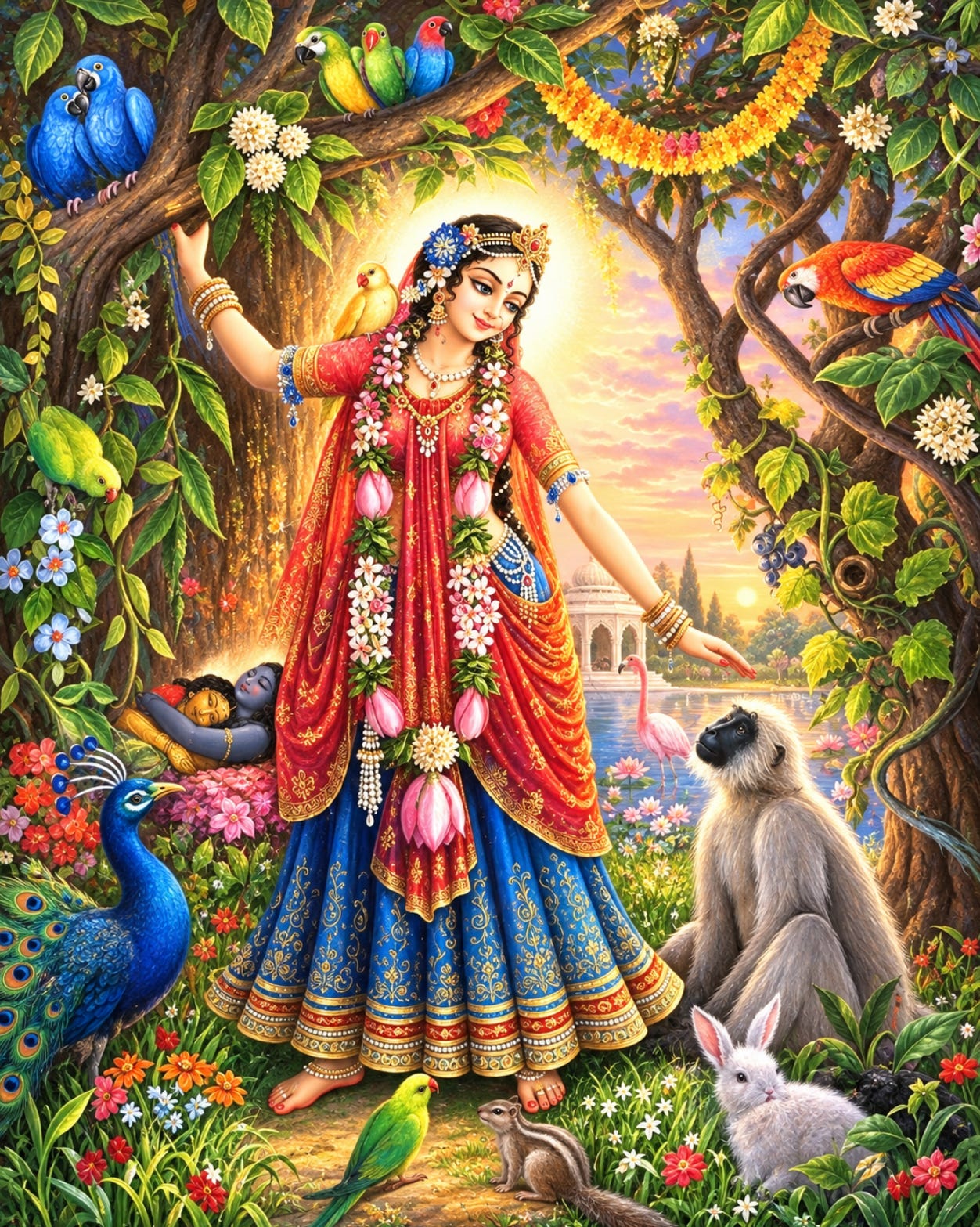
Tulasi Devi is the incarnation of Vṛndā Devī, who is in turn the personification of the pastime potency of Kṛṣṇa. She is the organizer of the pastimes between Rādhā and Kṛṣṇa, and it is after her that Vṛndāvana is named. “Vṛndāvana,” the forest of Vṛndā. Rādhārāṇī is called Vṛndāvaneśvarī (the queen of Vṛndāvana), and Kṛṣṇa is considered the king, but without the mercy of Vṛndā Devī is not possible to enter their pastimes. Therefore, we worship her every day in the morning, chanting “ye tomara sarana loy tara vancha purna hoy krpa kori koro tare vrndavana-vasi” (Whoever takes shelter of you, all his desires are fulfilled and by your mercy, he becomes a resident of Vṛndāvana.) She is actually a partial expansion of Śrīmatī Rādhārāṇī and one of her intimate associates. As a gopī, she has a molten golden complexion and wears blue garments, decorated with many ornaments, pearls, and flowers. At the same time, she appears as the plant Tulasi, who is very dear to Kṛṣṇa.
Vṛndā Devī also appears as Tulasi in the material world to facilitate the service of devotees to Kṛṣṇa and help us attain His service. There is a whole pastime explaining her advent, which is narrated in the Brahma-vaivarta Purāṇa. As in other pastimes narrated in the same book, this pastime is difficult to understand because it is narrated in a way that appeals to people influenced by the mode of passion. It is, therefore, full of curses and apparent conflict. These descriptions are of course not false, but to properly understand them one has to study them under the light of Vaiṣnava philosophy.
Curses in Goloka?
The story is that, by the will of the Lord, once Sudāmā desired to have an amorous relationship with Vṛndā Devī, and thus they appeared in this world as Tulasi and Śaṅkhacūḍa. This story appears to be similar to the story of Jaya and Vijaya, as both came to facilitate the Lord’s pastimes and not as a fall. Just like Jaya and Vijaya, Vṛndā Devī and Sudāmā came under the excuse of being cursed, but in reality, everything happened as part of a pastime. This story is full of profound meanings, but I will just try to describe it as far as I can understand.
It may look very strange that Sudāmā could have desired Vṛndā Devī while in Goloka, but as many of Kṛṣṇa’s associates, Sudāmā is a partial expansion of Kṛṣṇa, while Vṛndā Devī is a manifestation of Kṛṣṇa’s pastime energy. There is therefore nothing wrong with their relationship; they are just like Laksmi and Nārāyaṇa. However, it could not happen in Goloka, where the predominant mood is different; therefore, they came to the material world under the pretext of a curse.
What curse was that? At some point, Vṛndā Devī had an amorous encounter with Kṛṣṇa. However, she was unable to take the ecstasy and fainted. Vṛndā Devī thus desired a relationship with Kṛṣṇa but was unable to enjoy it in Goloka. Understanding her desire, Śrīmatī Rādhārāṇī “cursed” her to come to the material world, where she could obtain Lord Nārāyaṇa (who is non-different from Kṛṣṇa) as her husband. In reality, it was not a curse but a blessing. Similarly, Sudāmā (being an expansion of Kṛṣṇa) desired to have a relationship with Vṛndā Devī, and he was thus similarly “cursed” (blessed) to also come and take part in the pastime.
By definition, a curse happens as a result of some hateful exchange between two persons, but hate and envy are emotions that are not present in the spiritual world. Just like we have curses here, there are also curses in the spiritual world, but such curses are not uttered out of envy but as blessings as part of loving exchanges. Such blessings in turn led to the appearance of numerous pastimes.
Sudāmā appears as Śaṅkhacūḍa
Back to Vṛndā Devī and Sudāmā, the whole pastime happened under the influence of Yogamāyā, the internal energy of Kṛṣṇa, and not Mahāmāyā (the material energy). Yogamāyā is the potency of Kṛṣṇa (more specifically of Balarāma) who understands Kṛṣṇa’s desires, as well as the desires of His pure devotees, and makes arrangements for their pastimes. Just as Kṛṣṇa can come in His different incarnations without getting in contact with the material energy, His pure devotees can also come to perform their pastimes without falling into Maya.
In this way, under the spell of Yogamāyā, Sudāmā appeared as Śaṅkhacūḍa, the son of Dambha, who, although born in the dynasty of the demons, was a great devotee of Lord Viṣnu. Dambha performed great austerities, and at the end, Lord Viṣnu personally appeared to him. The Lord granted him the blessing of having a courageous son who would be invincible to the demigods and be the conqueror of the three worlds.
It’s described that Śaṅkhacūḍa was radiant as a child and was a favorite of all family members. As he grew up, he became handsome like Cupid himself. Later, he practiced severe austerities and received blessings from Lord Brahma to become invincible to the demigods and to be able to marry Tulasi Devi. Lord Brahma gave him a divine amulet, imbued with the power of Lord Viṣnu, that made him practically invincible. There is another Śaṅkhacūḍa who was killed by Kṛṣṇa after the rasa dance, but this is a different personality, an associate of Kuvera.
Tulasi performs austerities
Tulasi Devi, in her turn, appeared as the daughter of Dharmadhvaja, a king who practiced great austerities. It’s described that she stayed in her mother’s womb for one hundred celestial years and was born as an already grown-up girl who was given the name Tulasi due to her incomparable beauty. However, the girl left home and started practicing severe austerities in the mountains soon after being born, with the goal of getting Kṛṣṇa as her husband.
As a result of her austerities, Lord Brahma appeared to offer her a boon. When she revealed her desire to get Kṛṣṇa as her husband, Lord Brahma replied:
“O Tulasi, Sudāmā was a partial expansion of Kṛṣṇa and was one of Kṛṣṇa’s cowherd boyfriends in Goloka. As a result of a curse by Rādhārāṇī, he is presently living on Earth among the Dānavas (demons). His name is Śaṅkhacūḍa. He is very energetic, and no one can compare with him in strength. While living in Goloka, he was very attracted to you and wanted to marry you. But because he feared Rādhārāṇī, he did not make any overtures.
Just as you are a jatismara [one who knows her previous births], Śaṅkhacūḍa also is. Remembering his past desire to be close to you, he has performed severe austerities to obtain you as his wife. I now wish to grant his desire. Therefore, O beautiful one, please agree to wed him. However, later on, by the special arrangement of Providence, you will get the beautiful Nārāyaṇa as your husband. But after that, He will curse you, and you will be transformed into the world-purifying Tulasi plant. You will be the best of flowers and dearer to Nārāyaṇa than His own life. No one’s worship will be complete without your leaves. You will remain as a tree in Vṛndāvana and will be widely known as Vṛndāvanī. The cowherd men and women will worship Lord Hari with your leaves. As the presiding deity of the Tulasi plant, you will always enjoy the company of Kṛṣṇa, the best of cowherd boys.”
Tulasi Devi is eternal, just as Lakshmi Devi is. However, just like Lakshmi Devi appears from the churning of the milk ocean, Tulasi Devi also appears as part of a pastime. Everything in this material world has to have a beginning, and thus even when Kṛṣṇa appears, He takes birth, although He is eternal. Similarly, Kṛṣṇa’s different associates also appear to take birth when they appear here. These pastimes repeat cyclically in all the different universes.
Tulasi marries Śaṅkhacūḍa
As an answer to her prayers, Tulasi Devi was instructed by Lord Brahma to marry Śaṅkhacūḍa, who was nothing other than Sudāmā. He also blessed her to later get Lord Nārāyaṇa as her husband. This may also sound strange to some, but being both Sudāmā and Narāyana expansions of Kṛṣṇa, they are non-different, just like Kṛṣṇa is not different from Lord Rāma. In the same way as Laksmi Devi, although being the eternal consort of Lord Viṣnu, desired to join Kṛṣṇa’s pastimes (and this was not infidelity, since Viṣnu and Kṛṣṇa are actually the same person), Tulasi Devi also accepted both Sudāmā and Lord Nārāyaṇa as her husbands, being them actually the same person.
Vṛndā Devī could not maintain an intimate relationship with Kṛṣṇa in Goloka, since it was not her rasa, but by the blessings of Lord Brahma (inspired by the desire of Kṛṣṇa), she could relate to Kṛṣṇa through His expansions, who are non-different from Him.
Under the guidance of Lord Brahma, Tulasi Devi engaged for twelve years in worshiping Śrīmatī Rādhārāṇī through a sixteen-lettered mantra. At the end of this period, she attained success and became cheerful. Soon afterward, Śaṅkhacūḍa appeared, wanting to marry her. They married under the Gandharva system, where the couple just falls in love and gets married by exchanging garlands and gifts. An interesting dialogue happened at this point, which I explore in another article: Tulasi Devi speaks about family life.
After marrying Tulasi, Śaṅkhacūḍa defeated all the demons and took all their weapons and opulence. He reigned over the celestial planets and had loving exchanges with his wife for a long time, but all this time equaled just about half a moment in the spiritual world. In this way, this whole pastime took a very short period from the perspective of his associates left in the spiritual world.
The demigods ask for help
Taking shelter in Lord Shiva, the demigods were brought by him to Vaikuṇṭha, where they got the audience of Lord Nārāyaṇa after passing all the gates. One could question how the demigods could visit Vaikuṇṭha without being liberated, and how they could go back to the material world after gaining entrance there. Śrīla Prabhupāda explains that sometimes Lord Nārāyaṇa allows people from the material world to gain entrance to Vaikuṇṭha so the inhabitants can see them, just like when animals from Africa are brought to other countries as an attraction. Durvāsā Muni was also able to enter in the same terms when he was trying to escape from the Sudarśana Cakra after offending Ambarisha Maharaja. In this case, they are not accepted as permanent residents and have to return to the material world after their short visits.
After the demigods met Lord Nārāyaṇa and explained their situation, the Lord explained to them the real identity of Śaṅkhacūḍa and gave His trident to Lord Shiva, so he could fight and kill him. Śaṅkhacūḍa had two opulences that were the source of his power. The first was a divine amulet that made him invincible, and the second was his wife’s chastity, which protected him from all dangers. As long as he had these two things, it would be impossible for anyone to kill him, even Lord Shiva. Therefore, Lord Nārāyaṇa devised a plan so he could deprive him of both oppulences, allowing Lord Shiva to fight and successfully kill him. At that time, it was already time for Sudāmā to return to the spiritual world.
Śaṅkhacūḍa fights Lord Shiva
Lord Shiva sent an envoy to Śaṅkhacūḍa, ordering him to return the kingdoms of the demigods, but it was, of course, refused. Śaṅkhacūḍa was fearless and was prepared to fight even Lord Shiva.
The next day, Śaṅkhacūḍa took his weapons and summoned his armies. It’s described that he had 300,000 aksauhinis. Of course, it’s not possible to gather such a vast army on this planet, but it’s important to consider that other planetary systems are vast and have much larger populations, and these were armies from not just one planet, but from all over the lower planetary systems. On the opposite side, Lord Shiva gathered his associates, as well as the different demigods, and ordered them to prepare for battle.
Śaṅkhacūḍa and his army met Lord Shiva in a sacred place called Siddhasrama, on the banks of the Puspabhadra River. Being a devotee, he was naturally respectful to Lord Shiva, and thus he bowed down before him, alongside all his associates. In return, Lord Shiva gave him blessings and glorified him. Lord Shiva understood that he was Sudama, and therefore there was a lot of respect and affection in their meeting.
Lord Shiva urged Śaṅkhacūḍa to return the kingdom to the demigods, arguing based on religious principles. Śaṅkhacūḍa argued that the quarrels between the demons and demigods are eternal, with sometimes the demigods winning and sometimes the demons getting the upper hand, and that therefore there was no need for him to get involved in such petty affairs, understanding that both are equal as souls. He also explained that Lord Shiva was much greater than him, and therefore if Lord Shiva would kill him in battle, this would not be a loss, but if somehow he would be able to defeat him, it would be a great glory. In this way, negotiations were over, and they prepared to fight.
It’s important to understand that, in this case, the fight was not conducted in envy or enmity. Both Lord Shiva and Śaṅkhacūḍa are eternal associates of the Lord. However, they had a role to play in the pastime, and thus they enjoyed fighting each other sportively, just like two friends in a mock fight. Materialistic people may fight over a kingdom under the spell of attachment, but as Krsna explains in the Bhagavad Gita, both the one who thinks he kills and the one who thinks he is being killed are in an illusion, thinking they are the body. Śaṅkhacūḍa understood who he was, and understood that his duty was to fight in the battle and return to his eternal position in the spiritual world.
As the battle started, soldiers and commanders on both sides chose opponents of similar strength to fight with. Both sides fought righteously using both regular and mystical weapons. Initially, the demons had the upper hand, but then Kartikeya entered the battle, fighting alongside his mother, in the form of Bhadra-Kali. Very quickly they started destroying the army of the demons.
Entering the battle, Śaṅkhacūḍa fought valiantly with Kartikeya and eventually defeated him by attacking him with a mystical spear that was imbued with Lord Viṣnu’s energy. Kartikeya fell unconscious from the attack and was rescued by his mother, who took him back.
Lord Shiva revived Kartikeya but prevented him from returning to the fight. Kali started fighting Śaṅkhacūḍa, but he was able to counteract all her weapons. Eventually, Kali attacked him with the Nārāyaṇa weapon, but Śaṅkhacūḍa avoided the attack by simply paying obeisances. The weapon of Lord Nārāyaṇa can’t kill a devotee, and thus simply dissipated upwards like a great fire. Kali threw a Brahmastra, but Śaṅkhacūḍa counteracted it with another Brahmastra.
Śaṅkhacūḍa revered Kali as his mother and thus avoided attacking her directly. Kali, on the other hand, was unable to defeat him by any means. She even tried to throw the Pasupata weapon at him, but a celestial voice told her that as long as he had his amulet, no one would be able to defeat him, including her. In this way, Kali defeated most of the demons and returned to Lord Shiva. Now it was time for him to personally fight with Śaṅkhacūḍa.
Both Lord Shiva and Śaṅkhacūḍa fought using many different types of weapons. Now, fighting with the powerful Lord Shiva, Śaṅkhacūḍa was not holding back. Both were fighting to the best of their abilities, but the battle came to a standstill. Śaṅkhacūḍa was protected by both his amulet and the chastity of his wife; therefore, even Lord Shiva was incapable of defeating him.
At this point, most of the demons had been killed or had run away. However, Śaṅkhacūḍa was still determined to fight to the end. He threw different weapons at Lord Shiva and used different illusory tricks, but Lord Shiva was able to dispel all his attacks. Lord Shiva was preparing to use the trident he got from Lord Viṣnu to kill Śaṅkhacūḍa, but a voice from the sky told him to not do that. Śaṅkhacūḍa was protected by the blessings of Lord Brahma and could not be killed while he was wearing his amulet, and Lord Shiva should not violate this boon.
Lord Viṣnu appears
The fight was thus at a standstill, with neither party being able to defeat the other. At this point, Lord Viṣnu intervened, as He had promised.
Appearing in the form of a Brahmana, he begged Śaṅkhacūḍa for his amulet. Being devoted to Brahminical culture, Śaṅkhacūḍa gave it to him, and thus he was deprived of its protection. Lord Shiva took the opportunity to continue fighting Śaṅkhacūḍa, but despite his best efforts, he was still unable to defeat him. It happened that apart from the amulet, Śaṅkhacūḍa was protected by the chastity of his wife. Although he lost his amulet, as long as Tulasi remained faithful to him, he could not be defeated.
This makes the point about the value of a caste wife. Every woman has a very powerful energy that she can’t use directly. This energy can only be given to a man she is devoted to. Therefore, when a woman marries a qualified man and becomes devoted to him, she is able to empower her husband to perform great deeds. A chaste wife is thus an extremely valuable asset. In the case of Śaṅkhacūḍa, his wife was so devoted that even Lord Shiva was not capable of killing him.
To solve this problem, Lord Viṣnu assumed the form of Śaṅkhacūḍa and went to his palace to see Tulasi. It appeared that her husband was returning after winning the battle. After being well received, He entered the inner chambers and met Tulasi. Thinking that her husband had returned, she worshiped him, seated him on the throne, and asked about the battle. Lord Vishnu told her that after a long fight, they had agreed to make peace, and thus he had returned home. In this way, He became intimate with Tulasi Devi, breaking her vows of chastity to her husband.
When he was deprived of both the protection of the amulet and the chastity of his wife, Lord Shiva was finally able to kill Śaṅkhacūḍa, hitting him with the trident given to him by Lord Viṣnu. Although Śaṅkhacūḍa was still powerful enough to fight the demigods, at this point he was not a match for Lord Shiva.
Śaṅkhacūḍa was killed while in deep meditation on Lord Viṣnu, and thus he easily returned to his original position in the spiritual world, where he was received by Sri Sri Rādhā and Kṛṣṇa with great delight. The bones of Śaṅkhacūḍa were thrown into the ocean and became all the conchshells of the world, which are thus considered pure and auspicious.
Back in the palace, Tulasi Devi understood that the person lying in bed with her was not her husband. Without knowing who he was, she cursed him. Lord Viṣnu then assumed his true form, and Tulasi Devi fainted. When she came back to consciousness, understanding that her husband had been killed due to the trick employed by Lord Viṣnu, she lamented that He had a heart of stone.
Tulasi becomes the wife of Lord Viṣnu
Lord Viṣnu consoled her by reminding her that she desired to have Him as her husband, and He had satisfied her wish. Śaṅkhacūḍa also desired to have her as his wife, and this was also satisfied; thus, there was no need for lamentation. He blessed her to assume a spiritual body and be eternally his wife, just like Lakshmi Devi. At the same time, she would remain on Earth as the river Gandaki and as the sacred Tulasi plant, giving her mercy to everyone.
The leaves of the Tulasi plant are most sacred and most dear to Lord Viṣnu. The Brahma-vaivarta Purāṇa offers a long list of blessings one can achieve by just offering a single Tulasi leaf to Lord Viṣnu, drinking water that has touched these leaves, dying while holding Tulasi leaves, or wearing a kunti-mala made of Tulasi wood. However, these are actually secondary benefits. The real benefit is that by worshiping Tulasi Devi and offering her leaves to the Lord, one attains love for Krsna.
Tulasi Devi is simultaneously in Goloka, in her original spiritual form, and on Earth as the plant Tulasi. Although she may look like a regular plant, her form is actually spiritual. Just as a deity is not different from Kṛṣṇa, the plant Tulasi is not different from Vṛndā Devī. She is just like a living deity.
To honor the curse that was uttered by Tulasi Devi, Lord Viṣnu assumed the form of the Śālagrāma-śilā, which appears close to the bank of the Gandaki River. In this way, He is always close to His wife.
These stones have a series of internal marks made by Vajrakita worms and can be recognized by the form of these rings. The Brahma-vaivarta Purāṇa describes different types of Śālagrāma-śilā (which can be recognized by the number of holes, the form of the rings, and other characteristics) and the material effects of worshiping each type, but again these are just secondary benefits. The real benefit is to attain the service of the Lord.
Both the plant Tulasi and the Śālagrāma-śilā appear all over the cosmos in different universes. In the same way, the pastime of their appearance is also shown in different universes to give the inhabitants the idea of a beginning, although both are eternal and spiritual. A deity may be carved at some point by an artisan, and thus it can be said that the form of the deity has a beginning, but we know that the form of the Lord is actually eternal.
The story of Tulasi Devi is described in more detail in the booklet “The Story of Śrīmatī Tulasi Devi” by His Holiness Amala-Bhakta Swami. It’s from there that I got the translations for the fragments I quoted. Here I’m just giving a summary.
Read more:

This is a publication for thoughtful readers who want to go deeper into Kṛṣṇa consciousness. I publish daily, trying to offer high-quality spiritual content, and all posts are available to free subscribers. If you wish, you can support this work with a monthly contribution. When you subscribe, you can choose between a free subscription and a monthly contribution, and you can switch from a free subscriber to a supporter at any time.
You can also receive updates on WhatsApp or Telegram.
If you would like to contribute further, you can find the donation links here.
Hare Krishna
Thank you
Beautifully presented the whole pastime of Tulasi Maharani and Shaligrama shila. That's why some people perform the Tulasi vivah to Shaligram shila every kartik month with great pomp and pleasure. Or Tulasi and Sri Krishna vivah🙏
Thank you for such a beautiful synopsis. I'd never heard that tale before. Hare Krishna! Radhe Radhe!