

« Making Sense of the Vedic Universe, a Higher-Dimensional Reality
Chapter 1: The Vedic Universe
The Śrīmad-Bhāgavatam explains that our universe is divided into 14 planetary systems. Each planetary system is formed by millions of different planets or stars spread throughout the cosmos, but they are categorized based on the level of consciousness of the inhabitants. In the Vedic model, consciousness creates reality. The environment we live in, including the type of body and senses we have, is determined by our previous consciousness, and similarly, what we do now shapes our consciousness in a certain way, and that will determine where we go next. In this way, we continuously travel through these 14 planetary systems, following the wheel of saṁsāra.
Here we have a diagram showing the order of the planetary systems in the Vedic model:
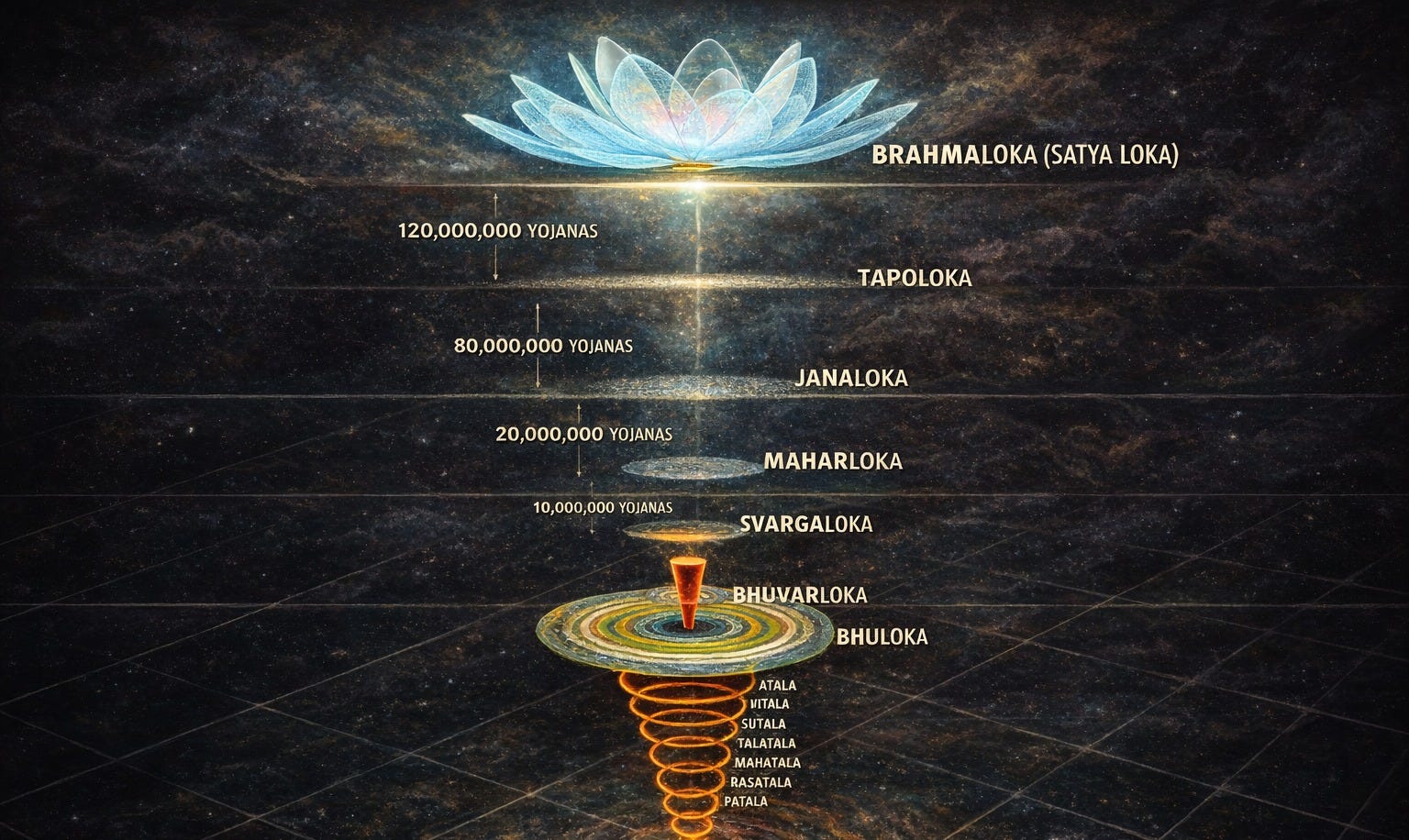
The point to keep in mind about this image is that it is not a telescope map of the universe, but a map of levels of consciousness. The planets and stars that form these different planetary systems do not appear neatly arranged in disks we can see using our telescopes, at least not in our gross reality. The point the Śrīmad-Bhāgavatam makes is that we are currently situated in the intermediate level of this sequence, and the goal of human life is to progress to the higher levels, culminating with liberation.
At the bottom of the sequence are the seven lower planetary systems inhabited by the asuras, where materialism and godlessness predominate. These places are compared to a pit because once one falls in, there are not many opportunities for getting out again. We live in Bhūrloka, the intermediate planetary system immediately above them. Our planet, Bhārata-varṣa, is special because it is a place where souls come to create a new set of karma that will influence their destiny for many lives to come. That’s the universal test room, so to speak, where we receive a short life to prove ourselves. According to our desires and actions, we can be elevated or degraded to any place in the cosmos, or even go beyond it, reaching the border regions of the pradhāna, going further, up to the effulgence of the impersonal Brahmājyoti, or returning home, back to Godhead, to our eternal position in the spiritual world.
Above our plane is Bhuvarloka. Its lower levels are inhabited by subtle beings, such as the Yakṣas and Rākṣasas. These are subtle regions rich in material opulence, under the control of Kuvera, the treasurer of the demigods. The existence of Bhuvarloka introduces a concept that is very central in the model of the Vedas, which is the concept of multiple dimensions. This abode of Kuvera is very close to us; it is described as starting in the upper atmosphere. From our point of view, there is nothing there; it is just rarefied air that gradually becomes thinner as we go upward. From their perspective, however, there are lakes, forests, and palaces. Because they live in a higher dimension, their bodies as well as their abodes are made of a subtle, or refined, form of matter that is invisible to us. As a result, they can see us, but we can’t see them. A little higher, are the abodes of the lower demigods, such as the Siddhas, Cāraṇas, and Vidyādharas. Human beings can gain access to their realm only through pious merit and purification of one’s existence. There is no space probe or weapon that can force our way there.
Still higher is Svargaloka, the celestial system, where the demigods live. The description given in the Fifth Canto puts Svargaloka very far from us, extending up to the Polestar, the abode of Maharaja Dhruva. The pious souls who take birth there can enjoy a life of great opulence for 10,000 years of the demigods. One day for them equals one year for us, resulting in an extremely long lifetime from our point of view.
Still higher are the planetary systems of Maharloka, Janaloka, Tapoloka, and Satyaloka, inhabited by highly elevated souls. Different from Svargaloka, these are not places for sensual enjoyment but places for advanced spiritual cultivation.
Maharloka and Janaloka are inhabited by great sages who can perfectly control their senses and wholeheartedly worship the Lord through the performance of sacrifices. Sages living in Maharloka can stay there until the end of the day of Brahmā. At the time of the partial destruction triggered by his night, the fire emitted by Lord Ananta destroys all the lower planets of the universe, up to Svargaloka. The scale of time given in the Bhāgavatam for this process of destruction roughly corresponds to the phenomenon of the sun becoming a red giant and engulfing our planet, which is predicted in astrophysics.
Maharloka is not directly destroyed, but it becomes too hot even for the great sages who live there. Those who are sufficiently qualified have at this point the possibility of ascending to the next planetary system, Janaloka, where they can live longer. The inhabitants of Janaloka, Tapoloka, and Brahmāloka, the three topmost planetary systems, are essentially deathless. They can continue living for trillions of years, until the end of the universe.
Tapoloka is the abode of the four Kumāras, the four celibate sons of Brahmā, as well as other great yogis who spend their time in solitary meditation. Beyond this very subtle realm, there is Satyaloka, the abode of Lord Brahmā and the highest planetary system. Souls who attain this abode remain engaged in the worship of Lord Garbhodakaśāyī Viṣnu, together with Brahmā, and normally go back to Godhead together with him at the end of his life, when the universe is finally destroyed.
Each of us may take our next birth in any of these planetary systems, according to our level of qualification. Great devotees, however, are unrestricted. They can go to any planet they like, be it material or spiritual. Yogis generally don’t have access to the spiritual planets, but they can still transfer themselves to higher material planets, while materialists can’t go higher than Svargaloka, even if they are extraordinarily pious by material standards. More often than not, they just glide down to the lower planetary systems, where they become progressively more restricted.
People like to talk about the freedom of doing whatever they want, but this is not real freedom. In conditioned life, “doing whatever we want” means just following the dictates of the mind and senses, which is actually a form of slavery. Real freedom is attained when we cultivate spiritual knowledge and learn to control our senses.
In general, as one goes upwards, the desire to enjoy one’s senses is reduced, and by the time one reaches Satyaloka, it is almost completely gone, and one can go back to Godhead at the end of the universe together with Lord Brahmā. Devotees, however, are a special case. They hear about Kṛṣṇa’s pastimes and practice devotional service, and in this way tune up their consciousness directly to the reality of the spiritual world. Obtaining this higher taste, by the time they leave their bodies they are not interested in anything more of this material world and are ready to go back home, back to Godhead.
There is also another, much longer path, that yogis who are going upwards by their own power may take. After Satyaloka, there are the seven elemental coverings of the universe, respectively composed of elemental earth, water, fire, air, ether, mahat-tattva, and false ego, with each covering being ten times greater than the previous. It’s described in the Bṛhad-bhāgavatāmṛta that the personification of the material energy lives in each of these coverings, worshiping a different form of the Lord. Yogis who are in the ascending process can gradually go through each one of these coverings, where they have access to objects of sense gratification more refined than anything available inside the universe, enjoying very long lives without any trace of pain. In this way, the yogi can satisfy any remaining material desires he may still have.
An analogy that could be used to explain such a refined level of sense gratification is that of a pig eating and a person eating in an expensive restaurant. Both enjoy eating, but the enjoyment of the pig is very gross, while the enjoyment of the human is more refined. While in the coverings, the yogi has the understanding that there is nothing better to be enjoyed anywhere in the material universe; therefore, when he finally becomes tired of the enjoyment there, he doesn’t have any desire to return, just as a rich person eating in a restaurant does not desire to become a pig and eat scraps.
We can see that a yogi who goes through this gradual ascending path can also achieve perfection, but only after an extremely long period, after passing through the different planetary systems and all the seven coverings of the material universe, a process painfully slow.
A devotee, on the other hand, can directly go to the spiritual world by just serving Kṛṣṇa and concentrating his or her mind on Him. This direct process of devotional service is the most auspicious and effective way of deliverance, and that’s the message of the Śrīmad-Bhāgavatam. All the cosmological and metaphysical knowledge offered there is just to help us realize that there is no better path and thus chalk the path of devotion with confidence.
As Śukadeva Goswami concludes at the end of chapter 2.2:
“For those who are wandering in the material universe, there is no more auspicious means of deliverance than what is aimed at in the direct devotional service of Lord Kṛṣṇa.
The great personality Brahmā, with great attention and concentration of the mind, studied the Vedas three times, and after scrutinizingly examining them, he ascertained that attraction for the Supreme Personality of Godhead Śrī Kṛṣṇa is the highest perfection of religion.”
“O King, it is therefore essential that every human being hear about, glorify and remember the Supreme Lord, the Personality of Godhead, always and everywhere.”
Read the whole book:
« Making Sense of the Vedic Universe, a Higher-Dimensional Reality
This is a publication for thoughtful readers who want to go deeper into Kṛṣṇa consciousness. I publish daily, trying to offer high-quality spiritual content, and all posts are available to free subscribers. If you wish, you can also choose a paid subscription to support this work.
You can also receive the updates on WhatsApp or Telegram.
If you would like to contribute further, you can find the donation links here.
Hare Krishna
All Glories to Srila Prabhupada
I have been reading your articles recently. I find them very interesting. I am not sure if I should comment but I had some doubts.
I am also reading Srimad Brihad Bhagwatamritam. Started chapter 4 today. Not reading in too much details though, kind of just the anuvaads ( Translations ). I am relishing it and referring Srila Sanatan Goswamipad.
I was confused also, it said 8 aavarans after the satya loka. I could ask you a few concerns.
1.And its a path of progression, so we cant take birth in any of these systems, how do we understand that.
EACH OF US MAY TAKE OUR NEXT BIRTH IN ANY OF THESE PLANETARY SYSTEMS, ACCORDING TO OUR LEVEL OF QUALIFICATION.
AFTER SATYALOKA, THERE ARE THE SEVEN ELEMENTAL COVERINGS OF THE UNIVERSE, RESPECTIVELY COMPOSED OF ELEMENTAL EARTH, WATER, FIRE, AIR, ETHER, MAHAT-TATTVA, AND FALSE EGO
Just that 8 coverings are mentioned in Sri Brihad Bhagwatamritam 2.3
Thank you so much for your dedicated time. I have not yet read SB in full details yet. Completed till Canto 4.
Been in KC for about 6 years. Haven't been initiated yet. Being honest, I had some doubts regarding ritvik and direct initiation.
You have an article on that also. Will read that too.
Hare Krishna