

« The Song of God—Volume 1, chapters 1-6
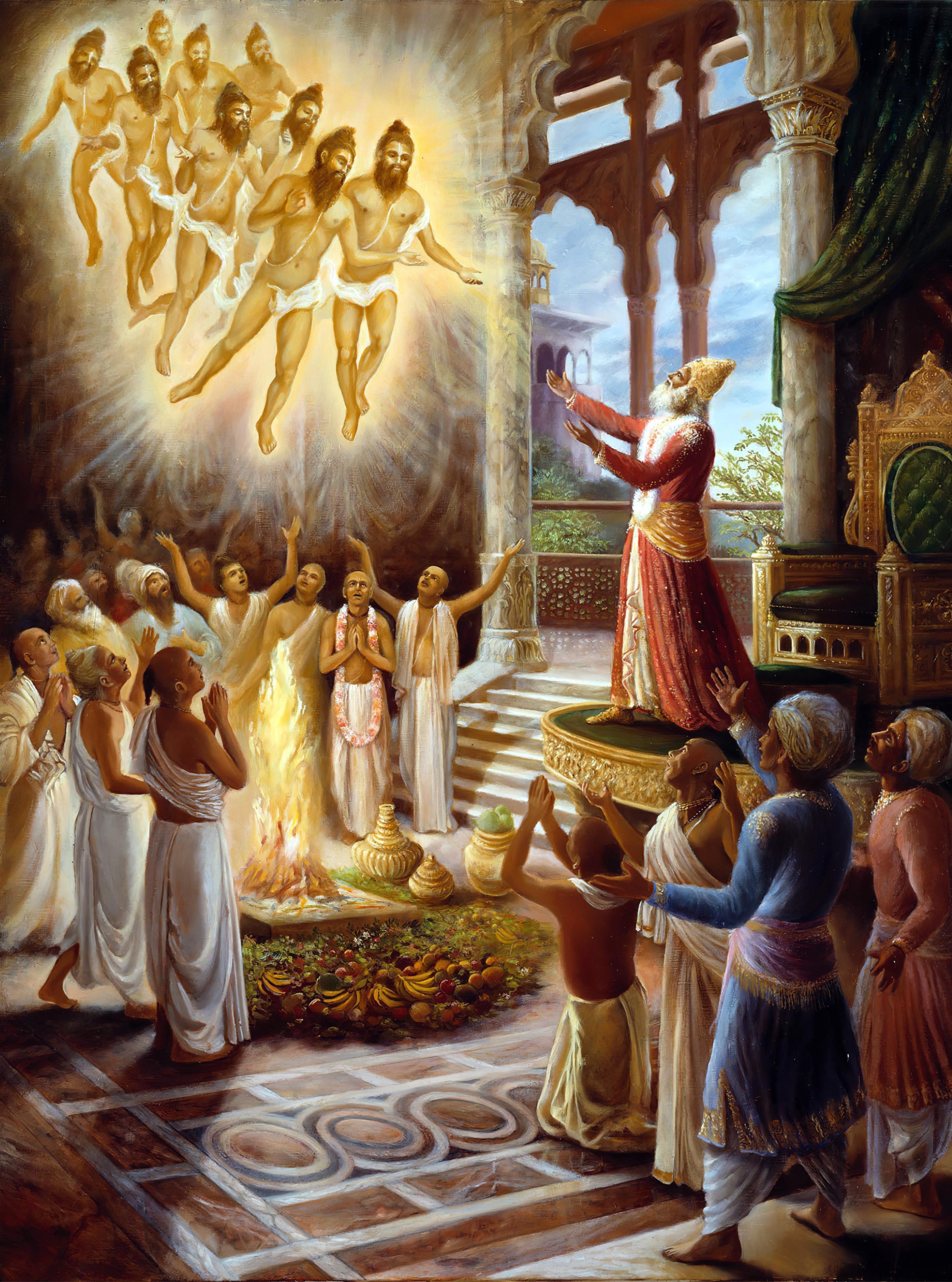
The vision of the perfect yogī (Bg 6.24 to 6.32)
In the previous section, Kṛṣṇa described the perfectional stage of yoga, in which the mind becomes stable, and the yogī realizes his eternal spiritual nature. The example of the lamp in a windless place is significant, because it indicates that spiritual perfection is not an artificial imposition, but the result of eliminating the source of material conditioning. In other words, it is not about becoming something else, but simply curing the material infection. Material life is an unnatural condition for the soul. As soon as the disease is cured, health is automatically reestablished. Similarly, as the yogī is able to give up material desire and ego, he becomes again situated in spiritual perfection. At this stage, he experiences spiritual happiness that makes any kind of material satisfaction previously experienced appear like a drop in the desert. At this stage, the yogī becomes steady and is not dragged back even if faced with great material difficulties.
Now, Kṛṣṇa will explain in more detail the process by which we can approach this state, giving up the idea of material sense gratification, fixing the mind upon the Self (Kṛṣṇa, in the form of Paramātmā), bringing it back when it wanders, and thus becoming free from material contamination, to the point of seeing the Lord everywhere and seeing all living beings with equal vision.
Again, this process is valid both for the yogī and the devotee; the only difference is that the devotee achieves it through an easier method, by directly fixing his mind on Kṛṣṇa through the devotional process, while the yogī has to fix the mind through the mechanical process of aṣṭāṅga-yoga.
Text 24: sa niścayena yoktavyo, yogo ’nirviṇṇa-cetasā
saṅkalpa-prabhavān kāmāṁs, tyaktvā sarvān aśeṣataḥ
manasaivendriya-grāmaṁ, viniyamya samantataḥ
One should engage oneself in the practice of yoga with determination and faith and not be deviated from the path. One should abandon, without exception, all material desires born of mental speculation and thus control all the senses on all sides by the mind.
Text 25: śanaiḥ śanair uparamed, buddhyā dhṛti-gṛhītayā
ātma-saṁsthaṁ manaḥ kṛtvā, na kiñcid api cintayet
Gradually, step by step, one should become situated in trance by means of intelligence sustained by full conviction, and thus the mind should be fixed on the Self alone and should think of nothing else.
Text 26: yato yato niścalati, manaś cañcalam asthiram
tatas tato niyamyaitad, ātmany eva vaśaṁ nayet
From wherever the mind wanders due to its flickering and unsteady nature, one must certainly withdraw it and bring it back under the control of the Self.
Text 27: praśānta-manasaṁ hy enaṁ, yoginaṁ sukham uttamam
upaiti śānta-rajasaṁ, brahma-bhūtam akalmaṣam
The yogī whose mind is fixed on Me verily attains the highest perfection of transcendental happiness. He is beyond the mode of passion, he realizes his qualitative identity with the Supreme, and thus he is freed from all reactions to past deeds.
Text 28: yuñjann evaṁ sadātmānaṁ, yogī vigata-kalmaṣaḥ
sukhena brahma-saṁsparśam, atyantaṁ sukham aśnute
Thus the self-controlled yogī, constantly engaged in yoga practice, becomes free from all material contamination and achieves the highest stage of perfect happiness in transcendental loving service to the Lord.
Text 29: sarva-bhūta-stham ātmānaṁ, sarva-bhūtāni cātmani
īkṣate yoga-yuktātmā, sarvatra sama-darśanaḥ
A true yogī observes Me in all beings and also sees every being in Me. Indeed, the self-realized person sees Me, the same Supreme Lord, everywhere.
Text 30: yo māṁ paśyati sarvatra, sarvaṁ ca mayi paśyati
tasyāhaṁ na praṇaśyāmi, sa ca me na praṇaśyati
For one who sees Me everywhere and sees everything in Me, I am never lost, nor is he ever lost to Me.
Text 31: sarva-bhūta-sthitaṁ yo māṁ, bhajaty ekatvam āsthitaḥ
sarvathā vartamāno ’pi, sa yogī mayi vartate
Such a yogī, who engages in the worshipful service of the Supersoul, knowing that I and the Supersoul are one, remains always in Me in all circumstances.
Text 32: ātmaupamyena sarvatra, samaṁ paśyati yo ’rjuna
sukhaṁ vā yadi vā duḥkhaṁ, sa yogī paramo mataḥ
He is a perfect yogī who, by comparison to his own self, sees the true equality of all beings, in both their happiness and their distress, O Arjuna!
Text 6.24 gives us the key to becoming free from material desires. All material desires are born from the mind, from saṅkalpa, plans born out of imagination. Saṅkalpa-prabhavān kāmāṁs: material desires are born of these mental speculations. What are these speculations? “I will get this,” “I will be honored like this,” “This will bring me happiness.” These mental constructions start as mere thoughts, but they agitate the mind and senses, starting a process that is difficult to stop. After the mind becomes agitated by desire and the senses are ready to act, it becomes difficult to stop, but if we act soon enough, cutting the thought from the root, we can stop material desires before they fully manifest.
Another point, emphasized by Prabhupāda in his purport, is determination. The process of controlling the mind is an uphill battle that takes time; it is not something that can be accomplished in one day. One has thus to remain determined, like the sparrow who lost her eggs, and was so determined that she tried to dry the ocean with her beak. Although she was unable to do so, her determination attracted the attention of Garuḍa, who helped her. Similarly, we may have difficulties in controlling the disturbed mind, but if we remain determined, Kṛṣṇa will eventually help. As mentioned, God helps those who help themselves.
This process of steady determination is emphasized in text 6.25. The mind should be situated in the transcendental position, fixed on Kṛṣṇa. However, this is not attained at once in a dramatic act. It is attained gradually, step by step. Buddhyā dhṛti-gṛhītayā: By patiently using the intelligence (buddhyā) firmly sustained by determination (dhṛti-gṛhītayā). We start by studying the instructions of Kṛṣṇa in the Gītā, which purify and fix the intelligence. As intelligence becomes fixed, we can use it to discipline the mind, and as this is gradually achieved, we can advance toward the transcendental platform.
One term that is frequently misunderstood is the term ātma. The verse mentions the term ātma-saṁsthaṁ: the mind should be fixed on ātma, the Self. The word ātma can be used in many senses; it can mean the individual self (as the soul, ego, mind, or even the body), and it is used in this sense in many passages, but the primary meaning of ātma is as indicating the Superself, Kṛṣṇa as the Supersoul. Therefore, when it is said that the mind should be fixed on the Self, it is not about some vague form of impersonal meditation, but direct thought on Kṛṣṇa. For a yogī, this process is difficult, but a devotee may start this process from the first day, by simply hearing about Kṛṣṇa, speaking about Him, chanting His names, and so on.
The problem is that eventually the mind wanders. The mind is cañcalam, flickering by nature. We may be able to chant attentively for a few minutes, but eventually we again become distracted. What to do when this happens? Vaśaṁ nayet: we need to bring it back under control, fixing it again on Kṛṣṇa, as indicated by the word ātmani (unto the Supersoul).
In this way, we should not pretend that keeping the mind fixed on Kṛṣṇa is easy. As Kṛṣṇa explains, that is an uphill battle. The point is that we should observe the activity of the mind, understand its unstable nature, and not identify with it. The mind will wander; that is expected. The point is how we react to it. We should simply bring the mind back, and repeat it as many times as necessary. This is valid both during meditation, when we are chanting our rounds, and in all moments of the day. We should gradually train the mind to remain fixed on Kṛṣṇa during all our daily activities. This is the secret of keeping the senses under control.
As Prabhupāda explains:
“One who controls the mind (and therefore the senses as well) is called gosvāmī, or svāmī, and one who is controlled by the mind is called go-dāsa, or the servant of the senses. A gosvāmī knows the standard of sense happiness. In transcendental sense happiness, the senses are engaged in the service of Hṛṣīkeśa, or the supreme owner of the senses – Kṛṣṇa. Serving Kṛṣṇa with purified senses is called Kṛṣṇa consciousness. That is the way of bringing the senses under full control. What is more, that is the highest perfection of yoga practice.”
This is another point in which bhakti differs from aṣṭāṅga-yoga. In the process of mystic yoga, there is no superior engagement; the yogī has to maintain the mind under control by force, which is very difficult. A devotee, however, has only to redirect the mind to the devotional activity. If the mind comes with the desire to eat tasty things, one can redirect this to cook nice preparations for Kṛṣṇa; if the mind desires to build a nice house, one can construct a temple for Kṛṣṇa, and so on. When desires are connected with Kṛṣṇa, we can engage them positively. For example, Dhruva Mahārāja approached the Lord out of desire for a kingdom, Gajendra out of distress, and Kubjā out of lust. However, because their desire was directed to Kṛṣṇa, they all became liberated.
Kṛṣṇa then returns to the explanation of the transcendental stage, the stage of transcendental happiness, attained when one becomes completely free from the influence of the modes of passion and ignorance. The mode of passion is characterized by desire, ambition, restlessness, desire for competition, dissatisfaction, constant anxiety, etc. As long as we are influenced by it, there is no question of having a peaceful mind. The mode of ignorance is even worse, bringing us into laziness, illusion, intoxication, depression, confusion, etc. When we finally become free from the influence of both, we attain the transcendental platform: “The yogī whose mind is fixed on Me verily attains the highest perfection of transcendental happiness. He is beyond the mode of passion, he realizes his qualitative identity with the Supreme, and thus he is freed from all reactions to past deeds.”
Later, starting from chapter 14, Kṛṣṇa will explain the three modes of nature. Here He appears to suggest that one attains the transcendental stage after becoming free from the influence of the mode of passion (and not from goodness), but here He refers to the modes as He does in other passages of the Gītā, with goodness indicating transcendental goodness. There is the material mode of goodness, in which the demigods are situated, but this is a form of goodness still touched by passion and ignorance. Here, Kṛṣṇa mentions that śānta-rajasaṁ brahma-bhūtam akalmaṣam (after his passion is pacified, one becomes free from all sinful reactions and attains liberation). This combination makes it clear that He is speaking about attaining the transcendental stage in pure goodness.
Brahma-bhūta is the stage of liberation, when one becomes situated on the platform of liberation. Text 18.54 connects this platform with attaining the transcendental service of the Lord (mad-bhaktiṁ labhate parām). Therefore, when Kṛṣṇa mentions in text 6.27 that after becoming free from material contamination the yogī becomes fixed on the brahma-bhūta platform, He again emphasizes that the ultimate goal is pure devotional service, as Prabhupāda mentions in his purport. Real freedom from material contamination is thus achieved when one comes to the platform of devotional service.
The transcendental stage
From texts 6.28 to 6.32, Kṛṣṇa describes the culmination of the process, the transcendental stage. If translated literally, these verses appear to refer to a yogī attaining Brahman realization, and reaching the state of happiness that comes after material liberation. For example, text 6.28 mentions sukhena brahma-saṁsparśam atyantaṁ sukham aśnute (being in constant touch with the Supreme Brahman, the yogī attains the highest happiness).
Śrīla Prabhupāda, however, translates these verses in the context of the previous ones, revealing the deepest meaning of the text: Kṛṣṇa is not merely speaking about Brahman or Paramātmā realization, but the state of ultimate perfection in pure devotional service. A yogī may reach only Brahman or Paramātmā realization, according to his understanding, but a devotee who knows Kṛṣṇa attains the highest level.
He thus translates text 6.28 as “Thus the self-controlled yogī, constantly engaged in yoga practice, becomes free from all material contamination and achieves the highest stage of perfect happiness in transcendental loving service to the Lord.”
We can see that, in the context, brahma-saṁsparśa doesn’t mean just contact with the effulgence of Kṛṣṇa, but loving association with Him in devotional service. This meaning is emphasized by the words atyantaṁ sukham: the highest happiness. Brahman realization can barely be described as transcendental happiness at all. Real spiritual happiness is experienced in directly serving the Lord in one of the transcendental rasas. This is real yoga, or connection with the Supreme.
Prabhupāda explains further in his purport:
“Self-realization means knowing one’s constitutional position in relationship to the Supreme. The individual soul is part and parcel of the Supreme, and his position is to render transcendental service to the Lord. This transcendental contact with the Supreme is called brahma-saṁsparśa.”
This state of brahma-saṁsparśa is not something that comes only after death; it is a state of realization that is attained during one’s life. This brings us to the next four verses, where Kṛṣṇa describes the vision of the perfect yogī who attains this realization:
“A true yogī observes Me in all beings and also sees every being in Me. Indeed, the self-realized person sees Me, the same Supreme Lord, everywhere. For one who sees Me everywhere and sees everything in Me, I am never lost, nor is he ever lost to Me. Such a yogī, who engages in the worshipful service of the Supersoul, knowing that I and the Supersoul are one, remains always in Me in all circumstances. He is a perfect yogī who, by comparison to his own self, sees the true equality of all beings, in both their happiness and their distress, O Arjuna!”
The first realization is that the perfect yogī sees that there is nothing apart from Kṛṣṇa. Everything that exists is part of the energies of Kṛṣṇa, and thus there is nothing separate from Kṛṣṇa. The material world is formed from the external potency of Kṛṣṇa, while the spiritual planets are part of the internal potency. We, the souls, are called the marginal potency, because we are free to choose between these two potencies.
Kṛṣṇa is everywhere, and everyone is in Him. The material experience doesn’t happen because we are factually separated from Kṛṣṇa, but because we are covered by ignorance and become incapable of seeing Him, even though He is present everywhere and inside our own hearts. Freed from this covering, the perfect yogī can see this transcendental reality. He is thus the perfect seer. Everyone else sees just the material illusion.
Another symptom is that the perfect yogī sees everyone as equal, because he can see the soul and the Supersoul inside each individual body. The body, as well as the material conditioning of the soul, may differ, but he sees the spiritual reality behind these differences. He sees the soul in his eternal nature as an eternal servant of the Lord, and not as a man, woman, cat, or dog. As Prabhupāda explains:
“The yogī sees equally because he sees that all living entities, although in different situations according to the results of fruitive work, in all circumstances remain the servants of God. While in the material energy, the living entity serves the material senses; and while in the spiritual energy, he serves the Supreme Lord directly. In either case the living entity is the servant of God. This vision of equality is perfect in a person in Kṛṣṇa consciousness.”
Kṛṣṇa then brings us to the result of this realization: “For one who sees Me everywhere and sees everything in Me, I am never lost, nor is he ever lost to Me.”
To see Kṛṣṇa everywhere is not just a mystical experience. Seeing Kṛṣṇa everywhere means to be always with Kṛṣṇa. The perfect yogī sees Kṛṣṇa at every moment, and Kṛṣṇa never stops noticing him. Prahlāda Mahārāja achieved this vision, and thus, when Hiraṇyakaśipu challenged him, asking whether Lord Viṣṇu was inside the pillar, Prahlāda answered yes, without any hesitation. He could factually see the Lord present there. To prove it to everyone, the Lord immediately appeared in a visible form out of the pillar as Nṛsiṃhadeva and killed the demon.
The impersonalist may see everything as Brahman, but this is a limited concept. The pure devotee and the perfect yogī see Kṛṣṇa personally present everywhere in His Viṣṇu form.
The words Kṛṣṇa uses, “I am never lost, nor is he ever lost to Me” are very personal, indicating a mutual relationship. The pure devotee always remembers Kṛṣṇa, and Kṛṣṇa always remembers His devotee. This is a personal relationship.
Prabhupāda explains these delicate points in his purport:
“Nothing can exist without Kṛṣṇa, and Kṛṣṇa is the Lord of everything – this is the basic principle of Kṛṣṇa consciousness. Kṛṣṇa consciousness is the development of love of Kṛṣṇa – a position transcendental even to material liberation. At this stage of Kṛṣṇa consciousness, beyond self-realization, the devotee becomes one with Kṛṣṇa in the sense that Kṛṣṇa becomes everything for the devotee and the devotee becomes full in loving Kṛṣṇa. An intimate relationship between the Lord and the devotee then exists. In that stage, the living entity can never be annihilated, nor is the Personality of Godhead ever out of the sight of the devotee.”
“At this stage, Lord Kṛṣṇa never disappears from the sight of the devotee, nor does the devotee ever lose sight of the Lord. In the case of a yogī who sees the Lord as Paramātmā within the heart, the same applies. Such a yogī turns into a pure devotee and cannot bear to live for a moment without seeing the Lord within himself.”
Even before attaining this level of factual realization, we can see Kṛṣṇa everywhere by seeing everything in connection with Him. This is an art that He teaches in the next chapters. We can see Kṛṣṇa in the light of the sun, in the coolness of the moon, in the taste of water. We can see the world as Kṛṣṇa’s energy, all living beings as His parts and parcels, all duties as opportunities for service, and so on.
One could insist that a yogī does not see Kṛṣṇa directly; he sees the Supersoul. Technically this is correct, but see what Kṛṣṇa personally speaks in the next verse:
“Such a yogī, who engages in the worshipful service of the Supersoul, knowing that I and the Supersoul are one, remains always in Me in all circumstances.”
Kṛṣṇa is personally speaking, and He uses the words mām (Me) and mayi (in Me). He is personally present inside the heart in His Viṣṇu form, and Viṣṇu is not different from Kṛṣṇa. He also mentions that such a perfect yogī remains always in Him in all circumstances. This means that his spiritual consciousness is not broken by external situations. Whether active or inactive, alone or among people, honored or dishonored, comfortable or uncomfortable, the yogī remains always connected with Him. Prabhupāda quotes the Nārada Pañcarātra to reinforce this point: “By concentrating one’s attention on the transcendental form of Kṛṣṇa, who is all-pervading and beyond time and space, one becomes absorbed in thinking of Kṛṣṇa and then attains the happy state of transcendental association with Him.”
A frequent misunderstanding is that Paramātmā divides into many forms to enter into the hearts of all living beings. This is not exactly correct. Paramātmā is one, but He becomes simultaneously present in the hearts of all living beings, just as the same sun situated in the sky shines everywhere and sees everything. As quoted: “Viṣṇu is one, and yet He is certainly all-pervading. By His inconceivable potency, in spite of His one form, He is present everywhere, as the sun appears in many places at once.”
The final quality mentioned by Kṛṣṇa in this section is compassion: “He is a perfect yogī who, by comparison to his own self, sees the true equality of all beings, in both their happiness and their distress, O Arjuna!”
The highest yogī sees others’ happiness and distress as his own, in truth, not merely as a theoretical idea. This manifests in many levels, but Prabhupāda calls our attention to the highest expression of it: the highest compassion is to give Kṛṣṇa consciousness.
All beings suffer due to forgetfulness of Kṛṣṇa. Bodily suffering comes and goes, but this ignorance keeps the soul bound to material suffering birth after birth, in a practically unlimited cycle. Real kindness is to help people to revive their eternal relationship with Kṛṣṇa.
A devotee considers that he or she received Kṛṣṇa consciousness as an act of mercy, and seeing that others are suffering due to the lack of it, becomes determined to help them. Instead of becoming absorbed in his own liberation, a devotee works for the benefit of others. This is the perfect manifestation of the transcendental quality Kṛṣṇa describes in 6.32.
Main points in the purports of Śrīla Prabhupāda:
“One should engage oneself in the practice of yoga with determination and faith and not be deviated from the path. One should abandon, without exception, all material desires born of mental speculation and thus control all the senses on all sides by the mind.”
a) The yogī should be determined in his practice and sure of the success at the end. One should be determined like the sparrow who lost her eggs in the ocean and worked hard to retrieve them until helped by Garuḍa.
b) Just as in the case of the sparrow, spiritual practice can be difficult, but if one follows the process with determination, Kṛṣṇa will surely help.
“Gradually, step by step, one should become situated in trance by means of intelligence sustained by full conviction, and thus the mind should be fixed on the Self alone and should think of nothing else.”
a) The process of stopping the activities of the senses is called pratyāhāra. After controlling the mind with conviction, one can advance in the process of meditation up to the level of samādhi, when one becomes fixed.
b) How does this apply to our practical life? Even though we are involved with matter, we should become fixed in spiritual pleasure in connection with Kṛṣṇa and not think of sense gratification. The way to achieve that is through the practice of Kṛṣṇa consciousness.
“From wherever the mind wanders due to its flickering and unsteady nature, one must certainly withdraw it and bring it back under the control of the Self.”
a) A yogī should control the mind, instead of being controlled by it. That’s the difference between a gosvāmī and a go-dāsa. Transcendental happiness is achieved when we use the senses in the service of Hṛṣīkeśa, the master of the senses. Kṛṣṇa consciousness is the process of bringing the senses under control and the highest perfection of yoga.
“The yogī whose mind is fixed on Me verily attains the highest perfection of transcendental happiness. He is beyond the mode of passion, he realizes his qualitative identity with the Supreme, and thus he is freed from all reactions to past deeds.”
a) Brahma-bhūta means liberation. Real liberation means to become situated in the transcendental service of the Lord. Without attaining the platform of service, one cannot become truly fixed on the transcendental platform. Therefore, to remain always engaged in devotional service means to be liberated from material contamination.
“Thus the self-controlled yogī, constantly engaged in yoga practice, becomes free from all material contamination and achieves the highest stage of perfect happiness in transcendental loving service to the Lord.”
a) Brahma-saṁsparśa means the constitutional position of the soul in relationship with Kṛṣṇa. The soul is part and parcel of Him, and his eternal position is one of service.
“A true yogī observes Me in all beings and also sees every being in Me. Indeed, the self-realized person sees Me, the same Supreme Lord, everywhere.”
a) The perfect yogī sees Kṛṣṇa situated in all hearts as Paramātmā, despite the differences in the bodies. The Lord remains neutral, just like a mother or father loves their different children without discrimination.
b) The soul is also situated in the heart, so what is the difference? The difference is that the Lord is situated in all hearts, while the individual soul is present only in a particular heart. The soul identifies with a body and becomes entrapped, while the Lord remains transcendental.
c) The Lord has three principal potencies: the spiritual potency, the material potency, and the marginal potency, the souls, who are originally part of the spiritual potency but somehow become conditioned by the inferior material potency. Under the inferior potency we serve the senses, and under the superior potency we serve Kṛṣṇa directly. However, whether in the superior or inferior potency, we are always situated in the Lord in one way or another.
d) The perfect yogī sees the spiritual reality beyond the differences of body. He sees that, although in different situations, all living entities are eternal servants of God.
“For one who sees Me everywhere and sees everything in Me, I am never lost, nor is he ever lost to Me.”
a) A materialist looks around and sees different material objects. A pure devotee, however, sees everything as a manifestation of Kṛṣṇa’s energy. Because he is always conscious of Kṛṣṇa, seeing that nothing can exist without Him, he in fact sees Kṛṣṇa everywhere.
b) Kṛṣṇa consciousness means the development of love for Kṛṣṇa. The perfect devotee becomes one with Kṛṣṇa in the sense that Kṛṣṇa becomes everything for him. Due to intense love, a very intimate relationship exists between them. This stage is transcendental to mere liberation.
c) In this stage, Kṛṣṇa never disappears from the devotee’s view, nor does the Lord ever lose sight of the devotee. The same state is attained by the perfect yogī, who can’t stay even a moment without seeing the Lord inside the heart. As Kṛṣṇa mentions, He and the Supersoul are one.
d) The liberation in the brahmajyoti achieved by the impersonalist is spiritual annihilation. It makes one unconscious in the light of the effulgence of Kṛṣṇa, depriving the soul of his relationship of service with the Lord. A pure devotee rejects it.
“Such a yogī, who engages in the worshipful service of the Supersoul, knowing that I and the Supersoul are one, remains always in Me in all circumstances.”
a) A perfect yogī sees Viṣṇu inside his heart, with all opulences, but he should know Viṣṇu is not different from Kṛṣṇa. Because Kṛṣṇa is absolute, there is no difference between Him and the Supersoul present in all hearts, nor is there a difference between a devotee engaged in devotional service and the perfect yogī seeing Paramātmā inside the heart.
b) A devotee always acting in Kṛṣṇa consciousness is automatically liberated, and so is the yogī seeing Paramātmā inside the heart.
c) Paramātmā is one, but He is simultaneously present in innumerable hearts, just as the same sun appears in many places.
“He is a perfect yogī who, by comparison to his own self, sees the true equality of all beings, in both their happiness and their distress, O Arjuna!”
a) The cause of all our miseries is forgetfulness of our relationship with Kṛṣṇa, and the solution for all this misery is to know Kṛṣṇa as the supreme enjoyer, proprietor, and friend. A perfect devotee or yogī understands this and thus tries to distribute knowledge of Kṛṣṇa everywhere. He is thus the best philanthropist and the dearest servitor of the Lord. Such a devotee always looks to the welfare of all living entities, and in this way he is the real friend. A yogī who meditates in an isolated place for his own elevation is not as perfect.
Read the entire book:
« The Song of God—Volume 1, chapters 1-6

This is a publication for thoughtful readers who want to go deeper into Kṛṣṇa consciousness. I publish daily, trying to offer high-quality spiritual content, and all posts are available to free subscribers. If you wish, you can also choose a paid subscription to support this work.
You can also receive the updates on WhatsApp or Telegram.
If you would like to contribute further, you can find the donation links here.