

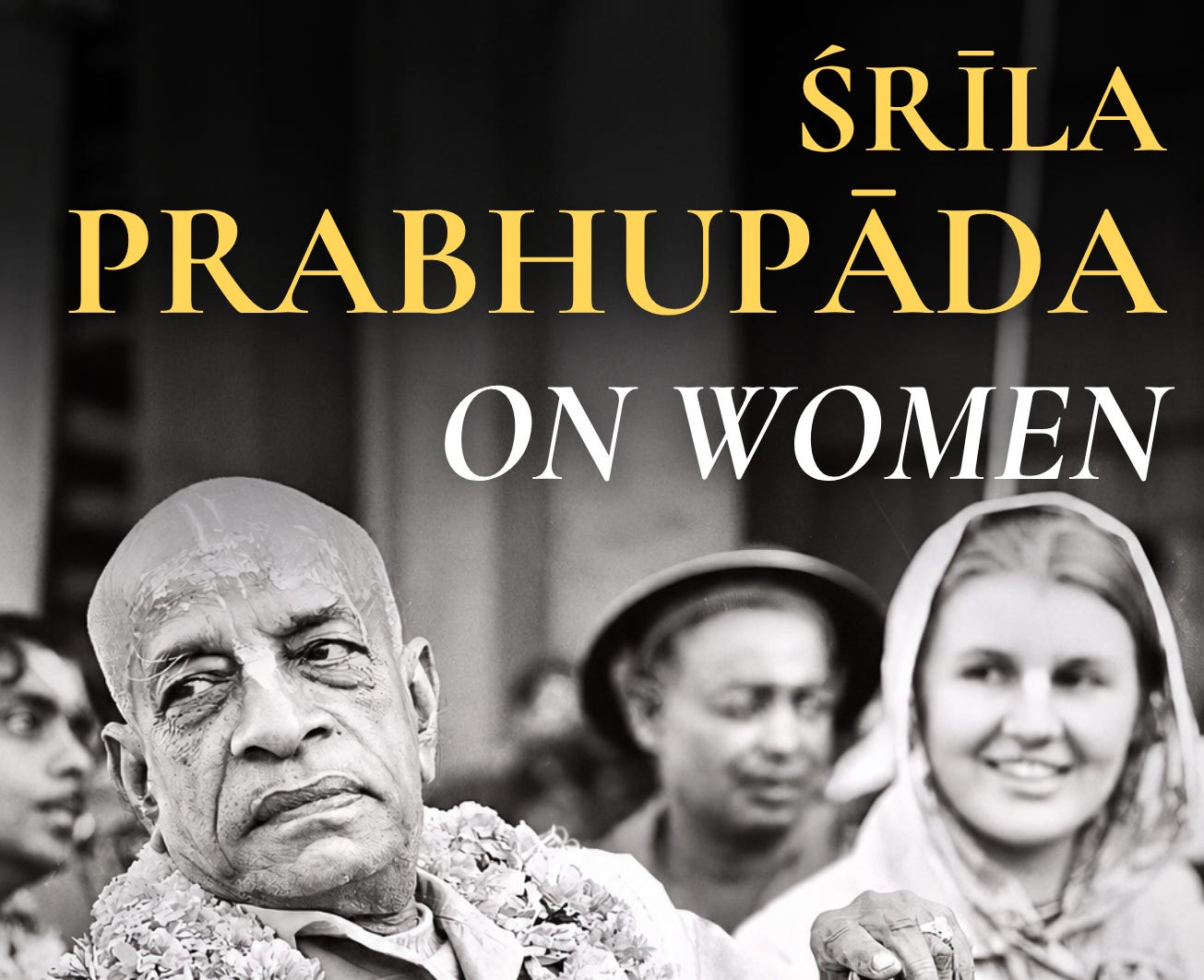
“These women are not ordinary women”
Just as in the passages about untrustworthy women, many other components of Prabhupāda’s teachings refer to materialistic women acting under the control of the mind and senses, and thus falling in the same category as dishonest men, like politicians. The criticism of “dishonest” women thus falls in the same category as his criticism of “rascal” men. On the bodily platform, he recognizes the male/female differences and social vulnerabilities. On the spiritual platform, however, he repeatedly teaches that a Vaiṣṇava is not to be judged by birth, nationality, caste, previous conduct, or gender.
The proof of that is found in the many passages in which Prabhupāda classifies his women disciples as well as other saintly women in a different category from regular women. This is also consistent with the broader teaching of Vaiṣnavas being different from ordinary people, superior even to brāhmanas. “Men” and “woman” are adjectives that can be used only in the material platform. As soon as one advances in the spiritual platform and starts acting as a soul, these designations cannot be applied in a derogatory sense. A Vaiṣnava is a soul; one may act as a man or woman, fulfilling general duties, but it is offensive to consider one as such. There is the term “Vaiṣnavī” to attend to grammatical rules, but in essence a Vaiṣnava is a soul, beyond negative conceptions of caste or gender.
For example, in a morning walk (Bombay, March 27th, 1974), Prabhupāda mentioned:
“But these women are not ordinary women. They are preachers. They are preachers. They are Vaiṣṇava. By their association, one becomes a Vaiṣṇava.”
During Śrīla Prabhupāda’s time, women distributed books, sang kīrtanas, and reached people to teach them Kṛṣṇa consciousness, just like the men. Although many famous book distributors are men, women collectively distributed more books than men in the history of our movement. Many of the difficulties we faced later, and continue to suffer in many places, began precisely with artificial restrictions preventing women from using their talents for Kṛṣṇa. Such artificial restrictions undermined the dynamic nature of Prabhupāda’s movement in many places, leading to stagnation and decline.
In this quote, Prabhupāda acknowledges the efforts of his lady disciples in distributing books, accepts them as Vaiṣnavas, beyond the material defects that are generally found in ordinary women. He also acknowledges that, being Kṛṣṇa conscious, they are capable of transmitting Kṛṣṇa consciousness to others.
A similar passage is described in the memories of Madhavananda dāsa:
“A disciple of Swami Narayana said to Śrīla Prabhupāda: “My spiritual master said to avoid all women and to never go where there are women.” Śrīla Prabhupāda laughed and said: “That is impossible, there are women everywhere.” Then, coming back to the temple and watching two women devotees bow down to him, he said: “By associating with these women, you will be purified.”
One example of a passage that illustrates the difference is the passage of Haridāsa Ṭhākura’s encounter with the prostitute sent by the Khān. Originally, she was a mundane lady, interested in comforts, but after hearing Haridāsa Ṭhākura chant for several days, she had a change of heart and adopted the process without reservations. She became well known as a saintly devotee, and many advanced Vaiṣnavas would visit her. They related to her based on her advanced spiritual status, rather than considering her a prostitute. This proves that her former bodily and social position no longer defined her in their eyes. Her defining identity became her devotional status.
“Thus the prostitute became a celebrated devotee. She became very advanced in spiritual life, and many stalwart Vaiṣṇavas would come to see her.”
“Purport: Stalwart, highly advanced Vaiṣṇava devotees are not interested in seeing prostitutes, but when a prostitute or any other fallen soul becomes a Vaiṣṇava, stalwart Vaiṣṇavas are interested in seeing them. Anyone can be turned into a Vaiṣṇava if he or she follows the Vaiṣṇava principles. A devotee who follows these principles is no longer on the material platform. Therefore, it is one’s strict adherence to the principles that should be considered, not the country of one’s birth. Many devotees join our Kṛṣṇa consciousness movement from Europe and America, but one should not therefore consider them European Vaiṣṇavas or American Vaiṣṇavas. A Vaiṣṇava is a Vaiṣṇava and should therefore be given all the respect due a Vaiṣṇava.” (CC Antya 3.142)
Similarly, a man or woman may have many defects due to material conditioning, but if one becomes an advanced Vaiṣnava due to serious spiritual practice, the material covering is removed and such defects disappear. One may have been a drunkard or a woman-hunter, but once one becomes fixed in spiritual practice, these defects cease to exist, and it becomes offensive to judge based on this previous conditioning. This applies equally to both genders.
We can see thus that Prabhupāda’s teachings are not directed to simply establish cheap, artificial equality between the sexes. Prabhupāda acknowledges that, in the material platform, men and women are different, and people are happier on both an individual and collective level when these differences are acknowledged. At the same time, however, he urges us to not settle in these differences, but to transcend them through the spiritual process, attaining the level where we become truly equal, as servants of Kṛṣṇa.
One may be a man here and now, but what he will be in the next life, no one knows. He may very well become a woman. However, the eternal nature of the soul is neither male nor female. A man may develop devotional feelings for Kṛṣṇa in conjugal love, and assume a feminine form in the spiritual world, and a woman may develop a relationship of friendship and assume a male form.
When this is acknowledged, we can see the two levels of dealings in Prabhupāda’s lines. One level was dealing with ordinary women, who were acting on the bodily platform, and another with his women disciples and others who were on an advanced spiritual platform.
A good example of this dynamic is found in the conversation with Sandy Nixon (Philadelphia, July 13, 1975). This conversation is also available in video, so one can see all the subtleties.
Sandy Nixon bases her questions on the assumptions of modern women’s liberation, while Prabhupāda answers from the standpoint of bodily differences, social protection, and spiritual equality. The conversation starts with spiritual topics about Kṛṣṇa consciousness and the eternal position of the soul, the fact that anyone can learn to love God, despite the material position. She is, however, more interested in discussing social issues, and later the conversation becomes focused on that.
When she asks about women’s liberation, Prabhupāda focuses on the point that this liberation is artificial, for when there is pregnancy, the woman carries the baby, not the man. The woman, thus, is forced into a vulnerable position, for she needs to maintain the child, while an irresponsible man may just walk away.
She mentions the point of having an abortion, and Prabhupāda brings up the point of being less intelligent; that’s certainly not a good choice. Prabhupāda then brings up a point he makes on other occasions, that women’s liberation means women become vulnerable to being cheated by men:
“Therefore I say they are cheating you in the name of independence. That you do not understand. Therefore 34 ounce. They are cheating you, and you are thinking you are independent.” … “they do not take the responsibility. They go away. They enjoy and go away. And the woman has to take the responsibility, either kill the child or maintain by begging [from the government].”
He then presents the solution many could be missing: family life. Instead of being seduced by a man, becoming pregnant, being abandoned, and then being forced into becoming dependent on social welfare, a woman can accept a husband and be maintained by him. A woman with a small child cannot escape being in a dependent position in one way or another, but the situation of a woman being cared for by a responsible husband is better.
One can try to be independent by using contraceptives and performing abortions, but spiritually, this is not a very good idea. One may become pregnant and have to raise a child alone. That’s also not a good idea. The only acceptable solution here is to find a good man and conceive children inside of marriage. The question is clear, but when emotions cloud one’s judgement, it becomes difficult to understand.
All of this, however, is material. It is a temporary distinction based on the body, not the eternal position of the soul. He then brings up the higher concept of spiritual equality:
“We give Kṛṣṇa consciousness both to the woman and man equally. We do not make any such distinction. But to protect them from this exploitation by man, we teach something, that “You do like this. You do like that. You be married. Be settled up. Don’t wander independently.” We teach them like that. But so far Kṛṣṇa consciousness is concerned, we equally distribute. There is no such thing that “Oh, you are woman, less intelligent or more intelligent. Therefore you cannot come.” We don’t say that. We welcome women, men, poor, rich, everyone, because in that platform equality.”
This summarizes the point. In the bodily platform, we have to play certain roles according to social obligations and practical factors. This cannot be avoided. The point, however, is that while acting under these distinctions, we should gradually elevate ourselves to the eternal spiritual platform where such distinctions cease to exist. A woman who becomes a serious devotee is not an ordinary woman; she is a Vaiṣṇavī, and must be honored as a servant of Kṛṣṇa.
Read the whole book:
« Śrīla Prabhupāda on Women
This is a publication for thoughtful readers who want to go deeper into Kṛṣṇa consciousness. I publish daily, trying to offer high-quality spiritual content, and all posts are available to free subscribers. If you wish, you can also choose a paid subscription to support this work.
You can also receive the updates on WhatsApp or Telegram.
If you would like to contribute further, you can find the donation links here.
Hare Krishna Prabhu, a problem I feel is that much of the description of women in the books starts from the position of ordinary men are generally good,honest etc or at least neutral, but that there are some men who are dishonest, unscrupulous etc, whereas it starts from the premise that ordinary women are generally dishonest etc, but there are some good women - in this case spiritually minded women.
However when looking at the majority of society who are generally materialistic, you don't see a majority of badly behaved women and some badly behaved men. In fact, often the news is filled with men who behave in morally negative ways - the prisons are mostly filled with men for example.
Additionally, the quoting of Chanakya Pandit is puzzling, because he is the advisor to a king. Of course a king should be wary of politicians and women, kings face a very real risk of "honey traps" (beautiful women sent to deceive or even kill the king) or being misled by politicians. That is very different to the experience of the average man or woman.