

« Making Sense of the Vedic Universe, a Higher-Dimensional Reality
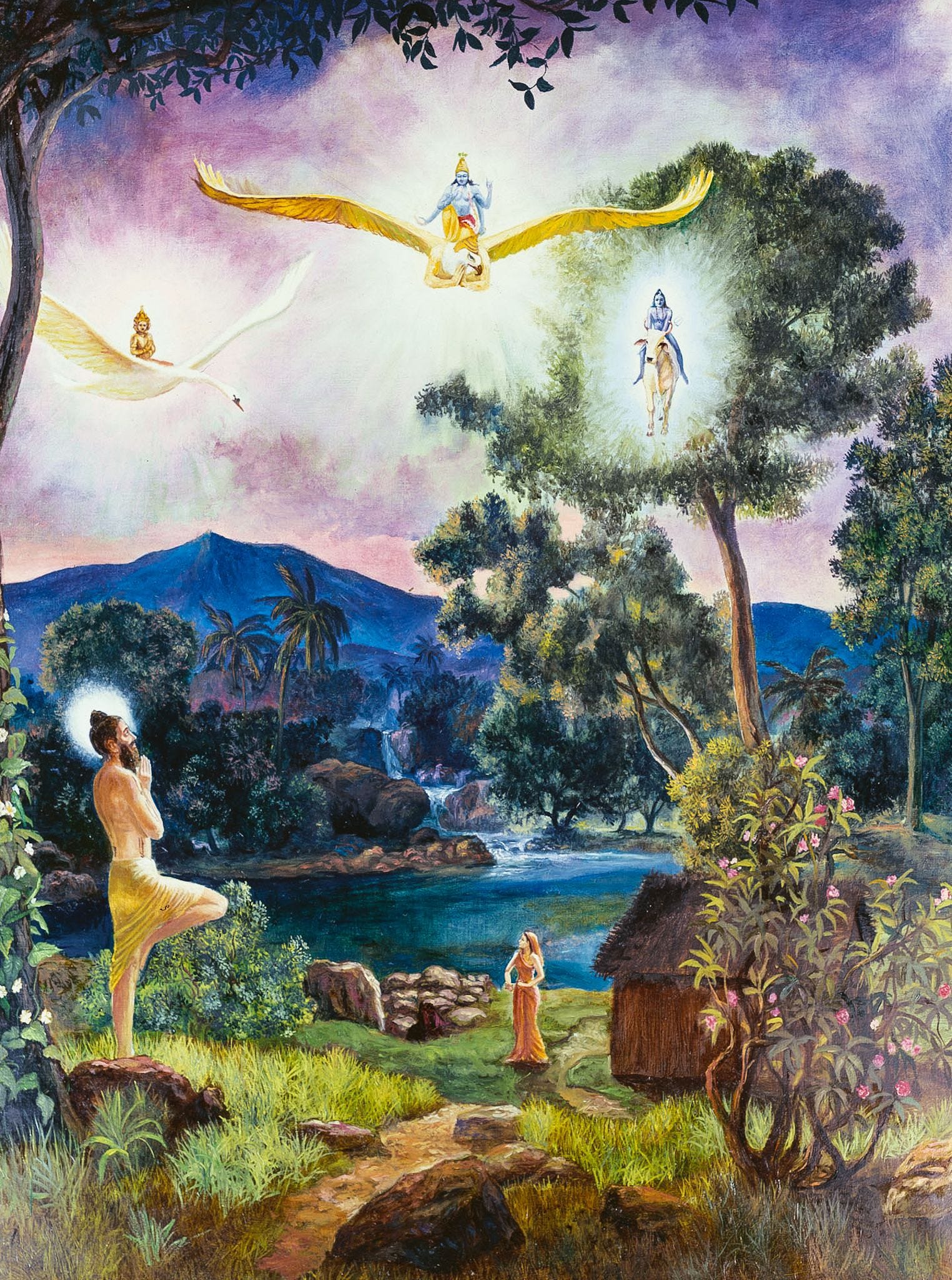
Three divisions of heavens in the Vedic universe
“Among the nine varṣas, the tract of land known as Bhārata-varṣa is understood to be the field of fruitive activities. Learned scholars and saintly persons declare the other eight varṣas to be meant for very highly elevated pious persons. After returning from the heavenly planets, they enjoy the remaining results of their pious activities in these eight earthly varṣas.” (SB 5.17.11)
There are three divisions of heavens in the universe: divya-svarga, bhauma-svarga, and bila-svarga.
Divya-svarga means the celestial planets that compose Svargaloka, where the demigods live, while bila-svarga refers to the subterranean heavens in the lower planets, where pious demons live. The expression “pious demon” may sound contradictory, but it is important to notice that demigods and demons appeared from Diti and Aditi, two wives of Kaśyapa Muni. In other words, they are two branches of the same family. The word “demon” (asura) is used to describe all kinds of atheists, who are not devotees of Viṣnu, but many of these atheists follow Vedic culture, worship the brāhmanas, etc. These are the materially pious demons who live in the bila-svarga and sometimes fight the demigods.
Bhauma-svarga, on the other hand, describes the earthly heavens of Bhū-mandala, where pious human beings live. The natural Vedic sequence is that human beings who have a desire for material enjoyment have the opportunity of practicing varnāśrama while living on earth, performing pious activities, and thus being elevated to Svargaloka at the end of life. There, they can live for 10,000 years of the demigods. When their pious merits are almost exhausted, they take a last birth in heavenly circumstances in one of the eight celestial varṣas in Bhū-mandala for a life of 10,000 human years, in still comfortable conditions. After their pious merits are finally completely exhausted, they take birth again on earth, where, (hopefully) having their material desires satisfied, they can finally dedicate themselves to the practice of devotional service.
Although the Vedas recommend this path for ordinary people in the karma-kanda section, the scriptures also alert to the ultimate futility of this process. Why waste time going up and down an uncertain path, just to come back to the same point? Better to solve the problem once and for all.
Coming to the path of devotional service, however, means coming in contact with a genuine representative of the Lord. In the second part of his purport to this verse, Prabhupāda describes the qualifications of a bona fide spiritual master. The main qualification is to be a genuine representative of the paramparā, distributing the instructions of Kṛṣṇa without any change, the way he received them from his own spiritual master. Birth and social position are irrelevant. As Prabhupāda mentions, “a Vaiṣnava, a bona fide representative of the Supreme Personality of Godhead, Viṣnu, can become a guru even if he is śva-paca, a member of a family of dog-eaters.”
In his purport, Prabhupāda also mentions that sometimes Kashmir is considered a heavenly place, since it offers good facilities for material sense enjoyment. Similarly, other passages also connect other places in the globe with celestial places from Jambūdvīpa. As previously mentioned, one of the meanings of the description of Jambūdvīpa is as a simplified description of the geography of our planet. We then have the higher-dimensional Jambūdvīpa, with all the varṣas described in Śrīmad-Bhāgavatam, and our gross earth, which manifests as some kind of microcosm of it.
Prabhupāda describes our planet in this context in his purport to SB 1.16.12, where he mentions, “This earth planet is divided into seven parts, and according to others it is divided into nine parts. This earth is called Jambūdvīpa and is divided into nine varṣas. Bhārata-varṣa is one of the above mentioned nine varṣas. Such varṣas are known as continents in the modern geographical context. Ketumāla is described as one of the above varṣas. It is said that in this varṣa, women are the most beautiful. This varṣa was conquered by Arjuna also. A description of this part of the world is available in the Mahābhārata (Sabhā Parva 286.32-33). It is said that this part of the world is situated on the western side of the Meru Parvata, and the inhabitants of this province used to live up to ten thousands of years (Bhīṣma Parva 6.16.31-32). Human beings living in this part of the globe are of golden color, and the women resemble the angels of heaven. The inhabitants are free from all kinds of diseases and grief.”
Somehow, these two manifestations exist simultaneously. There is the higher-dimensional Jambūdvīpa, with the celestial varṣas and the geographical features that are described in the Śrīmad-Bhāgavatam, where the inhabitants are almost like demigods and live for 10,000 years, and there is our planet, which is some kind of gross representation of it, offering a geography that remembers Jambūdvīpa in some aspects (with India, the Himalayas, etc.), but on a much smaller scale.
Something similar can be noted in the case of the moon, which is described in the Śrīmad-Bhāgavatam as a celestial planet, the abode of Soma, which is higher than the sun in the hierarchy of the planets and is further away than it. The same moon, when represented in our gross reality, however, appears as the much smaller rocky sphere that is close to our planet. When we look at the sky, the moon we see is simultaneously both. However, when we try to reach the moon using a spacecraft, we reach this gross moon, which appears to be uninhabited.
In other words, the true moon is a celestial planet, but it is represented in our gross reality as close to our planet. As in other situations, both exist simultaneously.
Vedic sages like Śukadeva Goswami used to walk from one side of India to the other, and knew very well mathematical formulas to calculate the earth’s circumference, the moon’s circumference, the distance to the moon, and other details. They were not ignorant of the geography of our planet and solar system. At the same time, however, they had access to a higher-dimensional reality that is shared in the descriptions offered in the Śrīmad-Bhāgavatam and other Purāṇas.
Read the whole book:
« Making Sense of the Vedic Universe, a Higher-Dimensional Reality
This is a publication for thoughtful readers who want to go deeper into Kṛṣṇa consciousness. I publish daily, trying to offer high-quality spiritual content, and all posts are available to free subscribers. If you wish, you can also choose a paid subscription to support this work.
You can also receive the updates on WhatsApp or Telegram.
If you would like to contribute further, you can find the donation links here.