

True equality
These different roles described in the scriptures, which are emphasized by Prabhupāda in certain passages, give us general directives, but there is something else that also must be emphasized, which is our relationship with Kṛṣṇa, which includes using our natural talents in His service. This brings us to another dimension of Śrīla Prabhupāda’s teachings. Although a family works as a base from which a woman can operate, whatever talents she has, she should use in Kṛṣṇa’s service.
Once, Bhibavati Dāsi asked Śrīla Prabhupāda: “Should I live like in the Vedic times, and simply serve my husband and child?” Prabhupāda answered, “No, you have a talent as a writer, you should write articles for newspapers and propagate Kṛṣṇa consciousness.” Another time, he wrote to Jayatirtha: “It is not that women should only produce children, but they are meant for advancing in devotion.”
Śrīla Prabhupāda was quite progressive regarding the roles of his lady disciples. Not only did he allow women to live in the temples and perform all kinds of activities, including deity worship, but he also engaged qualified women in giving classes, performing kīrtanas, writing articles, painting, giving public speeches, etc.
Even more than fifty years ago, Prabhupāda was already more progressive than many of us are nowadays. In this way, he upheld the true Vedic conclusion that every person has a right to use his or her talents for Kṛṣṇa, breaking with previous traditions that were more restrictive. He was giving second initiation to women, encouraging them to write articles, lead kīrtanas (up to today, in every ISKCON temple, we hear a tape of Mother Yamunā singing every morning), worship the deities, distribute books, live in temples, and so on. This is all extensively documented.
Many of these initiatives were criticized by his Godbrothers and others, but when later on he was asked if he would do something different, he said no. If he were to start again, he would have done exactly the same. This shows how these innovative ideas were the secret to his being able to spread Kṛṣṇa consciousness, creating a dynamic movement capable of spreading through the world, and shows how the reversal of many of these initiatives in the name of “Varnāśrama” or “traditionalism” took much of this potency away.
In his purport to CC Ādi 7.31-32, Prabhupāda speaks strongly on these points, sharply rebuffing his critics. Many of these points apply exactly to challenges we also face nowadays.
“Here is an important point. Lord Caitanya Mahāprabhu wanted to invent a way to capture the Māyāvādīs and others who did not take interest in the Kṛṣṇa consciousness movement. This is the symptom of an ācārya. An ācārya who comes for the service of the Lord cannot be expected to conform to a stereotype, for he must find the ways and means by which Kṛṣṇa consciousness may be spread. Sometimes jealous persons criticize the Kṛṣṇa consciousness movement because it engages equally both boys and girls in distributing love of Godhead. Not knowing that boys and girls in countries like Europe and America mix very freely, these fools and rascals criticize the boys and girls in Kṛṣṇa consciousness for intermingling. But these rascals should consider that one cannot suddenly change a community’s social customs. However, since both the boys and the girls are being trained to become preachers, those girls are not ordinary girls but are as good as their brothers who are preaching Kṛṣṇa consciousness. Therefore, to engage both boys and girls in fully transcendental activities is a policy intended to spread the Kṛṣṇa consciousness movement. These jealous fools who criticize the intermingling of boys and girls will simply have to be satisfied with their own foolishness because they cannot think of how to spread Kṛṣṇa consciousness by adopting ways and means that are favorable for this purpose. Their stereotyped methods will never help spread Kṛṣṇa consciousness. Therefore, what we are doing is perfect by the grace of Lord Caitanya Mahāprabhu, for it is He who proposed to invent a way to capture those who strayed from Kṛṣṇa consciousness.”
From this, we can see that far from making women a subjugated class, he was eager to engage their talents in Kṛṣṇa’s service and facilitate their spiritual advancement, seeing them as souls and not as bodies.
Śrīla Prabhupāda would usually mention the point of women being less intelligent when confronted with feminism. Feminism comes from bodily identification, which in the Vedic view is a symptom of foolishness. To live in family life demands a great deal of humility. Such humility is also essential for one to be able to advance in his or her spiritual path.
The argument that women can do most things that men can do and therefore they should just be like the men is not very sound, because it disregards all psychological aspects, propensities, and differences. This idea falls into the same basic mistake as communism, trying to artificially abolish all differences and social roles, which in the end just creates havoc. Men are more fit for certain roles, and women are more fit for other roles. When both can cooperate harmoniously, both can be happy and society can flourish. When cooperation fails, problems start.
A woman who can accept a supportive role to a qualified man can fulfill her natural tendency towards family life and be happy, which in turn allows her to follow spiritual life with a peaceful mind. We can see by historical examples that even great, exalted women, like Sītā, Kuntī, Draupadī, etc., were married to even greater husbands, like Rāmacandra, Pāndu, the Pāndavas, etc., and would become even more dignified acting as dedicated wives and giving birth to exalted children. Naturally, men nowadays are not like Ramacandra or Arjuna, just like the women are not like Sita or Draupadi, but the principle remains the same: a woman selects a qualified man and takes a supportive role, working in harmony with him. Śrīla Prabhupāda gives a nice explanation about this in his purport to SB 9.10.27:
“Not only was mother Sita powerful, but any woman who follows in the footsteps of mother Sita can also become similarly powerful. There are many instances of this in the history of Vedic literature. Whenever we find a description of ideal chaste women, mother Sita is among them. Mandodari, the wife of Ravana, was also very chaste. Similarly, Draupadi was one of five exalted chaste women. As a man must follow great personalities like Brahma and Narada, a woman must follow the path of such ideal women as Sita, Mandodari and Draupadi. By staying chaste and faithful to her husband, a woman enriches herself with supernatural power.”
Feminism undermines this system. The more one is affected by the image of the independent, ruthless woman, the harder it is to revert to the mentality of a nourishing wife or mother.
Nobody is independent. Everyone is dependent on different authorities. When a child is born, the authorities are the parents, and as one grows up, other authorities are added, like the teachers and mentors, the initiating guru, the instructing gurus, and so on. Some of these are authorities on a material level and others on a spiritual level, but all of them are representatives of Kṛṣṇa, who are empowered by Him to give us direction, teaching us what is proper and improper to do, and thus advance.
To be able to advance in spiritual life (or even to advance in a material sense, becoming a civilized human being), it’s essential that one accept this principle of authority. That’s why this particular point is emphasized in the scriptures. One is allowed to not follow an authority in cases where such a person gives unbonafide instructions (like when Bali Maharaja rejected Sukracharya) or falls from the regulative principles, but the general rule is that we should respect and follow authority.
In fact, we are for so long in this material world exactly because we don’t want to accept our dependent position. We want to be separate enjoyers, masters of everything that we see. In this sense, feminism is just as bad as chauvinism, since it feeds this diseased condition of the soul, leading one to rebel against the principle of authority, which is essential for a progressive life. Real intelligence means being able to abandon our propensity to try to be the controllers in this material world and realize our original spiritual position.
This is a topic that tends to make people defensive since most women have the experience of being exploited or neglected by unqualified men; therefore, when someone speaks about dedication to a man, an image of exploitation comes to mind. That’s the other side of the question: men need to be trained to be responsible and respectful toward women, especially their wives.
As Prabhupāda emphasizes in the purport to SB 7.11.28, which we already studied, “It is not that a chaste woman should be like a slave while her husband is naradhama, the lowest of men. Although the duties of a woman are different from those of a man, a chaste woman is not meant to serve a fallen husband.”
On the one hand, the wife should be supportive and dedicated to making the marriage work, but on the other, the husband should be qualified and act properly. As Prabhupāda explains, the most sinful thing is to exploit someone who has taken shelter of us. A man who exploits a woman who gives her heart to him commits a most grievous sin and should expect a very severe reaction, be it in this life or in the next.
A woman will feel naturally inclined to follow a man who has good qualities and takes good care of the family. If the man is respectful and responsible and the lady is supportive, a very deep and peaceful relationship can be established. If the relationship is not deep, it will break easily when problems appear. As Prabhupāda writes a little later, in the same purport, “The conclusion is that a husband should be a pure Vaiṣnava and that a woman should be a chaste wife with all the symptoms described in this regard. Then both of them will be happy and make spiritual progress in Kṛṣṇa consciousness.”
As you can see, this is a complex subject that deals with a set of values that is different from what we normally find in modern society. Śrīla Prabhupāda speaks based on these principles, in line with the succession of teachers he represents. The idea of a woman acting like a woman and a man acting like a man may sound revolutionary nowadays, but ancient societies based on these values prospered for thousands of years. Considering the rate of divorce, depression, and suicide in our current societies, maybe we could consider the possibility that they understood a few things we did not.
Read the whole book:
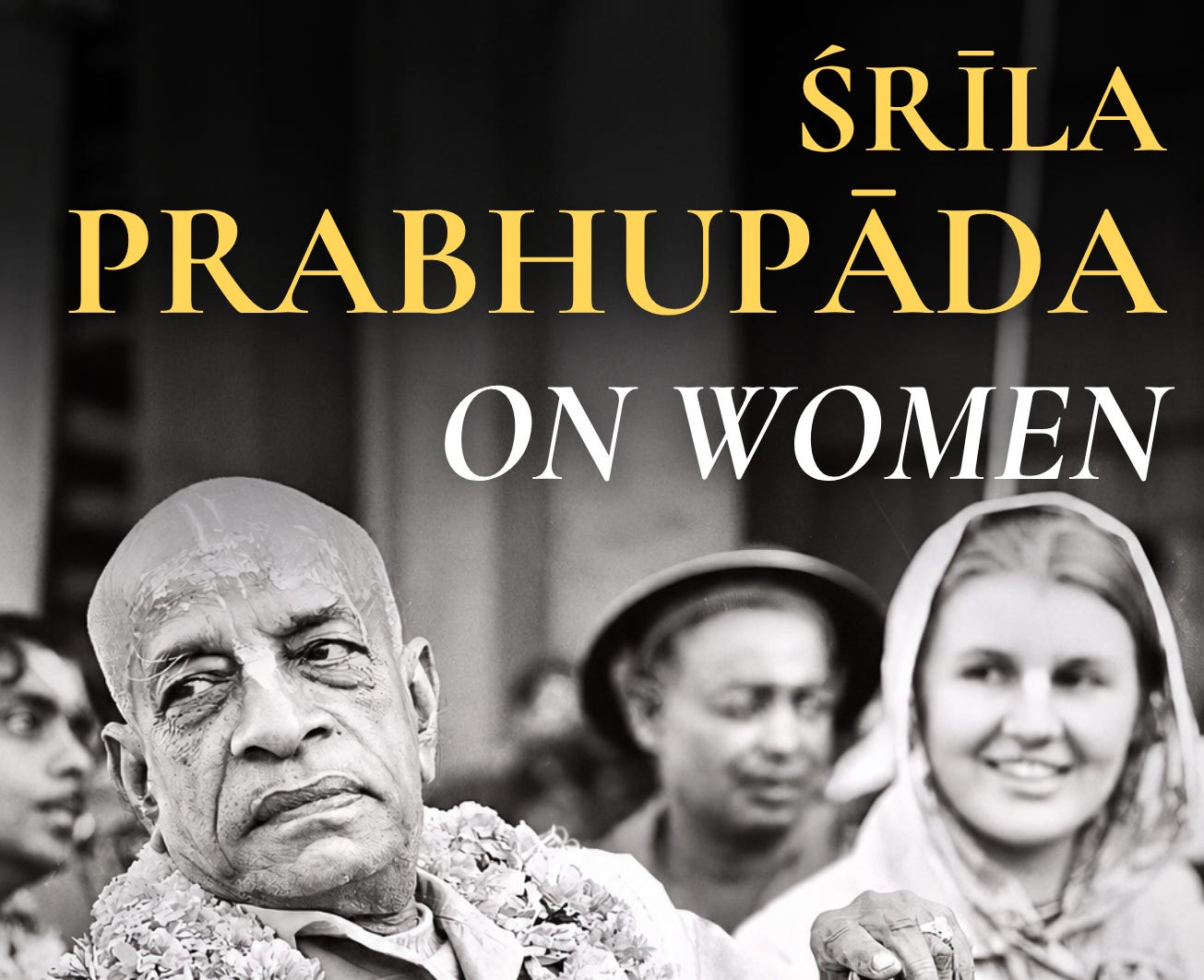
« Śrīla Prabhupāda on Women
This is a publication for thoughtful readers who want to go deeper into Kṛṣṇa consciousness. I publish daily, trying to offer high-quality spiritual content, and all posts are available to free subscribers. If you wish, you can also choose a paid subscription to support this work.
You can also receive the updates on WhatsApp or Telegram.
If you would like to contribute further, you can find the donation links here.