

Subscribe to receive new articles by e-mail. It’s free, but if you like, you can pledge a donation:
🔉 Audio of the lesson »
🎙Podcast (Search for “Mysteries of the Vedas” on Spotify, iTunes, etc. to hear all the lessons
Join the Telegram group if you would like to join the live lessons. This course is maintained with your donations. Click here to donate.
💬 Text of the lesson
Understanding the reason for the fall of Bharata Maharaja
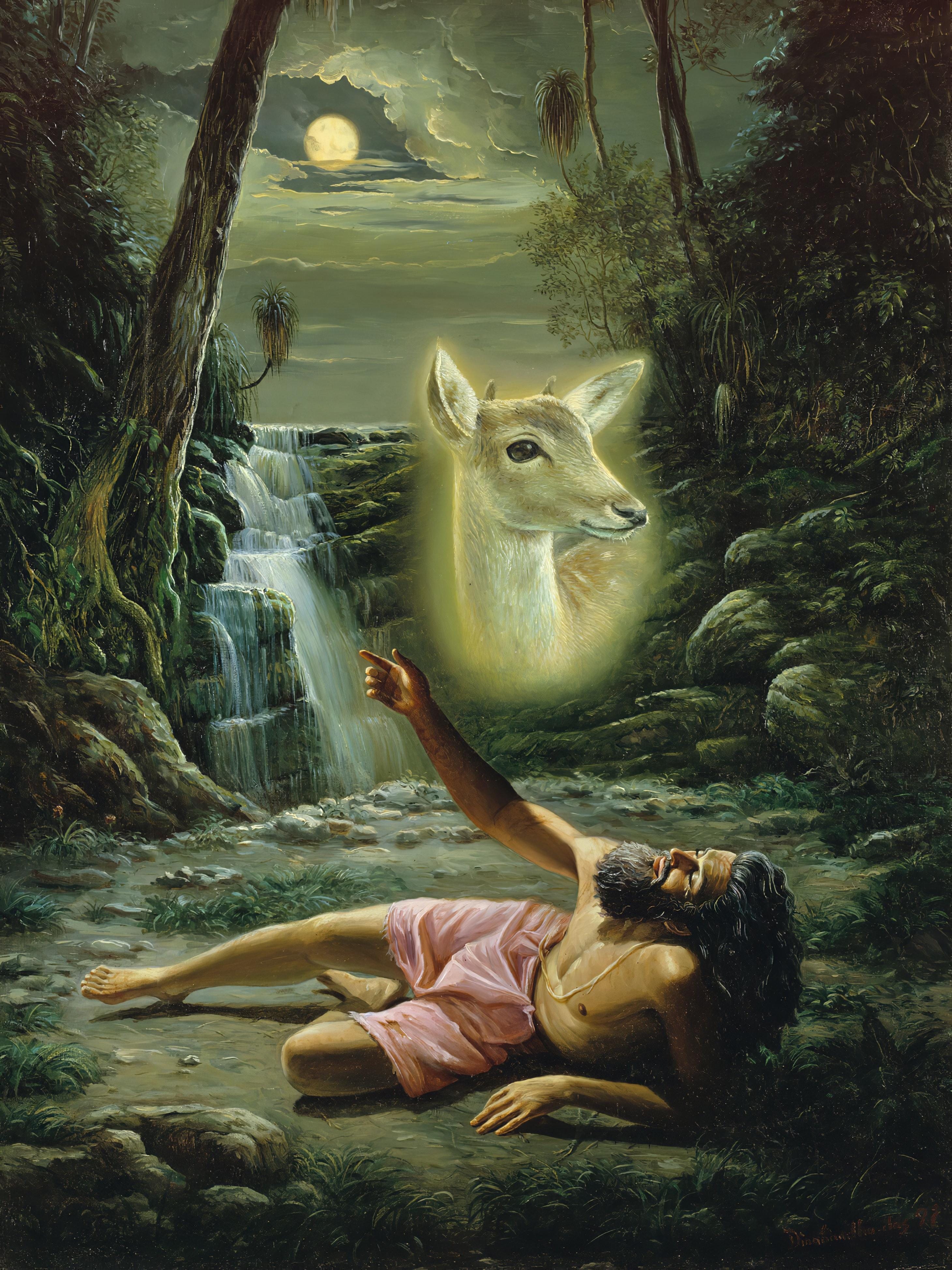
“Śukadeva Gosvāmī continued: My dear King, in this way Bharata Mahārāja was overwhelmed by an uncontrollable desire which was manifest in the form of the deer. Due to the fruitive results of his past deeds, he fell down from mystic yoga, austerity and worship of the Supreme Personality of Godhead. If it were not due to his past fruitive activity, how could he have been attracted to the deer after giving up the association of his own son and family, considering them stumbling blocks on the path of spiritual life? How could he show such uncontrollable affection for a deer? This was definitely due to his past karma. The King was so engrossed in petting and maintaining the deer that he fell down from his spiritual activities. In due course of time, insurmountable death, which is compared to a venomous snake that enters the hole created by a mouse, situated itself before him.” (SB 5.8.26)
By the words sva-ārabdha-karmaṇā, Śukadeva Gosvāmī mentions that Bharata Maharaja fell due to the results of his past karma, and in his Bhakti Sandarbha, Śrila Jīva Goswami adds that such karmic results must have been due to offenses executed in previous lives. Prabhupāda, however, mentions that Bharata Mahārāja could not be punished for his past misdeeds. He thus concludes that there was no external reason for Bharata Maharaja abandoning his practice: he purposefully became over-addicted to the deer and neglected his spiritual advancement.
This may sound like a contradiction at first, but it just shows us two levels of understanding. When the deity of Gopīnātha desired to give sweet rice to Mādhavendra Purī, He did so through the priest. In this case, the priest was the apparent cause, while the desire of the Lord was the real, or internal cause. Similarly, a great devotee such as Bharata Maharaja may externally appear to be receiving the fruits of karma or previous offenses, but in reality, everything happens due to the will of the Lord, with the ultimate purpose of bringing them back to Him.
Prabhupāda gives more examples in his purport:
“The conclusion must be that Mahārāja Bharata purposefully became over-addicted to the deer and neglected his spiritual advancement. To immediately rectify his mistake, for a short time he was awarded the body of a deer. This was just to increase his desire for mature devotional service. Although Bharata Mahārāja was awarded the body of an animal, he did not forget what had previously happened due to his purposeful mistake. He was very anxious to get out of his deer body, and this indicates that his affection for devotional service was intensified, so much so that he was quickly to attain perfection in a brāhmaṇa body in the next life. It is with this conviction that we declare in our Back to Godhead magazine that devotees like the gosvāmīs living in Vṛndāvana who purposely commit some sinful activity are born in the bodies of dogs, monkeys and tortoises in that holy land. Thus they take on these lower life forms for a short while, and after they give up those animal bodies they are again promoted to the spiritual world. Such punishment is only for a short period, and it is not due to past karma. It may appear to be due to past karma, but it is offered to rectify the devotee and bring him to pure devotional service.”
Śukadeva Gosvāmī thus indicates that the apparent cause was reactions for past actions, while Prabhupāda indicates that the real cause was Bharata becoming purposefully over-addicted to the deer and neglecting his spiritual practice, leading him to be corrected by the Lord. Sanātana Goswami adds that this purposeful negligence had the goal of showing us an instructive example, and thus we can see how these three statements fit together.
This point can also be applied to us in many circumstances. Often, we face difficulties due to our past karma, and often these difficulties cause obstacles to our spiritual practice. However, there are many obstacles that are not imposed by karma: they are the result of our own choices, a simple matter of free will. After taking shelter of the spiritual master and being initiated, we have the opportunity to continue acting under his guidance, following the precepts of the scriptures, and thus remain protected from the results of our previous karma. However, if we choose to abandon this process or if we intentionally seek distractions, we create problems for ourselves.
The absence of karma does not eliminate free will. At each moment, we have the choice of engaging ourselves in Krsna Consciousness or seeking some distraction. The cumulative result of these choices will determine what kind of body we will have next. Devotees who can achieve perfection in this life are the ones who can consistently make the right choices, engaging their attention and energy in the service of Krsna. The more we consistently make the right choices, the easier it becomes to continue being engaged in a virtuous cycle. The more we choose material distractions, however, the harder it becomes to concentrate.
In any case, a devotee can count on the reciprocation of the Lord, but if we are not serious in our practice, He may have to first rectify us, putting us in some difficult situation so we may wake up and come back to proper consciousness, just as in the case of Bharata Maharaja.
This can be summarized in this way:
a) Ordinarily, people act according to their karma, and are awarded their next body according to karma. There is always free will, but in the case of a materialist, karma is the main factor. One simply continues to act on the path set by his previous actions.
b) In the case of a devotee seriously following the spiritual process, such as Bharata Maharaja, there is no more karma. However, one can still get distracted from spiritual practice due to free will.
c) When a devotee intentionally falls from his practice due to distractions, inattention, or other factors, one can get different material results from his activities, and this may appear to be awarded according to karma. Bharata Maharaja got the body of a deer, while Citraketu got the body of a demon, for example. However, karma or destiny, in this case, is just the apparent cause. Ultimately, these results are given by the Lord according to what will be helpful for a devotee to become serious in his practice and go back to Godhead as soon as possible.
d) Sometimes, great personalities purposefully commit mistakes to instruct us on the consequences of such actions. This also happens due to the desire of the Supreme Lord to teach us.
“At the time of death, the King saw that the deer was sitting by his side, exactly like his own son, and was lamenting his death. Actually the mind of the King was absorbed in the body of the deer, and consequently — like those bereft of Kṛṣṇa consciousness — he left the world, the deer, and his material body and acquired the body of a deer. However, there was one advantage. Although he lost his human body and received the body of a deer, he did not forget the incidents of his past life.
Although in the body of a deer, Bharata Mahārāja, due to his rigid devotional service in his past life, could understand the cause of his birth in that body. Considering his past and present life, he constantly repented his activities, speaking in the following way.” (SB 5.8.27-28)
One may think that he can do anything during his life, and just think about Kṛṣṇa at the time of death, but it doesn’t work in this way. As Prabhupāda explains, at death, a person always thinks about things he was attached to in this life. To be able to think about Kṛṣṇa at the time of death, we need to practice by remembering him constantly during our lifetime. Bharata Maharaja was on this path, but he got distracted and ended being concentrated on the deer in the last part of his life. Thus, following the general karmic rules, he assumed the body of a deer. As Kṛṣṇa explains in the Gītā (8.6): “Whatever state of being one remembers when he quits his body, that state he will attain without fail.”
However, because of his past devotional service, He was protected by the Lord, who kept his remembrance intact, even in the body of a deer. This made Bharata again determined to finish his devotional service and go back home, back to godhead. The Lord could have protected him from the natural result of his activities, but seeing that receiving the body of a deer would be favorable in the long run, the Lord decided to keep this result, but at the same time kept his memory, giving him the conditions for realizing his mistake and quickly coming back to the path. This is yet another example of how a devotee is always protected by the Lord, even when one willingly abandons his spiritual practice.
“In the body of a deer, Bharata Mahārāja began to lament: What misfortune! I have fallen from the path of the self-realized. I gave up my real sons, wife and home to advance in spiritual life, and I took shelter in a solitary holy place in the forest. I became self-controlled and self-realized, and I engaged constantly in devotional service — hearing, thinking, chanting, worshiping and remembering the Supreme Personality of Godhead, Vāsudeva. I was successful in my attempt, so much so that my mind was always absorbed in devotional service. However, due to my personal foolishness, my mind again became attached — this time to a deer. Now I have obtained the body of a deer and have fallen far from my devotional practices.” (SB 5.8.29)
Prabhupāda connects the situation of Bharata Maharaja with our practical reality. Even though a devotee is generally protected from the results of karma, the Lord can allow a devotee to face difficulties, so one can be corrected and return to his spiritual practice:
“This is significant for every devotee. If we misuse our position and think that we are fully engaged in devotional service and can do whatever we like, we have to suffer like Bharata Mahārāja and be condemned to accept the type of body that impairs our devotional service. Only the human form is able to execute devotional service, but if we voluntarily give this up for sense gratification, we certainly have to be punished. This punishment is not exactly like that endured by an ordinary materialistic person. By the grace of the Supreme Lord, a devotee is punished in such a way that his eagerness to attain the lotus feet of Lord Vāsudeva is increased. By his intense desire, he returns home in the next lifetime.”
In another purport, he gives one example in this direction: devotees who willingly commit sinful activities while living in Vṛndāvana often are reborn as dogs, monkeys, and tortoises. In such a birth, they can live in the holy land without the possibility of committing new sinful activities, and in this way return home, back to Godhead.
Such a punishment is thus also a form of mercy, just as in the case of Bharata Maharaja, but this doesn’t make the immediate results any less unpleasant. We are thus urged to just take the direct path and practice without deviation. As Prabhupāda explains, the secure position for someone wanting to go back home, back to Godhead in this lifetime is to see that every moment is used for rendering some form of service to the Lord.
How is this possible? We can achieve this position by connecting all our actions with Kṛṣṇa, as He explains in the Bhagavad-gītā. There are nine limbs of devotional service, starting with śravaṇam kīrtanam. Sometimes we may do some practical service, other times we may hear about Kṛṣṇa, chant, describe his glories, pray, etc., or simply remember Him. In the beginning, there may be many distractions, but if we get a little bit of taste, we can be caught in the devotional flow of just doing one devotional activity after another, day after day.
However, as this pastime of Bharata Maharaja illustrates, we should not become careless. As long as we are under the influence of material illusion, we need to always put a conscious effort to continue progressing, just as a person cast into the ocean has to make a continuous effort to stay afloat.
“Although Bharata Mahārāja received the body of a deer, by constant repentance he became completely detached from all material things. He did not disclose these things to anyone, but he left his mother deer in a place known as Kālañjara Mountain, where he was born. He again went to the forest of Śālagrāma and to the āśrama of Pulastya and Pulaha.
Remaining in that āśrama, the great King Bharata Mahārāja was now very careful not to fall victim to bad association. Without disclosing his past to anyone, he remained in that āśrama and ate dry leaves only. He was not exactly alone, for he had the association of the Supersoul. In this way he waited for death in the body of a deer. Bathing in that holy place, he finally gave up that body.” (SB 5.8.30-31)
Remembering the devotional practice of his previous life and lamenting having been demoted to the body of a deer, Bharata returned to the same Pulaha-āśrama, where he was practicing in his first life, and practiced austerities, remaining alone and eating dry leaves only. In this way, he passed the time allotted to him in that animal form, remembering the Supreme Lord. The words ātma-sahacaraḥ are very important, for he was never alone.
Prabhupāda also makes the point that just as the deer Bharata left his home and deer family, which were not favorable for his self-realization, a devotee should not be too attracted to his birthplace and family if they are not favorable. The main point about devotional life is to take shelter in the association of like-minded devotees. In the highest sense, being alone means to be always in the association of pure devotees who are always engaged in Krsna Consciousness.
So elevated was the consciousness of Bharata Maharaja that even in the body of a deer, he could remember and offer prayers to the Lord while leaving his body, as revealed in text 5.14.45:
“Even though in the body of a deer, Mahārāja Bharata did not forget the Supreme Personality of Godhead; therefore when he was giving up the body of a deer, he loudly uttered the following prayer: “The Supreme Personality of Godhead is sacrifice personified. He gives the results of ritualistic activity. He is the protector of religious systems, the personification of mystic yoga, the source of all knowledge, the controller of the entire creation, and the Supersoul in every living entity. He is beautiful and attractive. I am quitting this body offering obeisances unto Him and hoping that I may perpetually engage in His transcendental loving service.” Uttering this, Mahārāja Bharata left his body.”
Bharata takes his third birth as a brāhmana
After quitting his deer body absorbed in thoughts of the Lord, Bharata took his next birth in a brāhmaṇa family. Ordinarily, when one falls into an animal body, one has to go through the whole evolutionary process before a new human birth, but this didn’t apply to Bharata Maharaja. His animal birth was a one-time event, and after leaving that body, he immediately took his next birth from pure brāhmana parents. As Kṛṣṇa explains in the Gītā, śucīnāṁ śrīmatāṁ gehe, yoga-bhraṣṭo ’bhijāyate: A devotee who is not able to conclude his self-realization in one life receives the opportunity to continue his practice in a pious or well-to-do family.
The qualities of his father are mentioned in text 5.9.1-2:
“He was fully qualified with brahminical qualifications. He could control his mind and senses, and he had studied the Vedic literatures and other subsidiary literatures. He was expert in giving charity, and he was always satisfied, tolerant, very gentle, learned and nonenvious. He was self-realized and engaged in the devotional service of the Lord. He remained always in a trance.”
Just as in the body of a deer, Bharata could remember all the incidents of his previous lives, how he was the great King Bharata, who had fallen because of the association with a deer, and now had been given a new opportunity in a human body. This time, however, he was extremely careful to avoid all bad association and dedicate himself exclusively to the service of the Lord. He was not interested even in performing brāhminical duties, considering these material and also a form of entanglement.
Brāhminical duties are under the material mode of goodness. They are superior to other material duties, and are useful to elevate conditioned souls, but they are in themselves not transcendental. Remembering his past lives, Bharata was a paramahaṃsa from birth. He was thus already beyond the brāhminical level. He could very well have performed brāhminical duties externally while remaining internally fixed in transcendental meditation, but after his experience in his first birth as a king, when he fell due to the association of a deer, he was afraid. A brāhmana can easily become proud of his position, or become attracted to fruitive performances. Apart from that, a brāhmana is forced to associate with many materialists in the course of his duties, performing ceremonies for them, instructing them in their Varnāśrama duties, and so on. The duties of a brāhmana are purer than fighting like a kṣatriya or dealing with money like a vaiśya, but it is still far from perfect.
As Prabhupāda explains:
“To remain immune from the material qualities, one must engage himself in devotional service — śravaṇaṁ kīrtanaṁ viṣṇoḥ. That is the perfection of life. When Mahārāja Bharata took birth as a brāhmaṇa, he was not very interested in the duties of a brāhmaṇa, but within he remained a pure Vaiṣṇava, always thinking of the lotus feet of the Lord. As advised in Bhagavad-gītā: man-manā bhava mad-bhakto mad-yājī māṁ namaskuru. This is the only process by which one can be saved from the danger of repeated birth and death.”
Afraid of again falling victim to bad association, Bharata decided to not take any chances this time, and behaved externally as dull, deaf, dumb, and blind. He is thus known in this third birth as Jaḍa Bharata (the dull Bharata). He was perfectly alert within, always fixed in meditation on the Supreme Lord, but externally, he was behaving in this way.
“Jaḍa Bharata behaved before his father like a fool, despite his father’s adequately instructing him in Vedic knowledge. He behaved in that way so that his father would know that he was unfit for instruction and would abandon the attempt to instruct him further. He would behave in a completely opposite way. Although instructed to wash his hands after evacuating, he would wash them before. Nonetheless, his father wanted to give him Vedic instructions during the spring and summer. He tried to teach him the Gāyatrī mantra along with oṁkāra and vyāhṛti, but after four months his father still was not successful in instructing him.” (SB 5.9.5)
In general, one is recommended to perform prescribed duties according to one’s nature, because even if imperfect, these duties are the correct medicine to treat one’s material conditioning and help to overcome one’s attachments. If man is attracted to money, for example, he is advised to work and give charity as a vaiśya, for this process of charity is the medicine for treating greediness. Similarly, a woman is advised to serve her husband and children, for this is the medicine to treat material desires and selfishness, and so on. In the Bhagavad-gītā, Krsna is very clear about not abandoning our prescribed duties. However, ultimately, these duties have a purpose, which is to elevate us to the platform of Kṛṣṇa Consciousness. Jaḍa Bharata was already fixed in this platform; therefore, there was no need for him to come down to the brāhminical level.
Prabhupāda summarizes this point in his purport to text six:
“He did not care for the Vedic instructions of his father. When one is fully interested in the service of the Lord, he does not need to follow all the regulative principles enunciated in the Vedas. Of course, for an ordinary man, the Vedic principles are imperative. No one can avoid them. But when one has attained the perfection of devotional service, it is not very important to follow the Vedic principles. Lord Kṛṣṇa advised Arjuna to ascend to the platform of nistraiguṇya, the transcendental position above the Vedic principles.”
Bharata’s father was very attached to him and therefore continued to instruct him despite his unwillingness, believing a father should instruct his son. He continued doing so until the end of his life, hoping in his heart that one day his son could become a learned scholar, but all his attempts were unsuccessful.
Text 5.9.6 adds an important insight: “Like everyone, this brāhmaṇa was attached to his home, and he had forgotten that someday he would die.” His father was a learned brāhmana, but he was not on the transcendental platform. He was still attracted to his family and home, a platform that Bharata had already rejected in his first life when he rejected the kingdom.
This brāhmana had two wives. The first had nine sons, and the second was the mother of Jaḍa Bharata and his sister. When the father finally met death, the second wife chose to enter the funeral pyre and follow him to his next birth, entrusting Bharata and his sister to the care of the first wife.
The nine step-brothers of Jaḍa Bharata were ritualistic brāhmanas. They were versed in the Ṛg Veda, Sāma and Yajur Veda, but had not transcended the level of fruitive activity, and could not understand the transcendental position of their brother. As proud materialists, they were propense to envy and anger, and would call Jaḍa Bharata ill names and mistreat him, but he would not protest and would act according to their desires, working in the fields and guarding the plantations at night. For this work, he would receive inedible food, like burned rice from the bottom of the pot, solid residues from oil production, worm-eaten grains, or even rice husk. Jaḍa Bharata was beyond material duality and would eat just to maintain his body, without considering food palatable or unpalatable, and would thus gladly accept anything he was given and would not protest or hold any grudges. Śukadeva Gosvāmī, however, calls these nine brothers degraded men who are actually no better than animals.
Jaḍa Bharata used to lie on the ground and would not bother covering his body, ignoring different climatic conditions. He was not taking baths or accepting any comforts. He just wore a dirty loincloth and a brāhmana thread that was put in his body by his father and became blackish over time. Seeing that he was the son of a brāhmana, people used to call him brahma-bandhu and other names, but Bharata did not care about it.
For a transcendentalist, being neglected by materialistic people is not a curse, but a blessing. Such neglect allows one to remain aloof, not getting involved with the entanglements of mundane society. Jaḍa Bharata took advantage of that to remain incognito, wandering here and there as he pleased.
One night, while he was watching the plantation, he was spotted by a group of dacoits who were worshipers of Bhadra Kālī. The leader desired a son and thus had the desire to do a human sacrifice to the goddess.
Prabhupāda explains that “Low-class men such as śūdras worship demigods like Goddess Kālī, or Bhadra Kālī, for the fulfillment of material desires. To this end, they sometimes kill a human being before the deity. They generally choose a person who is not very intelligent — in other words, an animal in the shape of a man.”
They had captured some dumb man that they considered a suitable man-animal to be sacrificed in this way, but he somehow escaped. Seeing Jaḍa Bharata, they considered him a fitting replacement, and thus captured him and brought him to the temple to be sacrificed.
Jaḍa Bharata’s body is described as being as strong as a bull. With such strength, he could have resisted or escaped, but situated in self-realization, he chose to not do so. In his purport to text 14, Prabhupāda explains the situation in detail:
“In some parts of India, animalistic men are still sacrificed before the goddess Kālī. However, such a sacrifice is only performed by śūdras and dacoits. Their business is to plunder the wealthy, and to become successful they offer an animalistic man before the goddess Kālī. It should be noted that they never sacrifice an intelligent man before the goddess. In the body of a brāhmaṇa, Bharata Mahārāja appeared deaf and dumb, yet he was the most intelligent man in the world. Nonetheless, being completely surrendered unto the Supreme Personality of Godhead, he remained in that condition and did not protest being brought before the deity for slaughter. As we have learned from the previous verses, he was very strong and could have very easily avoided being bound with ropes, but he did not do anything. He simply depended on the Supreme Personality of Godhead for his protection.”
In the portions of the Vedas destined to people in the mode of ignorance, there is the description of rituals of animal sacrifice to Kālī or Durgā as a concession for meat eaters, but nowhere is there a prescription in the scriptures for a human sacrifice. The dacoits were simply speculating a process, as indicated by the word sva-vidhinā. Their concocted ritual is described in text 15:
“After this, all the thieves, according to their imaginative ritual for killing animalistic men, bathed Jaḍa Bharata, dressed him in new clothes, decorated him with ornaments befitting an animal, smeared his body with scented oils and decorated him with tilaka, sandalwood pulp and garlands. They fed him sumptuously and then brought him before the goddess Kālī, offering her incense, lamps, garlands, parched grain, newly grown twigs, sprouts, fruits and flowers. In this way they worshiped the deity before killing the man-animal, and they vibrated songs and prayers and played drums and bugles. Jaḍa Bharata was then made to sit down before the deity.”
Kālī is depicted as drinking the blood of demons. The thief who was acting as the chief priest was thus ready to kill Jaḍa Bharata and offer his blood to Kālī to be drunk as a liquor. He took a sharp sword and chanted the mantra of Bhadra Kālī to consecrate it. Goddess Kālī, however, could not tolerate the offense of having a pure devotee being killed. The body of the deity burst, and Kālī personally emerged from it in a body that was intolerably effulgent.
“Intolerant of the offenses committed, the infuriated Goddess Kālī flashed her eyes and displayed her fierce, curved teeth. Her reddish eyes glowed, and she displayed her fearsome features. She assumed a frightening body, as if she were prepared to destroy the entire creation. Leaping violently from the altar, she immediately decapitated all the rogues and thieves with the very sword with which they had intended to kill Jaḍa Bharata. She then began to drink the hot blood that flowed from the necks of the beheaded rogues and thieves, as if this blood were liquor. Indeed, she drank this intoxicant with her associates, who were witches and female demons. Becoming intoxicated with this blood, they all began to sing very loudly and dance as though prepared to annihilate the entire universe. At the same time, they began to play with the heads of the rogues and thieves, tossing them about as if they were balls.” (SB 5.9.18)
As Prabhupāda explains, “Neglecting Kṛṣṇa consciousness, foolish people try to satisfy the goddess by offering her many abominable things, but ultimately when there is a little discrepancy in this worship, the goddess punishes the worshiper by taking his life. Demoniac people worship Goddess Kālī to obtain some material benefit, but they are not excused of the sins performed in the name of worship. To sacrifice a man or animal before the deity is specifically forbidden.”
This is yet another instance of the protection of the Lord. Ordinary men protect themselves with weapons and other material arrangements, but pure devotees like Jaḍa Bharata simply depend on the protection of the Lord, who sometimes protects them personally, like in the case of Nṛsiṁhadeva emerging from the pillar, and sometimes through His different potencies or representatives. A pure devotee fully understands that the soul is different from the body and is thus fearless.
“Śukadeva Gosvāmī then said to Mahārāja Parīkṣit: O Viṣṇudatta, those who already know that the soul is separate from the body, who are liberated from the invincible knot in the heart, who are always engaged in welfare activities for all living entities and who never contemplate harming anyone are always protected by the Supreme Personality of Godhead, who carries His disc [the Sudarśana cakra] and acts as supreme time to kill the demons and protect His devotees. The devotees always take shelter at the lotus feet of the Lord. Therefore at all times, even if threatened by decapitation, they remain unagitated. For them, this is not at all wonderful.” (SB 5.9.20)
Parīkṣit Maharaja could have questioned how Jaḍa Bharata could have remained tolerant even in such a situation, and this verse conveys the preemptive answer of Śukadeva Gosvāmī. It is indeed very difficult to remain composed when faced with impending death, but this is possible for a devotee who is detached from the body and fully surrendered to the Lord.
To understand the significance of this answer, it is important to keep in mind that Parīkṣit Maharaja faced a similar situation, being about to be killed by the winged serpent. In fact, we all live in this material world with a sword on our neck, with death potentially coming at any moment. Śukadeva Gosvāmī thus instructs the king – and all of us – on how to face such imminent danger.
Jaḍa Bharata meets King Rahūgaṇa
King Rahūgaṇa was a human king who ruled two states of India: Sindhu and Sauvīra. He was not a great ruler like Bharata’s ancestors, but was, in general, a pious person who was a follower of Lord Kapila and was inclined to philosophical inquiry. However, as a king, he was also inclined to act in the mode of passion. He became proud of his position and started to believe he had a duty to exploit the work of others just for being the king. He was thus engaging some men without payment as palanquin carriers while he traveled to Kapilāśrama.
By the time they reached the banks of the river Ikṣumatī, they were short of one carrier in the crew. When they saw Jaḍa Bharata, they considered him fit for the post, seeing that he was very strong. They thus conscripted him forcefully. Again, Jaḍa Bharata didn’t protest. He just started carrying the palanquin as he was ordered, without any complaint.
However, because of is sense of non-violence, Jaḍa Bharata could not move very swiftly. He would stop every three feet to see if there were ants on the way. This constant moving and stopping made the palanquin move unevenly, angering the king.
Being threatened, the other carriers quickly pointed to Jaḍa Bharata as the source of the disturbance. The king thus became angry and spoke to him:
“How troublesome this is, my dear brother. You certainly appear very fatigued because you have carried this palanquin alone without assistance for a long time and for a long distance. Besides that, due to your old age you have become greatly troubled. My dear friend, I see that you are not very firm, nor very strong and stout. Aren’t your fellow carriers cooperating with you?” (SB 5.10.6)
Prabhupāda takes the situation as an illustration of the three modes. The carriers were just ordinary workers in the mode of ignorance. They had no compassion for the ants nor for Jaḍa Bharata, being concerned only about avoiding punishment. The king was in the mode of passion, nourishing a proud, entitled mentality. Even though being comfortably carried, he became easily angry at the smallest disturbance. Jaḍa Bharata, on the other hand, despite the injustice, remained unagitated due to his spiritual advancement. He thus simply continued to carry the palanquin as before, despite the sarcastic words of the king.
The king, however, became even angrier with his uneven pace and threatened him:
“Thereafter, when the King saw that his palanquin was still being shaken by the carriers, he became very angry and said: You rascal, what are you doing? Are you dead despite the life within your body? Do you not know that I am your master? You are disregarding me and are not carrying out my order. For this disobedience I shall now punish you just as Yamarāja, the superintendent of death, punishes sinful people. I shall give you proper treatment so that you will come to your senses and do the correct thing.” (SB 5.10.7)
You can also donate using Buy Me a Coffee, PayPal, Wise, Revolut, or bank transfers. There is a separate page with all the links. This helps me enormously to have time to write instead of doing other things to make a living. Thanks!