

« Making Sense of the Vedic Universe, a Higher-Dimensional Reality
Units of time used in the Vedas
The Third Canto also gives us a condensed explanation of the units of measurement of time used in the Vedas. This gives us some context on what time is for us and how it looks on the universal scale of things. All material bodies, from the sun to the atom, are under the influence of the kāla-cakra, or material time, but the scales of time for different types of bodies can be wildly different. Time is perceived differently in different planetary systems, and thus the descriptions show how time for different levels of demigods and higher beings scales in relation to our time.
This description of the units of time is divided into two parts. The first are the units of time that are smaller than the lifespan of a human being, or in other words, the units of time we use in our practical life, starting from the truti, the smallest division of time according to the Vedas, all the way to the vatsara (year).
According to Śrīmad-Bhāgavatam, the smallest particles of material creation in our plane are called paramāṇu, or atoms. The smallest measurements of time mentioned there are equal to the time necessary for certain atomic combinations to take place. Two paramāṇus combine to form an aṇu (double atom), and three aṇus combine to form a trasareṇu (hexatom). The time needed for the combination of three trasareṇus, forming a trasareṇu-trikam (a certain type of cluster or aggregate of 18 atoms), is called a truti, which equals about half a thousandth of a second:
One danda = 30 minutes
One laghu = 2 minutes
One kastha = 8 seconds
One ksana = 1.6 seconds
One mimesa = 0.533 seconds
One lava = 0.177 seconds
One vedha = 0.0592 seconds
One truti = 0.000592 seconds (1 second divided by 1,687.5)
The Bhāgavatam mentions a danda as a fixed unit of approximately 30 minutes (instead of 24 minutes, as in astrology), and this unit is used as the basis for calculating all the larger units of time:
2 dandas = 1 muhurta (1 hour)
3 muhurtas = 1 prahara (3 hours)
8 paharas = 1 ahani (24 hours)
15 ahanis = 1 pakṣa (fortnight)
2 pakṣa = 1 māsa (month)—24 hours in Pitṛloka.
6 masa = 1 ayanam (half of the year, one movement of the sun from south to north of the equator)
2 ayanam = 1 vatsara (year)—24 hours for the demigods, 360 days for us.
Human beings live nominally for 100 years. Higher beings, however, have much larger lifespans. This brings us to the second part of Maitreya’s explanation, describing the larger cycles of time, which measure the duration of time of inhabitants of higher planetary systems, many of whom live for many kalpas.
The divya-yuga
Our planet goes through a cyclic sequence of four ages: Satya-yuga, Treta-yuga, Dvāpara-yuga, and Kali-yuga. Each cycle of these four eras is called a divya-yuga. There are 71 divya-yugas in each manvantara, and a total of 1,000 in a day of Brahmā.
Many cultures from the past had a conception of a forgotten golden age. The Greeks, for example, believed that humanity went through a sequence of four ages before the present times. In the first, the golden age, humans lived almost like gods, living a long and opulent life without having to work and never experiencing suffering. In the next age, called the silver age, humans became vastly inferior in appearance and wisdom and had to work to make a living. However, they still lived very long lives, with children playing for 100 summers before growing up. In the third age, called the bronze age, or the age of heroes, men were strong and warlike and had shorter lives. Greeks believed they were living in the last age of the cycle, an iron age where humans are evil and selfish, burdened with weariness and sorrow. According to them, in this age piety and other virtues disappeared, and the gods abandoned Earth.
In the Vedas, the Greeks are described as the Pulindas (SB 2.4.18), people close to Vedic culture who, although not a direct part of it, shared much of its values and knowledge. It’s not a wonder, thus, that the concept of the golden, silver, bronze, and iron ages of the Greeks is also described in the Vedas, but in this case with more detail.
The first of the four ages is Satya-yuga, the golden age. That’s the age of purity, when enlightened souls are born on this planet to practice self-realization. In Satya-yuga humans live almost like the inhabitants of higher planetary systems: they have bodies that are free of diseases and are capable of living for incredible 100,000 years. During this age all necessities of human beings are supplied by nature; nobody has to work on farms or factories to make a living. By living such natural and pure lives, people of this age are completely free of anxiety and are thus capable of reaching spiritual perfection through the practice of aṣṭāṅga-yoga. Kardama Muni, described in the Third Canto, for example, lived in Satya-yuga, and practiced the process of meditation that was current at the time.
Satya-yuga lasts for 4,800 celestial years. Each celestial year corresponds to 360 years of our time, and therefore Satya-yuga lasts for a total of 1,728,000 years. During this period, there is a gradual decline in the level of consciousness, which in time leads humanity to the second age in the cycle: Treta-yuga, or the silver age.
During this period, people become interested in economic development. Agriculture becomes prominent, and society is divided into different classes, with pious kings watching over the well-being of the general population. Most people in this age are still quite pious, and their level of consciousness is sufficient to award them bodies capable of living up to 10,000 years. The preferred method of self-realization in this age is the performance of elaborate Vedic sacrifices. The events of the Ramayana, for example, happened during a past Treta-yuga.
Treta-yuga lasts for 3,600 celestial years, or 1,296,000 years of our time. Again, there is a gradual deterioration, and low qualities become more prominent, leading humanity to the third age: Dvāpara-yuga, or the bronze age. In this age, about half of humanity is dominated by lust, greed, and other similar qualities. At the start of Dvāpara-yuga, people live for 1,000 years, but life expectancy diminishes gradually and by the end of the period is close to 100 years.
During Dvāpara-yuga, there is also an acute division between groups that continue to follow the path of dharma, like in the case of the Pāṇḍavas, and groups that succumb to the influence of lower qualities, like Duryodhana and his brothers, as mentioned in the Mahābhārata. We can see that in the Ramayana it is described that the demons lived in a separate island, Lanka, while in Dvāpara-yuga they are spread all over. Due to this, wars become frequent. Still, wars in this period were conducted in a chivalrous way, where kṣatriyas would fight one-on-one following certain rules until one side would retreat. Typically, the two sides would previously agree on a certain place, and the battles would happen away from the general population, like in the case of the Battle of Kuruksetra. We can see that this martial code was still followed to a certain extent in ancient civilizations, like Greece, but it was gradually abandoned.
The battle of Kurukṣetra that took place right after the Bhagavad-gītā, happened in the final years of Dvāpara-yuga, as described in detail in the Mahābhārata. We can see how at those times there was a strong polarization around the virtuous Pāṇḍavas and the impious Kauravas, and that the group that supported the Kauravas was bigger. The Pāṇḍavas managed to assemble seven divisions of soldiers in their army, while the Kauravas amassed eleven divisions. After the battle, the planet flourished for some time under the rule of Yudhiṣṭhira Maharaja and later Parikṣit, but after he passed away, bitten by Takṣaka, Kali-yuga started in force.
There is a great shift in consciousness after the end of Dvāpara-yuga. With the beginning of Kali-yuga, humanity descends to a gross dimension, where we don’t have contact with demigods and other higher beings. During this age, our planet is basically quarantined. This idea explains why we can’t find much evidence of evolved civilizations from the past: these were evolved humans, who were living in the subtle dimension of the inhabitants of Bhū-mandala, to which we don’t have access in our time. As a result, when we dig in the ground, we can find only bones and stone artifacts from aboriginal humans who were living in the same gross dimension as ourselves.
Dvāpara-yuga lasts for 2,400 celestial years, or 864,000 years. It’s followed by Kali-yuga, the last era of the cycle, the time we are currently living in. According to astronomical calculations, this age started at 3012 BCE, at the time Kṛṣṇa left this world. The Sūrya-siddhānta describes a particularly inauspicious alignment of planets that happened at the start of this era. Modern calculations confirm this alignment happened at the described time.
During Kali-yuga, humanity degrades as souls coming from animal species and from the lower planetary systems get the opportunity to take birth on our planet to accumulate a new set of karma. It is also the shortest of the four eras, lasting for just 1,200 celestial years, or 432,000 years.
At the beginning of the age of Kali, people live for about 100 years, but just as before, the life expectancy gradually diminishes as time goes on. As people from our age have short lifespans and are incapable of concentrating for long periods, the recommended process for self-realization is the path of bhakti-yoga, and especially the process of sankirtana. The chanting of the holy names is the essence of the processes of self-realization practiced in other ages, and allows even the most degraded to come to the spiritual platform. It also creates the conditions for demigods and souls from the previous ages to take birth in our planet, creating an auspicious situation.
Degradation or elevation depends on the consciousness of the people living in our planet. If the chanting of the holy names is taken seriously, a great shift can happen. It’s predicted that as the congregational chanting of the holy names spreads, a golden age will gradually take hold, creating a very auspicious period in the midst of Kali-yuga. The period in which this golden age is possible started with the advent of Śrī Caitanya Mahaprabhu in 1486 CE and lasts for 10,000 years. After this, Kali-yuga will continue its circle. We live thus in an ascending period , in the midst of a larger descending cycle.
It is described that by the end of Kali-yuga, people become short like dwarves, and will have white hair in their twenties. Due to the scarcity of food, cannibalism becomes rampant, and all good qualities become practically absent. The characteristics of this desolate time are described in the Twelfth Canto:
“By the time the Age of Kali ends, the bodies of all creatures will be greatly reduced in size, and the religious principles of followers of varṇāśrama will be ruined. The path of the Vedas will be completely forgotten in human society, and so-called religion will be mostly atheistic. The kings will mostly be thieves, the occupations of men will be stealing, lying and needless violence, and all the social classes will be reduced to the lowest level of śūdras. Cows will be like goats, spiritual hermitages will be no different from mundane houses, and family ties will extend no further than the immediate bonds of marriage. Most plants and herbs will be tiny, and all trees will appear like dwarf śamī trees. Clouds will be full of lightning, homes will be devoid of piety, and all human beings will have become like asses.” (SB 12.2.12-15)
This cycle of degradation ends with the advent of Kalki. He destroys the oppressive kings and soldiers, who, by that time, have become nothing more than plunderers, and creates the conditions for the beginning of a new cycle. Kalki is a direct incarnation of Lord Viṣnu. Due to His presence, the mode of goodness manifests in the hearts of the remaining people, and due to this influence, they start bringing forth pure children who gradually repopulate the planet.
There are two kings from previous ages who are still alive: Maru (from the sun dynasty) and Devāpi (from the moon dynasty). They remain alive in a higher dimensional place called Kalāpa, practicing austerities. At the right time, inspired from inside the heart by the Supreme Lord, they will return to human society and reestablish proper kṣatriya rule. Under their guidance, humanity again flourishes by practicing dharma, and after a period of transition of 1,000 years, a new Satya-yuga begins.
Modern theories conclude that modern humans are the apex of evolution, but the Vedas explain that we are actually the fruit of a devolutive process. True human potential is manifested during Satya-yuga, when all good qualities are present, and humanity slowly degrades as time passes. One of the central differences in the two views is that the modern view is based on the idea that life appears from matter and evolves due to pressures from the environment. The Vedas acknowledge that humans and animals change over time, but not for the better. The Vedic explanation is that humanity is created by the prajapatis in an almost perfect stage, and gradually degrades as the ages progress. When degradation reaches an extreme, the earth is repopulated with help from pure human beings left from previous ages, starting a new Satya-yuga.
Even genetically, this idea makes sense, as successive copies of the DNA result in errors and mutations. Modern theories are based on the idea that such mistakes, combined with natural selection, lead to improvements in the species. This may appear to make sense when one tries to explain the existence of intelligent human beings starting from the belief that life comes from matter, but ultimately it is similar to arguing that hitting a Ferrari with a hammer may, over the course of millions of years, result in a better car.
The Vedas offer a different explanation, based on the idea that human beings are created by higher beings. When we start from this principle, the idea of a gradual devolution due to spiritual and cultural degradation, combined with errors in the replication of the DNA, starts to make sense. Hitting a Ferrari with a hammer will never result in any improvement: it just degrades the car, up to the point the whole thing has to be replaced.
The cycles of Satya-yuga, Treta-yuga, Dvāpara-yuga, and Kali-yuga go on thus cyclically like the seasons of the year. Each complete cycle of four ages is called a divya-yuga, and it lasts for a total of 12,000 celestial years, or 4.32 million years. It may seem like a very long period, but it’s just a moment in the cosmic scale of time. It’s described that the inhabitants of Svargaloka live for 10,000 celestial years (3.6 million years). What’s almost a complete universal cycle for us is just a lifetime for them.
The manvantara cycles
A manvantara is composed of 71 divya-yugas and lasts for a total of 852,000 celestial years, or 306,720,000 years.
All the devas, led by Manu, stay in their posts for the period of a single manvantara. When the period is concluded, they are promoted to Maharloka, and a new Manu, as well as a new generation of demigods, takes their places. During this time, there are many disturbances in the universe, and it takes some time until things get back on track. During this period, life on most planets is disturbed, and everything comes back on track again with the advent of a new Manu, who receives the mission of repopulating the universe with all the different species of life. This period of transition is called a manvantara-sandhyā, and it lasts for 1.728 million years.
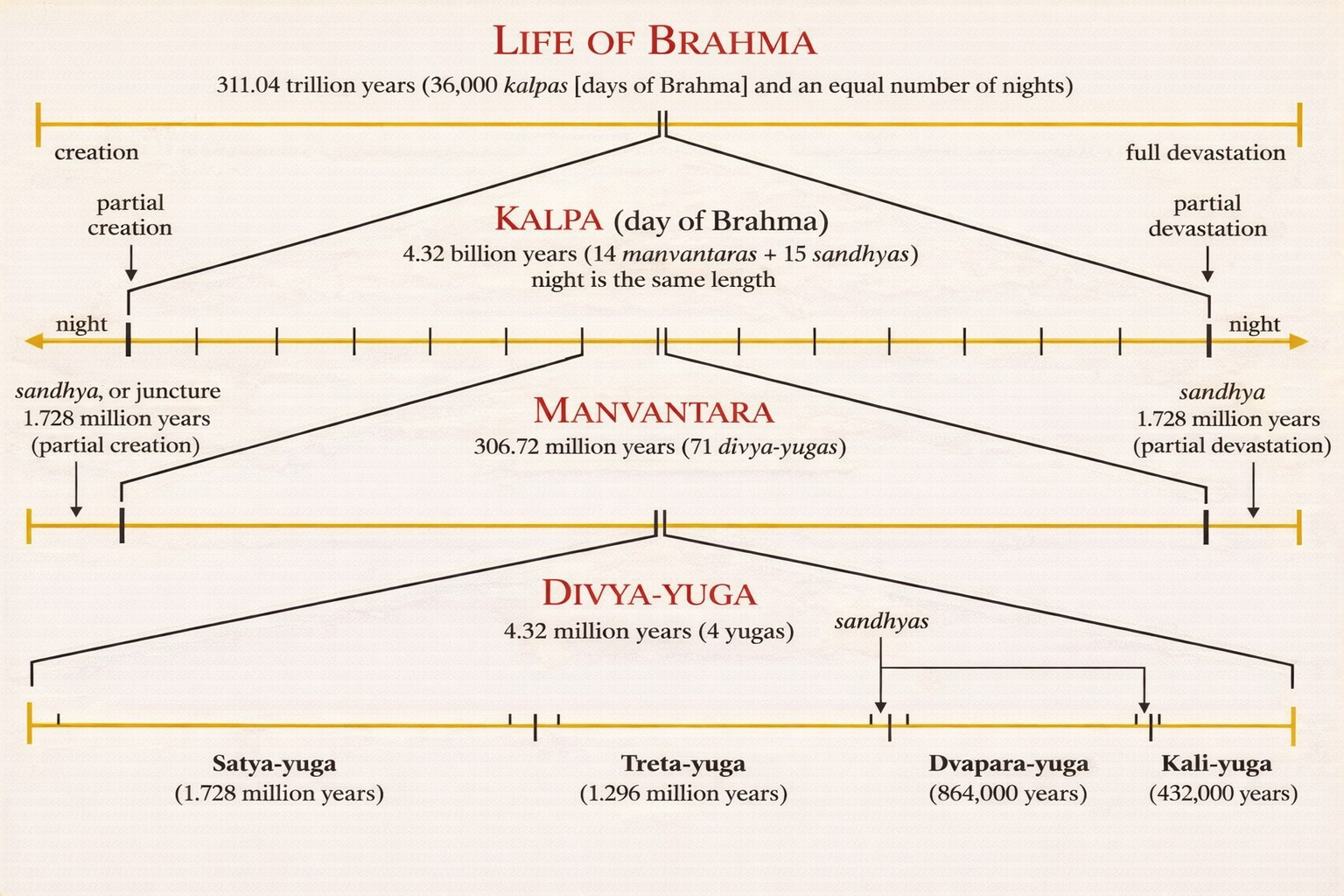
71 divya-yugas, or complete cycles of four yugas, form a manvantara (306,720,000 years), and 14 manvantaras, together with their sandhyās, form a day of Brahmā (4.32 billion years). The same is the duration of his night:
1 divya-yuga (set of 4 yugas) = 4.32 million years (12,000 celestial years)
1 manvantara (71 divya-yugas) = 306.72 million years (852,000 celestial years)
1 kalpa (a day of Brahmā) = 4.32 billion years
360 of such days and nights form one of Brahma’s years, and 50 of such years form a parārdha. Brahmā lives for two such parārdhas, and thus his life is divided into two halves. As mentioned in SB 3.11.34: “The one hundred years of Brahmā’s life are divided into two parts, the first half and the second half. The first half of the duration of Brahmā’s life is already over, and the second half is now current.”
With this, we enter into the really large units of time:
2 kalpas (a day and night of Brahmā) = 8.64 billion years
1 parārdha (50 years of Brahmā) = 155.52 trillion years
2 parārdhas = 1 mahā-kalpa (311,04 trillion years)
1 mahā-kalpa (a life of Brahmā) = 1 mimesa for Lord Mahā-Viṣnu, the time of His one breath.
The total duration of the life of Brahmā equals just one mimesa (about half a second) for Lord Mahā-Viṣnu, which gives us an idea of the insignificance of our limited lifespans in this material world. In material terms, we are insignificant both in terms of physical size and duration of life. It is better to accept our eternal spiritual nature, which is eternal and full of bliss.
Here is a diagram showing how all these different units of time fit together:
How to remember all these different units? There is an easy way.
To remember the length of the four ages, we can keep in mind that Dvāpara-yuga lasts twice the period of Kali-yuga, Treta-yuga lasts three times as long, and Satya-yuga lasts four times as long. Combined, the four eras last for 10 times as long as Kali-yuga.
We have, thus, just to remember this sequence of three numbers: 4, 3, 2. Make it 432,000. Then remember: 1 + 2 + 3 + 4 = 10. With this, we master the length of the four ages (432,000; 864,000; 1,296,000; and 1,728,000), and come to the total of 4,320,000 for the divya-yuga, or the four ages combined.
Now remember the numbers 71 and 1000. When we multiply the 4,320,000 years of the divya-yuga by 71, we come to the 306.72 million years of the manvantara, and by multiplying it by 1000, we come to the 4.32 billion years of Brahmā’s day (12 hours). To get his 24 hours, we multiply it by two: 8.64 billion years.
Brahmā lives for 36,000 days (100 years of 360 days); thus, if we multiply 8.64 billion by 36,000, we come to the total of his life: 311.04 trillion years. These are, in turn, divided into two halves: 155.52 trillion years each. By learning these simple formulas, we can easily learn all these cosmic periods of time and never forget.
Here are a few significant verses in this connection:
In the Gītā, Kṛṣṇa mentions: sahasra-yuga-paryantam, ahar yad brahmaṇo viduḥ, rātriṁ yuga-sahasrāntāṁ, te ’ho-rātra-vido janāḥ.
“By human calculation, a thousand ages taken together form the duration of Brahmā’s one day. And such also is the duration of his night.”
In the Śrīmad-Bhāgavatam, Maitreya explains:
“Thus the process of the exhaustion of the duration of life exists for every one of the living beings, including Lord Brahmā. One’s life endures for only one hundred years, in terms of the times in the different planets.
The one hundred years of Brahmā’s life are divided into two parts, the first half and the second half. The first half of the duration of Brahmā’s life is already over, and the second half is now current.
The duration of the two parts of Brahmā’s life, as above mentioned, is calculated to be equal to one nimeṣa [less than a second] for the Supreme Personality of Godhead, who is unchanging and unlimited and is the cause of all causes of the universe.” (SB 3.11.33-34, 38)
Read the whole book:
« Making Sense of the Vedic Universe, a Higher-Dimensional Reality
This is a publication for thoughtful readers who want to go deeper into Kṛṣṇa consciousness. I publish daily, trying to offer high-quality spiritual content, and all posts are available to free subscribers. If you wish, you can also choose a paid subscription to support this work.
You can also receive the updates on WhatsApp or Telegram.
If you would like to contribute further, you can find the donation links here.
Extremely valuable information Sir
I did requested to you about the yuga cycle.
Thank you once again.