


You can receive new articles directly in your inbox. Subscription is free; donations are welcome.
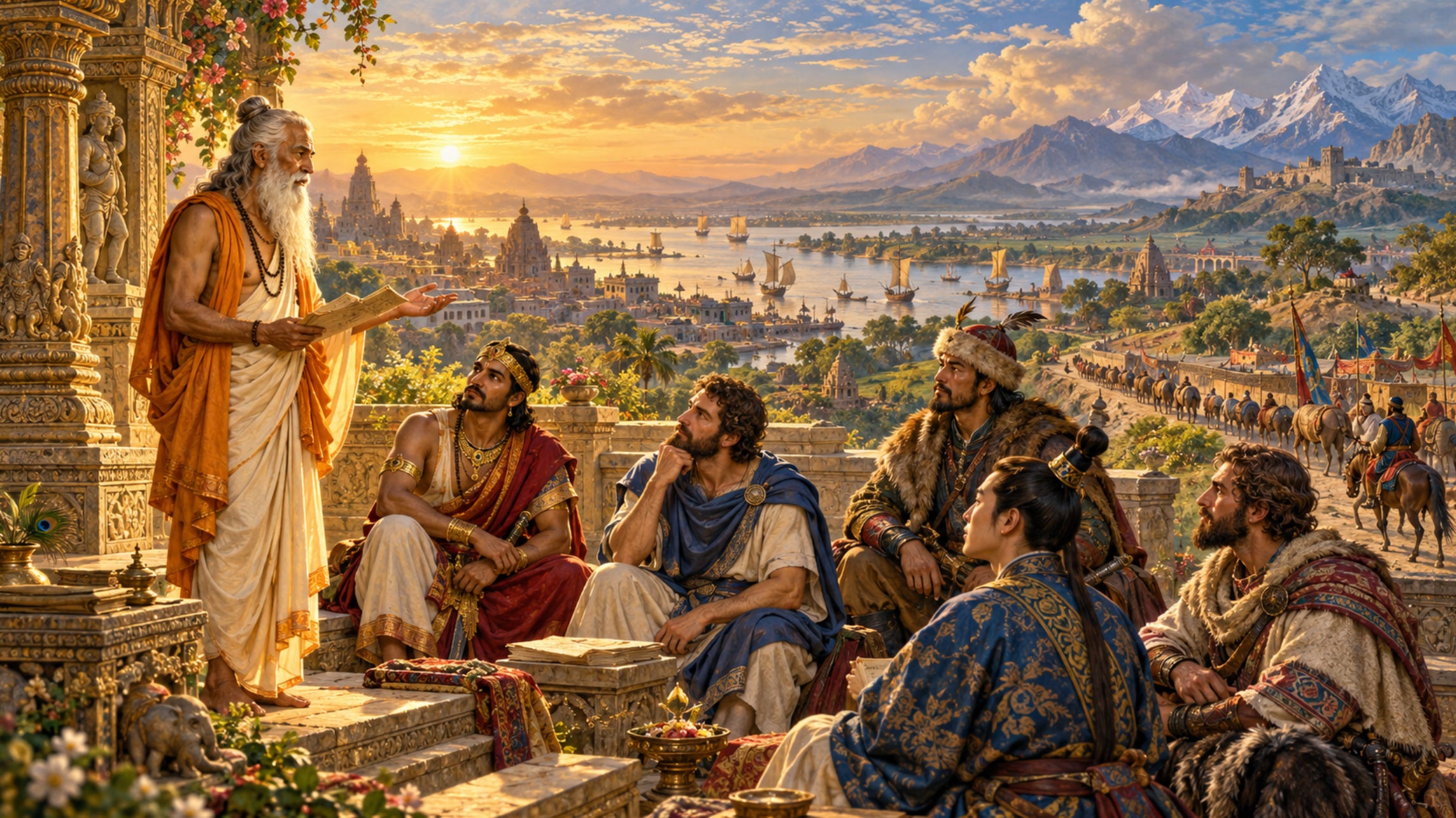
In his purport to SB 2.4.18, Śrila Prabhupāda gives us a glimpse of how most of the ancient civilizations were formed by people who emigrated from India or were connected with Vedic culture. This gives us a valuable resource to better understand the history of humanity from the Vedic perspective.
For example, in the Vedas, the Greeks are called Pulindas and were in the past classified among the ksatriya kings. However, later on, they gave up brahminical culture and thus started being classified as mlecchas. When Maharaja Yudhisthira became the king, the Pulindas were conquered by Bhima and Sahadeva. The Greeks are largely considered the birthplace of Western culture; therefore, their Vedic origins are quite significant. In the Vana-Parva of Mahābhārata, it is mentioned that during Kali-yuga the Greeks would rule the world, which became true with Alexander the Great as well as indirectly through ideas that started from there, like democracy.
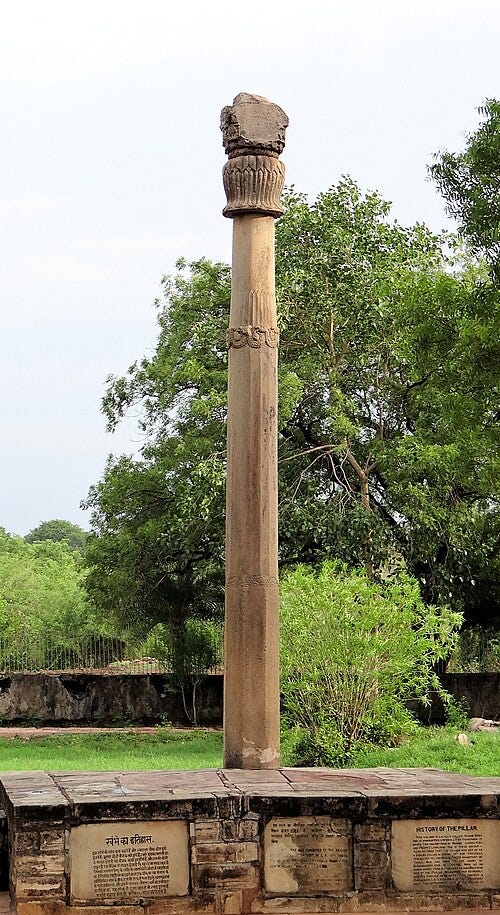
A strong piece of archeological evidence that still survives is the Heliodorus pillar. Around the second century BCE, a Greek ambassador named Heliodorus erected a Garuḍa pillar at Besnagar, India. In the inscription present in the pillar, he identifies himself as a Bhāgavata, a devotee of Vāsudeva. This shows evidence of Greeks not only visiting India but also presenting themselves as devotees of Kṛṣṇa.
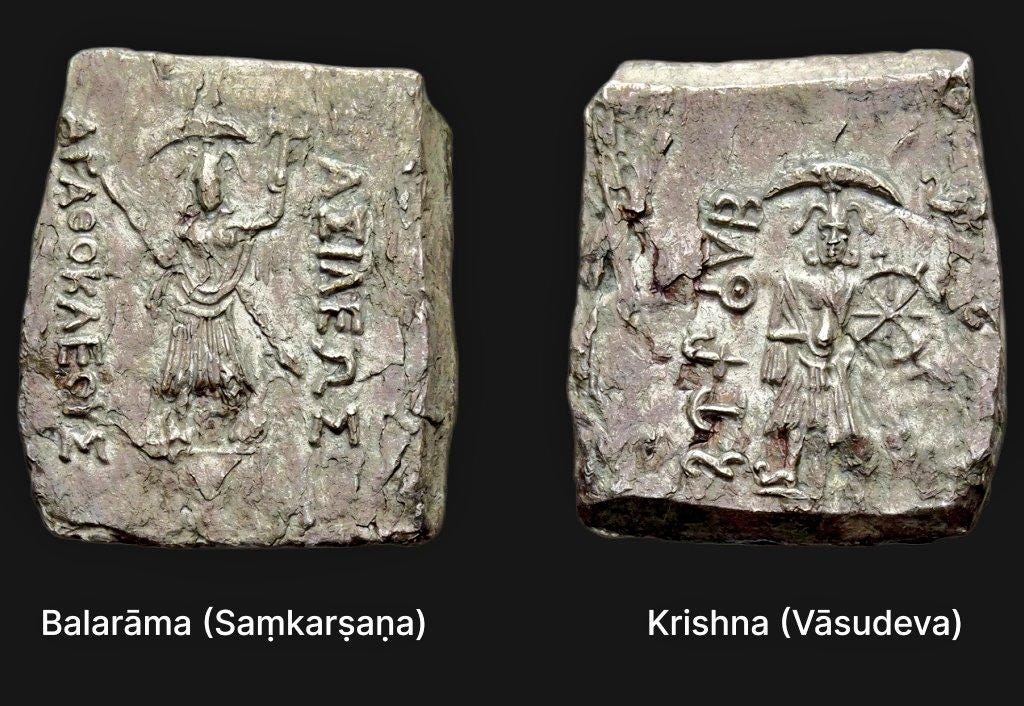
Another piece of archaeological evidence is coins issued by the Indo-Greek king Agathocles, also around the second century BCE. The coins depict Balarāma with His plow and club and Kṛṣṇa with the cakra and conch. The coins were found in Ai-Khanoum, present-day Afghanistan.
Another people mentioned are the Turks, called Yavanas in the Mahabharata. The Turks are descendants of an old Vedic community that started with Maharaja Yavana, one of the sons of Maharaja Yayati, who was given this part of the world to rule. Just like the Greeks, the Turks were originally Vedic ksatriyas, but later they gave up Vedic culture and became mlecchas. It’s described that the Yavanas joined Duryodhana in the Battle of Kurukṣetra.
Another people mentioned are the Abhiras, who correspond to people of the Caucasus regions, including what is nowadays Georgia, Armenia, Azerbaijan, and southern Russia. It’s mentioned that these people came from ksatriyas who left India because of Parasurama and took shelter in the Caucasus mountains. It’s interesting to note that people in Georgia and Armenia are historically very strong and have very white skin. In the Armenian language, a considerable number of Sanskrit words (and especially names) are still used. These people also used to be very warrior-like, defeating many strong invasions over time. Historically, they used to be worshipers of the sun, being converted to Christianity or Islam only within the last two thousand years.
It’s very probable that people from Russia and Europe are also descendants of these original Ksatriyas, who over time migrated north. By different characteristics, it appears that the Celts, as well as the different German tribes and the different Slavic groups, are also descendants of Vedic ksatriyas, as Prabhupada mentions in a lecture. Before Christianity, the Russians were still largely following a type of Vedic culture that included the worship of Radha and Krsna, as well as numerous demigods.
The Mongolians and Chinese, as well as other Asiatic groups, are described as Khasas, and their distinctive feature is stunted growth of hair on the upper lip. They were also originally Aryan people who later abandoned Vedic culture. It’s interesting to note that in the sects of Buddhists found nowadays in Japan and Korea, the cult of demigods like Brahma and Indra is still present, a visible trace of the original Vedic culture.
According to modern paleontologists, the native Indians living in both North and South America are descendants of people who originally migrated from Asian countries. In this way, they can also be classified among the Khasas. This explains how tribes of native American Indians have a concept of the universe that is very similar to the model of the universe described in the Puranas (although much simplified), among other cultural traces that remind of Vedic culture.
The Huns are described as Huna. Historically, their empire included parts of the territories of modern Russia and East Germany. There is not much information about the original Huna people, but apparently, they were also originally followers of Vedic culture who later became degraded. It appears that the modern Mongols, Huns, and Tatars derive from this tribe.
People from Siberia are described as the Sabarah. This group apparently includes people like the Yakuts, who still live there. Just as the Huna, the Sabarah are described as sinful on SB 2.7.46, apparently due to meat-eating. Even today, the Yakuts who still follow the traditional culture have a diet based on horse meat and mare (female horse) milk.
Western historians frequently explain such similarities on the basis of the Aryan Invasion Theory (which is based on very weak evidence), but when we study the Vedas, the recent history of humanity becomes clearer.
In short:
Greeks (Pulindas): Originally Vedic Kshatriyas (warrior-kings), they later abandoned Vedic culture. The Mahabharata mentions their conquest by Bhima and Sahadeva. In the Vana-Parva of Mahābhārata, it is mentioned that during Kali-yuga the Greeks would rule the world.
Turks (Yavanas): Descended from a Vedic king, Maharaja Yavana. Like the Greeks, they were once Vedic Kshatriyas who later strayed. Just like the Greeks, the Turks were originally Vedic ksatriyas, but later they gave up Vedic culture and became mlecchas. It’s described that the Yavanas joined Duryodhana in the Battle of Kurukṣetra.
Caucasus People (Abhiras): Descendants of Kshatriyas displaced by Parasurama. They share physical traits and remnants of Sanskrit in their languages.
Europeans and Russians: Descendants of ksatriyas who ran from Parasurama. The Celts, Germans, and Slavs share Vedic ancestry. Traces of Vedic culture existed in pre-Christian Russia and are still practiced in small groups.
Mongolians, Chinese (Khasas): Originally Aryan, they later abandoned Vedic practices. Buddhist sects in Japan and Korea still show traces of Vedic influence.
Native Americans: Classified as Khasas due to potential Asian origins. Similarities in their cosmology to the Puranas suggest a connection to Vedic culture.
Huns (Huna): Believed to have followed Vedic culture before degradation. Modern Mongols, Huns, and Tatars descend from this ancient tribe.
Siberians (Sabarah): Like the Huns, they might have strayed from the Vedic path. The Yakuts, with their traditional diet of horse meat, exemplify this.
Read more about the Vedic universe:

This is a publication for thoughtful readers who want to go deeper into Kṛṣṇa consciousness. I publish daily, trying to offer high-quality spiritual content, and all posts are available to free subscribers. If you wish, you can support this work with a monthly contribution. When you subscribe, you can choose between a free subscription and a monthly contribution, and you can switch from a free subscriber to a supporter at any time.
You can also receive updates on WhatsApp or Telegram.
If you would like to contribute further, you can find the donation links here.
Hare Krsna Prabhuji, Prabhuji I want to humbly apologise for the mental offenses that I have committed against you in my mind. Prabhuji I have a severe brain disorder, Ocd, intrusive thoughts, of disturbing nature come to me every now and then, accompanied sometimes by even hallucination at times. Prabhuji, I am suffering please please...please do this simple favor to me by forgiving me, please, because such offensive thoughts keep coming, I feel very frustrated, and sucks my life out of the day, please prabhuji, forgive me for all my offenses I have done in past, or if these thimgs happen in future.
I beg you please pardon me, for my mental offenses, please, else my life is finished.
Amazing summary. I have been trying to find exact sources for this and you gave it all here. We can also see that how Europeans have colonized and genocides whole of America as well. This also shows how the evil forces are not being punished by anyone at this time.