

« Making Sense of the Vedic Universe, a Higher-Dimensional Reality
What does “yojana” mean?
One important point when we study the Vedic Universe is the distances. All the measurements of the universe given in the Purāṇas are based on a unit called yojana. This is a measure of distance derived from characteristics of the human body, much like the inches and feet used in the imperial system.
One definition is that a yojana equals 8,000 times the height of a man. Another is that it equals 32,000 sets of 24 finger widths. Yet another definition states that a yojana equals four times the maximum distance a healthy man can shout and still be heard. That’s one of the reasons the length of the yojana varies through different sources, sometimes as 5 miles, 8 miles, etc. For comparison, the mile also has a similar origin, corresponding originally to 1000 steps.
The difficulty with the Vedic model is that when the distances described in the Śrīmad-Bhāgavatam are taken literally, the universe is described as being very small, with just 4 billion miles in diameter. When we exclude the vast areas of Aloka-varṣa, the Golden Land, and the Garbhodaka Ocean, which are uninhabited, the inhabited universe becomes even smaller, with just 656 million miles in diameter (two times 41,100,000 yojanas, the diameter of the inner border of the Golden Land) and about two billion miles in height (from Bhū-mandala to the upper covering). It is very difficult to imagine that everything we see in the sky could fit in such a small space.
To have an idea, even if we take the total diameter of four billion miles, the relative distances of the stars of our galaxy would result in each star having just a few dozen meters in diameter. If we tried to fit what is believed to be the observable universe (with all the galaxies), then the size of each star would fall into the scale of microns. Unless we want to believe that the celestial planets are microscopic abodes and that the great sages that inhabit them are smaller than atoms; there must be some detail we are missing.
Taking the idea of 4 billion miles literally, a logical conclusion would be to take just our solar system as the Vedic universe and, from there, conclude that other solar systems are separate universes. This, however, results in many contradictions that just grow as we try to reconcile with different passages from the scriptures.
There is, however, another possible interpretation that perhaps makes more sense.
The Vedas describe that other species that live in our universe (like the celestial humans living in the other varṣas of Bhū-mandala, as well as demigods and great sages living in the upper planetary systems) have different physical characteristics. They are much larger than we are, and can travel for much greater distances, apart from having different mystical perfections that allow them to perform feats impossible to us. In that case, 8,000 times their height, 32,000 sets of 24 of finger widths, four times the maximum distance they can be heard, or 1,000 of their steps would surely be much more than it is in our case.
It is thus not completely implausible to believe that the effective scale of a yojana may correspond to different scales in different planes of existence. In other words, what is a yojana for us may be perceived differently by inhabitants of different planets, and, conversely, what is a yojana for them, in their abodes, may be very different from what it is for us.
Imagine a yogi traveling through the cosmos using the mystical process prescribed in the Vedas. Being an inhabitant of Satya-yuga, he starts from the higher-dimensional reality of Bhū-mandala that we study in the pages of Śrīmad-Bhāgavatam, which is already much more refined than our gross reality. It is described that from this level, he has to traverse a vertical distance of 100,000 yojanas to reach Svargaloka, traveling using the rays of the sun. He has to first reach the sun itself, and from there reach the desired planet in the celestial planetary system.
By the time he arrives there, he is free from all sinful reactions and has acquired a much more elevated state of consciousness, which makes him qualified to assume a celestial body that is larger, subtler, and much more powerful than the body he had while living in Bhū-mandala. Now, his perception of distance becomes different. What is now a yojana (or eight miles) for him is much more than what a yojana is for the inhabitants of Bhū-mandala, and even more than what it is for us.
Now, imagine that he again sits in meditation, this time aiming to reach Maharloka, the next planetary system, which is 10,000,000 yojanas above, by what is now his measure. This time, he travels a distance that is inconceivable to an inhabitant of Bhū-mandala, and even more so for us. For this trip, he elevates his consciousness even further, which leads him to acquire an even subtler and more powerful body. Now, the yojana in his higher dimensional reality is even larger, incalculable to us.
Now, imagine he continues traveling upwards, traveling the 20,000,000 yojanas (by his measure) to Janaloka, then the 80,000,000 yojanas to Tapoloka, then the 120,000,000 yojanas to Satyaloka, then the 5,000,000,000 yojanas of the first covering, the 50,000,000,000 yojanas of the second covering, etc. How many miles is it for us?
If we see it from this perspective, the universe described in the Vedas is even larger than what is believed in modern cosmology, incalculable from our perspective. The only way to travel through it and reach the spiritual reality beyond is by following the process of purification described in the scriptures and not by building a spaceship. This is precisely the point made in the Śrīmad-Bhāgavatam.
The main point is that although we are limited by such distances, demigods and great sages, like Nārada Muni, are not. Inhabitants of Satyaloka can thus easily reach all regions of the cosmos, while we can travel only around our planet, or close by.
Therefore, when we study the model of the universe described in the Śrīmad-Bhāgavatam, it makes more sense to try to understand it as a map of different levels of consciousness, a description of how each level is progressively harder to attain than the previous, and the process to achieve it, rather than a literal description of distances measured in earthly inches or meters.
There is another illustration that may help to understand this concept:
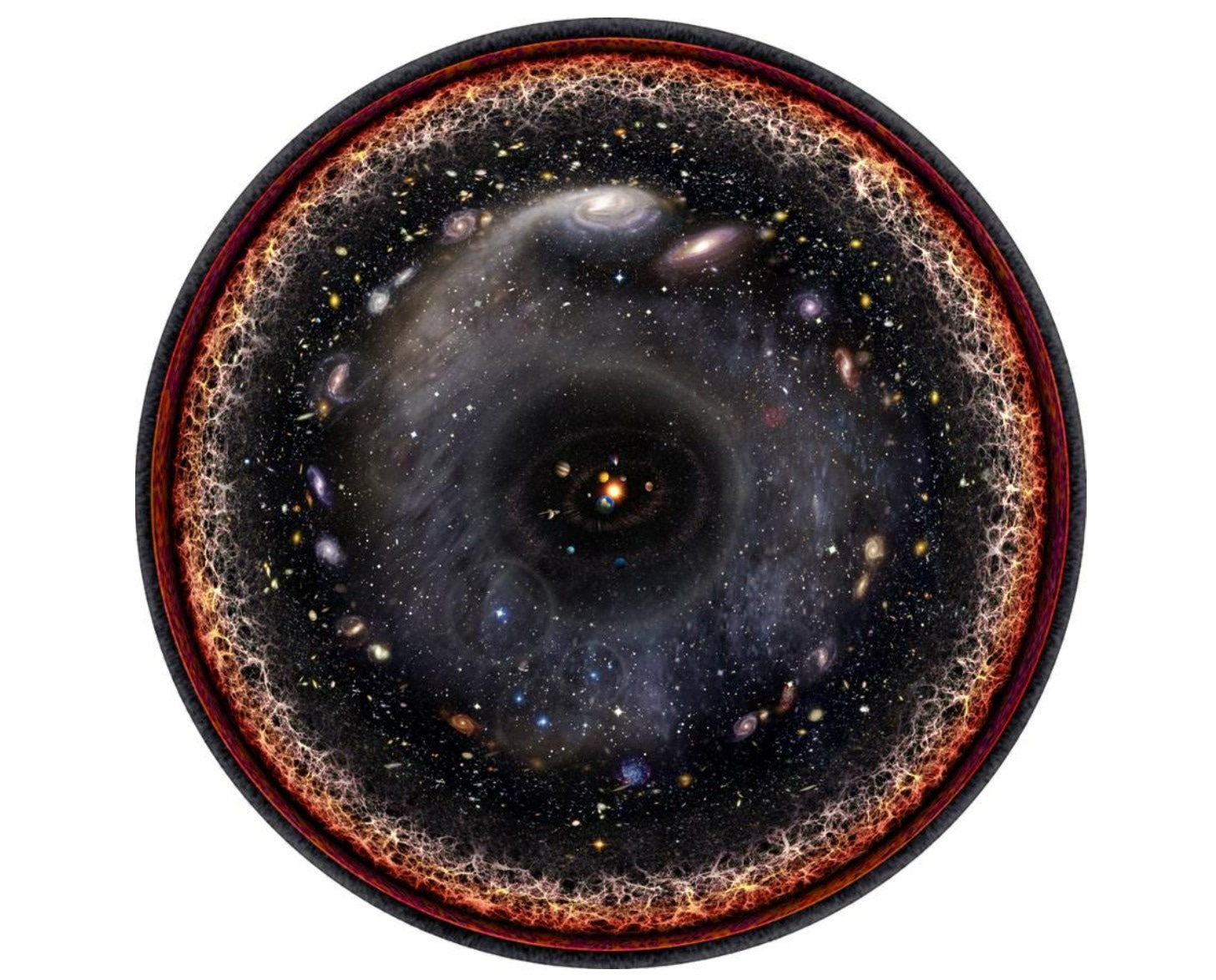
What is it?
This image is an artistic representation of the modern understanding of the observable universe, with our solar system at the center and the rest of the structures of the Milky Way and distant galaxies arranged around it. The distances are represented on a logarithmic scale, meaning that regions farther from the center are progressively compressed so that the entire observable cosmos can be shown in a single image. In other words, for each pixel or millimeter one moves, starting from the center, the real distance to be covered is exponentially larger.
We can notice a visual similarity with traditional representations of the Vedic universe, where we have Jambudvipa and Mount Sumeru at the very center of the image, with Svargaloka above it, followed by the higher planetary systems and the universal coverings, also represented on a logarithmic scale:
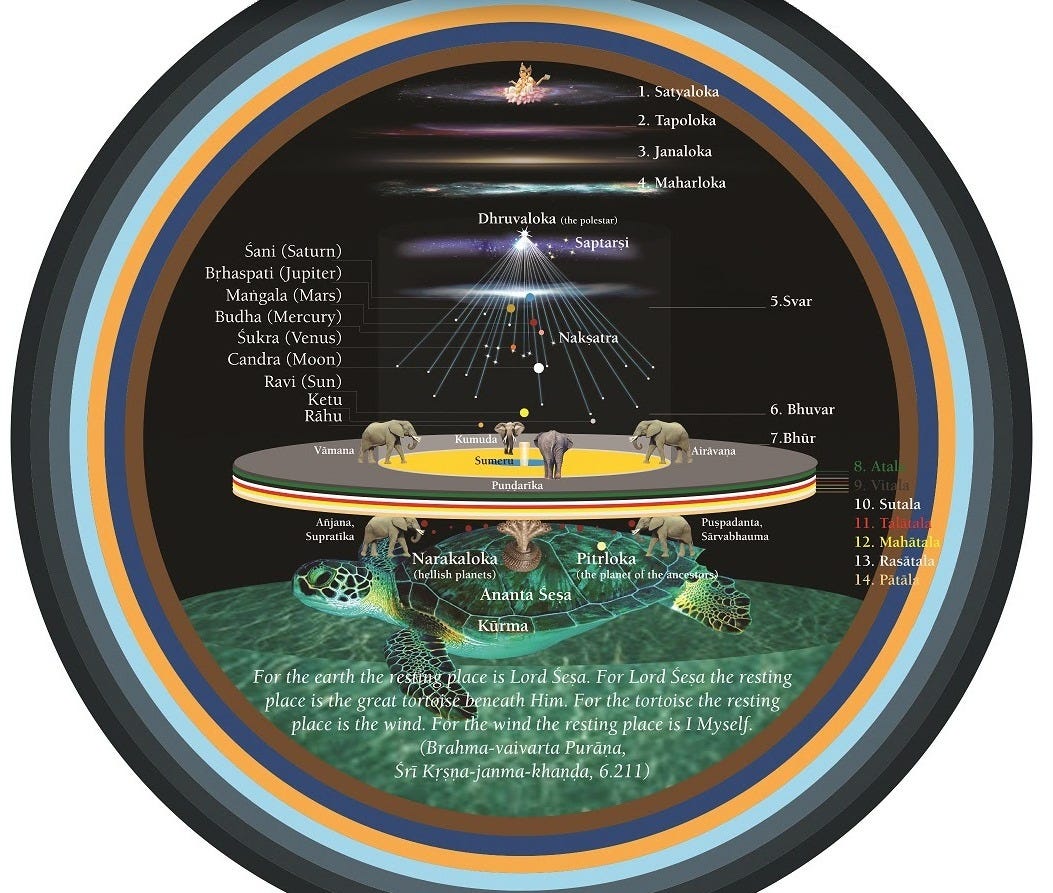
Both images give us an idea of the scale of the universe, and of the futility of trying to reach the end of it through physical or mechanical means. Modern science may help us map the observable cosmos and understand the physical laws that govern it, but it offers no practical path for transcending it. On the contrary, it closes the question from the very beginning: the observable universe is defined as tens of billions of light-years across, while simultaneously it is concluded that nothing can travel faster than light. And when this is combined with the conclusion that we are nothing more than the body, and that there is no reincarnation, any hope of going beyond it is dismissed from the start.
The Vedas, on the other hand, describe a workable process by which one may not only cross the material universe, but attain the spiritual reality that lies beyond it. We still have to accept that the material cosmos is far more complex than we can conceive, and that many of its structures remain beyond our understanding, but the knowledge given in the Vedas helps us grasp its general structure and purpose.
The real point of Vedic cosmology, however, is to help us understand enough to find our way beyond it. That’s the true purpose of studying it: not merely to measure it, but to transcend it.
Read the whole book:
« Making Sense of the Vedic Universe, a Higher-Dimensional Reality
This is a publication for thoughtful readers who want to go deeper into Kṛṣṇa consciousness. I publish daily, trying to offer high-quality spiritual content, and all posts are available to free subscribers. If you wish, you can also choose a paid subscription to support this work.
You can also receive the updates on WhatsApp or Telegram.
If you would like to contribute further, you can find the donation links here.