

« Making Sense of the Vedic Universe, a Higher-Dimensional Reality
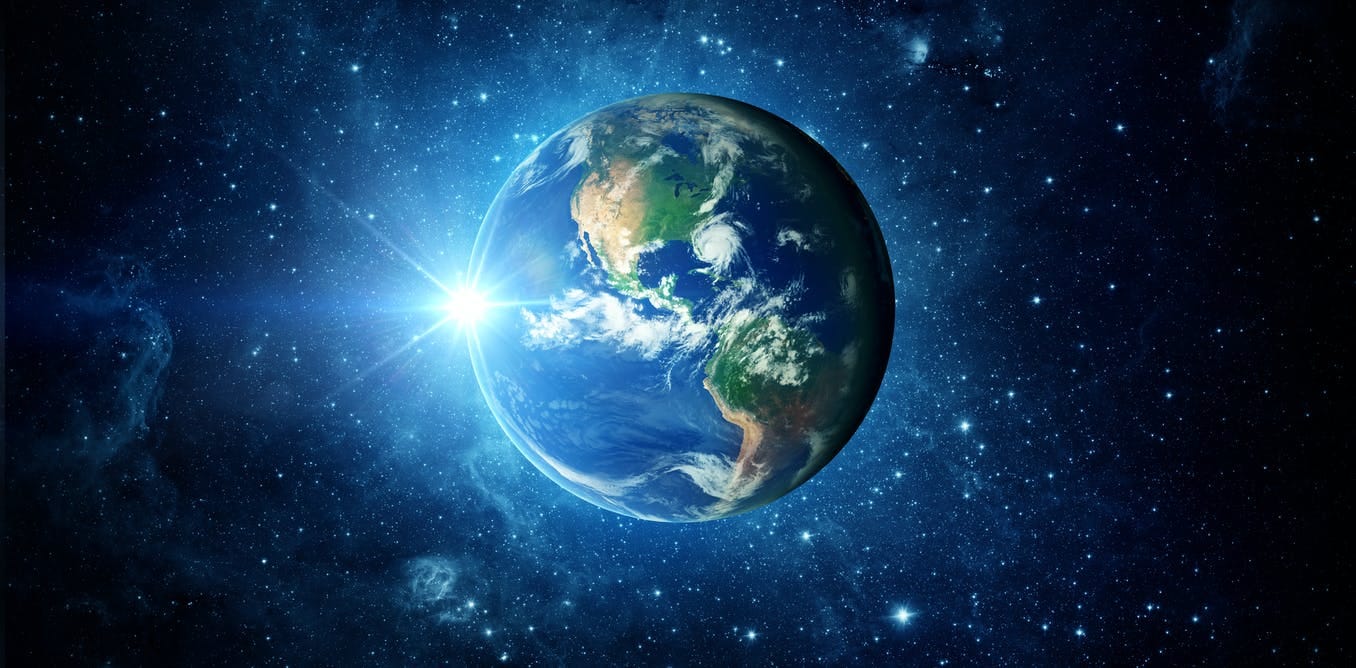
Where exactly does our planet fit into the description of Jambūdvīpa?
Śrīla Bhaktisiddhānta Sarasvatī Ṭhākura provided many details about the Vedic model of the universe in his Siddhānta-śiromaṇi, his early work on Vedic astronomy. In his purport to CC Madhya 20.218, Prabhupāda quotes two verses that provide details on the islands that form Bhū-mandala, and the varṣas that compose Jambūdvīpa:
“The seven islands are mentioned in the Siddhānta-śiromaṇi:
bhūmer ardhaṁ kṣāra-sindhor udak-sthaṁ
jambu-dvīpaṁ prāhur ācārya-varyāḥ
ardhe ’nyasmin dvīpa-ṣaṭkasya yāmye
kṣāra-kṣīrādy-ambudhīnāṁ niveśaḥ
śākaṁ tataḥ śālmalam atra kauśaṁ
krauñcaṁ ca gomedaka-puṣkare ca
dvayor dvayor antaram ekam ekaṁ
samudrayor dvīpam udāharantiThe seven islands (dvīpas) are known as (1) Jambu, (2) Śāka, (3) Śālmalī, (4) Kuśa, (5) Krauñca, (6) Gomeda, or Plakṣa, and (7) Puṣkara. The planets are called dvīpas. Outer space is like an ocean of air. Just as there are islands in the watery ocean, these planets in the ocean of space are called dvīpas, or islands in outer space. There are nine khaṇḍas, known as (1) Bhārata, (2) Kinnara, (3) Hari, (4) Kuru, (5) Hiraṇmaya, (6) Ramyaka, (7) Ilāvṛta, (8) Bhadrāśva and (9) Ketumāla. These are different parts of Jambūdvīpa. A valley between two mountains is called a khaṇḍa or varṣa.”
He continued this description later, on his purport to CC Antya 2.10:
“In the Siddhānta-śiromaṇi, chapter one (Golādhyāya), in the Bhuvana-kośa section, the nine khaṇḍas are mentioned as follows:
aindraṁ kaśeru sakalaṁ kila tāmraparṇam
anyad gabhastimad ataś ca kumārikākhyam
nāgaṁ ca saumyam iha vāruṇam antya-khaṇḍaṁ
gāndharva-saṁjñam iti bhārata-varṣa-madhye“Within Bhārata-varṣa, there are nine khaṇḍas. They are known as (1) Aindra, (2) Kaśeru, (3) Tāmraparṇa, (4) Gabhastimat, (5) Kumārikā, (6) Nāga, (7) Saumya, (8) Vāruṇa and (9) Gāndharva.”
In this way, Bhū-mandala, the intermediate planetary system is composed of seven dvīpas: (1) Jambu, (2) Śāka, (3) Śālmalī, (4) Kuśa, (5) Krauñca, (6) Gomeda, or Plakṣa, and (7) Puṣkara. Based on the description of the Śrīmad-Bhāgavatam (with the dvipas being separated in distinct tracts of land with particular features), each of these dvīpas appears to be a collective of numerous planets. We live in the central island, Jambūdvīpa, which is also subdivided into smaller tracts of land: (1) Bhārata-varṣa, (2) Kinnara-varṣa (Kimpuruṣa), (3) Hari-varṣa, (4) Kuru-varṣa (Uttarakuru), (5) Hiraṇmaya-varṣa, (6) Ramyaka-varṣa, (7) Ilāvṛta-varṣa, (8) Bhadrāśva-varṣa and (9) Ketumāla-varṣa. Each of these divisions also appears to be formed by several planets, so we can’t say how many planets in total form Bhū-mandala.
Bhārata-varṣa, in turn, is subdivided into nine smaller tracts of land (khaṇḍas): (1) Aindra, (2) Kaśeru, (3) Tāmraparṇa, (4) Gabhastimat, (5) Kumārikā, (6) Nāga, (7) Saumya, (8) Vāruṇa, and (9) Gāndharva.
There are reasons to believe that these nine are not just continents or valleys on earth, but also different planets, or different dimensional spaces. The Viṣnu Purāṇa (2.2), for example, describes these nine khaṇḍas, and then gives a separate description of the countries that compose our planet, suggesting these are two separate categories.
Another piece of evidence is found in the Taittirīya Upaniṣad. The Gandharvas we normally hear about are the Deva-gandharvas, the celestial musicians who have their planet between the plane of Bhū-mandala and Svargaloka. They are part of the upa-devas, or lower demigods. In the Mahābhārata, Vana-parva, for example, it is described that once the Kauravas were defeated by an army of Deva-gandharvas led by Citrasena. Their army was routed, Karṇa fled, and Duryodhana was captured, being later saved by the five Pāṇḍavas.
There is, however, another species of Gandharvas called Manuṣya-gandharvas. Their standard of living is higher than that of human beings, but much lower than that of the Deva-gandharvas. This hierarchy is explained in the Taittirīya Upaniṣad 2.8.2:
te ye śatam mānuṣā ānandāḥ
sa eko manuṣya-gandharvāṇām ānandaḥ
śrotriyasya cākāma-hatasya
te ye śatam manuṣya-gandharvāṇām ānandāḥ
sa eko deva-gandharvāṇām ānandaḥ
śrotriyasya cākāma-hatasya
te ye śatam deva-gandharvāṇām ānandāḥ
sa ekaḥ pitṛṇām cira-loka-lokānām ānandaḥ
śrotriyasya cākāma-hatasya
te ye śatam pitṛṇām cira-loka-lokānām ānandāḥ
sa eka ājānajānām devānām ānandaḥ
śrotriyasya cākāma-hatasya“If we multiply this limit of human bliss a hundred times, it equals the bliss of a Manuṣya-gandharva. If we multiply the bliss of a Manuṣya-gandharva one hundred times, it equals the pleasure of a Deva-gandharva, and if we multiply that one hundred times, it equals the bliss of the ancestors living in Pitṛloka. If we go further and multiply this standard of bliss of the Pitṛs one hundred times, we come to the standard of bliss of a lower demigod born in Svargaloka. Each one of these different standards of bliss is matched by a self-realized soul who has no material desires.”
Where do these Manuṣya-gandharvas live? Such a difference in their standard of living makes it difficult to consider that they live in the same planetary system as the Deva-gandharvas. It makes more sense to map their abode to the Gāndharva division of Bhārata-varṣa.
Similarly, the Nāga division of Bhārata-varṣa appears to be inhabited by a race of human-like Nāgas, while another division is inhabited by human-like Rākṣasas, and so on.
This understanding allows us to reconcile narrations of the Mahābhārata that appear to describe Nāgas, Rākṣasas, and others as celestial inhabitants, coming to earth from space or subterranean realms, and other passages that describe them as part of earthly kingdoms.
Ghaṭotkaca, the son of Bhīma, for example, becomes the chief of a race of Rākṣasas, described as kṣatriyas ruling cities and organizing themselves in akṣauhiṇī formations, similar to their human counterparts, despite also possessing supernatural powers. This description makes them substantially different from the Rākṣasas that inhabit the abode of Kuvera in Bhuvarloka. Similarly, there are descriptions of an earthly Nāga kingdom around the forest of Khaṇḍava (close to Hastinapura), and a fight of the Pāndavas against them during the episode of the burning of the forest.
In Vedic cosmology, Nāgas are inhabitants of the lower planetary systems, while the Rakṣasas live in Bhuvarloka. They can visit earth, but have no fixed kingdoms here. When we start from this idea, these descriptions of the Mahābhārata appear contradictory, and the whole text starts sounding mythological. In fact, some conclude that the Mahābhārata simply offers exaggerated descriptions of different tribes from antiquity.
If, however, we accept the idea of races of earthly Nāgas, Gandharvas, Rākṣasas, etc. that are different from their celestial counterparts (closer to human beings), and have their territories in the higher-dimensional Bharata-varṣa inhabited by the Pāndavas, then the whole description starts to make sense. Some of the passages of the Mahābhārata thus describe interactions with celestial beings, like the fight against the Deva-gandharvas led by Citrasena, while others describe interactions with their earthly counterparts that live in the different khaṇḍas of Bharata-varṣa.
In our case, however, in our current gross reality, we don’t have access to any of these realms, nor do we meet any of these other species. Just as in the case of the other divisions of Bhū-mandala, we don’t have access to their abodes, which appear to be part of a higher-dimensional reality.
It is therefore not entirely unreasonable to conclude that these nine divisions of Bhārata-varṣa also constitute different planets, or some form of higher-dimensional space. If this is accepted, then our planet is just one of them, only one of the nine divisions of Bhārata-varṣa. This can explain the differences in scale between our planet and the description of Bhārata-varṣa. The equatorial circumference of our planet is about 24,901 miles (3,113 yojanas), while Bhārata-varṣa is described as extending 9,000 yojanas north to south, and 80,000 yojanas east to west. If we consider our planet as just one of the nine divisions of Bhārata-varṣa, the description makes much more sense.
This realization shrinks our horizons even further. All we have access to in our gross reality is one of the divisions of Bhārata-varṣa, which is, in turn, just one of the nine divisions of Jambhūdvīpa, which is the smallest of the dvīpas that form Bhū-mandala, which is, in turn, just one of the 14 planetary systems that comprise a universe that is described as the smallest among millions of other universes that compose the total material creation. The total material creation comprises, in turn, just one-quarter of the total creation. That’s certainly something to think about.
Read the whole book:
« Making Sense of the Vedic Universe, a Higher-Dimensional Reality
This is a publication for thoughtful readers who want to go deeper into Kṛṣṇa consciousness. I publish daily, trying to offer high-quality spiritual content, and all posts are available to free subscribers. If you wish, you can also choose a paid subscription to support this work.
You can also receive the updates on WhatsApp or Telegram.
If you would like to contribute further, you can find the donation links here.