

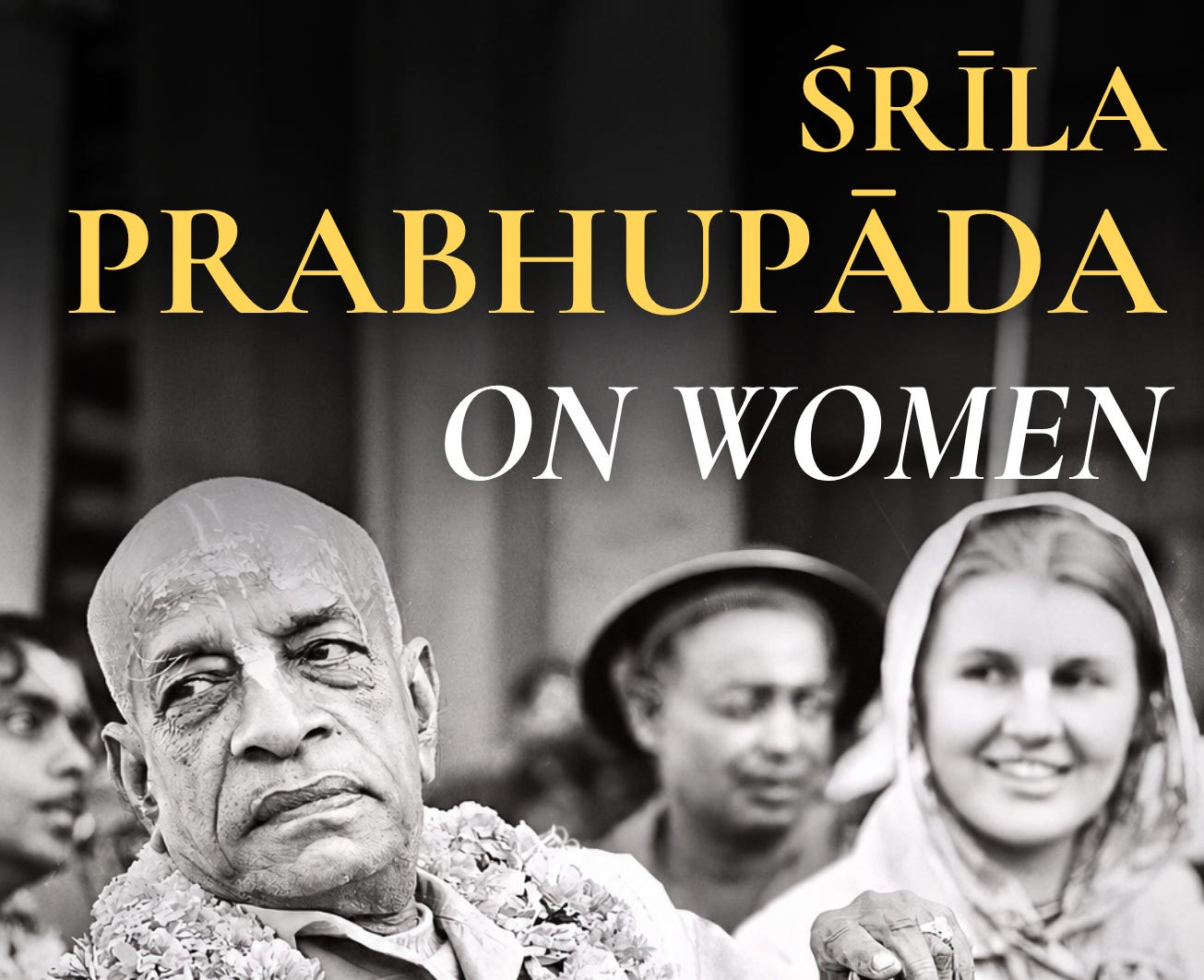
Why does Prabhupāda use the word “prostitute”?
There are a number of passages where Prabhupāda uses the word “prostitute” in ways that can challenge our understanding. Take this passage, for example:
“Woman given freedom means prostitute. Free woman means prostitute.” (Room Conversation, April 5, 1977, Bombay)
At first, this passage sounds quite offensive, since we usually associate the word “prostitute” with a woman who sells her body, but this is not the only meaning for the term. The Merriam-Webster dictionary, for example, also lists it as “a person (such as a writer or painter) who deliberately debases their talents (as for money)” and also “to devote to corrupt or unworthy purposes”.
When we observe the way Prabhupāda uses the term, we can see that he uses it in an even broader way. In some passages, he says the apsarās in the heavenly planets are prostitutes, for example, although obviously, they are not in the business of sex for money. So, what does he mean?
The point is that Vedic culture has different moral standards from most contemporary societies. The moral standards are much more rigid, and there is a much greater focus on families and social order. There is a much greater emphasis on chastity, for example. Liberals may be quick to condemn this system, but one point to keep in mind is that it is a social system that allowed society to prosper for millions of years. This proves they must have been doing some things right.
What about the word we were discussing? The idea of “prostitute” in Vedic societies is very different from what is commonly used today, and this is reflected in the way Śrīla Prabhupāda uses the term. In most cases, when the term “prostitute” is used, it does not mean someone who sells her body for money, but rather a woman who has affairs with men outside of marriage.
This explains why the term is used in connection with the apsarās, as in the previous example. Apsarās are celestial society girls who are free to associate with men outside the bounds of marriage. Not only do they associate freely with different classes of demigods, but they also sometimes come to our planet to associate with kings and other handsome men, or even on missions from the demigods to seduce sages who threaten their positions by dint of their austerities. It is not considered condemnable for the apsarās to do that (they operate under a different set of morals), but according to the standard of morality prescribed in the Vedas for our planet, this would be considered prostitution.
Similarly, many women mentioned in different pastimes are described as prostitutes. Some were really selling their bodies for money, as in the case of Piṅgalā, but others were just widows or young women who would have affairs with different men for different reasons, often out of necessity. In other words, the term “prostitute” is frequently used in the sense of a “free woman”, in opposition to a woman who gets married to a qualified man and performs her duties within family life.
We can see the term used in this sense in the description of the “prostitutes” of Dvārakā in the first canto of Śrīmad-Bhāgavatam, for example. These were artists, dancers, and other unmarried women who would have affairs with different men who temporarily maintained them or gave them gifts. As Śrīla Prabhupāda points out in his purports, such a class of women has its function in society, although this path is not generally recommended.
This is probably one of the reasons Śrīla Prabhupāda was also condemning the women’s liberation movement, since it is strongly based on the idea of women being free to have affairs with men as they please. From a spiritual perspective, this is not considered something positive, and as the spiritual master, Prabhupāda had the duty to warn us about this fact, which he did. It’s up to us to take it into consideration or not.
The term “prostitute” is also used to describe a woman of loose character. For example, the woman Ajāmila got involved with is described as a prostitute, although there is no indication that she was selling her body. She was having an affair with a śūdra man when Ajāmila saw her for the first time, and as Ajāmila started giving her gifts and money, she quickly went to him. Although it’s mentioned that they later got married, she is still described as a prostitute because she was staying with Ajāmila mainly because of the money.
The term “prostitution” is sometimes even used in connection with family life. There are instances where Prabhupāda calls married life “legal prostitution”. This applies to marriages where the main goal is just sex life. Such unions are simply a matter of convenience that is easily broken as soon as there is dissatisfaction. When this happens, both the man and woman go for new partners, resulting in cases of people already in their 6th or 9th “marriage”. Such unions are just based on mutual pleasure and facilities for sense gratification, different from a true marriage that is based on responsibility, fidelity, commitment, and self-sacrifice.
These are different points that may sound difficult to understand because we may identify with different values, but it is important to understand this rationale in order to better understand points that Śrīla Prabhupāda makes in his books.
If we go back to the first quote, “Woman given freedom means prostitute. Free woman means prostitute,” we can see that this is based on the idea of women having affairs with different men instead of entering family life. This idea gained force in the 1960s with the sexual revolution, women’s liberation, etc., and Prabhupāda felt the need to oppose these ideas on several occasions.
The point is that most women have the necessity of an affective relationship, just as practically all men do. The problem is that without a good system for boys and girls being trained to be dutiful wives and husbands, the only other option is that people go from one partner to the other, having girlfriends, boyfriends, and sex buddies, as it is the norm nowadays. We may call it normal, but this is not such a great idea from a spiritual perspective.
What about the men? Prabhupāda also refers to men who prefer to have affairs with different women instead of becoming responsible and accepting responsibility for a wife in many passages, using derogatory terms such as “debauchee”, “woman-hunter”, “drunkard”, “rascal”, etc. Such attacks against men are far more common than passages criticizing women in Prabhupāda’s books; it is just that men usually get less offended by it.
The bottom line is that although Prabhupāda uses the word “prostitute” in several passages to criticize the loose moral standards many of us have nowadays, just as he uses “debauchee” or “rascal”, this is also not a disqualification in the spiritual path. The “prostitutes” of Dvārakā were all great devotees, and the “prostitute” with whom Bilvamaṅgala Ṭhākura was hanging out in his young life gave him a valuable spiritual instruction that ultimately saved him from a life of debauchery. The spiritual process offered by Śrī Caitanya Mahāprabhu is so powerful that anyone who sincerely chants can get free of all bad habits and attain spiritual perfection, regardless of one’s previous habits and standards.
Read the whole book:
« Śrīla Prabhupāda on Women
This is a publication for thoughtful readers who want to go deeper into Kṛṣṇa consciousness. I publish daily, trying to offer high-quality spiritual content, and all posts are available to free subscribers. If you wish, you can also choose a paid subscription to support this work.
You can also receive the updates on WhatsApp or Telegram.
If you would like to contribute further, you can find the donation links here.