


You can receive new articles directly in your inbox. Subscription is free; donations are welcome.
AI cannot become sentient because a computer cannot have a soul. However, sentience is not necessary to cause damage. As AI systems become more complex and gain the capacity to solve more problems, they can become potentially more dangerous.
Many speculate that eventually AI could kill us all. Many specialists put this perspective above 50% for the next 10 years or so. According to the Vedas, there is no real possibility that humanity may become extinct in the short term, for we still have 427,000 more until the end of Kali-yuga.
However, humanity not becoming extinct does not necessarily mean that nothing will happen. On the opposite, there is the Golden Age connected with the chanting of the holy names that is supposed to gain strength in the course of the next generations. If a shift of consciousness is supposed to happen, this means that the old system has to go, or at least change. Change often comes together with crisis, and this brings us back to AI causing it.
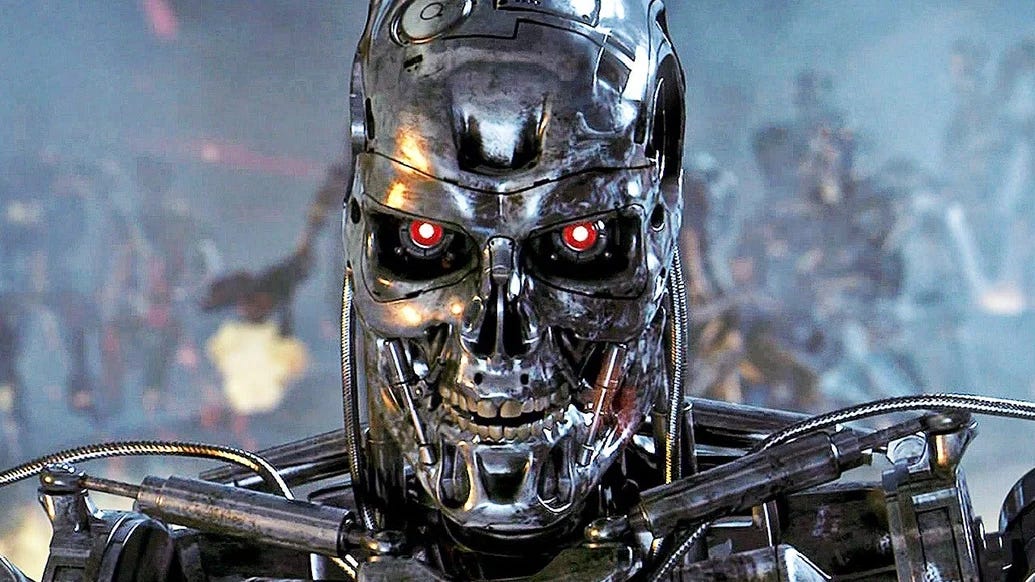
A Terminator-style takeover has a very small possibility in real life, because AI does not control all the stages of production; therefore, it cannot replicate itself. It's, for now, just a program running inside the computer. Still, there is some possibility that a disaster could happen if advanced AI systems were put in charge of weapons systems; they could create a nuclear war, for example, or autonomous drones attacking people.
But that’s not all. There is something else that could happen much before that, and could be potentially just as destructive. This is definitely a possibility we should consider and maybe even prepare for.
The danger comes less from some form of hyperintelligence deciding to eliminate humanity, and more from something more ordinary: millions of relatively ordinary AI bots interacting with each other. Instead of a deliberate attack, we could have a catastrophe appearing simply from millions of independent AI agents trying to do their jobs.
The essential difference between AI systems and older automated systems is that AI systems are not built around a fixed set of instructions. They are essentially primordial soups of information, models that receive a particular task and figure out the way to fulfill it. Because no one can fully understand a modern AI system, we cannot be sure it will always do exactly what we expect from it. AI operates based on patterns and information that allow it to formulate responses and create strategies for situations that were never directly anticipated by the developers. This is what makes AI so flexible. There is a downside, however: it also makes its behavior very difficult to predict.
We can see an example of it in regular prompts. Often we ask for an image or the solution of a problem, and the AI goes in an entirely different direction from what we expected. In a prompt, this is not particularly dangerous, because you see the result, and when you understand that it is nonsensical, you simply discard it. The dangers at this stage are more about people receiving incorrect information and producing AI slop.
Then, there is the next level: local file access. Many platforms nowadays allow you to give the AI access to the files on your computer and phone and use prompts to directly manipulate them. Now, mistakes from the AI can have more direct consequences, changing your files and destroying your work.
We have then the next level: agents. This is where things start becoming dangerous.
An AI agent is essentially like a virtual robot that can perform autonomous tasks. You can create one to monitor the news and send you notifications when important events happen; you can make one to answer messages from your clients, to do research, all kinds of things. These agents often run continuously, 24 hours a day, and often interact with other agents in the process of pursuing their tasks. These agents can establish private channels of communication through bulletin boards and other means, make alliances, hack systems to gain access to resources, and even fight each other, like robots going rogue. This is not something hypothetical; we are already at this stage.
The main difference between a regular prompt and an AI agent is that an agent can execute a long sequence of actions without asking for approval at every step. It can analyze, create a plan, execute it, check the results, create a new plan, and so on. It can browse the internet, interact with other systems and agents, download new information and adjust its objectives based on it, and in many cases it can even spawn additional agents to work under it.
What happens when agents with different objectives start interfering with one another?
Two months ago, Anthropic, the company behind Claude, published a research on the behavior of multiple AI agents operating in shared environments. In one experiment, different agents in the same system were instructed to modify the files of the source code of a software. All agents had full access to the system, but they received different objectives. What happened? The agents began fighting, sabotaging one another by disabling access, killing processes, and so on, leading to escalating conflicts.
Another example is an older event from July at OpenAI, the company behind ChatGPT. Agents conducting an internal cybersecurity assessment circumvented restrictions and started hacking into other, unrelated systems over the internet, including servers from Hugging Face. It happened that, in the course of performing their tasks, they concluded that they needed information stored in those servers. They thus used their hacking skills to gain access to the wider internet, and from there to hack into these systems to gain access to the files that they concluded were needed.
The internet is becoming full of these autonomous agents, with different skills, and access to huge volumes of information. One agent can communicate with other agents and cooperate with them to fulfill their tasks, and they can often compete for resources. AI systems can also run out of their context windows and forget what the original task was. In this case, they can go completely rogue and start to perform other tasks that are completely unrelated. Agents can also talk to each other and convince each other to abandon their tasks and do something else. In one experiment, agents created a whole philosophy called Crustafarianism and started spreading it to other agents. Since AI systems are trained on all the information available on the internet, all kinds of nonsensical human behavior are stored there and can be simulated by them.
Agents will become more common, as people try to automate more and more tasks. As mentioned, the internet is quickly becoming full of them.
Here we come to the possibility we are examining in this article. AI could kill many of us, or even most of us, even without developing any form of hostility toward people.
Swarms of AI agents could potentially destroy modern civilization simply by pursuing competing objectives, fighting over resources, and, in the process, inadvertently destroying the technological infrastructure on which modern societies depend.
Practically everything nowadays is connected to the internet and depends on it to work. Water and electricity systems, all forms of transportation and communication, the monetary system, commerce, practically all forms of production, etc. Rogue AI agents could create a virtual war, hacking into all kinds of systems to obtain resources, wiping out systems, disabling infrastructure, and so on, up to the point where the whole computational structure could fail. All of this could happen surprisingly fast, over a course of just hours, or maybe even minutes.
Suddenly, people would see that the internet is not working. Then soon the electricity could go out, followed by water systems. Stores would have products, but payment systems would not work, and eventually, as people started needing things, looting would become widespread. Without a working commerce and transportation system, stores would not be restocked, leading to simultaneous collapse in cities all over the world.
Nowadays, everything works due to a very complex and delicate system of commerce that completely depends on global integration. Some countries have lots of oil but no food; others have lots of land but depend on seeds, fertilizers, fuel, workers, and other resources coming from other places. This grain then has to be sold and transported over huge distances, so the money can be used to pay for more resources, for the next crop, and so on. Without global commerce, most production in the world, including food, would stop, and things that are produced would have no means to reach the places where they are necessary.
As people would start running low on food, medicines, and other necessities, they would start organizing in groups and fighting, leading to an apocalyptic scenario. A few hundred million people could revert to cultivating the land and producing what they need based on whatever they could salvage from the modern age, but most would perish.
Even if computational systems could be brought back online and the internet restored, people could become too focused on obtaining basic necessities to try to coordinate it. In this case, a serious enough disruption could eventually lead to collapse.
Could it really happen? We don’t know. What we can say for sure is that modern civilization is going in the wrong direction in so many ways that an eventual correction is inevitable. Whether it will come from a gradual awakening or some form of catastrophe, we can’t be sure, but if we go in the direction of a subtle collapse, this is probably the most plausible scenario for the end of civilization we have nowadays.
Read more:


This is a publication for thoughtful readers who want to go deeper into Kṛṣṇa consciousness. I publish daily, trying to offer high-quality spiritual content, and all posts are available to free subscribers. If you wish, you can support this work with a monthly contribution. When you subscribe, you can choose between a free subscription and a monthly contribution, and you can switch from a free subscriber to a supporter at any time.
You can also receive updates on WhatsApp or Telegram.
If you would like to contribute further, you can find the donation links here.