

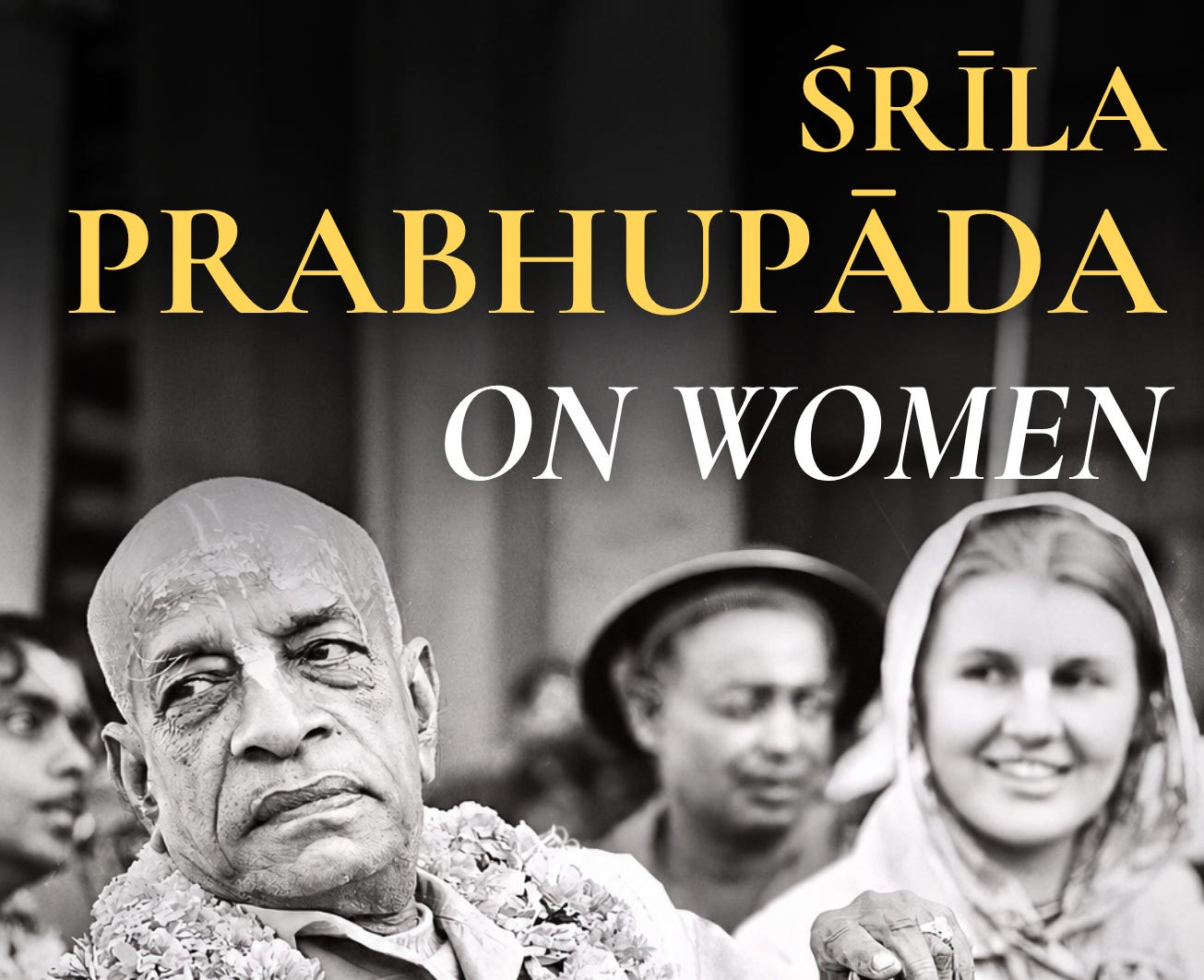
Women are also called Prabhu
To conclude this book on a positive note, let’s examine another point connected with women consistently made by Śrīla Prabhupāda. This is a small detail that may pass unnoticed, but it helps to better understand many other actions and statements he made during the time he was with us.
A number of Śrīla Prabhupāda’s disciples remember that at the beginning of ISKCON, all devotees used to call each other “Prabhu,” regardless of gender. The men were “Prabhus,” and the women were also “Prabhus.” According to them, Śrīla Prabhupāda established it in this way, and the system was changed to the Prabhu/Mataji style of address only later.
If we examine Śrīla Prabhupāda’s letters, there are a number of letters in which Prabhupāda addresses lady disciples as “Prabhu.” This is well documented.
On April 25, 1971, for example, he wrote:
“I am so glad to note how nicely your Sankirtana activities are going on there in Laguna Beach center. You write to say that you are considering the possibility of celebrating feast days with festivals on the street. That is very good program, so do it nicely. Aratik ceremony may be done also, if possible. Otherwise, it is not necessary. So long as there is Guru-Gauranga worship, Yamuna Prabhu may act as pujari. Otherwise, one must be initiated to tend the Deity.”
Similarly, on July 04, 1971, he wrote:
“Here in L.A. things are going on very nicely and just this week 40 new devotees were initiated. So the stock of japa beads I brought with me has been depleted. Malati Prabhu was supposed to have brought some beads with her from India, and so I would like that those beads be sent immediately to N.Y. center by air. I have instructed Tamala Kṛṣṇa in Calcutta and he soon will be sending more beads to London, for distribution in Europe. So take care of this matter right away so that the beads will be there upon my arrival in N.Y.”
Some will argue that he did this only to senior lady disciples who were spiritually advanced, like Mother Yamuna or Mother Malati, but other letters suggest that was not the case. On April 13, 1971, for example, he wrote:
“Since it is uncertain when I shall arrive, the devotees recommended by you for initiation in a previous letter may now be initiated. Presently I am securing wooden beads from here and as soon as I receive them, I shall send them to the respective devotees, duly chanted on. Anna Prabhu may be initiated also and she has my blessings for being married to Puranda at the earliest convenience.”
Here he is calling a new lady, who was being recommended for initiation as Prabhu, just like the others.
Some will argue that it was in the early years of our movement, and later it was changed, but letters from later years maintain the same trend. On October 15, 1976, for example, he wrote:
“My Dear Sacimata Prabhu,
Please accept my blessings. I am in receipt of your letter dated 3rd October 1976 and I have noted the contents carefully.
There is nothing mystical about getting Gaura Nitai deities for worshiping. The Lord is all powerful and omnipresent, he knows the heart of the devotee and reciprocates with the devotee accordingly. So now the Lord has come to your home and agreed to be worshiped by you, therefore everything should be clean and neat. Nice prasadam should be offered regularly and distributed to guests. Kirtana may be performed morning and evening and some discussion from Bhagavad-gita as it is, or other books from our publications.”
Some could argue that these are mistakes, that Prabhupāda just called ladies “Prabhu” on certain occasions due to inattention, simple human mistakes. However, this also does not seem to be the case. On December 16, 1971, he blessed a marriage between “Haladhara Prabhu” and “Joan Prabhu.” It does not seem he was blessing a marriage between two men (Joan is the feminine form of John in English-speaking countries).
“Please accept my blessings. I am in due receipt of your telegram received by me on 11th February, 1971. Yes, I have all blessings for the happy marriage of Haladhara Prabhu and Joan Prabhu, so you may immediately do the needful in this regard.
How are things going on there in Pittsburgh? I have reports that the temple there is doing very nicely and that our Spiritual Sky incense business is expanding in volume very rapidly. So please keep me informed.”
There is a whole page on Vaniquotes (Śrīla Prabhupāda addressing his female disciples as “Prabhu”) with references that go as far as 1976. Based on these references from Śrīla Prabhupāda and the remembrances of some of his early disciples, it appears that this was indeed the practice.
On the other hand, in some of his commentaries, Śrīla Prabhupāda mentions that men should call all ladies except his wife “Mataji.” This seems to be one of these cases where both sides are correct. Yes, Prabhupāda established the use of “Prabhu” for both genders, and he himself was addressing his lady disciples in this way, at least in private correspondence, and yes, he also said that men should address ladies besides their wives as Mataji.
If we consider this point from an inclusive perspective, we can see that both standards are applicable in different circumstances, and they should somehow coexist.
A possible key to understanding this controversial topic is the comments Śrīla Prabhupāda made on a few occasions about the possibility of a transcendental standard of society, superior to the varṇāśrama standard. For example, on January 22, 1977, Bhubaneśvara, Śrīla Prabhupāda mentioned:
“So a systematic society means varṇāśrama-dharma. But there is another way. That is another way, that is called transcendental society, or Vaiṣṇava society. As it is stated in the Śrīmad-Bhāgavatam: kecit kevalayā bhaktyā Vāsudeva-parāyaṇāḥ aghaṁ dhunvanti kārtsnyena nīhāram iva bhāskaraḥ [SB 6.1.15]
Simply by becoming devotees of Vāsudeva, vāsudeva-parāyaṇa, everything can be adjusted. When Rāmānanda Rāya answered Caitanya Mahāprabhu about the systematic society of human beings, Caitanya Mahāprabhu rejected (it). He said eho bāhya āge kaha āra.”
In this way, there is varṇāśrama society, which is important and desirable for the good of all human beings, but there is also something even higher, which is a transcendental society composed of pure Vaiṣnavas.
Varṇāśrama society is strongly based on bodily identification since it teaches people who are still in a conditioned state to behave in ways that are not contradictory to their spiritual advancement. In a varṇāśrama society, a man is profoundly different from a woman, and thus, they are addressed and related to in different ways.
In a pure Vaiṣnava society, however, we are supposed to see each other as souls and relate in ways that transcend bodily identification. Prabhupāda explains this distinction in several parts of his teachings, including the history of Ajāmila, described both in the Śrīmad-Bhāgavatam and in the book A Second Chance. This society of pure Vaiṣnavas, beyond even the standards of varṇāśrama, seems to be what Śrīla Prabhupāda originally envisioned for his movement.
This is supported by a passage from Govinda Dāsi, one of the first disciples of Śrīla Prabhupāda:
“Actually Śrīla Prabhupāda NEVER addressed his disciples as Mataji. Maybe some Indian ladies, guests, but there are plenty of letters he wrote to Himavati Prabhu, Yamuna Prabhu, and Malati Prabhu, and others wherein he called them Prabhu, or addressed the letter as prabhu. Indisputable fact.
But the deeper and real truth of this matter is even more significant. In Boston, in May of 1968, the day Śrīla Prabhupāda chose to accept the title, “Śrīla Prabhupāda” is the day he ordered us all, both male and female, to address one another as Prabhu. His explanation of this was, “As I am the Prabhupāda, you are all the Prabhus taking shelter of the Prabhupāda. I am your Prabhupāda, and you are my Prabhus who have taken shelter at my pada, lotus feet.”
It was more or less a title for those devotees who had accepted his shelter as their all in all. He then had my husband Goursundar bow down and call me “Govinda dasi Prabhu,” and he had me bow down and call Goursundar “Goursundar Prabhu.”
Nowadays, we often use the Vedas as an excuse to see things on the bodily platform, forgetting that the ultimate purpose of the Vedas is to push us out of this bodily conception. The Vedas explain many topics for different levels of people; that’s why in the Bhagavad-Gītā (2.45) Kṛṣṇa proclaims that, “The Vedas deal mainly with the subject of the three modes of material nature. O Arjuna, become transcendental to these three modes. Be free from all dualities and from all anxieties for gain and safety, and be established in the self.”
One of the missions of great ācāryas like Śrīla Prabhupāda is exactly to reveal the ultimate conclusions of the scriptures, taking us out of our comfort zone and pushing us in the direction of the transcendental platform. However, because we are so intimately attached to our material identities, we often resist it.
Yet another dimension to this topic is that frequently we use “Prabhu” and “Mataji” as some kind of caste designation, giving the idea that “Prabhus” are higher and “Matajis” are lower. This is yet another aspect of our mental conditioning. One who sees himself as a “man” will consider himself superior to another called “woman,” one who sees himself as a “brāhmana” will see himself as superior to another called “śūdra,” and so on. One who is bound to such bodily conception will resist the idea of spiritual equality and bring forth many arguments. However, we can consider what Kṛṣṇa reveals in the Gītā:
“That knowledge by which one undivided spiritual nature is seen in all living entities, though they are divided into innumerable forms, you should understand to be in the mode of goodness. That knowledge by which one sees that in every different body there is a different type of living entity you should understand to be in the mode of passion. And that knowledge by which one is attached to one kind of work as the all in all, without knowledge of the truth, and which is very meager, is said to be in the mode of darkness.” (18.20-22)
Read the whole book:
« Śrīla Prabhupāda on Women
This is a publication for thoughtful readers who want to go deeper into Kṛṣṇa consciousness. I publish daily, trying to offer high-quality spiritual content, and all posts are available to free subscribers. If you wish, you can also choose a paid subscription to support this work.
You can also receive the updates on WhatsApp or Telegram.
If you would like to contribute further, you can find the donation links here.