

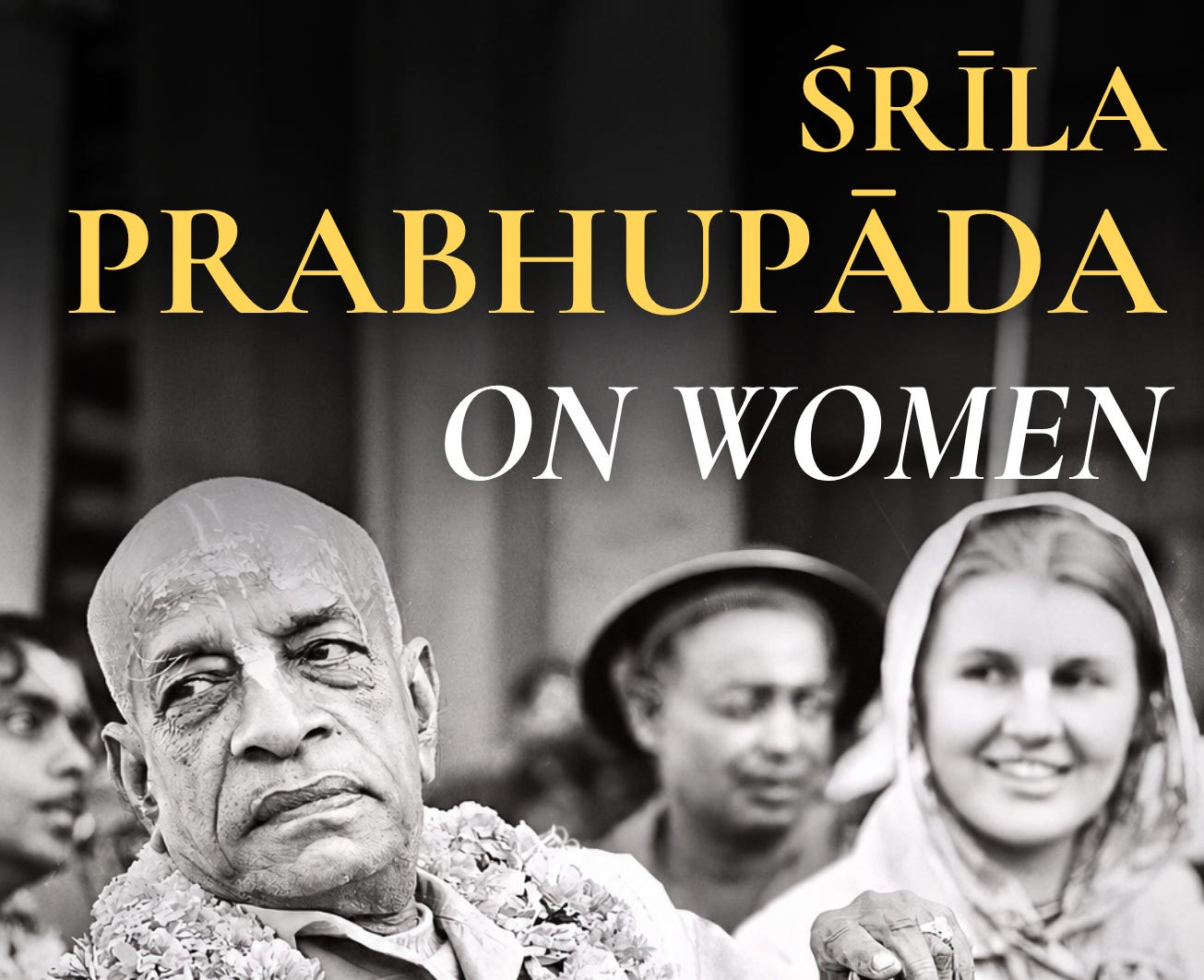
Women like men who are “expert at rape”?
In the Fourth Canto of the Śrīmad-Bhāgavatam, we find the description of the allegory of King Purañjana, which represents the situation of every conditioned soul trying to enjoy the material creation. In the allegory, Purañjana (the soul) enters the city (the body), where he meets a beautiful woman (the material intelligence), to whom he becomes attracted. The material intelligence is the main tool we use to enjoy the world, and thus the soul becomes deeply attached to it. Intelligence, on the other hand, is activated by the soul and acts based on one’s desires. Thus, it has no meaning without the soul. In this way, the two become very intimately connected, just like two lovers.
The word for “man” in Sanskrit is puruṣa, the same word used for “enjoyer”. The conditioned soul is described as male because, although originally part of Kṛṣṇa’s potency, we assume the role of enjoyers of this material world. Purañjana thus represents every conditioned soul, man or woman, trying to enjoy this world.
This is described in the allegory:
“Nārada continued: My dear King, when Purañjana became so attracted and impatient to touch the girl and enjoy her, the girl also became attracted by his words and accepted his request by smiling. By this time she was certainly attracted by the King.” (SB 4.25.32)
In his purport, Prabhupāda explains:
“By this incident we can understand that when a man is aggressive and begins to woo a woman, the woman becomes attracted to the man. This process is described in the Bhāgavatam (5.5.8) as puṁsaḥ striyā mithunī-bhāvam etam. This attraction is enacted on the platform of sexual life. Thus the sex impulse is the platform of material engagement. This conditional life, the platform of material sense enjoyment, is the cause of forgetfulness of spiritual life. In this way a living entity’s original Kṛṣṇa consciousness becomes covered or converted into material consciousness. Thus one engages in the business of sense gratification.”
We can see that in this purport, Prabhupāda connects the verse to human sexuality, describing the basic process of a man courting or wooing a woman to try to win her heart. This process is aggressive in nature in the sense of being assertive (not violent). The man takes the initiative and acts in a confident way.
Affected by lust, a man sees a beautiful woman as the source of satisfaction for all his desires, and similarly, a woman sees a handsome man as the source of affection, protection, romance, security, fulfillment, wealth, etc. Just as it is difficult for a man to resist the beauty of a young, attractive woman, it is very difficult for a woman to resist the advances of a handsome man who tries to seduce her. This is the very basis of material conditioning. The strategy of seduction may be different for the two genders, but the attraction is similar. Because of this mutual attraction, both men and women become attracted to material life, and this keeps us forgetful of our original spiritual nature. Even experienced transcendentalists can fall when an opportunity for material enjoyment appears, as in the many cases of sages seduced by apsarās described in the scriptures.
As in most romantic stories, Purañjana takes the initiative, attracted by the beauty of the woman, and, attracted in this way, she eagerly accepts him.
“O my dear hero, who in this world will not accept a husband like you? You are so famous, so magnanimous, so beautiful and so easily gotten. O mighty-armed, who in this world will not be attracted by your arms, which are just like the bodies of serpents? Actually you relieve the distress of husbandless women like us by your attractive smile and your aggressive mercy. We think that you are traveling on the surface of the earth just to benefit us only.” (SB 4.25.41-42)
This leads to one of the most controversial purports of Śrīla Prabhupāda. Taken out of context, it can appear shocking:
“In this regard, the word vikhyātam is very significant. A man is always famous for his aggression toward a beautiful woman, and such aggression is sometimes considered rape. Although rape is not legally allowed, it is a fact that a woman likes a man who is very expert at rape.” (SB 4.25.41 purport)
What exactly does it mean? Are we supposed to believe that every woman secretly desires to become a victim of a violent sexual assault? Certainly not. As in other difficult passages from Śrīla Prabhupāda, the meaning becomes clearer when the sentence is not isolated from the surrounding discussion.
The first detail we may miss is that the woman is already attracted to Purañjana when he starts speaking to her. This is mentioned in SB 4.25.32 and is made clear in the next verses, culminating with:
“O mighty-armed, who in this world will not be attracted by your arms, which are just like the bodies of serpents? Actually you relieve the distress of husbandless women like us by your attractive smile and your aggressive mercy. We think that you are traveling on the surface of the earth just to benefit us only.” (SB 4.25.42)
The lady becomes enchanted by the king and openly declares her intentions. Then she waits for him to take the initiative.
This shows a basic principle of human psychology: a single woman will look for a man, and a single man will look for a woman. Nothing is more normal than that. However, when they find a potential spouse, they act (at least traditionally) in different ways. A man will generally actively try to seduce the lady in different ways, while a woman will try to attract the attention of the man and wait for him to take the initiative. When a lady desires a man, she becomes very pleased if he gives her attention and attempts to seduce her in a confident way. This assertive courting on the part of a handsome man is glorified in romantic literature and cinema and becomes the object of fantasy for many ladies.
If directed at a woman who is not interested, this seduction would be considered a form of aggression. Such advances are even considered a crime in some countries. If the man insists, attempting to touch the lady and so on, this could be considered rape. We can thus make a clear distinction between three different things: 1) welcomed assertive courtship (seduction), 2) unwanted persistence (harassment), 3) coercion or use of force (rape). The passage refers to the first.
A delicate point, however, is that the same assertive attitude can be perceived in very different ways according to the disposition of the lady. The line between seduction and aggression can be tenuous. In this context, we should also notice the use of the word “expert” when Prabhupāda mentions, “a woman likes a man who is very expert at rape.” A woman will generally be attracted by a man who knows how to seduce her and overcome her hesitation (an expert in seduction), but no woman will appreciate a clumsy beast who tries to take her by force.
One could argue about the usage of the word “rape”, a word that in modern times has a clear meaning and is always used in a negative sense, but the point is that the meaning of words changes over time. The original meaning of the word “rape” is “to seize and carry off” (in other words, to steal or to take possession of something).
Chambers’s Twentieth Century Dictionary from 1908, for example, gives this as the primary meaning: “Rape, rāp, n. the act of seizing and carrying away by force.” Even the American Heritage, a modern dictionary, still preserves this as a secondary meaning: “2. The act of seizing and carrying off by force; abduction: the rape of Europa by Zeus.”
The word “rape” comes from the Latin “rapere”, which referred to seizure, plundering, abduction. The equivalent in Greek is harpázō, which has the same meaning. Stories in Greek mythology use the word in the sense of seduction or kidnap, like in the story of the “rape” of Europa by Zeus mentioned in the American Heritage dictionary. In the story, Zeus appears as a bull and carries Europa away. The Sanskrit equivalent is “haraṇa,” which means to steal, carry away, or kidnap. The pastime of Kṛṣṇa kidnapping Rukmiṇī, for example, is called rukmiṇī-haraṇa, the kidnapping of Rukmiṇī.
The word “rape” in English originally had the same meanings. Up to the 18th century, it was common for the word to be used in the sense of theft, kidnapping, or assertive seduction, like in “The Rape of the Sabine Women” in which the women of a city were carried away, or the poem “The Rape of the Lock”, in which a woman has a lock of her hair stolen. The narrowing of the meaning to only sexual assault became common starting in the 19th century.
Understanding the situation (a man making advances toward a willing woman, winning her heart, and taking her hand), it becomes clear that Prabhupāda is not using the word “rape” in the modern sense but to describe the process of assertive seduction that is the basis of the love affairs between men and women.
In this connection, it is also interesting to note that Śrīla Prabhupāda studied at the Scottish Church College, where he learned from dictionaries from the 19th century. He used English words in a traditional and classic sense, as we can observe in his purports. Many words are used in ways that sound uncommon nowadays.
Yet another point is that in Indian law, cases in which a man seduced a woman into sexual relations outside marriage through false promises, would often be treated as rape, even if the relation itself is consensual. This changed only recently, with the Indian criminal-law overhaul of 2023. At the time Prabhupāda wrote this purport, the law was in effect, and it was relatively common for men to be sentenced to jail time based on it.
It appears that this is the exact point Prabhupāda refers to when he mentions that “such aggression is sometimes considered rape. Although rape is not legally allowed, it is a fact that a woman likes a man who is very expert at rape.”
If the word “rape” is taken in its contemporary meaning, the sentence makes no sense; sexual assault is always illegal in any country or culture. However, in this specific historical context of Indian law, we have a situation where a consensual relationship is later qualified as “rape.” That’s a specific case where the act may or may not be treated as criminal, depending on the interpretation of the judge. This brings us to the situation described by Prabhupāda, where a Don Juan who has consensual affairs with different ladies could still be charged with rape.
Seduction on the part of a man is almost always aggressive in nature, in the sense that it is assertive, active, based on practical actions to impress and attract a woman. Handsome men who are experts in the art of seduction are not only desired and appreciated by women, but also glorified in books and movies, and that’s what Prabhupāda refers to when he mentions that “A man is always famous for his aggression toward a beautiful woman.”
The Bollywood movie Baahubali includes a scene that is a good example of this dynamic. In the movie, the heroine had suppressed her femininity to become a warrior. She is courted by the hero, who seduces her close to a waterfall in a particularly assertive way. The scene was defined by a prominent Indian politician as “the longest rape scene in the history of Indian cinema.” Despite being called “rape” by some, it is probable that many ladies watching the movie desired to be in the place of the heroine.
Keeping this in mind, we can understand that Prabhupāda describes this facet of human psychology in his purport, following the ideas expressed in the verses. In the verse, the mysterious woman entices King Purañjana to show his “aggressive mercy” and Śrīla Prabhupāda felt the need to include a short commentary on this particular point, describing a side of human psychology that may be useful to understand in the process of finding our way out of this material world.
When the context is understood, we can better understand what Śrīla Prabhupāda meant in context:
“Every husband is certainly a great hero to his wife. In other words, if a woman loves a man, that man appears very beautiful and magnanimous. Unless one becomes beautiful in the eyes of another, one cannot dedicate his whole life to another. The husband is considered very magnanimous because he gives as many children to the wife as she likes. Every woman is fond of children; therefore any husband who can please his wife by sex and give her children is considered very magnanimous. Not only does the husband become magnanimous by begetting children, but by giving his wife ornaments, nice food and dresses, he keeps her completely under submission. Such a satisfied wife will never give up the company of her husband. Manu-saṁhitā recommends that to keep a wife satisfied a husband should give her some ornaments because women are generally fond of home, ornaments, dresses, children, etc. In this way the woman is the center of all material enjoyment.
In this regard, the word vikhyātam is very significant. A man is always famous for his aggression toward a beautiful woman, and such aggression is sometimes considered rape. Although rape is not legally allowed, it is a fact that a woman likes a man who is very expert at rape.” (SB 4.25.41 purport)
Read the whole book:
« Śrīla Prabhupāda on Women
This is a publication for thoughtful readers who want to go deeper into Kṛṣṇa consciousness. I publish daily, trying to offer high-quality spiritual content, and all posts are available to free subscribers. If you wish, you can also choose a paid subscription to support this work.
You can also receive the updates on WhatsApp or Telegram.
If you would like to contribute further, you can find the donation links here.