

« Making Sense of the Vedic Universe, a Higher-Dimensional Reality
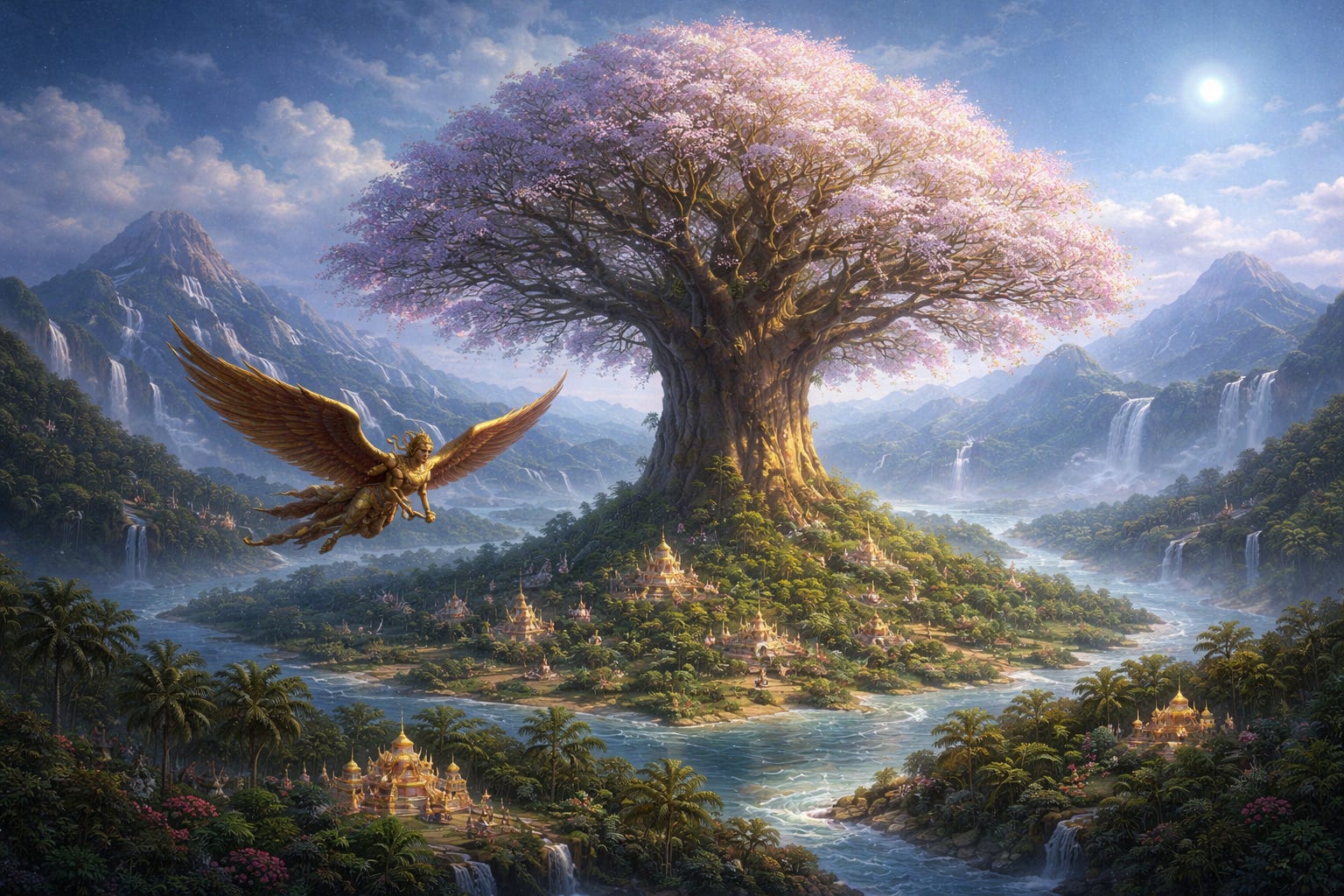
Worshipers of the moon: the inhabitants of Sālmalīdvīpa
“Plakṣadvīpa is surrounded by an ocean of sugarcane juice, equal in breadth to the island itself. Similarly, there is then another island — Sālmalīdvīpa — twice as broad as Plakṣadvīpa [400,000 yojanas, or 3,200,000 miles] and surrounded by an equally broad body of water called Surāsāgara, the ocean that tastes like liquor.
On Sālmalīdvīpa there is a śālmalī tree, from which the island takes its name. That tree is as broad and tall as the plakṣa tree — in other words 100 yojanas [800 miles] broad and 1,100 yojanas [8,800 miles] tall. Learned scholars say that this gigantic tree is the residence of Garuḍa, the king of all birds and carrier of Lord Viṣṇu. In that tree, Garuḍa offers Lord Viṣṇu his Vedic prayers.
The son of Mahārāja Priyavrata named Yajñabāhu, the master of Sālmalīdvīpa, divided the island into seven tracts of land, which he gave to his seven sons. The names of those divisions, which correspond to the names of the sons, are Surocana, Saumanasya, Ramaṇaka, Deva-varṣa, Pāribhadra, Āpyāyana and Avijñāta.
In those tracts of land there are seven mountains — Svarasa, Śataśṛṅga, Vāmadeva, Kunda, Mukunda, Puṣpa-varṣa and Sahasra-śruti. There are also seven rivers — Anumati, Sinīvālī, Sarasvatī, Kuhū, Rajanī, Nandā and Rākā. They are still existing.
Strictly following the cult of varṇāśrama-dharma, the inhabitants of those islands, who are known as Śrutidharas, Vīryadharas, Vasundharas and Iṣandharas, all worship the expansion of the Supreme Personality of Godhead named Soma, the moon-god.
[The inhabitants of Śālmalīdvīpa worship the demigod of the moon in the following words.] By his own rays, the moon-god has divided the month into two fortnights, known as śukla and kṛṣṇa, for the distribution of food grains to the pitās and the demigods. The demigod of the moon is he who divides time, and he is the king of all the residents of the universe. We therefore pray that he may remain our king and guide, and we offer him our respectful obeisances.” (SB 5.20.7-12)
The waters of the oceans that surround each of the islands of Jambūdvīpa have different tastes and properties. To help us to visualize what they look like, the waters are compared to different substances we find on our planet. In this way, Plakṣadvīpa is described as surrounded by an ocean that tastes like sugarcane, Sālmalīdvīpa by an ocean that tastes like liquor, and so on.
Prabhupāda describes these points didactically in the first chapter of the Kṛṣṇa book: “There is a planet within this universe called Śvetadvīpa, and on that planet there is an ocean of milk. It is understood from various Vedic literatures that just as there is the ocean of salt water on this planet, there are various kinds of oceans on other planets. Somewhere there is an ocean of milk, somewhere there is an ocean of oil, and somewhere there are oceans of liquor and of many other types of liquids. The Puruṣa-sūkta is the standard prayer which the demigods recite to appease the Supreme Personality of Godhead, Kṣīrodaka-śāyī Viṣṇu. Because He is lying on the ocean of milk, He is called Kṣīrodaka-śāyī Viṣṇu. He is the form of the Supreme Personality of Godhead through whom all the incarnations within this universe appear.”
An ocean of oil or sugarcane may look mythological at first, but even in modern cosmology it is believed that such exotic oceans exist. Modern studies conclude that Saturn’s moon Titan has lakes and seas of liquid hydrocarbons (forming a petroleum-like substance). Europa, a Jupiter satellite, is believed to have a liquid ocean under its icy shell, and so on.
If we imagine Bhū-mandala as a planetary system spread across the cosmos, in which the different planets appear close to one another in a higher dimension, and the oceans described exist as part of these different planets, the idea doesn’t sound too implausible, even inside the scope of modern cosmological beliefs.
Above all, however, is the Vedic concept of the universe being a creation of God, who has an artistic sense and is all-powerful. We can see that apart from these oceans composed of different substances, Kṣīrodakaśāyī Viṣṇu creates an ocean of literal milk for His own planet, Śvetadvīpa. It seems that this was the ocean of milk churned by the demigods and demons under the guidance of the Lord to produce nectar (instead of the ocean around Krauñcadvīpa).
These descriptions of the Śrīmad-Bhāgavatam help us thus to break free of our frog-in-the-well mentality of imagining the universe as an uninhabited wasteland just because we can’t find other civilizations using our limited senses and instruments. While the modern scientific method can help us to understand our immediate reality up to a certain point, the Vedas remain the only source of knowledge about what exists beyond our ordinary sensory perception.
Back to the description of Bhū-mandala, the second ring-island of Bhū-mandala is called Sālmalīdvīpa. The defining feature of this island is a gigantic celestial śālmalī tree (silk-cotton tree). Both this and the plakṣa tree from the previous island are described as having the same size as the jambū tree on Jambūdvīpa: 1,100 yojanas in height, and with a trunk 100 yojanas broad. It is not directly mentioned, but it is plausible to assume that the branches also spread to a radius of 1,100 yojanas, just as the jambū tree. In other words, these are cosmic trees, with a size on the scale of our planet. This great tree is the residence of Garuḍa, who constantly offers prayers to the Lord. Garuḍa is a great devotee of the Lord, and also the embodiment of all the Vedas. It is described that he produces Vedic hymns from the mere flapping of his wings.
The original king of this island was Yajñabāhu, who divided it into seven tracts of land passed to his sons. Again, the names describe some of the qualities of these islands: Surocana (the radiant land), Saumanasya (the place of inner peace), Ramaṇaka (the delightful region), Deva-varṣa (the place of the demigods), Pāribhadra (the auspicious land), Āpyāyana (the place of satisfaction), and Avijñāta (the place beyond ordinary cognition). Similarly, the names of the seven mountains are connected with different names of Viṣnu, Śiva, Indra and Brahmā (which in this context are all taken as names of the Lord), and the names of the seven rivers are connected with the names of Vedic goddesses, which represent potencies of the Lord. All of this, combined with the personal presence of Garuḍa as a guest of honor, confirms the devotional mood of the inhabitants.
Just as in Plakṣadvīpa, the inhabitants of Sālmalīdvīpa are divided into four classes that represent their qualities: Śrutidharas (bearers of the Vedas), Vīryadharas (bearers of strength), Vasundharas (bearers of wealth), and Iṣandharas (bearers of offerings). They all cooperate in the service of the Lord, worshiping Him as Soma, the moon-god.
Their worship follows the same logic as the worship of the sun-god in Plakṣadvīpa. By worshiping the Lord in this way through the performance of prescribed duties and sacrifices, they live lives of great opulence, and attain the moon at the end of their lives. From there, they can continue their devotional practice in material opulence, continuing to gradually evolve in the direction of the ultimate goal.
All of this confirms yet again the main conclusion of Śrīmad-Bhāgavatam: the Lord is the ultimate goal of all forms of worship.
The inhabitants of Kuśadvīpa, who worship the Lord through fire
“Outside the ocean of liquor is another island, known as Kuśadvīpa, which is 800,000 yojanas [6,400,000 miles] wide, twice as wide as the ocean of liquor. As Śālmalīdvīpa is surrounded by a liquor ocean, Kuśadvīpa is surrounded by an ocean of liquid ghee as broad as the island itself. On Kuśadvīpa there are clumps of kuśa grass, from which the island takes its name. This kuśa grass, which was created by the demigods by the will of the Supreme Lord, appears like a second form of fire, but with very mild and pleasing flames. Its young shoots illuminate all directions.
O King, another son of Mahārāja Priyavrata, Hiraṇyaretā, was the king of this island. He divided it into seven parts, which he delivered to his seven sons according to the rights of inheritance. The King then retired from family life to engage in austerities. The names of those sons are Vasu, Vasudāna, Dṛḍharuci, Stutyavrata, Nābhigupta, Vivikta and Vāmadeva.
In those seven islands there are seven boundary mountains, known as Cakra, Catuḥśṛṅga, Kapila, Citrakūṭa, Devānīka, Ūrdhvaromā and Draviṇa. There are also seven rivers, known as Ramakulyā, Madhukulyā, Mitravindā, Śrutavindā, Devagarbhā, Ghṛtacyutā and Mantramālā.
The inhabitants of the island of Kuśadvīpa are celebrated as the Kuśalas, Kovidas, Abhiyuktas and Kulakas. They are like the brāhmaṇas, kṣatriyas, vaiśyas and śūdras respectively. By bathing in the waters of those rivers, they all become purified. They are expert in performing ritualistic ceremonies according to the orders of the Vedic scriptures. Thus they worship the Lord in His aspect as the demigod of fire.
[This is the mantra by which the inhabitants of Kuśadvīpa worship the fire-god.] O fire-god, you are a part of the Supreme Personality of Godhead, Hari, and you carry to Him all the offerings of sacrifices. Therefore we request you to offer to the Supreme Personality of Godhead the yajñic ingredients we are offering the demigods, for the Lord is the real enjoyer.” (SB 5.20.13-17)
Kuśadvīpa is the third island. The defining characteristic of this island is that it is covered in a celestial type of kuśa grass that emits mild and pleasing flames that produce light without burning. The whole island is thus luminous. How is it possible? The verse itself answers: This kuśa grass was created by the demigods by the will of the Supreme Lord. If Priyavrata could create a second sun, it is not difficult to imagine that demigods can create luminous grass. The source of both creations is the empowerment of the Supreme Lord.
Prabhupāda uses this description to sustain his conclusion that the different stars we see in the sky are not like suns, as believed in modern cosmology, but instead emit light through other processes. Even scientifically speaking, this idea is not completely implausible. Practically speaking, we see stars in the sky simply as dots of light. Scientists create theories of how they may emit light based on what they understand about the cosmos, but since there are many things that are unknown, theories about the nature of stars and their distance from our planet may be completely off. Another point is that the features described in the Śrīmad-Bhāgavatam are not necessarily observable in our reality. The light of the sun, for example, is described as being ultimately a reflection of the light of the impersonal Brahmājyoti, which is converted in materially visible light by the potency of the Lord. However, when we study the sun, it appears that the light is produced by a process of nuclear fusion, since we can’t perceive these subtle aspects with our limited senses.
Just as in the previous islands, the inhabitants of Kuśadvīpa worship the Lord not directly, but through the fire-god, who is perceived as a servant of the Lord, who simply carries the offerings intended to Him. In his purport, Prabhupāda gives us more insight into this process of worship:
“The demigods are servants who assist the Supreme Personality of Godhead. If one worships the demigods, the demigods, as servants of the Supreme, carry the sacrificial offerings to the Lord, like tax collectors collecting revenue from the citizens and bringing it to the government’s treasury. The demigods cannot accept the sacrificial offerings; they simply carry the offerings to the Supreme Personality of Godhead. As stated by Śrīla Viśvanātha Cakravartī Ṭhākura, yasya prasādād bhagavat-prasādaḥ: since the guru is a representative of the Supreme Personality of Godhead, he carries to the Lord whatever is offered to him. Similarly, all the demigods, as faithful servants of the Supreme Lord, hand over to the Supreme Lord whatever is offered to them in sacrificial performances. There is no fault in worshiping the demigods with this understanding, but to think that the demigods are independent of the Supreme Personality of Godhead and equal to Him is called hṛta-jñāna, a loss of intelligence (kāmais tais tair hṛta jñānāḥ). One who thinks that the demigods themselves are the actual benefactors is mistaken.”
The island itself is divided into seven varṣas, named after the sons of Hiraṇyaretā, its original king, with seven boundary mountains and seven great rivers. Again, the meaning of the names indicates the auspicious nature of the island and how the rivers and land support the spiritual practice of the inhabitants and grant them spiritual qualities. These features are thus not accidental, but part of the plan of the Lord in gradually elevating all the souls to a platform of devotional service.
The seven tracts of land are Vasu (precious), Vasudāna (giver of wealth), Dṛḍharuci (steadiness in determination), Stutyavrata (vow of devotion), Nābhigupta (protected by the Lord), Vivikta (free from distraction), and Vāmadeva (divine nature). The seven boundary mountains are Cakra (the wheel of the Lord), Catuḥśṛṅga (the four pillars of dharma), Kapila (named after the incarnation of the Lord), Citrakūṭa (the beautifully formed mountain, in the context of devotional practice), Devānīka (the place of the gods), Ūrdhvaromā (whose hair stands upward, in the context of spiritual ecstasy), and Draviṇa (spiritual riches). The seven rivers are Ramakulyā (stream of spiritual bliss), Madhukulyā (stream of spiritual sweetness), Mitravindā (giver of spiritual friendship), Śrutavindā (giver of spiritual knowledge), Devagarbhā (bearer of divine qualities), Ghṛtacyutā (stream of sacrificial offerings), and Mantramālā (garland of divine mantras).
Read the whole book:
« Making Sense of the Vedic Universe, a Higher-Dimensional Reality
This is a publication for thoughtful readers who want to go deeper into Kṛṣṇa consciousness. I publish daily, trying to offer high-quality spiritual content, and all posts are available to free subscribers. If you wish, you can also choose a paid subscription to support this work.
You can also receive the updates on WhatsApp or Telegram.
If you would like to contribute further, you can find the donation links here.