

« The Song of God—Volume 1, chapters 1-6
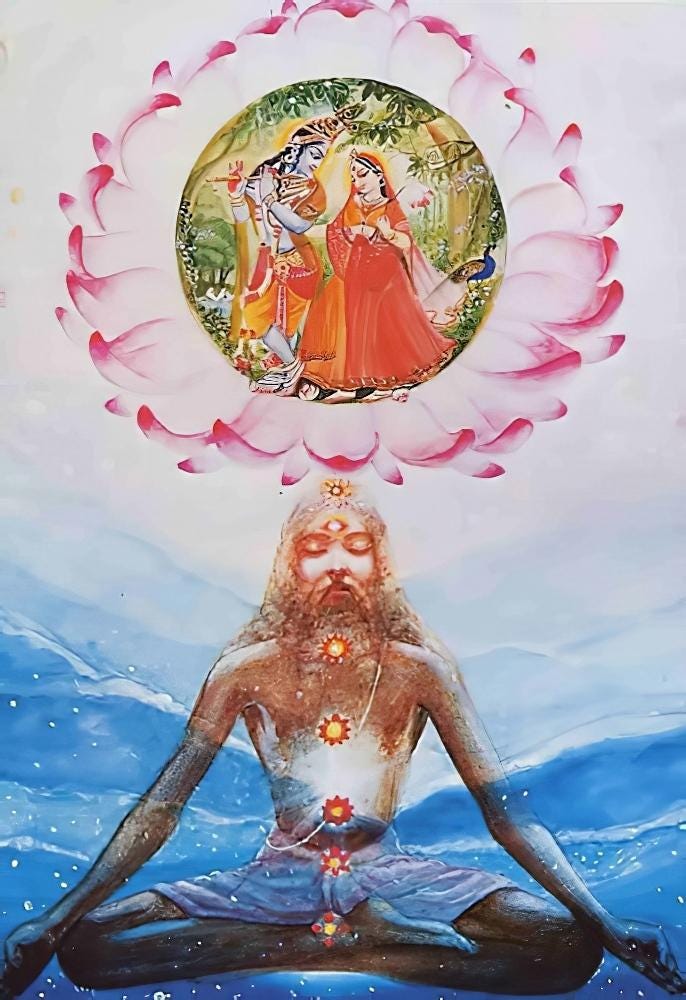
Yogārurukṣu and yogārūḍha: two stages in the practice of yoga (Bg 6.1 to 6.9)
After the short introduction at the end of chapter five, Kṛṣṇa begins to explain the process of aṣṭāṅga-yoga in greater detail. Real yoga does not begin with dry renunciation, but with detached action. One who acts without attachment to the fruits of his labor is already a true renunciant and yogī, and not the pretender who sits under a tree while thinking of sense enjoyment. Kṛṣṇa explains the distinction between the beginner, who is still struggling to control the mind, and the advanced yogī, who has already controlled the mind and become steady in realization, and the different processes recommended for them.
Text 1: śrī-bhagavān uvāca
anāśritaḥ karma-phalaṁ, kāryaṁ karma karoti yaḥ
sa sannyāsī ca yogī ca, na niragnir na cākriyaḥ
The Supreme Personality of Godhead said: One who is unattached to the fruits of his work and who works as he is obligated is in the renounced order of life, and he is the true mystic, not he who lights no fire and performs no duty.
Text 2: yaṁ sannyāsam iti prāhur, yogaṁ taṁ viddhi pāṇḍava
na hy asannyasta-saṅkalpo, yogī bhavati kaścana
What is called renunciation you should know to be the same as yoga, or linking oneself with the Supreme, O son of Pāṇḍu, for one can never become a yogī unless he renounces the desire for sense gratification.
Text 3: ārurukṣor muner yogaṁ, karma kāraṇam ucyate
yogārūḍhasya tasyaiva, śamaḥ kāraṇam ucyate
For one who is a neophyte in the eightfold yoga system, work is said to be the means; and for one who is already elevated in yoga, cessation of all material activities is said to be the means.
Text 4: yadā hi nendriyārtheṣu, na karmasv anuṣajjate
sarva-saṅkalpa-sannyāsī, yogārūḍhas tadocyate
A person is said to be elevated in yoga when, having renounced all material desires, he neither acts for sense gratification nor engages in fruitive activities.
Text 5: uddhared ātmanātmānaṁ, nātmānam avasādayet
ātmaiva hy ātmano bandhur, ātmaiva ripur ātmanaḥ
One must deliver himself with the help of his mind, and not degrade himself. The mind is the friend of the conditioned soul, and his enemy as well.
Text 6: bandhur ātmātmanas tasya, yenātmaivātmanā jitaḥ
anātmanas tu śatrutve, vartetātmaiva śatru-vat
For him who has conquered the mind, the mind is the best of friends; but for one who has failed to do so, his mind will remain the greatest enemy.
Text 7: jitātmanaḥ praśāntasya, paramātmā samāhitaḥ
śītoṣṇa-sukha-duḥkheṣu, tathā mānāpamānayoḥ
For one who has conquered the mind, the Supersoul is already reached, for he has attained tranquillity. To such a man happiness and distress, heat and cold, honor and dishonor are all the same.
Text 8: jñāna-vijñāna-tṛptātmā, kūṭa-stho vijitendriyaḥ
yukta ity ucyate yogī, sama-loṣṭrāśma-kāñcanaḥ
A person is said to be established in self-realization and is called a yogī [or mystic] when he is fully satisfied by virtue of acquired knowledge and realization. Such a person is situated in transcendence and is self-controlled. He sees everything – whether it be pebbles, stones or gold – as the same.
Text 9: suhṛn-mitrāry-udāsīna-madhyastha-dveṣya-bandhuṣu
sādhuṣv api ca pāpeṣu, sama-buddhir viśiṣyate
A person is considered still further advanced when he regards honest well-wishers, affectionate benefactors, the neutral, mediators, the envious, friends and enemies, the pious and the sinners all with an equal mind.
Chapter five ended with the real peace formula: we should know Kṛṣṇa in truth, as the supreme enjoyer, the proprietor of everything, and the eternal friend. This is the real position of the soul. Everything else is part of the same material illusion.
Chapter six describes a particular progression in the yoga ladder, where one starts from the process of jñāna-yoga and gradually progresses into dhyāna-yoga (meditation) and from there eventually reaches bhakti-yoga.
Kṛṣṇa starts the chapter by again emphasizing that the path of action in Kṛṣṇa consciousness is superior to the path of dry renunciation. Many great sages attain perfection by the practice of the yoga system, like Kardama Muni, but none of them have adopted the path of artificial renunciation Arjuna was inclined to at the end of the first chapter.
Instead, Kṛṣṇa emphasizes the same formula as in chapter five: the real renunciant is one who renounces the fruits, working without attachment, as a matter of duty, and not the one who simply abandons his duty, thinking the world is his to renounce. This is the true sannyāsī and the true yogī. This makes the point that yoga and renunciation are not goals in themselves. They are just processes that lead to a goal, and the goal for both is the same: pure devotional service. One who attains it is considered perfect, no matter if coming from the path of action in Kṛṣṇa consciousness or meditation. This also frames the process of mystic yoga Kṛṣṇa is about to explain in the right light. It is not a progression of the process of niṣkāma-karma-yoga Kṛṣṇa already explained, but a parallel process that, although more difficult, can potentially bring one to the same result.
Prabhupāda summarizes the whole discussion in his purport:
“The criterion of perfection is to act in Kṛṣṇa consciousness, and not with a view to enjoying the fruits of work. To act in Kṛṣṇa consciousness is the duty of every living entity because all are constitutionally parts and parcels of the Supreme. The parts of the body work for the satisfaction of the whole body. The limbs of the body do not act for self-satisfaction but for the satisfaction of the complete whole. Similarly, the living entity who acts for satisfaction of the supreme whole and not for personal satisfaction is the perfect sannyāsī, the perfect yogī.”
Currently, we have two problems: We are disconnected from our eternal nature as souls, and we are attached to matter. Dry renunciation solves neither, because it may restrict external action, but it does not eliminate selfish desire, which is the root cause of our material conditioning. We may cut grass, but as long as the roots are there, it will grow again sooner or later.
Desire for impersonal liberation is also not pure, for it is also based on self-interest, just as mystic yoga performed to attain mystic perfections. The real solution comes from rejecting the desire for selfish sense enjoyment and reviving our original attitude of service to Kṛṣṇa. This is the sanātana-yoga, the yoga of understanding our eternal constitutional position, and understanding Kṛṣṇa in truth, as the Supreme Personality of Godhead.
Kṛṣṇa continues to push this conclusion in the second verse: “What is called renunciation you should know to be the same as yoga, or linking oneself with the Supreme, O son of Pāṇḍu, for one can never become a yogī unless he renounces the desire for sense gratification.”
What is the difference between sannyāsa and yoga? They may appear as two unrelated terms at first, but when the proper meaning is accepted, we can understand they are one and the same. It was already defined that true sannyāsa, or renunciation, means to use everything for Kṛṣṇa in devotional service, abandoning all sense of false proprietorship, or in other words, devotional service. Yoga means connection with Kṛṣṇa. Real connection with Kṛṣṇa means to be situated in devotional service. With this, Kṛṣṇa again emphasizes that the ultimate goal of all yoga processes is to come to the platform of devotional service. This is a conclusion Kṛṣṇa will state again, even more directly, at the end of the chapter.
Prabhupāda also emphasizes this point, as well as the point of the constitutional position of the soul in his purport to text two:
“The purpose of knowledge and of restraining the senses, as prescribed in the jñāna and yoga processes, is automatically served in Kṛṣṇa consciousness. If one is unable to give up the activities of his selfish nature, then jñāna and yoga are of no avail. The real aim is for a living entity to give up all selfish satisfaction and to be prepared to satisfy the Supreme. A Kṛṣṇa conscious person has no desire for any kind of self-enjoyment. He is always engaged for the enjoyment of the Supreme. One who has no information of the Supreme must therefore be engaged in self-satisfaction, because no one can stand on the platform of inactivity. All purposes are perfectly served by the practice of Kṛṣṇa consciousness.”
In text 6.3, Kṛṣṇa speaks of two levels of yoga practice: yogārurukṣu and yogārūḍha. For the first level, work is said to be the means; and for the second level, cessation of all material activities is said to be the means. What does it mean?
A neophyte yogī has still not controlled his mind and senses. One must therefore continue working, keeping himself properly engaged to advance. In aṣṭāṅga-yoga, this corresponds to the first four limbs: yama, niyama, āsana, and prāṇāyāma: the rules and regulations, plus āsanas and breathing exercises. Moving the body or breathing in a deliberate way is also a form of karma, or work, but without it, a neophyte has no means to elevate himself to the platform of pratyāhāra (sense control), and without it there is no question of factual meditation. Not only is the yogic process at this stage also a form of work, but the yogī also has to maintain his body by eating, sleeping, etc., which also demands some occupation. As Kṛṣṇa mentioned previously, “One cannot even maintain one’s physical body without work.”
We can see how this reinforces Kṛṣṇa’s previous arguments. Even a yogī has to perform work for a long time before becoming situated on a platform of firm meditation. Without such work, one simply follows the path of cheap imitation already rejected.
The sentence “For one who is a neophyte in the yoga system, work is said to be the means” is also applicable in Kṛṣṇa consciousness. In the beginning, there is no question of sitting and meditating; the way to progress is by working for Kṛṣṇa. As Prabhupāda explains in his purport to SB 3.28.11, “For every item in the yoga system there is a parallel activity in bhakti-yoga, but the practice of bhakti-yoga is easier for this age.” Both the aṣṭāṅga-yogī and the bhakta have to work in the neophyte stage. The difference is that a yogī has to spend many years in the preliminary stages of yama, niyama, āsana, and prāṇāyāma, without much of a touch with transcendence, while the devotee is in contact with Kṛṣṇa since the first day, chanting, seeing the deity, taking prasādam, etc. The devotee can thus think of Kṛṣṇa and experience transcendental bliss since the beginning, something the yogī experiences only much later, in the advanced stages of his practice.
Similarly, “for one who is already elevated in yoga, cessation of all material activities is said to be the means,” also applies to both. After controlling his mind and senses, the yogī can finally start the process of meditation, continuing to progress until the stage of samādhi. At this stage, he advances by stopping the activities of his senses and focusing his meditation on the Supreme Lord. Similarly, at the last stage of his life, a devotee, after controlling his mind and senses, may retire to a solitary place to chant and focus his attention on Kṛṣṇa. The point is that in both cases this cannot be done prematurely.
Prabhupāda emphasizes this difference in his purport:
“Concerning the eightfold yoga system, attempts in the beginning to enter into meditation through regulative principles of life and practice of different sitting postures (which are more or less bodily exercises) are considered fruitive material activities. All such activities lead to achieving perfect mental equilibrium to control the senses. When one is accomplished in the practice of meditation, he ceases all disturbing mental activities.
A Kṛṣṇa conscious person, however, is situated from the beginning on the platform of meditation because he always thinks of Kṛṣṇa. And, being constantly engaged in the service of Kṛṣṇa, he is considered to have ceased all material activities.”
After the difference between the levels of yogārurukṣu and yogārūḍha is explained, the next question is how to determine when one becomes qualified for the yogārūḍha stage. This is answered in text 6.4. One has to have renounced all material desires, and stopped all selfish activities. As Prabhupāda explains in his purport, the way to achieve that is through Kṛṣṇa consciousness. Everyone needs engagement; therefore, only when we become fixed in the service of the Lord, can we fully abandon the desire for satisfaction in this world.
Many great yogīs are devotees, who practice meditation as a way to perfect their devotion to Kṛṣṇa, such as the Pracetās. They are already advanced in Kṛṣṇa consciousness, free from material desires, and this allows them to practice meditation on the highest level. Without Kṛṣṇa consciousness, a yogī may fix his mind through a mechanical process, but this will not be so stable. This again emphasizes the difference between the ordinary yogī who follows the mechanical process, and the pure devotee who happens to use aṣṭāṅga-yoga as a process for further deepening his meditation on the Lord.
Prabhupāda gives us a very deep purport:
“When a person is fully engaged in the transcendental loving service of the Lord, he is pleased in himself, and thus he is no longer engaged in sense gratification or in fruitive activities. Otherwise, one must be engaged in sense gratification, since one cannot live without engagement. Without Kṛṣṇa consciousness, one must be always seeking self-centered or extended selfish activities. But a Kṛṣṇa conscious person can do everything for the satisfaction of Kṛṣṇa and thereby be perfectly detached from sense gratification. One who has no such realization must mechanically try to escape material desires before being elevated to the top rung of the yoga ladder.”
What is the process for controlling the mind for a person who is progressing through these different stages, and how can we measure our progress? These questions are answered in texts 6.5 to 6.9.
We often see the mind as a force that pushes us down, incessantly replaying different desires, hopes, and frustrations. However, this is not the natural state of the mind. In the Śrīmad-Bhāgavatam, it is mentioned that the mind is created from the mode of goodness. It is originally placid, just as the waters of a lake. However, it becomes progressively more and more agitated as we become involved with material life.
The natural function of the mind is to desire. When this propensity is applied to matter, we become entangled in this material world, but if we can somehow redirect it to self-realization, by following the proper process, the mind can become a friend. The mind is thus just a tool. When absorbed in sense objects, it becomes the cause of bondage, but when directed to self-realization through the yoga process, it becomes the cause of liberation. This applies to both aṣṭāṅga-yoga and devotional service.
As long as we don’t finish our homework, focusing our mind on the service of Kṛṣṇa, it will remain our enemy. It will keep distracting us, and forcing us off the path. Here again, Kṛṣṇa emphasizes how we must practice with seriousness in the beginning stages, withdrawing the mind from sense gratification, not artificially, but through the proper process. Without disciplining the mind in the beginning, it becomes difficult to progress to the higher stages later. We then may fall later, or be tempted to become a fraud, performing a show of spiritual advancement just to attract cheap adoration from the innocent public.
As Prabhupāda mentions, “The purpose of practicing eightfold yoga is to control the mind in order to make it a friend in discharging the human mission. Unless the mind is controlled, the practice of yoga (for show) is simply a waste of time.”
Kṛṣṇa then gives us another enigmatic verse: “For one who has conquered the mind, the Supersoul is already reached, for he has attained tranquillity. To such a man happiness and distress, heat and cold, honor and dishonor are all the same.”
Technically speaking, the mind is controlled in the pratyāhāra stage, while the yogī may be able to see Paramātmā in the samādhi stage. There is a long path between the two stages, so how can Kṛṣṇa say that the Supersoul is already reached by the time one controls the mind?
The point is that being in contact with the Supersoul does not mean just seeing Him. He lives with us inside the heart, and dictates from within. However, because of the agitation of the mind, we cannot hear, and thus we go astray. When the mind finally silences, the guidance of the Supersoul becomes clear, and we automatically follow it. Just as a yogī who has failed in controlling the mind may fall, a devotee who is still disturbed by the turbulence of the mind and senses may act erratically. However, as we fix the mind, we become dovetailed with the desires of the Lord and stop acting independently. That is the stage mentioned by Kṛṣṇa. We may not see Paramātmā, but He is already within reach.
At this stage, we attain tranquility, and become impervious to the changing conditions of this world. We become aware of our eternal relationship with Him, and the mere semblance of this realization makes the temporary situations we face in this world, such as heat and cold, happiness and distress, look small. In fact, we gradually come to realize they are all the same, different faces of the same material manifestation.
Kṛṣṇa then concludes the section by explaining the symptoms by which such an advanced yogī or devotee can be recognized.
The first level is that one becomes fully satisfied because of the acquired knowledge and realization. Situated in transcendence, he is self-controlled, and sees all material objects, be they pebbles, stones, or gold, as the same.
The second level is that this sameness is extended even to people with whom one relates. One starts seeing well-wishers, benefactors, neutral people, as well as the envious, friends and enemies, the pious and sinners with an equal mind.
What makes these two platforms different?
A materialistic person sees gold as more valuable than stones because gold can be converted into material possessions and power. Gold is thus an instrument to satisfy desires. A self-realized soul, however, has no material desires, and thus sees no value in gold or money. For him, gold is like an ordinary stone, and money is like ordinary paper. A devotee may desire for Kṛṣṇa, of course, but in terms of his self-satisfaction, there is indifference. There are other forms of “gold” in this world, such as fame or mundane scholarship, which may look valuable for others, but are also pebbles and stones for a pure devotee.
Seeing all people as the same, however, demands even higher realization. How to react the same to both offenses and praise, honor, and dishonor? It demands not only fully controlling the mind, but becoming completely free from ego.
Once, great sages wanted to determine who was supreme, and sent Bhṛgu Muni to test Brahmā, Śiva, and Viṣṇu. Bhṛgu went first to the assembly of Brahmā, his father. However, when he entered, he deliberately did not greet him or offer respects. Brahmā became angry, but because Bhṛgu was his son, he controlled his anger and did not punish him. Thus, Bhṛgu understood that Brahmā, although very advanced, was not completely free from the material influence. He then went to Lord Śiva, who rose to embrace him affectionately. Bhṛgu, however, refused the embrace and seriously insulted him. Śiva became furious, but somehow controlled himself. Bhṛgu then understood that even he was not completely unaffected. Finally, he went to Lord Viṣṇu, and committed the greatest offense by directly kicking Him on the chest. Lord Viṣṇu, however, did not become angry. Instead, He humbly asked whether Bhṛgu’s foot had been hurt by touching His hard chest.
Lord Viṣṇu is completely transcendental, and thus beyond material anger. This is a platform that even great demigods cannot imitate. A pure devotee, however, rises to the same spiritual platform, and becomes one with the Lord in quality, and can exhibit the same form of transcendental tolerance that is impossible even to demigods. Kṛṣṇa mentions it last, because this is the definitive proof one has reached the transcendental platform.
Main points in the purports of Śrīla Prabhupāda:
“The Supreme Personality of Godhead said: One who is unattached to the fruits of his work and who works as he is obligated is in the renounced order of life, and he is the true mystic, not he who lights no fire and performs no duty.”
a) Although Kṛṣṇa explains aṣṭāṅga-yoga in chapter six, He emphasizes that action in Kṛṣṇa consciousness is better. To act in this spirit is the duty of every living being, because we are all parts and parcels of Kṛṣṇa. Everyone in this material world works out of self-interest, be it concentrated or extended. One who can give this up and act for the satisfaction of Kṛṣṇa is the perfect sannyāsī and yogī.
b) Even the impersonal liberation desired by impersonalists who accept sannyāsa and stop performing their material duties is not free from self-interest. It is just a more refined form of selfish desire. Similarly, the yogī who performs the eightfold process to attain mystical perfections also desires personal satisfaction. Only the devotee, working for the satisfaction of Kṛṣṇa, acts without self-interest.
“What is called renunciation you should know to be the same as yoga, or linking oneself with the Supreme, O son of Pāṇḍu, for one can never become a yogī unless he renounces the desire for sense gratification.”
a) Bhakti is also called sannyāsa-yoga, knowing our constitutional position and acting accordingly. There is no separate identity from our original identity in relation to Kṛṣṇa. Material life means being bound by illusion. Kṛṣṇa consciousness is our real, natural state of life, when we are aware of the spiritual energy.
b) When a yogī comes to complete knowledge, he stops all activities for sense gratification, understanding them to bind him to illusion. In the case of a devotee, however, this is automatic, due to his complete absorption in the service of Kṛṣṇa. The devotee is, therefore, both a sannyāsī and a yogī.
c) No one can remain inactive. If a person has no knowledge about Kṛṣṇa, then one automatically has to act on the selfish platform. The real goal is to abandon this desire for selfish satisfaction and come to the platform of satisfying Kṛṣṇa. Jñāna and yoga can help one to come to the platform of Kṛṣṇa consciousness, but if they don’t lead a person to this goal, they become useless. On the other hand, if one practices Kṛṣṇa consciousness, the purposes of both jñāna and yoga are automatically satisfied. All purposes are perfectly served by the practice of Kṛṣṇa consciousness.
“For one who is a neophyte in the eightfold yoga system, work is said to be the means; and for one who is already elevated in yoga, cessation of all material activities is said to be the means.”
a) Yoga means linking oneself with the Supreme. The yoga ladder starts from the lowest material position and goes all the way to full self-realization. The progression described in the sixth chapter is jñāna-yoga, dhyāna-yoga, and bhakti-yoga. The beginning stage is called yogārurukṣu and the advanced, yogārūḍha.
b) In the aṣṭāṅga process, regulative principles and the practice of āsanas are still considered material activities, performed with the goal of controlling the senses. When one becomes accomplished in this process, one can finally meditate. A devotee, however, becomes situated in meditation from the beginning by always thinking of Kṛṣṇa and being engaged in His service. On this platform, one can cease all material activities.
“A person is said to be elevated in yoga when, having renounced all material desires, he neither acts for sense gratification nor engages in fruitive activities.”
a) Without Kṛṣṇa consciousness, one must pursue selfish activities, for no one can live without engagement.
b) A pure devotee can do everything for Kṛṣṇa and thereby be perfectly detached from sense gratification. A yogī who has no such realization has to first control his material desires using the mechanical yogic process before being elevated to the higher stage.
“One must deliver himself with the help of his mind, and not degrade himself. The mind is the friend of the conditioned soul, and his enemy as well.”
a) The word ātmā, or “self,” has different meanings in different contexts. Here it denotes the mind, the central point in the yoga practice.
b) We become conditioned in the material world because the mind becomes involved with the false ego, the idea of lording over matter. The mind must be thus trained in such a way that it can save us from material ignorance. How is this possible?
c) Instead of degrading ourselves by attraction to material sense objects, we should discipline the mind by always keeping it engaged in Kṛṣṇa consciousness. “For man, mind is the cause of bondage and mind is the cause of liberation. Mind absorbed in sense objects is the cause of bondage, and mind detached from the sense objects is the cause of liberation.”
“For him who has conquered the mind, the mind is the best of friends; but for one who has failed to do so, his mind will remain the greatest enemy.”
a) Controlling the mind is the goal of the process of aṣṭāṅga-yoga, for without controlling the mind, the performance of yoga becomes merely a show. To live with an uncontrolled mind is like living with the greatest enemy.
b) Our constitutional position is to serve. An uncontrolled mind forces us to serve lust, anger, and so on. When the mind is controlled, however, we can voluntarily serve the Lord, who is present in our hearts as Paramātmā. Real yoga means meeting Him inside the heart and following His dictation. In Kṛṣṇa consciousness, this surrender to the dictation of the Lord follows automatically.
“For one who has conquered the mind, the Supersoul is already reached, for he has attained tranquillity. To such a man happiness and distress, heat and cold, honor and dishonor are all the same.”
a) Everyone is intended to live under the guidance of Paramātmā. What prevents it is the agitated mind focused on the material sense objects. When the mind is finally controlled, one again follows the Supersoul; therefore, it is said one has already reached Him.
b) This position, however, which is so difficult for the yogī to reach, can be attained at once by a devotee fixed in Kṛṣṇa consciousness. A devotee can remain unaffected by the material dualities. This is practical samādhi.
“A person is said to be established in self-realization and is called a yogī [or mystic] when he is fully satisfied by virtue of acquired knowledge and realization. Such a person is situated in transcendence and is self-controlled. He sees everything – whether it be pebbles, stones or gold – as the same.”
a) The message of the Bhagavad-gītā cannot be understood by mere mundane scholarship. One has to associate with a self-realized soul situated in pure consciousness. Realized knowledge comes from pure devotional service, and by this knowledge, one becomes perfect.
b) This transcendental knowledge makes a devotee fixed. Mundane, academic knowledge, on the other hand, keeps one vulnerable to illusion and confusion due to apparent contradictions.
c) A truly self-realized soul has nothing to do with mundane scholarship. He becomes self-controlled because he is surrendered to Kṛṣṇa. This brings him to the platform of real spiritual realization instead of mere speculative knowledge. The mundane knowledge that is so valuable to others is like pebbles or stones to the pure devotee.
Read the entire book:
« The Song of God—Volume 1, chapters 1-6

This is a publication for thoughtful readers who want to go deeper into Kṛṣṇa consciousness. I publish daily, trying to offer high-quality spiritual content, and all posts are available to free subscribers. If you wish, you can also choose a paid subscription to support this work.
You can also receive the updates on WhatsApp or Telegram.
If you would like to contribute further, you can find the donation links here.