

« The Song of God—Volume 1, chapters 1-6
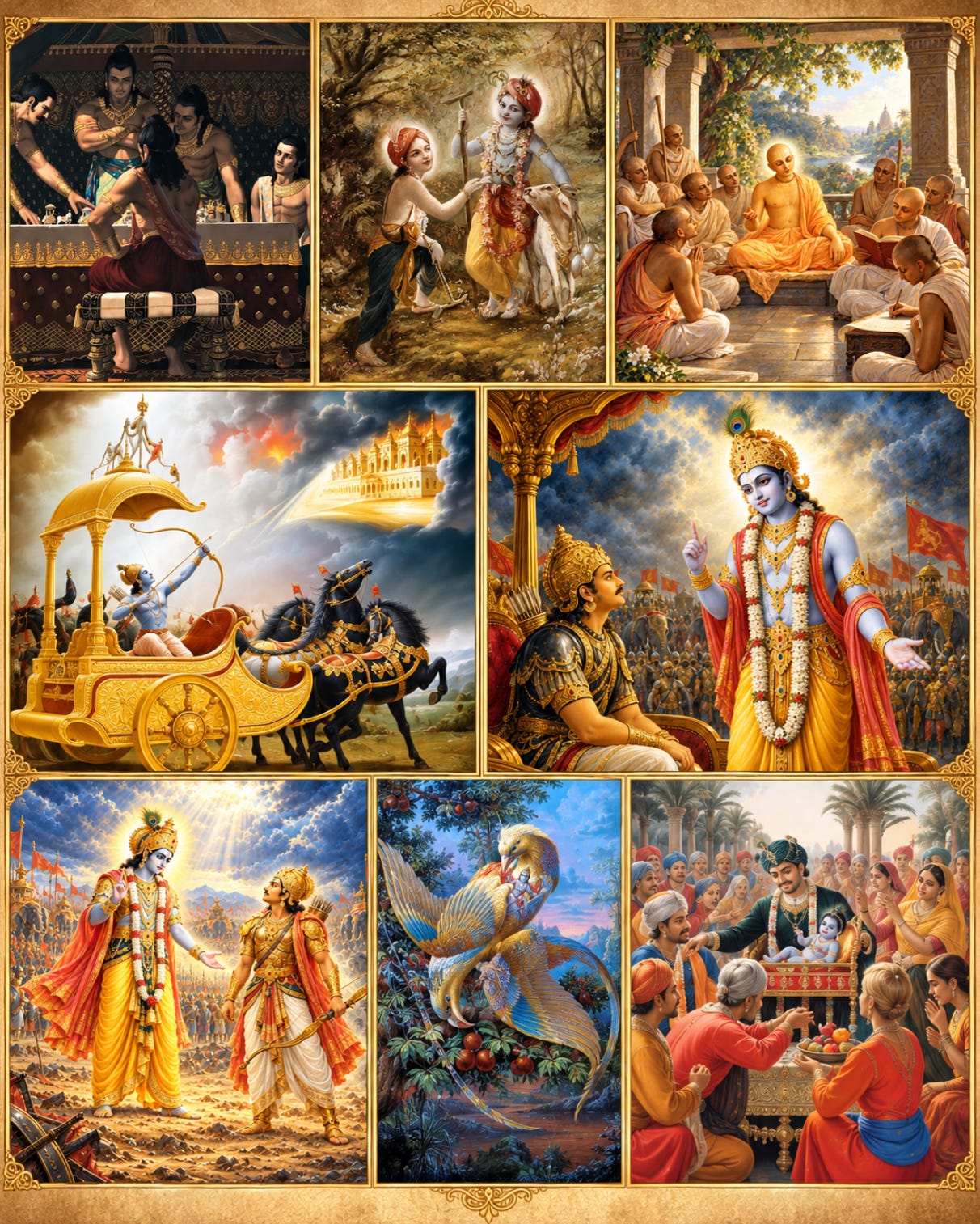
A map of the fourth chapter
The main topic of the fourth chapter is transcendental knowledge, the understanding of our eternal relationship with Kṛṣṇa, which is the basis of the whole devotional process. The keys are:
Source - Subject - Reciprocation
Dilemma - Solution - Process - Key - Choice
Source: The disciplic succession (4.1 to 4.3)
Transcendental knowledge is transmitted through the system of disciplic succession. Without it, the text may remain, but the meaning is lost. The Gītā was originally transmitted to Vivasvān, but over time the succession was broken. Kṛṣṇa thus transmitted it again to Arjuna. Why him? Because he possesses the right qualification to understand the mysteries of the text: he is a devotee and a friend of the Lord. No one can understand the Gītā without having faith in Kṛṣṇa.
Subject: The mystery of Kṛṣṇa’s appearance and activities (4.4 to 4.10)
How can God come to this planet? How can He take birth if He is unborn? Kṛṣṇa reveals His transcendental, absolute nature: He never changes His body, He never forgets, and He never comes in contact with material contamination. Why does He come? To deliver the pious, annihilate the miscreants, and reestablish religious principles. When we truly understand the divine nature of Kṛṣṇa’s appearance and activities, we become pure like Him and never again take birth in this world.
Reciprocation: Kṛṣṇa rewards according to one’s surrender (4.11 to 4.15)
The sun shines for all, but still, people benefit according to the degree to which they come in contact with its light. Similarly, Kṛṣṇa reciprocates with everyone according to their level of surrender. To materialists who want to enjoy without being bothered, He appears as the universal apparatus, giving them their karmic results, while with devotees He reciprocates personally in loving exchanges. To facilitate people’s advancement, He created the varṇāśrama system to regulate material work, but He remains transcendental to it.
Dilemma: The intricacies of action (4.16 to 4.18)
The nature of action is incredibly complex and bewildering. Even the learned have difficulty in correctly differentiating karma, akarma, and vikarma. Only the self-realized can properly understand how detached work can free us from karma (inaction in action) and how showbottle renunciation entangles us (action in inaction).
Solution: Action with knowledge and detachment (4.19 to 4.24)
The main topic of this chapter is transcendental knowledge. Here Kṛṣṇa describes its symptoms. Ordinary people act due to attachment, and jñānis who become detached stop working. A devotee in full knowledge, however, works tirelessly, but without any desire for sense gratification. How is it possible? Transcendental knowledge elevates him to the platform of Kṛṣṇa consciousness, destroying all his accumulated karma. On this platform, he remains fully satisfied, independent of material association, and unaffected by success or failure. Because he works for Kṛṣṇa, his actions merge into transcendence. In other words, even while acting in this world, he remains completely pure.
Process: Different types of sacrifice (4.25 to 4.32)
Different types of transcendentalists perform different types of sacrifices prescribed in the Vedas. Some give charity, others perform austerities or yoga, study the Vedas, etc. All these sacrifices help one to control the senses and are designed to culminate in spiritual knowledge. When we finally come to understand our relationship with Kṛṣṇa, the same sacrifices lead us to the platform of devotional service. This is the key to progressing from ordinary karma or jñāna to bhakti-yoga. The transcendental knowledge Kṛṣṇa describes here is thus the root cause of all spiritual progress.
Key: Learn the truth by approaching a spiritual master (4.33 to 4.38)
After explaining the vital importance of transcendental knowledge, Kṛṣṇa explains how it is obtained. It cannot be obtained by speculation. One has to approach a self-realized spiritual master and learn the correct conclusions from him. One has to inquire with submission and offer some service. The latter is essential, because service to the spiritual master creates the invisible qualification one needs to understand. Why does the spiritual master have to be self-realized? Only someone who has seen the truth can perfectly describe it. And what is the benefit? Transcendental knowledge acts as a boat to cross the ocean of material miseries and as a blazing fire that destroys all karmic reactions.
Choice: The two paths: Faith and doubt (4.39 to 4.42)
The process Kṛṣṇa described can be followed only by someone with strong faith. Without faith, one cannot control the senses, and without it one cannot practice the process. The doubting soul cannot attain any real spiritual progress and eventually falls from whatever platform he may achieve. Ultimately, he cannot find happiness in either this world or the next. Therefore, we should slash any doubts we have in our hearts with the weapon of transcendental knowledge and “stand up and fight,” working for Kṛṣṇa in devotional service.
From the eternal Source, true knowledge descends;
its Subject is Kṛṣṇa, the beginning and end.
Through loving Reciprocation, He answers each soul,
and resolves action’s Dilemma by revealing its goal.
Knowledge and detachment uncover the Solution;
Sacrifice is the Process that leads to purification.
From the spiritual master, we receive the Key;
Our Choice lies between doubt and the faith that sets us free.
Read the entire book:
« The Song of God—Volume 1, chapters 1-6

This is a publication for thoughtful readers who want to go deeper into Kṛṣṇa consciousness. I publish daily, trying to offer high-quality spiritual content, and all posts are available to free subscribers. If you wish, you can also choose a paid subscription to support this work.
You can also receive the updates on WhatsApp or Telegram.
If you would like to contribute further, you can find the donation links here.