

« The Song of God—Volume 1, chapters 1-6
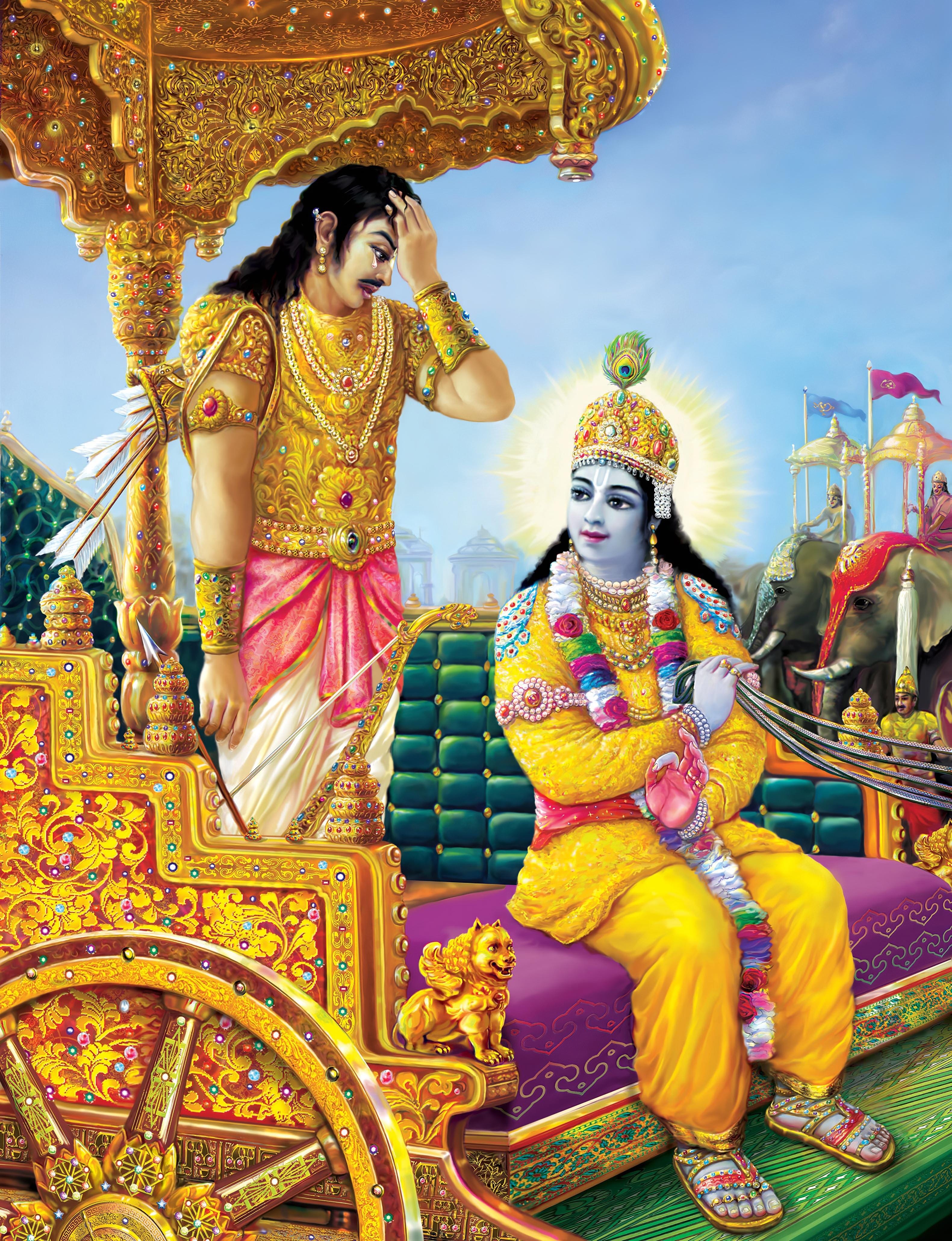
Arjuna feels compassion and fear (Bg 1.28 to 1.29)
Kṛṣṇa brought Arjuna to the middle of the armies so he could see with his own eyes the real cost of the battle. Seeing his relatives, teachers, friends, and well-wishers assembled on both sides, Arjuna’s confidence vanishes. His internal conflict is so acute that it appears as visible symptoms in his body.
Text 28: arjuna uvāca
dṛṣṭvemam sva-janam kṛṣṇa, yuyutsum samupasthitam
sīdanti mama gātrāṇi, mukham ca pariśuṣyati
Arjuna said: My dear Kṛṣṇa, seeing my friends and relatives present before me in such a fighting spirit, I feel the limbs of my body quivering and my mouth drying up.
Text 29: vepathuś ca śarīre me, roma-harṣaś ca jāyate
gāṇḍīvam sramsate hastāt, tvak caiva paridahyate
My whole body is trembling, my hair is standing on end, my bow Gāṇḍīva is slipping from my hand, and my skin is burning.
Arjuna felt a mixture of emotions that led to different symptoms described in these two verses. In his commentary, Prabhupāda explains that some of these symptoms, described in the first verse (the quivering of the limbs and the mouth drying up), were symptoms of compassion for the soldiers on the opposite side. Although it’s not directly described in the verse, we can also assume that he was crying out of compassion. Arjuna was naturally compassionate toward the soldiers on his side from the beginning, but his compassion even for the soldiers on the opposite side is a symptom of his being a pure devotee of the Lord.
Prabhupāda quotes verse 5.18.12 of the Śrīmad-Bhāgavatam, yasyāsti bhaktir bhagavaty akiñcanā, sarvair guṇais tatra samāsate surāḥ. One who has unflinching devotional faith in the Supreme Lord and is engaged in His service automatically develops all the good qualities of the demigods. We can see a practical example in Arjuna.
According to Prabhupāda, however, the symptoms described in text 1.29 were due to fear. Arjuna was afraid to fight because he was afraid of losing his life in battle or causing others to be killed. As Prabhupāda mentions, “There is no fear in transcendental realization. Arjuna’s symptoms in this situation are out of material fear – namely, loss of life.”
Arjuna thus showed a complex mixture of contradictory symptoms that are described in these and the following verses. The state to which Arjuna had descended, the way he was overwhelmed by the situation, and his state of internal conflict and confusion serve as the stage for Kṛṣṇa’s instructions in the Bhagavad-gītā. Arjuna, the great hero of the Mahābhārata, was disturbed to the point of wanting to abandon the battlefield at the crucial moment. This highlights the seriousness of the situation and helps us to understand the impact and value of Kṛṣṇa’s teachings.
Main points in the purports of Śrīla Prabhupāda:
“Arjuna said: My dear Kṛṣṇa, seeing my friends and relatives present before me in such a fighting spirit, I feel the limbs of my body quivering and my mouth drying up.”
a) Being a devotee is not just a matter of faith. It is the key to developing all good qualities. A pure devotee naturally develops all the good qualities of saints and demigods, whereas a materialist, no matter how educated by material standards, will always lack in genuine good qualities.
b) Being a pure devotee of the Lord, Arjuna possessed all good qualities. His first reaction to seeing the soldiers on the other side was compassion. The sight of the whole community of blood relatives prepared to fight against him overwhelmed a kind devotee like Arjuna. His limbs were quivering, his mouth was drying up, and he was crying out of compassion. These symptoms were not due to weakness but to a soft heart.
“My whole body is trembling, my hair is standing on end, my bow Gāṇḍīva is slipping from my hand, and my skin is burning.”
a) The quivering of the whole body and hair standing on end, on the other hand, were symptoms of fear. Prabhupāda explains that these two symptoms can also manifest out of great spiritual ecstasy, but that was not the case of Arjuna. It was because of fear of loss of life under a material conception of life. This is reinforced by his bow slipping from his hands and the burning sensation of the skin.
Next: The result of material attachment (Bg 1.30)
Read the entire book:
« The Song of God—Volume 1, chapters 1-6

This is a publication for thoughtful readers who want to go deeper into Kṛṣṇa consciousness. I publish daily, trying to offer high-quality spiritual content, and all posts are available to free subscribers. If you wish, you can also choose a paid subscription to support this work.
You can also receive the updates on WhatsApp or Telegram.
If you would like to contribute further, you can find the donation links here.