

« Making Sense of the Vedic Universe, a Higher-Dimensional Reality
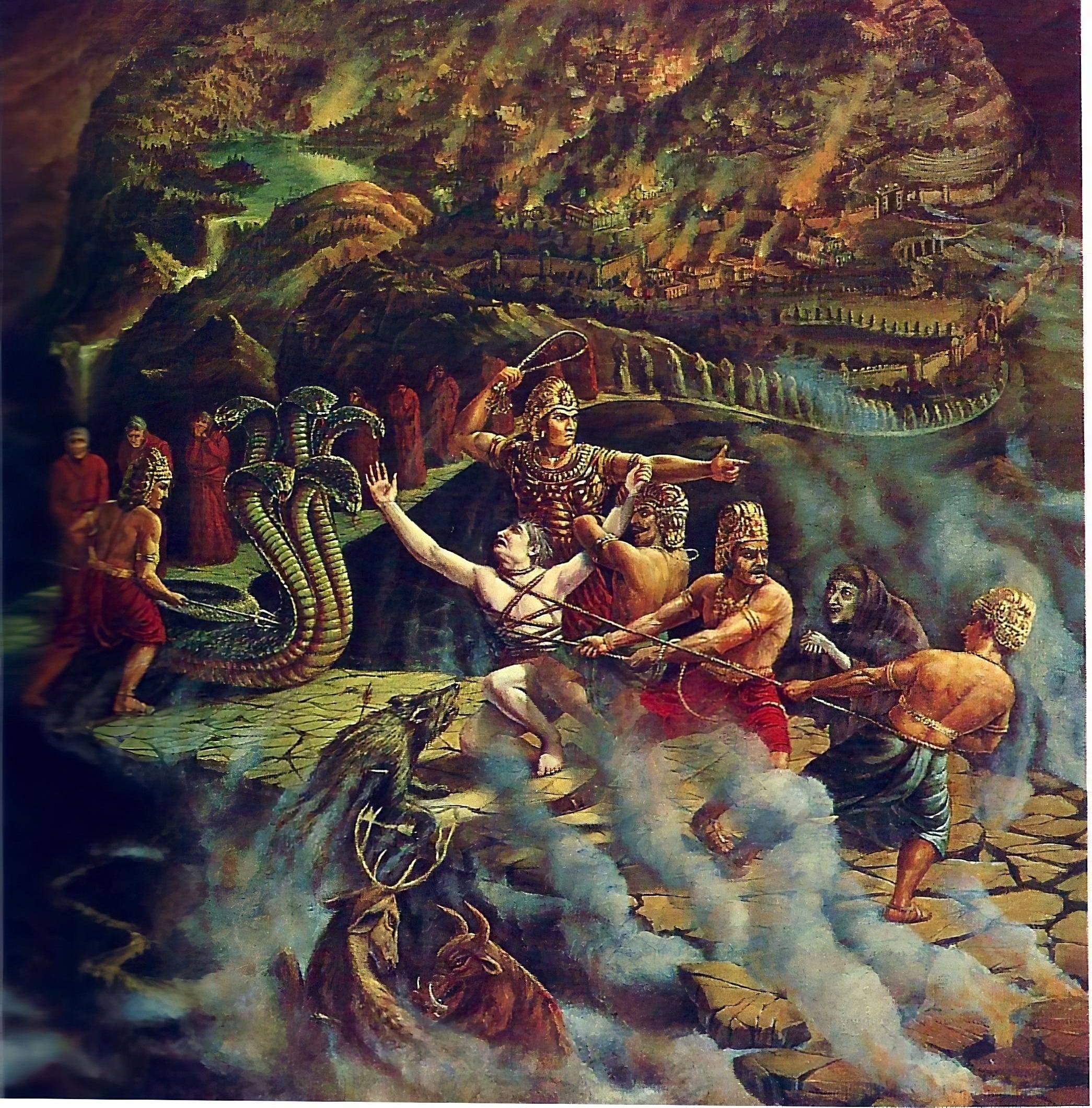
A description of the hellish planets
Śukadeva Gosvami continues with a description of some of the individual hells a person can go to for performing specific types of sinful activities.
“My dear King, a person who appropriates another’s legitimate wife, children or money is arrested at the time of death by the fierce Yamadūtas, who bind him with the rope of time and forcibly throw him into the hellish planet known as Tāmisra. On this very dark planet, the sinful man is chastised by the Yamadūtas, who beat and rebuke him. He is starved, and he is given no water to drink. Thus the wrathful assistants of Yamarāja cause him severe suffering, and sometimes he faints from their chastisement.
The destination of a person who slyly cheats another man and enjoys his wife and children is the hell known as Andhatāmisra. There his condition is exactly like that of a tree being chopped at its roots. Even before reaching Andhatāmisra, the sinful living being is subjected to various extreme miseries. These afflictions are so severe that he loses his intelligence and sight. It is for this reason that learned sages call this hell Andhatāmisra.” (SB 5.26.8-9)
Family life is considered very sacred in Vedic culture. Not only is one’s family very central to his duties and place in society, but it is also the place where one can perform the service of educating his children in God consciousness. Having one’s wife and children taken away is certainly a very painful experience, and it is also very damaging for society at large. If one treacherously performs such a sin, one becomes entitled to be punished on this particular planet.
“A person who accepts his body as his self works very hard day and night for money to maintain his own body and the bodies of his wife and children. While working to maintain himself and his family, he may commit violence against other living entities. Such a person is forced to give up his body and his family at the time of death, when he suffers the reaction for his envy of other creatures by being thrown into the hell called Raurava.
In this life, an envious person commits violent acts against many living entities. Therefore after his death, when he is taken to hell by Yamarāja, those living entities who were hurt by him appear as animals called rurus to inflict very severe pain upon him. Learned scholars call this hell Raurava. Not generally seen in this world, the ruru is more envious than a snake.
Punishment in the hell called Mahāraurava is compulsory for a person who maintains his own body by hurting others. In this hell, ruru animals known as kravyāda torment him and eat his flesh.
For the maintenance of their bodies and the satisfaction of their tongues, cruel persons cook poor animals and birds alive. Such persons are condemned even by man-eaters. In their next lives they are carried by the Yamadūtas to the hell known as Kumbhīpāka, where they are cooked in boiling oil.” (SB 5.26.10-13)
The rurus are not regular animals. They are very angry and have very strong bodies, and are thus capable of causing great suffering. Where do they come from? The very animals and other creatures that a person tortured in his life have the opportunity to take such forms to avenge their suffering.
In the Fourth Canto, it is described that Nārada Muni showed these rurus to King Prācīnabarhi, in a visual display of what was awaiting him after death due to his indiscriminate killing of animals in unnecessary fruitive sacrifices: “The great saint Nārada said: O ruler of the citizens, my dear King, please see in the sky those animals which you have sacrificed without compassion and without mercy in the sacrificial arena. All these animals are awaiting your death so that they can avenge the injuries you have inflicted upon them. After you die, they will angrily pierce your body with iron horns.” (SB 4.25.7-8)
This is, however, not something imposed. The animals are not forced to take such forms, but if they hold a grudge against their tormentor, they have this opportunity of waiting for him or her at the doors of the hellish planets to get their revenge. After that, they continue their evolutionary path. In his purport to text 10, Prabhupāda explains that, “If one simply considers his body to be his self, as do the animals, he is not very sinful. However, if one needlessly commits sins to maintain his body, he is put into the hell known as Raurava. This is the opinion of Śrīla Viśvanātha Cakravartī Ṭhākura. Although animals are certainly in the bodily concept of life, they do not commit any sins to maintain their bodies, mates or offspring. Therefore animals do not go to hell. However, when a human being acts enviously and cheats others to maintain his body, he is put into a hellish condition.”
Meat eating is sanctioned in the scriptures in certain cases and for certain types of persons, but never with unnecessary cruelty. When Nārada Muni saw Mṛgāri torturing the animals before killing them, intentionally shooting them at non-vital points, so they would bleed to death, he asked him to at least kill the animals immediately, so they would not suffer in that way. On that occasion, he also showed him the punishment that was awaiting him in hell. This led Mṛgāri to have a change of heart and stop killing animals altogether, becoming instead a pure Vaiṣnava.
“The killer of a brāhmaṇa is put into the hell known as Kālasūtra, which has a circumference of eighty thousand miles and which is made entirely of copper. Heated from below by fire and from above by the scorching sun, the copper surface of this planet is extremely hot. Thus the murderer of a brāhmaṇa suffers from being burned both internally and externally. Internally he is burning with hunger and thirst, and externally he is burning from the scorching heat of the sun and the fire beneath the copper surface. Therefore he sometimes lies down, sometimes sits, sometimes stands up and sometimes runs here and there. He must suffer in this way for as many thousands of years as there are hairs on the body of an animal.” (SB 5.26.14)
In Vedic societies, brāhmanas and cows have special importance, for the brāhmanas take care of the society spiritually, while cows and bulls maintain it materially, with milk, labor, and fertilizer for agriculture. Brāhmanas and cows are thus considered most beneficial for any civilized society. Due to their importance, and also the fact that they are basically defenseless, it is considered a great sin to kill them. If, despite this strong warning from the scriptures, one does so, he becomes eligible for being tormented in this particular type of hell.
“If a person deviates from the path of the Vedas in the absence of an emergency, the servants of Yamarāja put him into the hell called Asi-patravana, where they beat him with whips. When he runs hither and thither, fleeing from the extreme pain, on all sides he runs into palm trees with leaves like sharpened swords. Thus injured all over his body and fainting at every step, he cries out, “Oh, what shall I do now! How shall I be saved!” This is how one suffers who deviates from the accepted religious principles.” (SB 5.26.15)
People who were born in Vedic societies would be trained since birth to follow the path of the Vedas and worship the Supreme Lord. This was a great privilege, that would allow them to follow the path of piety since early life, instead of being born in degraded families and having the opportunity to come in contact with Kṛṣṇa consciousness only later on, as most of us do nowadays. However, this would also come with a great responsibility, since they were expected to continue following these principles. An innocent person, who was never educated in the Vedas, and because of this would commit different sinful activities, would not be punished in the same way as someone who was born in an advanced society and received proper training since birth, but still chose to live a life of sin, even though having all opportunities, and understanding that these activities are wrong.
There is also the question of emergencies. Sometimes there would be great famines, and people would be forced to eat animals or other types of food that would normally not be acceptable. This would generally not be considered very sinful if performed under certain limits. However, if one would kill an animal without necessity, just to enjoy the meat, there would be serious punishment.
What about us? Even though we may not be expected to follow rules and regulations to the same extent as people born in Vedic societies, still we need to accept the laws of God. Prabhupāda explains how this applies to our reality in his purport to text 5.26.15.
Dharmaṁ tu sākṣād bhagavat-praṇītam: Ultimately, religious principle means to follow the orders of the Supreme Personality of Godhead. The dharma for this age is to practice the process of saṅkīrtana, chanting the holy names of the Lord. When we do that, not only do we automatically advance in spiritual realization, but we are also excused for past sinful activities. Apart from Kṛṣṇa consciousness, there are other systems of religion that offer other forms of God worship. Even if one is not a Vaiṣnava devotee, one should follow one of these systems and abide by the rules and regulations prescribed, following thus the laws of God at least to some level. If one intentionally rejects the path of religion and becomes an atheist, living a life of sin, disregarding all regulations from the scriptures, one becomes eligible to be punished in this particular hell.
In this context, it’s important to note that both the Bible and the Quran contain passages that condemn the killing of animals, such as “Thou shalt not kill.” This is not unique to Vaiṣnava literature. The difficulty is that people opt for overlooking these rules. Other forms of animal cruelty are also punishable, as described in texts 5.26.32 to 34.
The next hell is described as a specific place for government officers who unnecessarily punish the innocent:
“In his next life, a sinful king or governmental representative who punishes an innocent person, or who inflicts corporal punishment upon a brāhmaṇa, is taken by the Yamadūtas to the hell named Sūkaramukha, where the most powerful assistants of Yamarāja crush him exactly as one crushes sugarcane to squeeze out the juice. The sinful living entity cries very pitiably and faints, just like an innocent man undergoing punishments. This is the result of punishing a faultless person.” (SB 5.26.16)
Kings, ministers, and other government officials concentrate a great deal of power, but this power is supposed to be used to protect the innocent public. If instead one becomes cruel or corrupt and uses this power to oppress, punishing innocent people, he becomes eligible to be punished on this particular planet.
Brāhmanas are generally considered out of the jurisdiction of common law. Even if a brāhmana commits some mistake, he is supposed to be corrected by other brāhmanas, or realize the mistake himself and atone for it. If a brāhmana commits serious sins, and doesn’t atone for them, he is eligible to be punished by Yamarāja. However, a brāhmana is never supposed to be imprisoned, whipped, or hanged like an ordinary criminal. If a government officer would do that, he would also become eligible to be punished in this way.
“By the arrangement of the Supreme Lord, low-grade living beings like bugs and mosquitoes suck the blood of human beings and other animals. Such insignificant creatures are unaware that their bites are painful to the human being. However, first-class human beings — brāhmaṇas, kṣatriyas and vaiśyas — are developed in consciousness, and therefore they know how painful it is to be killed. A human being endowed with knowledge certainly commits sin if he kills or torments insignificant creatures, who have no discrimination. The Supreme Lord punishes such a man by putting him into the hell known as Andhakūpa, where he is attacked by all the birds and beasts, reptiles, mosquitoes, lice, worms, flies, and any other creatures he tormented during his life. They attack him from all sides, robbing him of the pleasure of sleep. Unable to rest, he constantly wanders about in the darkness. Thus in Andhakūpa his suffering is just like that of a creature in the lower species.” (SB 5.26.17)
The most fundamental religious principle is non-violence. We can see that Lord Buddha was forced to reject the Vedas because people at the time were misusing the authority of the scriptures and indiscriminately killing animals. He thus centered his message on the idea of non-violence, bringing people back to the path of piety and creating the basis for the work of the following ācāryas.
Even insects that bite, such as mosquitoes, should not be killed, for they lack the understanding that their bites create pain to others and are thus considered to be innocent. Animals may kill each other, like a tiger hunting a deer, or a spider capturing another insect, but as human beings we are gifted with superior intelligence and should use it to find peaceful ways to deal with disturbing insects and other creatures.
Even if one argues that this is too difficult for general people to follow, the scriptures prescribe that at least brāhmaṇas, kṣatriyas, and vaiśyas, who would receive higher education, should follow this principle. If a member of these higher classes indiscriminately kills these animals, he or she becomes eligible to be punished in this particular place.
“A person is considered no better than a crow if after receiving some food, he does not divide it among guests, old men and children, but simply eats it himself, or if he eats it without performing the five kinds of sacrifice. After death he is put into the most abominable hell, known as Kṛmibhojana. In that hell is a lake 100,000 yojanas [800,000 miles] wide and filled with worms. He becomes a worm in that lake and feeds on the other worms there, who also feed on him. Unless he atones for his actions before his death, such a sinful man remains in the hellish lake of Kṛmibhojana for as many years as there are yojanas in the width of the lake.” (SB 5.26.18)
Sharing food is considered a very important principle in Vedic society. The central idea is that food is given by the Supreme Lord; it doesn’t belong to us. It should thus be first offered in sacrifice, and then the prasāda should be distributed to others. Prabhupāda quotes Bg 3.13 and 3.9 in his purport to sustain this point.
In Vedic societies, there would be many itinerant sages who would dedicate themselves to serving the Lord and educating society, and would depend on the charity of the householders to eat. Each family would thus always cook extra to feed these exalted guests as well as other hungry people who would be around. Similarly, a man, as the head of the family, was supposed to feed his dependents, including his wife, children, elderly parents, etc. If one just eats alone, leaving all these dependents hungry, one becomes eligible to be born as a worm in this hellish lake.
Another similar verse is SB 5.26.35, which describes an envious person who mistreats such guests: “A householder who receives guests or visitors with cruel glances, as if to burn them to ashes, is put into the hell called Paryāvartana, where he is gazed at by hard-eyed vultures, herons, crows and similar birds, which suddenly swoop down and pluck out his eyes with great force.”
In summary, receiving guests and distributing prasāda should be accepted as an important duty in family life, that we should perform with happiness according to our means. As Kṛṣṇa mentions in the Gītā (17.20-21), charity given out of duty, without expectation of return, at the proper time and place, and to a worthy person is considered to be in the mode of goodness. Conversely, charity performed with the expectation of some return, or with a desire for fruitive results, or in a grudging mood is said to be charity in the mode of passion
“My dear King, a person who in the absence of an emergency robs a brāhmaṇa — or, indeed, anyone else — of his gems and gold is put into a hell known as Sandaṁśa. There his skin is torn and separated by red-hot iron balls and tongs. In this way, his entire body is cut to pieces.” (SB 5.26.19)
When we speak about not eating meat, people often bring forth the idea of killing animals to feed starving people and other extreme situations. This idea of emergency situations is acknowledged in the Vedas. One may have to kill an animal, or even be forced to steal to survive some extreme situation. That is understandable. If, however, one performs such activities when there is no emergency, unnecessarily causing suffering to others, one becomes punishable.
Another similar verse is 5.26.27: “In this world, some persons are professional plunderers who set fire to others’ houses or administer poison to them. Also, members of the royalty or government officials sometimes plunder mercantile men by forcing them to pay income tax and by other methods. After death such demons are put into the hell known as Sārameyādana. On that planet there are 720 dogs with teeth as strong as thunderbolts. Under the orders of the agents of Yamarāja, these dogs voraciously devour such sinful people.”
“A man or woman who indulges in sexual intercourse with an unworthy member of the opposite sex is punished after death by the assistants of Yamarāja in the hell known as Taptasūrmi. There such men and women are beaten with whips. The man is forced to embrace a red-hot iron form of a woman, and the woman is forced to embrace a similar form of a man. Such is the punishment for illicit sex. A person who indulges in sex indiscriminately — even with animals — is taken after death to the hell known as Vajrakaṇṭaka-śālmalī. In this hell there is a silk-cotton tree full of thorns as strong as thunderbolts. The agents of Yamarāja hang the sinful man on that tree and pull him down forcibly so that the thorns very severely tear his body.” (SB 5.26.20-21)
In Vedic societies, people would be extremely careful about sex life, being sure to follow the principles that would bring forth good children, who could be trained to follow the path of dharma and uphold the family traditions.
Illicit sex is often described as the most sinful activity, because it invites a degraded soul to take shelter in the womb. A child may be innocent when small, but as one grows up, the nature of one’s past life comes to the surface, and one continues on the path he was previously on. One may not kill brāhmanas or cows, but if he or she is the cause of the birth of people who will perform these activities, one also becomes responsible. That’s precisely the problem with promiscuous sex. It has immediate consequences, in terms of degrading one’s consciousness and destroying families, and even more serious consequences for the future, for the quality of the descendants it produces.
Uncontrolled sex drive is also the cause of many types of violence, especially against women. Sometimes people even molest animals for this purpose. All of this is also punishable.
Prabhupāda explains this point didactically in his purport to text 20: “Generally a man should not have sexual relations with any woman other than his wife. According to Vedic principles, the wife of another man is considered one’s mother, and sexual relations are strictly forbidden with one’s mother, sister and daughter. If one indulges in illicit sexual relations with another man’s wife, that activity is considered identical with having sex with one’s mother. This act is most sinful. The same principle holds for a woman also; if she enjoys sex with a man other than her husband, the act is tantamount to having sexual relations with her father or son. Illicit sex life is always forbidden, and any man or woman who indulges in it is punished in the manner described in this verse.”
“A person who is born into a responsible family — such as a kṣatriya, a member of royalty or a government servant — but who neglects to execute his prescribed duties according to religious principles, and who thus becomes degraded, falls down at the time of death into the river of hell known as Vaitaraṇī. This river, which is a moat surrounding hell, is full of ferocious aquatic animals. When a sinful man is thrown into the river Vaitaraṇī, the aquatic animals there immediately begin to eat him, but because of his extremely sinful life, he does not leave his body. He constantly remembers his sinful activities and suffers terribly in that river, which is full of stool, urine, pus, blood, hair, nails, bones, marrow, flesh and fat.” (SB 5.26.22)
Many of the punishments described in this chapter apply only to people from certain classes or occupying certain positions, taking into account one’s varṇa, knowledge, duties, and social responsibilities. The higher one’s social and spiritual position, the more is expected, and the more serious the consequences of failing to follow basic religious and moral principles. This suggests that varṇa and the level of training and facilities one receives affect the consequences one faces. A person in a lower varṇa, such as a śūdra or lower than a śūdra, might not be held to the same standard or suffer the same punishment for the same acts, just like children in primary school are not supposed to answer the same tests as adults at the university.
“The shameless husbands of lowborn śūdra women live exactly like animals, and therefore they have no good behavior, cleanliness or regulated life. After death, such persons are thrown into the hell called Pūyoda, where they are put into an ocean filled with pus, stool, urine, mucus, saliva and similar things. Śūdras who could not improve themselves fall into that ocean and are forced to eat those disgusting things.” (SB 5.26.23)
Brāhmanas, kṣatriyas and vaiśyas are supposed to perform the duties and regulations prescribed for their own classes. There are many reasons for that, but one of them is because they occupy responsible, privileged positions on which many others depend. If a brāhmana fails to give the proper example and educate people on religious principles, people become irreligious, perform sinful activities, and go to hell, and thus the brāhmana also shares part of these sins. Similarly, if a kṣatriya fails to perform his duty of protecting people, or abuses his position, he causes suffering to many innocent persons, and thus becomes punishable. The same applies in a lesser degree to a vaiśya, who is supposed to protect many workers, animals, etc.
Śūdras are not expected to perform the same level of duties at the start, but they must try to elevate themselves. It is not because one has taken birth in a degraded position that one should stay there. We should use the higher intelligence we receive in human life to improve ourselves, no matter how high or low our current birth is, what kind of education we received, or what kind of mistakes we did in the past. In any case, we should reform ourselves, and the most practical way to do that in the age we live, is by practicing Kṛṣṇa consciousness.
As Prabhupāda explains in his purport, “Even if one is by qualification a śūdra, he must try to improve his position and become a brāhmaṇa. No one should try to check a person, no matter what his present position is, from coming to the platform of a brāhmaṇa or a Vaiṣṇava. Actually, one must come to the platform of a Vaiṣṇava. Then he automatically becomes a brāhmaṇa. This can be done only if the Kṛṣṇa consciousness movement is spread, for we are trying to elevate everyone to the platform of Vaiṣṇava. As Kṛṣṇa says in Bhagavad-gītā (18.66), sarva-dharmān parityajya mām ekaṁ śaraṇaṁ vraja: “Abandon all other duties and simply surrender unto Me.” One must give up the occupational duties of a śūdra, kṣatriya or vaiśya and adopt the occupational duties of a Vaiṣṇava, which include the activities of a brāhmaṇa. Kṛṣṇa explains this in Bhagavad-gītā (9.32): māṁ hi pārtha vyapāśritya, ye ’pi syuḥ pāpa-yonayaḥ, striyo vaiśyās tathā śūdrās, te ’pi yānti parāṁ gatim
“O son of Pṛthā, those who take shelter in Me, though they be of lower birth — women, vaiśyas [merchants], as well as śūdras [workers] — can approach the supreme destination.” Human life is specifically meant for going back home, back to Godhead. That facility should be given to everyone, whether one be a śūdra, a vaiśya, a woman or a kṣatriya. This is the purpose of the Kṛṣṇa consciousness movement. However, if one is satisfied to remain a śūdra, he must suffer as described in this verse: tad evātibībhatsitam aśnanti.”
“If in this life a man of the higher classes [brāhmaṇa, kṣatriya and vaiśya] is very fond of taking his pet dogs, mules or asses into the forest to hunt and kill animals unnecessarily, he is placed after death into the hell known as Prāṇarodha. There the assistants of Yamarāja make him their targets and pierce him with arrows.” (SB 5.26.24)
Animal hunting is not entirely prohibited in the Vedas, but was practiced under very strict conditions. Hunters and forest dwellers would kill animals without cruelty and chant a mantra in the ear of the dying animal, promising that just as they are killing the animal to eat its flesh, the animal would kill them in a future life. In this case, the hunter would still have to be killed in a future life, following the laws of nature, but he would not go to hell. This custom is still followed in some tribes of Africa.
Kṣatriyas would be allowed to hunt ferocious animals such as tigers to practice their military skills. This was considered a duty to control the population of these animals and prevent them from attacking innocent sages and villagers, and similarly, brāhmanas would sometimes sacrifice animals in Vedic sacrifices. This was also under the scope of their duties and would not produce reactions if executed under the proper regulations.
Hunting animals unnecessarily, as a form of sport is condemnable in any circumstance, but it is especially serious for members of the higher classes, who are supposed to follow the principles of the scriptures. If a brāhmaṇa, kṣatriya, or vaiśya disregards all these regulations and hunts animals for sport, one becomes eligible to be punished in this particular hell.
“A person who in this life is proud of his eminent position, and who heedlessly sacrifices animals simply for material prestige, is put into the hell called Viśasana after death. There the assistants of Yamarāja kill him after giving him unlimited pain.” (SB 5.26.25)
Prabhupāda connects this verse with caste brāhmanas who kill animals as a supposed sacrifice to Durgā, which is still popular in many parts of India: “The word dambha-yajñeṣu in this verse is significant. If one violates the Vedic instructions while performing yajña and simply makes a show of sacrifice for the purpose of killing animals, he is punishable after death. In Calcutta there are many slaughterhouses where animal flesh is sold that has supposedly been offered in sacrifice before the goddess Kālī. The śāstras enjoin that one can sacrifice a small goat before the goddess Kālī once a month. Nowhere is it said that one can maintain a slaughterhouse in the name of temple worship and daily kill animals unnecessarily. Those who do so receive the punishments described herein.”
“If a foolish member of the twice-born classes [brāhmaṇa, kṣatriya and vaiśya] forces his wife to drink his semen out of a lusty desire to keep her under control, he is put after death into the hell known as Lālābhakṣa. There he is thrown into a flowing river of semen, which he is forced to drink.” (SB 5.26.26)
Women often become victims of different forms of sensualized violence. One common form is when a woman is pressed into performing oral sex and taking the semen. It appears that it was also sometimes done in previous ages by men as a way to make their wives submissive, which is defined by Prabhupāda as a black art, a demoniac practice. Here, a specific hell is mentioned for that.
“A person who in this life bears false witness or lies while transacting business or giving charity is severely punished after death by the agents of Yamarāja. Such a sinful man is taken to the top of a mountain eight hundred miles high and thrown headfirst into the hell known as Avīcimat. This hell has no shelter and is made of strong stone resembling the waves of water. There is no water there, however, and thus it is called Avīcimat [waterless]. Although the sinful man is repeatedly thrown from the mountain and his body broken to tiny pieces, he still does not die but continuously suffers chastisement.” (SB 5.26.28)
Families are one of the pillars of society. Another is trust. When people can’t trust each other in basic transactions, life becomes extremely difficult. Anṛtam means lie. Lies are always wrong, but this verse applies specifically to lies that undermine three important dharmic functions: justice, economic trust, and religious trust.
The first is sākṣye (when giving witness). This undermines the principle of justice, potentially causing an innocent to be condemned or a culprit to be freed. Another is dravya-vinimaye (in commercial exchanges), which undermines economic trust and creates problems for others. The third is dāne (in acts of charity), when one promises to give something and later breaks his promise. All three of them are considered serious sins. We should be honest in our dealings and never deliberately lie to gain advantage.
“Any brāhmaṇa or brāhmaṇa’s wife who drinks liquor is taken by the agents of Yamarāja to the hell known as Ayaḥpāna. This hell also awaits any kṣatriya, vaiśya, or person under a vow who in illusion drinks soma-rasa. In Ayaḥpāna the agents of Yamarāja stand on their chests and pour hot melted iron into their mouths.” (SB 5.26.29)
Prabhupāda explains that “One should not be a brāhmaṇa in name only and engage in all kinds of sinful activities, especially drinking liquor. Brāhmaṇas, kṣatriyas and vaiśyas must behave according to the principles of their order. If they fall down to the level of śūdras, who are accustomed to drink liquor, they will be punished as described herein.”
It is much better to be an honest worker, than artificially maintain an exalted position just for the sake of prestige or privileges.
“A lowborn and abominable person who in this life becomes falsely proud, thinking “I am great,” and who thus fails to show proper respect to one more elevated than he by birth, austerity, education, behavior, caste or spiritual order, is like a dead man even in this lifetime, and after death he is thrown headfirst into the hell known as Kṣārakardama. There he must suffer great tribulation at the hands of the agents of Yamarāja.” (SB 5.26.30)
In Vedic culture, people are very strict about offering respects to senior persons. This is another essential part of the social structure. If seniors are not respected, they can’t transmit their knowledge, culture, and experience to the next generations, and society gradually descends into barbarism. By being respectful to seniors, we can benefit from their experience and gain their blessings, and this is especially important in spiritual life. Excessive pride breaks this process, and thus makes us eligible for punishment.
“There are men and women in this world who sacrifice human beings to Bhairava or Bhadra Kālī and then eat their victims’ flesh. Those who perform such sacrifices are taken after death to the abode of Yamarāja, where their victims, having taken the form of Rākṣasas, cut them to pieces with sharpened swords. Just as in this world the man-eaters drank their victims’ blood, dancing and singing in jubilation, their victims now enjoy drinking the blood of the sacrificers and celebrating in the same way.” (SB 5.26.31)
Human sacrifices are not sanctioned anywhere in the Vedas. Even animal sacrifices are not practiced with the goal of killing the animal, but merely testing the power of the mantra, sacrificing an old animal and immediately reviving it. However, as time passed, this original understanding of sacrifice was forgotten, and people started to indiscriminately kill animals, with some going to the point of human sacrifices, like in the case of certain classes of followers of Kālī. It is described that Jaḍa Bharata was once captured by one of such groups. There is a particular hell for those who do this kind of thing.
“One who in this world or this life is very proud of his wealth always thinks, “I am so rich. Who can equal me?” His vision is twisted, and he is always afraid that someone will take his wealth. Indeed, he even suspects his superiors. His face and heart dry up at the thought of losing his wealth, and therefore he always looks like a wretched fiend. He is not in any way able to obtain actual happiness, and he does not know what it is to be free from anxiety. Because of the sinful things he does to earn money, augment his wealth and protect it, he is put into the hell called Sūcīmukha, where the officials of Yamarāja punish him by stitching thread through his entire body like weavers manufacturing cloth.” (SB 5.26.36)
In his purport, Prabhupāda makes the point that whatever money we earn should be used for Kṛṣṇa, since everything belongs to Him. Maharaja Parīkṣit allowed Kali to live in five places: where there is gambling, intoxication, prostitution, animal slaughter, and where there is accumulation of money, since money enables all the other four activities. Too much money also brings pride and greed, which are two great obstacles for any transcendentalist. When one becomes greedy, he tries to accumulate more and more money, often by dishonest means, and becoming proud, he disrespects superiors. As Prabhupāda mentions, “One who possesses more money than he needs should spend it for Kṛṣṇa. Unless one does so, he will become puffed up because of his false possessions, and therefore he will be punished in the next life, as described herein.”
Read the whole book:
« Making Sense of the Vedic Universe, a Higher-Dimensional Reality
This is a publication for thoughtful readers who want to go deeper into Kṛṣṇa consciousness. I publish daily, trying to offer high-quality spiritual content, and all posts are available to free subscribers. If you wish, you can also choose a paid subscription to support this work.
You can also receive the updates on WhatsApp or Telegram.
If you would like to contribute further, you can find the donation links here.
Hare Krishna, please accept my humble obeisances. I have one question.
In thise post on verse SB 5.26.14 it is mentioned that sun heated from above very much on copper flore. Thise raised my question. Since hellish planets are possitioned as lowest in universe and still have sun light, at least thise one, how so that lower planetary sistems like Sutala, Atala, .... and others not have sun lights? If thise lower planetary sistems are planets and not subterranien realms under Bhumandala how they dont have sunlight and even hellish planets positioned lower than them have sunlight?
How to understand thise properly?