


You can receive new articles directly in your inbox. Subscription is free; donations are welcome.
Dhruva is the perfect example of the spirit that kṣatriyas of previous ages would often display. Despite being just a five-year-old child, he became so offended after being rebuked by his stepmother and deprived of his inheritance that he went alone to the forest to practice austerities with the goal of meeting Lord Viṣnu and asking Him for a benediction of achieving a kingdom greater than that of his father or any other of his ancestors. Considering that his father was the grandson of Brahmā, who is the master of the entire universe, this goal appeared impossible. Still, he wanted to achieve it.
He performed such unprecedented austerities that Lord Viṣnu agreed to appear to him after just six months, agreeing to grant Dhruva any blessing he desired. Kṛṣṇa’s policy is that if He gives a material benediction, He gives in such a way that the devotee never has to ask for anything again. A poor person may beg in the street for a few dollars each time, enough to buy his next meal, but if one goes to a trillionaire, he may get enough money to live his whole life without having to beg again. Similarly, the demigods can grant only temporary benefits that disappear quickly, sending one back to the starting point. That’s one of the reasons it is said one should worship only Kṛṣṇa.
What was the blessing given to Dhruva Maharaja? Actually, Dhruva Maharaja became reluctant to ask for anything. Because he had practiced his austerities in a spirit of devotion, under the guidance of Nārada Muni, by the time the Lord finally appeared, he was already so purified that he did not desire anything apart from serving Him.
The Lord was extremely satisfied by that, but He still remembered that Dhruva had originally approached Him with material desires, and decided to satisfy them before bringing Dhruva back to Godhead.
The first blessing the Lord gave was to make Dhruva the emperor of Bhū-loka, the entire planetary system. He was going to reign as an undisputed ruler for 36,000 years and perform great sacrifices.
The second blessing is that even while enjoying his reign as a king, he would never forget him. Therefore, Dhruva could enjoy his reign to the fullest extent, without any danger of falling down from his elevated devotional standard.
The third and highest of the three was to grant him a spiritual planet, a Vaikuṇṭha planet, where Dhruva would not only rule eternally, but remain in the personal association of the Lord. This benediction fulfilled his desire of having a kingdom greater than even Brahmā. Compared to that, sovereignty over a temporary material universe is insignificant.
What did he do after that? We could imagine that after receiving such benedictions, Dhruva was radiant, but in reality he wasn’t. He became morose, regretting having approached the Lord with material desires instead of practicing pure devotional service from the start.
This story is described in the Śrīmad-Bhāgavatam. Hearing it from Maitreya, Vidura was astonished and asked:
“My dear brāhmaṇa, the abode of the Lord is very difficult to attain. It can be attained only by pure devotional service, which alone pleases the most affectionate, merciful Lord. Dhruva Mahārāja achieved this position even in one life, and he was very wise and conscientious. Why, then, was he not very pleased?” (SB 4.9.28)
Maitreya answered that Dhruva started his devotional service to the Lord with material demands in mind instead of desiring liberation from material entanglement. In other words, Dhruva sought to improve his material position instead of asking the Lord for pure devotional service, or for being freed from material contamination. When the Lord finally appeared, he was ashamed of his previous intentions.
Śrila Prabhupāda explains it in his purport to verse 4.9.29:
“Sense gratification means domination over material nature. The whole competition between conditioned souls is based upon domination of this material nature. Modern scientists are proud of their knowledge because they are discovering new methods to dominate the laws of material nature. They think that this is the advancement of human civilization — the more they can dominate the material laws, the more advanced they are. Dhruva Mahārāja’s propensity in the beginning was like that. He wanted to dominate this material world in a greater position than Lord Brahmā. Therefore elsewhere it is described that after the appearance of the Lord, when Dhruva Mahārāja thought and compared his determination to his final reward, he realized that he had wanted a few particles of broken glass but instead had received many diamonds. As soon as he saw the Supreme Personality of Godhead face to face, he immediately became conscious of the unimportance of his demand from the Lord to have an exalted position better than Lord Brahmā’s.”
However, Dhruva became purified due to his practice of devotional service, and when he finally saw the Lord face to face, he became fully situated in the Vāsudeva platform, his original pure consciousness as a soul, or in other words, pure Kṛṣṇa consciousness, and did not want anything apart from serving the Lord. He realized that he had wanted a few particles of broken glass but instead had received many diamonds. Dhruva thus felt he had misused the blessings of his spiritual master Nārada Muni, and that he had thus fallen from his position. Sometimes demigods become envious of great yogis and sadhus and create hindrances in their path. Dhruva concluded they must have compromised his intelligence, making him maintain a vision of duality.
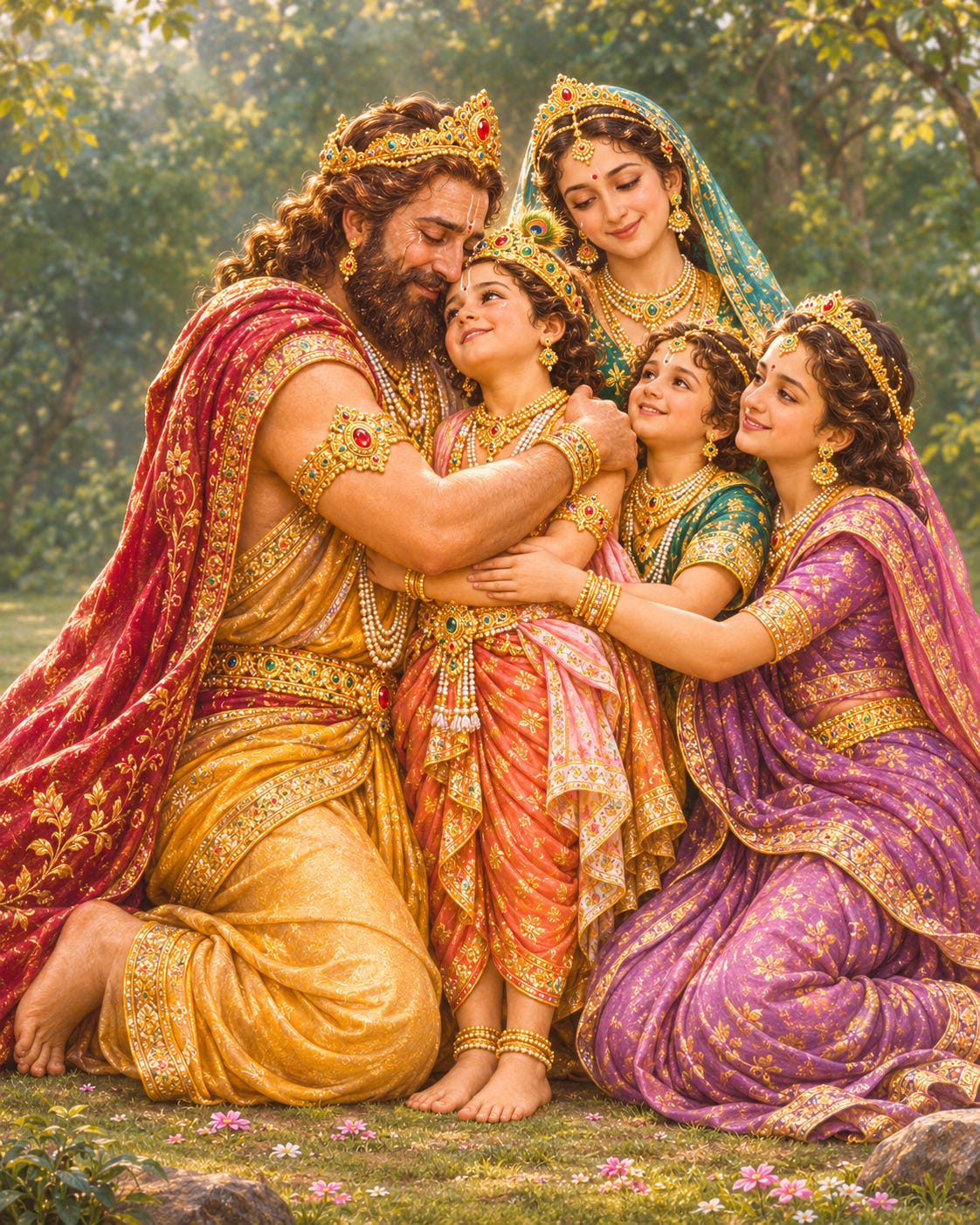
Thinking like this, Dhruva walked back home. When Maharaja Uttānapāda heard the news of the return of his son, he immediately departed to meet him on the way, accompanied by his whole royal entourage, including his family, ministers, soldiers, etc. When he saw Dhruva in a small forest not very far away, he ran to embrace him. However, now Dhruva was not the same as before. He was now completely purified, free from any sense of insult or false prestige. He offered obeisances not only to his father, but to both his mothers. Seeing this exemplary behavior, Suruci also forgot their enmity towards him and also embraced and blessed him; what to say of his mother Sunīti, his brother Uttama and other inhabitants of the palace.
As Maitreya mentions:
“Unto one who has transcendental qualities due to friendly behavior with the Supreme Personality of Godhead, all living entities offer honor, just as water automatically flows down by nature.”
A devotee, having pleased the Lord, automatically pleases everyone, and thus everyone offers him respect. Persons who are averse to the Lord may sometimes become inimical, but any person with a little piety will follow the Lord’s inspiration, and thus a pure devotee receives so much respect from all classes of people.
Although Dhruva abandoned all material aspirations, the Lord knew about his previous desires and thus gave him the opportunity of becoming a great kind, performing many wonderful activities and sacrifices. The Lord thus desired to spread the fame of His pure devotee all over the world, giving the perfect example to all others.
After a short time, his father decided to retire to the forest, passing the kingdom to Dhruva, and after reigning for the allotted 36,000 years, the Viṣṇudutas appeared to take Dhruva back home, back to Godhead, to live with the Lord in his own Vaikuṇṭha planet, Dhruvaloka.
Read more:


This is a publication for thoughtful readers who want to go deeper into Kṛṣṇa consciousness. I publish daily, trying to offer high-quality spiritual content, and all posts are available to free subscribers. If you wish, you can support this work with a monthly contribution. When you subscribe, you can choose between a free subscription and a monthly contribution, and you can switch from a free subscriber to a supporter at any time.
You can also receive updates on WhatsApp or Telegram.
If you would like to contribute further, you can find the donation links here.