


⤴️ There is a narration of the article in my voice. You have the option of hearing instead of reading
You can receive new articles directly in your inbox. Subscription is free; donations are welcome.
In Iskcon and most other contemporary Vaiṣnava groups, we chant 16 rounds of the Hare Kṛṣṇa mantra on beads daily as the foundation of our spiritual practice. We may have the impression that this is some kind of eternal standard and that it was always this way, but in reality, Vaiṣnavas in previous centuries had different standards for japa.
In the times of Sri Caitanya Mahaprabhu, the minimum standard for Vaiṣnavas (followed even by householders) was to chant one lakh, or 100,000 names. This was taught by Mahaprabhu himself, as narrated in the Sri Caitanya Bhagavata:
“As the devotees invited the Lord (Sri Caitanya Mahaprabhu) to take His meal in their houses, the Lord took the opportunity to teach them all this topic. When invited to take a meal, the Lord smiled and said, “First you should become a laksesvara.” “I take meals only in the house of a laksesvara.” Hearing this, the brahmanas became worried.
The brahmanas offered prayers to the Lord, “O Gosaani, what to speak of a hundred thousand, none of us possess even a thousand. If You don’t accept meals from us, then let our entire household be burnt to ashes.”
The Lord replied, “Do you know who is a laksesvara? He is someone who daily chants a hundred thousand holy names. I call that person a laksesvara. I take meals in only such a person’s house, not in the houses of others.” Hearing this merciful statement of the Lord, the brahmanas gave up their anxiety and became joyful. “O Lord, we will chant a hundred thousand names. Please therefore take Your meals in our houses. It is our good fortune that You are teaching us in this way.” (Caitanya Bhagavata, Antya, 9.116-125)
If we make the calculation, one lakh of names equals 58 rounds (16 names per mantra, 108 mantras per round), but generally 64 rounds are taken as one lakh. Prabhupāda mentions this point in his purport to text five of the Nectar of Instruction.
Starting from the times of Mahāprabhu, many devotees were following this principle strictly and would often make vows to not accept prasādam before completing their chanting. Even many householders would follow this standard.
Renunciants would frequently chant even more. Śrila Haridasa Thakura would chant three lakhs, which would take almost the whole day. This granted him the title of namāchārya, the āchārya of the holy names. In the Jaiva Dharma, more concrete examples are given. Lahiri Mahasaya, for example, steadily increased his chanting after initiation until he was consistently chanting two lakhs daily, following the example of the Vaiṣnava babajis he was living with.
By the time of the Gauḍīya Maṭha, brahmacaris and sannyasis were expected to chant 64 rounds, while householders would have 16 rounds as an absolute minimum. Śrila Prabhupada himself was chanting 64 rounds during his renounced years in Vrindavana, before coming to the West, despite all his literary work. Devotees who associated with him during this period would be impressed with the intensity and stability with which he followed his daily sadhana.
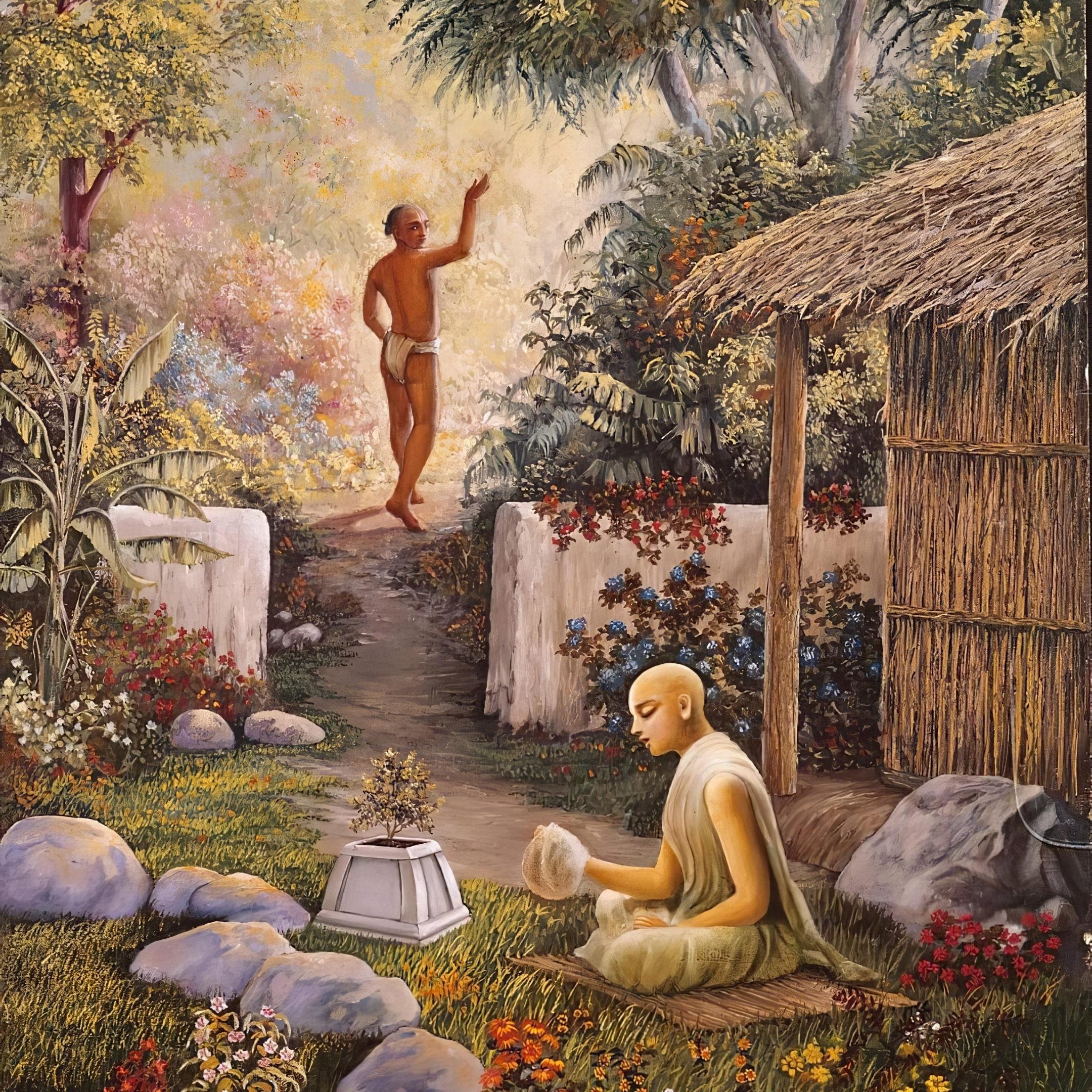
Śrila Bhaktisiddhanta Sarasvati Thakura was chanting three lakhs as a minimum for nine years. He made a vow to chant one billion names before starting his preaching and took nine years to complete it. During his time, he was doing great austerities, like eating just rice once a day, and he was so absorbed in chanting that he would not even take the time to fix the holes in the roof of the hut he was living in. After concluding this vow, he continued chanting one lakh as a minimum until his final days, just as he was instructing his disciples to do.
When Śrila Prabhupāda came to the West, he intended to establish 64 rounds as the standard for brahmacaris and renounced devotees, following the example of the Gauḍīya Maṭha, but due to vehement protests from his first disciples, he eventually agreed to lower the standard to 16 rounds, but “no less”. This is narrated in The Hare Krsna Explosion:
“Now that you have beads,” Swamiji says the next morning, “you should chant sixty-four rounds every day.” “Sixty-four rounds?” To pronounce every word of the mantra distinctly, we require five minutes to chant a round. Sixty-four rounds would take over five hours. “Impossible!” we say. “We’ll never have the time.” “All right,” Swamiji says. “Thirty-two rounds.” “Impossible,” we say. “We’ll never be able to do it. It’s way too much.” “All right,” Swamiji says. “Sixteen rounds. No less.” (p. 63)
Prabhupāda comments on that in the Nectar of Instruction and a few other references:
“The Krsna consciousness movement prescribes sixteen rounds daily because people in the Western countries cannot concentrate for long periods while chanting on beads. Therefore the minimum number of rounds is prescribed. However, Srila Bhaktisiddhanta Sarasvati Thakura used to say that unless one chants at least sixty-four rounds of japa (one hundred thousand names), he is considered fallen (patita). According to his calculation, practically every one of us is fallen, but because we are trying to serve the Supreme Lord with all seriousness and without duplicity, we can expect the mercy of Lord Sri Caitanya Mahaprabhu, who is famous as patita-pavana, the deliverer of the fallen.” (Nectar of Instruction, text 5)
We have the impression that all devotees around us chant 16 rounds, but this is also not true. I know many devotees who chant more. Some chant twenty rounds, or 32; a few chant 64 rounds even. However, usually, devotees who chant more are very secretive about that because most devotees simply can’t understand how someone can chant 64 rounds and just become disturbed upon hearing it. I also know cases of devotees who chant more on Ekadasis and special days, up to 192 rounds. All of this happens around us, although we are often not aware of it.
Chanting 64 rounds may seem like something from another planet, but if one concentrates, it’s possible to chant in five or six hours, and these can be broken into segments. At the beginning of our movement, devotees were trained to always carry their beads whenever they went, so they would always remember to chant whenever there was spare time. If we get the habit of always chanting when there is opportunity, we can chant a lot of extra rounds by the end of the day. Of course, it’s not always possible to chant on beads because of different circumstances, but a counter can help with that. Chanting on counters is not considered as good as chanting on beads for several reasons. Still, it’s always better to chant than not to chant, be it on a counter, on the fingers, making marks on the floor, aloud, mentally, hanging upside down, or whatever. In the Caitanya-caritāmṛta, it is mentioned that Śrī Caitanya Mahāprabhu would often chant on His fingers.
Chanting more is just like fasting on Ekadasis and other practices; it may sound scary at first, but when we finally start doing it, we see that it’s not so hard. In fact, we usually feel better after doing it, since it helps us to get closer to Kṛṣṇa, who is the source of real happiness.
The whole idea is that we should start with a certain number of rounds (even if just one round) and gradually increase during our lives, both in quality and quantity. Quantity also helps, because the purifying effect of the holy names is cumulative, and we tend to start chanting better as we chant more. Sixteen rounds are just the bare minimum for initiated devotees, not a state of perfection.
We often think that as long as we are doing different services, we don’t really need to chant, but Prabhupada mentioned that 90% of our advancement is due to chanting and nothing else. Different services, as well as the study of the scriptures and other limbs of our devotional practice, augment our chanting but don’t replace it. The idea is that by doing services and studying, we can continue to remember Krsna even when we are not chanting, and in this way chant better. To just do services and not chant is like practicing a skill but never really using it.
Read more:


This is a publication for thoughtful readers who want to go deeper into Kṛṣṇa consciousness. I publish daily, trying to offer high-quality spiritual content, and all posts are available to free subscribers. If you wish, you can support this work with a monthly contribution. When you subscribe, you can choose between a free subscription and a monthly contribution, and you can switch from a free subscriber to a supporter at any time.
You can also receive updates on WhatsApp or Telegram.
If you would like to contribute further, you can find the donation links here.
Thank you 🙏
तैलधारामिवाच्छिन्नं दीर्घघण्टानिनादवत् । अवाच्यं प्रणवस्याग्रं यस्तं वेद स वेदवित् ॥
tailadhārāmivācchinnaṁ dīrghaghaṇṭāninādavat । avācyaṁ praṇavasyāgraṁ yastaṁ veda sa vedavit ॥
Continuous like the uninterrupted flow of oil, and like the long, resonant reverberation of a bell; he who knows that indescribable, topmost tip of Pranava (Om) (Naam), he alone truly knows the Vedas.