

« The Song of God—Volume 1, chapters 1-6
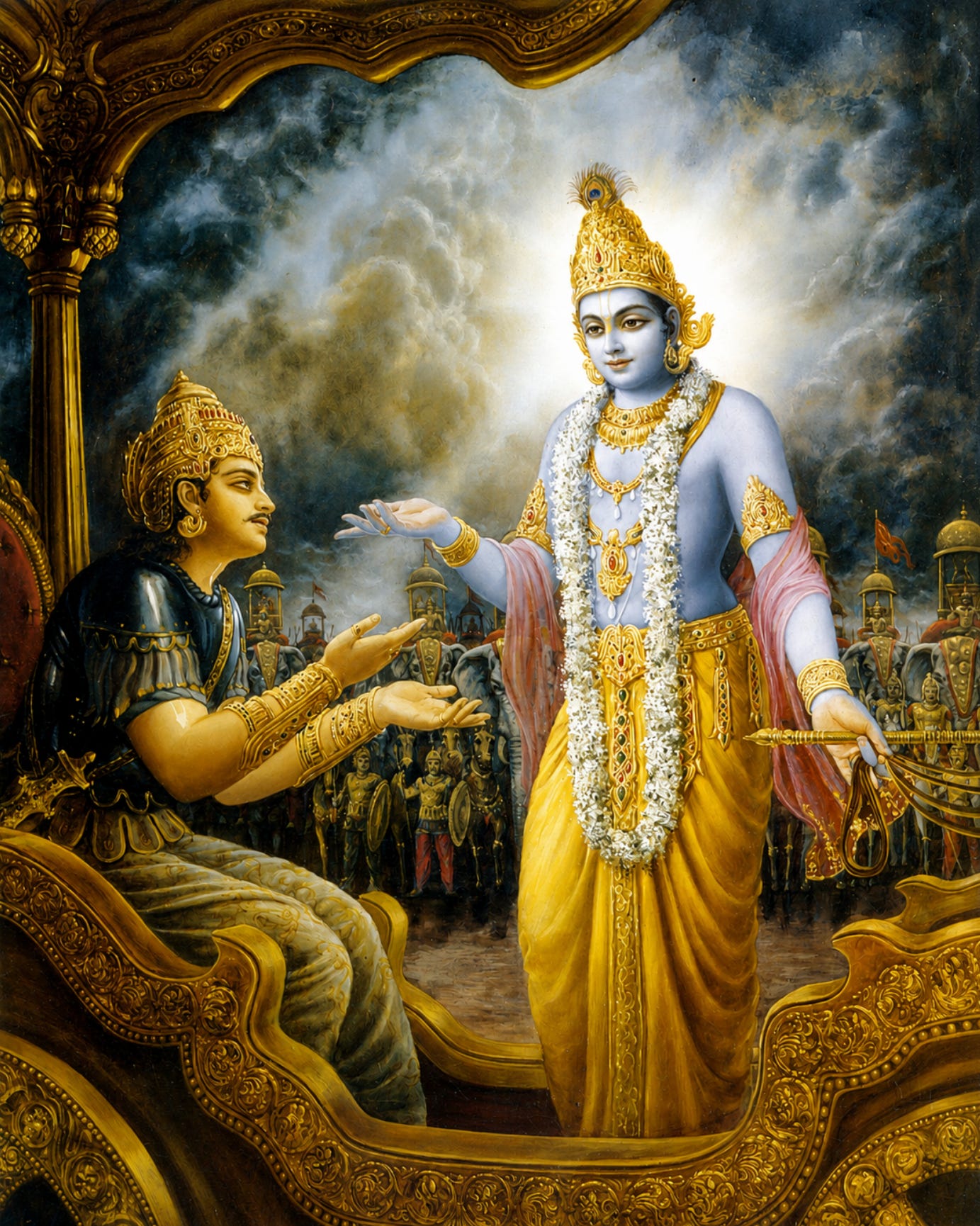
Kṛṣṇa assumes a new role and chastises Arjuna (Bg 2.11)
The root of Arjuna’s confusion is the bodily conception of life: he is thinking in terms of who will live, who will die, and how he will suffer from their loss. Kṛṣṇa immediately cuts through it by declaring that the wise lament neither for the living nor for the dead.
Text 11: śrī-bhagavān uvāca
aśocyān anvaśocas tvam, prajñā-vādāmś ca bhāṣase
gatāsūn agatāsūmś ca, nānuśocanti paṇḍitāḥ
The Supreme Personality of Godhead said: While speaking learned words, you are mourning for what is not worthy of grief. Those who are wise lament neither for the living nor for the dead.
The word “prahasan” in the previous verse means “smiling”. Kṛṣṇa was smiling because His friend Arjuna had become a disciple, allowing Him to destroy his doubts. Arjuna is the eternal friend of Kṛṣṇa; this is his eternal constitutional position as a soul. As it will be revealed later, in the 4th chapter, Arjuna appears together with Kṛṣṇa in different situations and different universes. Just as a king always appears accompanied by his retinue, Kṛṣṇa always appears together with His eternal associates. As a friend, Kṛṣṇa smiled at Arjuna, almost in a joking mood, but this smile quickly gave way to a grave expression, revealing the seriousness of the talks between guru and disciple. After that, Kṛṣṇa was not in the mood of joking, but in the mood of revealing the truth for the benefit of Arjuna.
As Prabhupāda explains, “Kṛṣṇa was smiling because a friend had chosen to become a disciple. As Lord of all, He is always in the superior position as the master of everyone, and yet the Lord agrees to be a friend, a son or a lover for a devotee who wants Him in such a role. But when He was accepted as the master, He at once assumed the role and talked with the disciple like the master – with gravity, as it is required.”
Kṛṣṇa is prepared to reciprocate with all souls who approach Him. Now that Arjuna had accepted Kṛṣṇa as his spiritual master, Kṛṣṇa was prepared to reciprocate by assuming the role of a guru. In a serious tone, He immediately brings the conversation to a higher level by stating, “While speaking learned words, you are mourning for what is not worthy of grief. Those who are wise lament neither for the living nor for the dead.”
The central fault in Arjuna’s arguments was the identification of the material body as the self. He thought Bhīṣma and Droṇa were their mortal bodies, and thus concluded that by attacking them with mortal weapons, he would kill them. By basing his whole reasoning on this false premise, all his logic was incorrect, and his conclusion of not fighting was equivocal. Kṛṣṇa, however, went directly to the root cause of the problem and countered it by reminding Arjuna that we are not the body.
Arjuna was speaking like a scholar, using wise words, but Kṛṣṇa was precise in telling him that in reality, he was behaving like a fool by lamenting the loss of the body while forgetting the existence of the soul. A mundane person cries at the funeral of a relative, lamenting that “my father is gone“ or “my mother is gone“, without realizing that the whole time his father or mother was present, he never associated with the true person, relating instead only with the body. Now that the real person is gone, he laments, even though the body he loved so much is still there. Arjuna was repeating the same mistake, and thus Kṛṣṇa indirectly called him a fool by saying that a panditā (a learned person) does not lament in such a way.
The fact that Kṛṣṇa and Arjuna were talking in between the two armies, allowing everyone to hear their conversation, is also significant, emphasizing the universality of the Bhagavad-gītā, as a book of knowledge destined for all people. Everyone is a soul, part and parcel of Kṛṣṇa. We are all bewildered by the ignorance of the age we live in, and Kṛṣṇa left us the Bhagavad-gītā as a beacon of light to guide us out. In this way, Arjuna became the original recipient of a book of knowledge that is destined for all of us.
Main points in the purport of Śrīla Prabhupāda:
“The Supreme Personality of Godhead said: While speaking learned words, you are mourning for what is not worthy of grief. Those who are wise lament neither for the living nor for the dead.”
a) Arjuna posed his arguments while lamenting over the body, something that is unworthy of lamentation. Because he was lacking in this essential knowledge, he should not have posed as a learned man. As the spiritual master, Kṛṣṇa immediately chastises his disciple.
b) The body is temporary and will eventually come to an end, be it today or tomorrow; therefore, it is not as important as the soul. One who knows the difference between the temporary and eternal does not lament.
Next: Knowledge about the soul (Bg 2.12 and 2.13)
Read the entire book:
« The Song of God—Volume 1, chapters 1-6

This is a publication for thoughtful readers who want to go deeper into Kṛṣṇa consciousness. I publish daily, trying to offer high-quality spiritual content, and all posts are available to free subscribers. If you wish, you can also choose a paid subscription to support this work.
You can also receive the updates on WhatsApp or Telegram.
If you would like to contribute further, you can find the donation links here.