


You can receive new articles directly in your inbox. Subscription is free; donations are welcome.
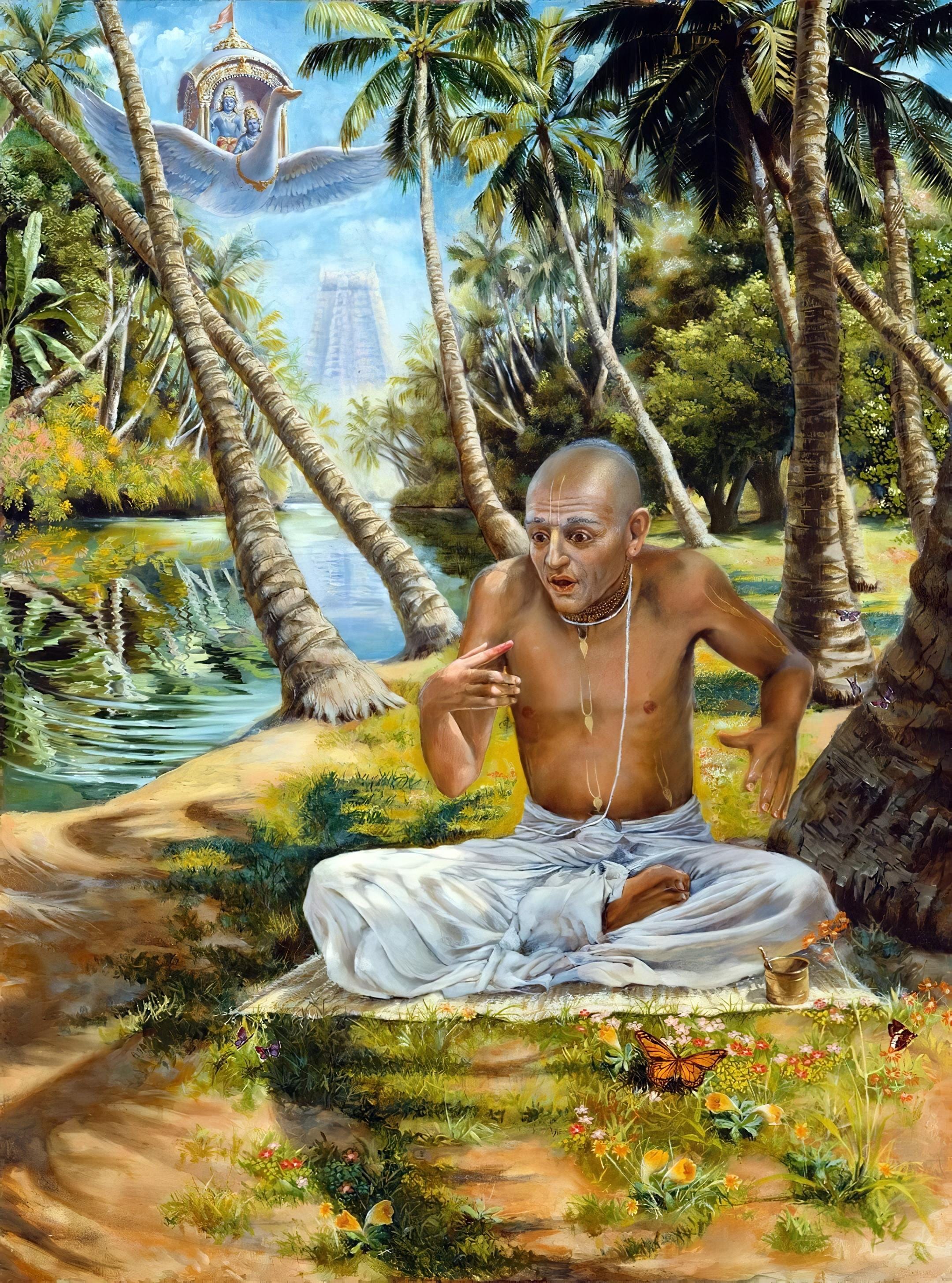
We hear in the scriptures that it’s possible to serve Kṛṣṇa in our minds. We hear, for example, the story of the poor brāhmana who started cooking sweet rice for Kṛṣṇa in his mind and was surprised when his finger got physically burned when he touched the pot of hot sweet rice in his meditation. Kṛṣṇa organized this small exchange to show him that although he was performing his service mentally, Kṛṣṇa was accepting it fully. We may think that what the brāhmana was doing was imaginary, but Kṛṣṇa saw it as completely real.
Can we do the same? It depends. If we can attain a similar level of concentration and devotion, then yes, it is perfectly possible. Based on this, one could then conclude that there is no need for us to strive to build temples or cook nice offerings for the deities since we can just do everything within our minds. However, we also see passages of Śrila Prabhupāda discouraging it. See this one, for example:
“Nirjana-bhajana—cultivating Kṛṣṇa consciousness in a solitary place—is not possible for the neophyte, for he will be disturbed by the bodily necessities (eating, sleeping, mating and defending). Being so disturbed, one cannot cultivate Kṛṣṇa consciousness. We therefore see that devotees known as sahajiyā, who make everything very easy, do not associate with advanced devotees. Such persons, in the name of devotional activities, are addicted to all kinds of sinful acts—illicit sex, intoxication, gambling and meat-eating. There are many so-called devotees passing themselves off as devotees while engaging in these sinful activities. In other words, one who is influenced by sinful activity cannot be accepted as a person in Kṛṣṇa consciousness. A person addicted to sinful life cannot develop Kṛṣṇa consciousness, as indicated in this verse.” (SB 4.29.41)
This point is also explained by Kṛṣṇa in the Bhagavad-gītā. In text 6.3, He declares that:
“For one who is a neophyte in the eightfold yoga system, work is said to be the means; and for one who is already elevated in yoga, cessation of all material activities is said to be the means.”
“Work” (or Karma) is a word used in the Bhagavad-gītā in several different contexts. Here the word “karma” (work) refers to two things: to perform our duties and to work for Kṛṣṇa. When Kṛṣṇa says that “For one who is a neophyte in the eightfold yoga system, work is said to be the means,” it means that when one is starting in the process of devotional service (or in any process of yoga), he can advance by continuing to perform his duties and gradually evolving to the platform of karma-yoga, where he works in Kṛṣṇa consciousness. For us, it means to physically perform different services. At this stage, it’s not possible to advance by just meditating, because we lack the proper concentration to do so. Our minds are very agitated, and thus the only way for us is to directly perform activities for Kṛṣṇa. At this stage we can only serve Kṛṣṇa using our hands, so to speak, and hope that the mind will also go along. If we try to perform service only mentally, it will not work, for our mind will simply continue to go everywhere.
On the other hand, for one who is advanced in devotional service, Kṛṣṇa gives a different prescription. For such a devotee, “cessation of all material activities is said to be the means”. As one advances in spiritual life, his mind gradually calms down and he or she gains the capacity of deeply meditating on Kṛṣṇa’s qualities, activities, and so on. When this meditation becomes sufficiently strong, one can directly serve Kṛṣṇa inside of it, without having to physically perform activities. He may still perform physical services when necessary or to give the proper example to others, but at this stage, it is not really necessary for his or her personal advancement. This explains great devotees like Śrīla Gaura-kiśora Dāsa Bābājī and Śrīla Vaṁśīdāsa Bābājī, who would perform solitary nirjana-bhajana, predominantly serving Kṛṣṇa in their minds.
Rūpa Gosvāmī gives a precise description of this in his explanation of rāgānugā-bhakti: sevā sādhaka-rūpeṇa siddha-rūpeṇa cātra hi. A pure devotee serves in two forms: in the sādhaka-rūpa, the current physical body that we can use to perform practical services from the beginning, and in the siddha-rūpa, the perfected spiritual form that can be developed as a devotee advances in the practice of devotional service.
Even though everyone is originally a pure soul, an eternal servant of Kṛṣṇa, this original identity is currently covered. In the beginning, everything we have is a material body and a material mind that must be engaged in practical services. We continue thus to hear, chant, associate, and serve externally using our physical bodies while gradually developing our internal meditation on Kṛṣṇa. Only at a very advanced stage, after we pass through the stages of anartha-nvṛtti and niṣthā, becoming free from material contamination and starting to develop genuine attachment to Kṛṣṇa, may we start uncovering the siddha-rūpa, the perfected spiritual form.
This point is described in greater context in the instructions of Śrī Caitanya Mahāprabhu to Sanātana Gosvāmī, in CC Madhya 22.158:
sevā sādhaka-rūpeṇa, siddha-rūpeṇa cātra hi
tad-bhāva-lipsunā kāryā, vraja-lokānusārataḥ“ ‘The advanced devotee who is inclined to spontaneous loving service should follow the activities of a particular associate of Kṛṣṇa’s in Vṛndāvana. He should execute service externally as a regulative devotee as well as internally from his self-realized position. Thus he should perform devotional service both externally and internally.’
After becoming pure of all material contamination and developing spontaneous attraction for Kṛṣṇa’s service, the self-realized devotee may become attracted to the devotional service of a particular associate of Kṛṣṇa, and by meditating on his or her activities, one develops a similar inclination. This process is the foundation of uncovering one’s spiritual form. This siddha-rūpa becomes revealed or realized as a devotee’s pure love for Kṛṣṇa awakens; it is not something to be artificially manufactured by imagination as sahajīyas believe. In Vṛndāvana, it is common for sahajīya babajis to hand out Xerox copies of supposedly spiritual identities for donations, but this is just a process of cheating.
In the genuine spiritual stage, the activities a devotee performs in his mind are not just imagination or dreams, but actual activities performed using one’s spiritual body. The process of ekadasa-bhāva that Śrila Bhaktivinoda Thākura mentions in his books, for example, is based on this process, and can thus be practiced only by very advanced Vaishnavas who would usually retire from society and perform their meditation in secluded places. The problem starts when neophytes try to imitate the process. In this case, the real spiritual activity performed in one’s spiritual body is replaced by mere fantasy.
Prabhupāda alerts us that one who tries to imitate this practice without proper spiritual realization ends up just becoming a sahajiyā, trying to attract adoration from the public by posing as a renunciant while his mind is still attracted to all sorts of material activities.
Nirjana-Bhajana, or silently meditating on Kṛṣṇa in a solitary place, is thus possible only for advanced devotees who have developed a genuine attraction for Kṛṣṇa and are able to fully control their minds. For them, stopping other activities and focusing on their meditation and solitary chanting is the process to advance. For a neophyte, however, the same process is highly ineffective, because his disturbed mind will not allow him to successfully meditate in this way. He will then eventually just go back to his previous habits, or will become some kind of sahajiyā or bogus guru, trying to externally act as some kind of sadhu while secretly doing all kinds of sinful activities. Śrila Bhaktisiddhānta Sarasvatī Thākura alerted us against it in many of his writings, a message that Śrila Prabhupāda was also repeating. As he explains in SB 4.28.33:
“This nirjana-bhajana, which is the silent worship of the Supreme Lord, is not possible for a neophyte devotee. Śrīla Bhaktisiddhānta Sarasvatī Ṭhākura never advised a neophyte devotee to go to a solitary place to engage in devotional service. Indeed, he has written a song in this connection: “My dear mind, what kind of devotee are you? Simply for cheap adoration you sit in a solitary place and pretend to chant the Hare Kṛṣṇa mahā-mantra, but this is all cheating.” Thus Bhaktisiddhānta Sarasvatī Ṭhākura advocated that every devotee, under the guidance of an expert spiritual master, preach the bhakti cult, Kṛṣṇa consciousness, all over the world. Only when one is mature can he sit in a solitary place and retire from preaching all over the world.”
For us, the way to advance is to associate with other devotees and perform different services. By doing so, we will be able to advance and gradually also be able to see Kṛṣṇa in our meditation. One who is not prepared to accept this path and prefers to go to a solitary place to sit down and meditate, despite the disturbances created by his mind, may lose the opportunity.
Read more:


This is a publication for thoughtful readers who want to go deeper into Kṛṣṇa consciousness. I publish daily, trying to offer high-quality spiritual content, and all posts are available to free subscribers. If you wish, you can support this work with a monthly contribution. When you subscribe, you can choose between a free subscription and a monthly contribution, and you can switch from a free subscriber to a supporter at any time.
You can also receive updates on WhatsApp or Telegram.
If you would like to contribute further, you can find the donation links here.