

« The Song of God—Volume 1, chapters 1-6
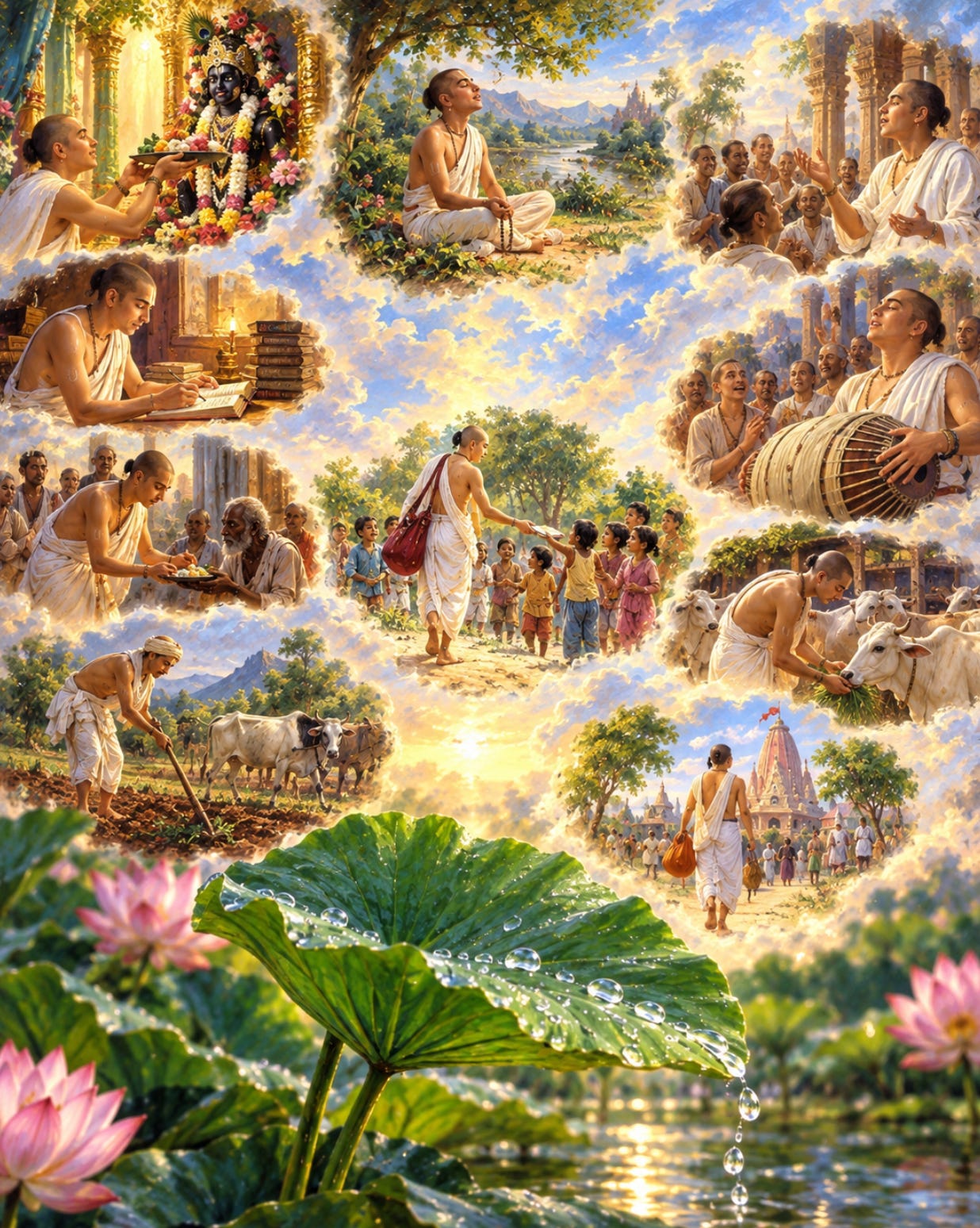
Niṣkāma-karma-yoga: Remaining free from bondage (Bg 5.7 to 5.12)
After establishing that devotional action is superior to dry renunciation, Kṛṣṇa now explains how devotional action frees us from bondage. The devotee does not become liberated by stopping activity, but by changing the consciousness behind the activity. Because his body, mind, senses, work, and results are connected with Kṛṣṇa, he remains untouched by karma, just as a lotus leaf remains untouched by water. He acts, but does not fall into the mistake of seeing himself as the doer and enjoyer. He uses the senses without falling under their control, and he performs duties without attachment. In this way, a devotee practicing niṣkāma-karma-yoga lives in this world without anxiety and without becoming entangled.
Text 7: yoga-yukto viśuddhātmā, vijitātmā jitendriyaḥ
sarva-bhūtātma-bhūtātmā, kurvann api na lipyate
One who works in devotion, who is a pure soul, and who controls his mind and senses is dear to everyone, and everyone is dear to him. Though always working, such a man is never entangled.
Texts 8-9: naiva kiñcit karomīti, yukto manyeta tattva-vit
paśyañ śṛṇvan spṛśañ jighrann, aśnan gacchan svapañ śvasan
pralapan visṛjan gṛhṇann, unmiṣan nimiṣann api
indriyāṇīndriyārtheṣu, vartanta iti dhārayan
A person in the divine consciousness, although engaged in seeing, hearing, touching, smelling, eating, moving about, sleeping and breathing, always knows within himself that he actually does nothing at all. Because while speaking, evacuating, receiving, or opening or closing his eyes, he always knows that only the material senses are engaged with their objects and that he is aloof from them.
Text 10: brahmaṇy ādhāya karmāṇi, saṅgaṁ tyaktvā karoti yaḥ
lipyate na sa pāpena, padma-patram ivāmbhasā
One who performs his duty without attachment, surrendering the results unto the Supreme Lord, is unaffected by sinful action, as the lotus leaf is untouched by water.
Text 11: kāyena manasā buddhyā, kevalair indriyair api
yoginaḥ karma kurvanti, saṅgaṁ tyaktvātma-śuddhaye
The yogīs, abandoning attachment, act with body, mind, intelligence and even with the senses, only for the purpose of purification.
Text 12: yuktaḥ karma-phalaṁ tyaktvā, śāntim āpnoti naiṣṭhikīm
ayuktaḥ kāma-kāreṇa, phale sakto nibadhyate
The steadily devoted soul attains unadulterated peace because he offers the result of all activities to Me; whereas a person who is not in union with the Divine, who is greedy for the fruits of his labor, becomes entangled.
After explaining how devotional service is superior to dry renunciation, Kṛṣṇa now describes how a devotee can remain active without being touched by karma. The main thread of this section is that although a devotee is constantly acting, because his body, mind, senses, and results are offered to Kṛṣṇa, he remains untouched by karma. This art of working for Kṛṣṇa without attachment to the results is called niṣkāma-karma-yoga, the perfection of the process of detached work Kṛṣṇa had been explaining since chapter two.
What are the characteristics of such a devotee? He is dear to all because he serves Kṛṣṇa, the root cause of everything; his senses are controlled because they are engaged in Kṛṣṇa’s service; he knows he is not the material doer and therefore he offers all results to Kṛṣṇa. Acting in this transcendental consciousness, he attains real peace.
In text 5.7, Kṛṣṇa mentions that “One who works in devotion, who is a pure soul, and who controls his mind and senses is dear to everyone, and everyone is dear to him. Though always working, such a man is never entangled.”
There are two terms that are central to the understanding of this passage: yoga-yukto and sarva-bhūtātma-bhūtātmā. Māyāvādīs accept the process of karma-yoga described by Kṛṣṇa, but they take it as a preliminary process for neophytes, where one works with a detached mindset for purification, with the goal of ultimately abandoning all activity. They then interpret “sarva-bhūtātma-bhūtātmā” as one later becoming the soul of all living entities, or, in other words, becoming one with Brahman. With this, they change the meaning of the whole passage, making it look as if one should engage in karma-yoga as a preliminary process, and then attain the platform of liberation later on, becoming one with Brahman. In this way, they can distort the whole passage and cover the real meaning.
Prabhupāda, on the other hand, keeps his commentary faithful to Kṛṣṇa’s teachings. He translates yoga-yukto as “engaged in devotional service” and sarva-bhūtātma-bhūtātmā as “being compassionate to all living entities.” Where do these meanings come from? They follow the thread of the previous sections. That’s the proper way to translate scripture. Not by taking verses as isolated passages, but by following the meaning of the previous verses, and the conclusions of the whole book. That’s how Prabhupāda translates the whole Bhagavad-gītā. That’s why it is called “The Bhagavad-gītā As It Is.”
With this, the real meaning of the verse is revealed: “One who works in devotion, who is a pure soul, and who controls his mind and senses is dear to everyone, and everyone is dear to him. Though always working, such a man is never entangled.”
A devotee working in Kṛṣṇa consciousness sees everyone as connected with Kṛṣṇa. He wishes everyone well, and becomes in this way dear to them, satisfied in his work, and pure in consciousness.
One could then protest: How could Arjuna be called dear to everyone if he was fighting in the war, attacking the soldiers on the other side with lethal weapons? How can this be called kind or beneficial?
This was already answered in the second chapter. No one dies with the death of the body. The main point is thus not to avoid death, but to die in a situation favorable to spiritual advancement, which will bring one to a better condition of life. No one would accept to live a thousand years if the price were to become a cockroach in the next life.
Kṛṣṇa was personally present in Kurukṣetra. He had created a plan to liberate all soldiers in both armies, organizing the battle in such a way that they would all die thinking of Him, after being enlightened by his words in the Bhagavad-gītā, and in His direct presence. Before the battle, Arjuna was reluctant, thinking that his engagement in the battle would cause them to suffer, but after understanding the plan of Kṛṣṇa, he agreed to fight, understanding that this would bring ultimate good for all the assembled fighters. To take away an old, broken coat to give a new one is not an act of violence. Similarly, Arjuna killing in the particular situation of the battle of Kurukṣetra was the ultimate welfare activity.
We come thus to an important point: nonviolence is not the absolute criterion; obedience to Kṛṣṇa is the criterion, because Kṛṣṇa’s desire means the ultimate good for everyone. A diseased person may want to eat, but if food will make his condition worse, a physician will refuse to give it. Superficially, it may appear he is being cruel to the patient, but that’s not the case. On the other hand, a person without knowledge could very well give opulent food to the patient, thinking it is welfare, only to see his condition worsen the next day.
Similarly, a devotee is always kind to everyone, doing what is ultimately beneficial for them. However, because others may not have the same transcendental vision, they may sometimes misunderstand his actions.
Another important point in the verse is the construction “yoga-yukto viśuddhātmā”. The word viśuddha-ātmā means “a purified soul.” A devotee is pure, but this purity does not appear by chance. One becomes pure by engaging in devotional service. This engagement in devotional service brings him to purity, and this purity leads to the development of the other qualities mentioned:
He controls his mind and senses.
He is dear to everyone.
Everyone is dear to him.
He is never entangled, even though always working.
The next symptom is indicated in texts 5.8 and 5.9: even though acting using his senses in Kṛṣṇa’s service, in reality he does nothing at all, because he does not identify with the body or the senses. The point thus is not inactivity, but freedom from the false ego, the concept of “I’m the doer.”
“Although he appears to be acting with his body and senses, he is always conscious of his actual position, which is spiritual engagement. In material consciousness, the senses are engaged in sense gratification, but in Kṛṣṇa consciousness the senses are engaged in the satisfaction of Kṛṣṇa’s senses. Therefore, the Kṛṣṇa conscious person is always free, even though he appears to be engaged in affairs of the senses.”
In a sense, a materialist also performs no activity, because all activities are performed by the body and senses under the control of the three modes. However, because a materialist claims the credit and the results, he also has to accept the karmic reactions. One may not be the one killing, but if he is the one who ordered the killing, he will go to jail all the same.
Being situated in knowledge, a devotee understands he is not the doer. His body, senses and other facilities were given by Kṛṣṇa and should be used in His service. He is just like a soldier, who kills in the battlefield for the right cause, and receives a medal. Therefore even if the external actions may appear similar, the purpose, intention, and consciousness are opposite, and thus the results are also very different. Because the pure devotee acts only for the satisfaction of Kṛṣṇa, without identifying with the body, he remains aloof from all sinful reactions, even while living in the material world. The analogy used is of a lotus leaf. A lotus may grow in the mud, but the leaves remain untouched by it. Being engaged in devotional service is thus the only method for remaining uncontaminated, even while living in this world.
In text 5.11, Kṛṣṇa lists the instruments of action that a devotee engages in service: the body, the mind, the intelligence, and the senses. A devotee does not offer just physical action; he uses his thinking, planning, desiring, hearing, speaking, and sensory activity to Kṛṣṇa. In this way, a pure devotee remains fully absorbed in service. This brings the state of complete purification and absorption Kṛṣṇa mentions in other verses. We often engage only partially in service, and therefore the absorption and purification are also only partial.
For a materialist, or even a neophyte devotee, beneficial activities are not natural, requiring a separate discipline. For example, a person may spend most of the time gossiping and speaking about mundane topics, but control himself to repeat prayers for a few minutes during a religious function. He or she may not have a taste for it, but because one is convinced it is beneficial, one stays. Similarly, when we are starting in Kṛṣṇa consciousness, we need to control ourselves to be able to perform sādhanā. For a pure devotee, however, spiritual activities are automatic, because all his actions are connected with Kṛṣṇa. The same eating that binds a materialist in many sinful reactions for killing animals liberates a devotee because he eats only Kṛṣṇa prasādam. The same speaking liberates, because a devotee is attracted only to Kṛṣṇa-kathā, and so on.
Prabhupāda quotes Śrī Rūpa Gosvāmī in the Bhakti-rasāmṛta-sindhu: “A person acting in Kṛṣṇa consciousness (or, in other words, in the service of Kṛṣṇa) with his body, mind, intelligence and words is a liberated person even within the material world, although he may be engaged in many so-called material activities.”
The word used in the verse is jīvan-muktaḥ. A pure devotee is not practicing a provisional process that will later be abandoned when he attains liberation. Jīvan-mukta means he is liberated while living. Even while technically living in a material body, he is fully absorbed in Kṛṣṇa consciousness, the original nature of the soul. He may be thus still living among us, but he is already tuned to the spiritual reality. This makes all his activities transcendental, even while acting using his body and senses.
Kṛṣṇa then concludes the section, mentioning that: “The steadily devoted soul attains unadulterated peace because he offers the result of all activities to Me; whereas a person who is not in union with the Divine, who is greedy for the fruits of his labor, becomes entangled.”
This verse describes two categories of workers: the yuktaḥ (the devotee) and the ayuktaḥ, the fruitive worker. One works for Kṛṣṇa, and attains peace (śāntim), while the other claims the results and becomes entangled.
Why is it that the devotee attains peace? Anxiety comes from material calculation of gain and loss. Because of material desire and attachment, we perform certain actions, calculating that we will receive something. However, things are not under our control, and we have many previous experiences of things not working as planned. Even before the results come, therefore, we are already anxious, questioning whether we will get it or not. Even when our plans work, there is a second problem: everything here is temporary. After I get what I desire, the next problem is how to maintain it. The maintenance of any material object or facility demands more work. In this way, my work simply expands my desires and anxiety. Since material work is the source of the problem, more of it cannot be the solution.
The devotee, on the other hand, offers the results of his work to Kṛṣṇa. This removes the material duality of seeing things as separate from Kṛṣṇa. He understands he is serving Kṛṣṇa now, and after the demise of the body, he will continue serving Kṛṣṇa in the spiritual world. His position is thus stable. He has nothing more to achieve, nor does he fear losing anything, since everything that he considers valuable exists in the transcendental platform.
Main points in the purports of Śrīla Prabhupāda:
“One who works in devotion, who is a pure soul, and who controls his mind and senses is dear to everyone, and everyone is dear to him. Though always working, such a man is never entangled.”
a) A pure devotee cannot think of anyone as separate from Kṛṣṇa. Because he loves Kṛṣṇa, he automatically loves everyone, and because he loves everyone, everyone loves him.
b) The sequence of causes and consequences is that he is a servant to all, and because of this he is dear to everyone. This makes him pure in consciousness, which results in a controlled mind and controlled senses. His mind is always fixed on Kṛṣṇa, and his activities of hearing, eating, moving, etc., are always connected with Kṛṣṇa, since he has no taste for anything else. Therefore, there is no question of forgetting Kṛṣṇa or using his senses for activities outside the service of the Lord.
c) Considering that a devotee in Kṛṣṇa consciousness, with controlled senses cannot do harm to anyone, how can we understand that Arjuna killed others in battle? He was only superficially violent. In reality, he was simply engaged in changing their external dresses under the order of Kṛṣṇa.
“A person in the divine consciousness, although engaged in seeing, hearing, touching, smelling, eating, moving about, sleeping and breathing, always knows within himself that he actually does nothing at all. Because while speaking, evacuating, receiving, or opening or closing his eyes, he always knows that only the material senses are engaged with their objects and that he is aloof from them.”
a) There are different causes for material action: the performer, the activity itself, the place of action, the practical effort, and divine sanction. A materialist thinks he is the one doing things, but in reality material action is the result of a complex system. A pure devotee, however, has nothing to do with it, because he acts in his original position as a soul, in the service of Kṛṣṇa.
b) The main difference is that in material action we act for sense gratification, while in Kṛṣṇa consciousness the body and senses are engaged in work for the satisfaction of Kṛṣṇa. A devotee, thus, remains free, even while acting using the body and senses.
c) Material activities entangle us, while spiritual activities bring us freedom. Because a pure devotee is fixed in his position as an eternal servitor of Kṛṣṇa, he does not perform any activity that is not connected with his service, and therefore he remains always free.
“One who performs his duty without attachment, surrendering the results unto the Supreme Lord, is unaffected by sinful action, as the lotus leaf is untouched by water.”
a) Everything in the material creation is a manifestation of the Supreme Brahman. Despite all material variety, the creation is ultimately nondifferent from the cause. In other words, everything is Kṛṣṇa’s energy, and therefore everything belongs to Him.
b) One who understands this and engages everything in the service of Kṛṣṇa, acts in devotional service without being affected by karmic results. Even the material body itself is seen as property of Kṛṣṇa and used as an instrument in His service. With this, not only the devotee, but even the material body used by him remains free from material contamination.
“The yogīs, abandoning attachment, act with body, mind, intelligence and even with the senses, only for the purpose of purification.”
a) When a devotee acts in Kṛṣṇa consciousness, all his actions are purified. Because all his actions in devotional service are beneficial, it is very easy for him to advance simply by engaging his body, senses and intelligence in the service of Kṛṣṇa. Purified activities are generally called sad-ācāra. For ordinary people, proper conduct requires separate discipline, but for a devotee sad-ācāra is automatic, because all his actions are connected with Kṛṣṇa.
b) A devotee remains liberated even while still living in this material world, even though performing many types of activities. The key for this state of liberation is that a pure devotee is free from false ego. This is the change that allows him to give up all sense of proprietorship and use everything for Kṛṣṇa. In this way, he becomes fully dovetailed with Kṛṣṇa and situated on the spiritual platform.
“The steadily devoted soul attains unadulterated peace because he offers the result of all activities to Me; whereas a person who is not in union with the Divine, who is greedy for the fruits of his labor, becomes entangled.”
a) In the material world, people work under the concept of duality, and consequently are constantly in anxiety over the results of their work. A devotee works on the transcendental platform, where everything is connected with Kṛṣṇa and is all good. Therefore, he has no anxiety. He realizes that there is no existence besides Kṛṣṇa, and therefore lives on the platform of peace and fearlessness.
Read the entire book:
« The Song of God—Volume 1, chapters 1-6

This is a publication for thoughtful readers who want to go deeper into Kṛṣṇa consciousness. I publish daily, trying to offer high-quality spiritual content, and all posts are available to free subscribers. If you wish, you can also choose a paid subscription to support this work.
You can also receive the updates on WhatsApp or Telegram.
If you would like to contribute further, you can find the donation links here.