

« The Song of God—Volume 1, chapters 1-6
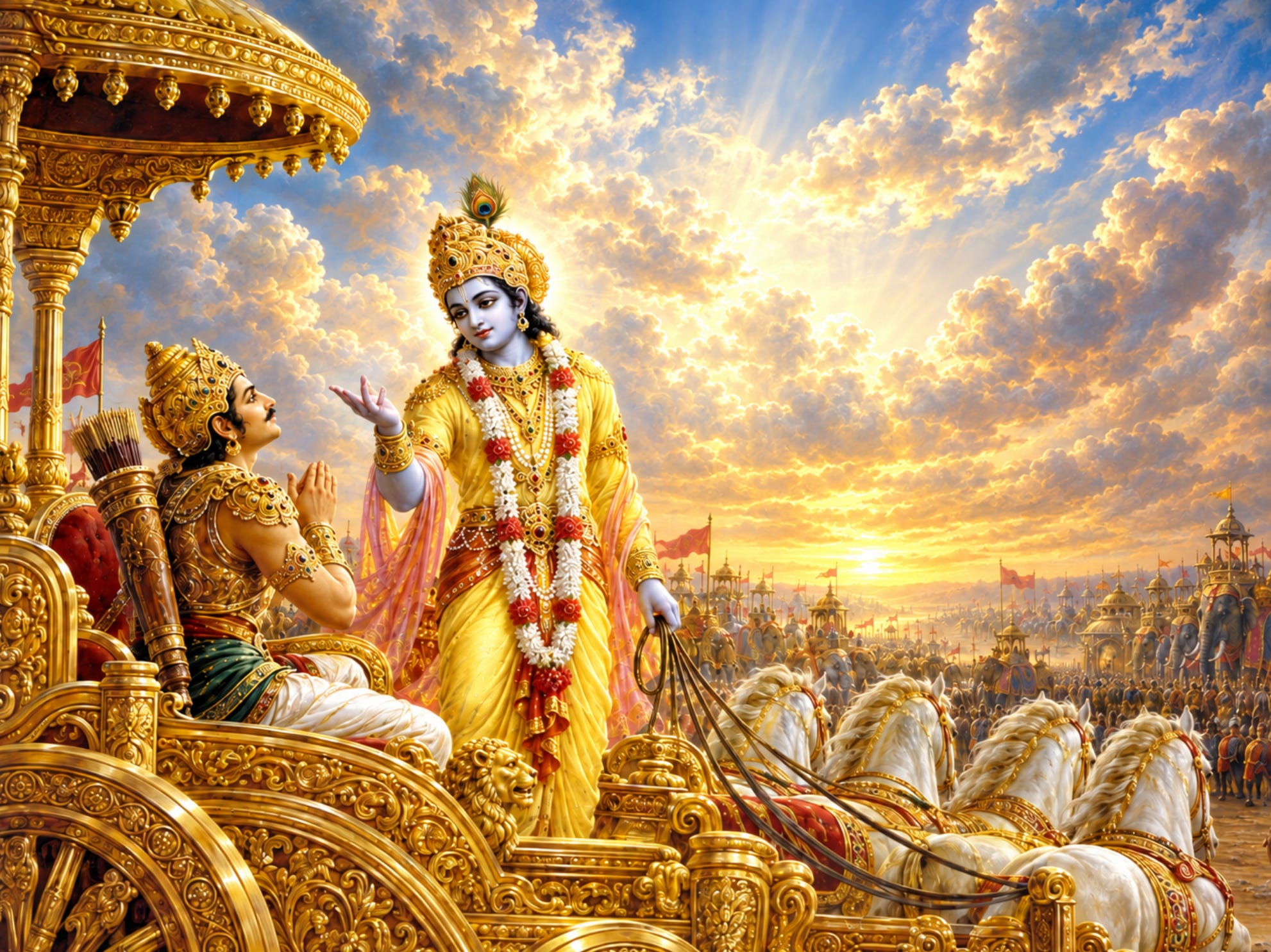
The liberated soul does not create activities, nor induce others to act (Bg 5.13 to 5.16)
In the previous section, Kṛṣṇa explained how a devotee can act in Kṛṣṇa consciousness without becoming entangled. Now, He offers a philosophical analysis of the process of action: who are the doers, how the transcendental soul becomes entangled in karmic reactions, and how He, as the Supersoul, is behind everything. Although He gives the living entity the facility to act, He does not assume the soul’s pious or sinful reactions. In this way, conditioned souls act to satisfy their material desires, identifying with the body and claiming proprietorship over their activities, and thus become entangled in the reactions. The liberated soul, however, does not identify with the body or senses, nor does he fall into the trap of seeing himself as the independent creator of activities and their results. Because of this, such a devotee remains free from material entanglement, and acts in perfect Kṛṣṇa consciousness.
Text 13: sarva-karmāṇi manasā, sannyasyāste sukhaṁ vaśī
nava-dvāre pure dehī, naiva kurvan na kārayan
When the embodied living being controls his nature and mentally renounces all actions, he resides happily in the city of nine gates [the material body], neither working nor causing work to be done.
Text 14: na kartṛtvaṁ na karmāṇi, lokasya sṛjati prabhuḥ
na karma-phala-saṁyogaṁ, svabhāvas tu pravartate
The embodied spirit, master of the city of his body, does not create activities, nor does he induce people to act, nor does he create the fruits of action. All this is enacted by the modes of material nature.
Text 15: nādatte kasyacit pāpaṁ, na caiva sukṛtaṁ vibhuḥ
ajñānenāvṛtaṁ jñānaṁ, tena muhyanti jantavaḥ
Nor does the Supreme Lord assume anyone’s sinful or pious activities. Embodied beings, however, are bewildered because of the ignorance which covers their real knowledge.
Text 16: jñānena tu tad ajñānaṁ, yeṣāṁ nāśitam ātmanaḥ
teṣām āditya-vaj jñānaṁ, prakāśayati tat param
When, however, one is enlightened with the knowledge by which nescience is destroyed, then his knowledge reveals everything, as the sun lights up everything in the daytime.
It was already explained that the soul is different from the body. The body is just an instrument, a machine composed of material energy. In text 5.13, the body is compared to a city of nine gates: two eyes, two ears,
two nostrils, a mouth, anus, and genitals. This analogy is explained in full detail in the Fourth Canto of Śrīmad-Bhāgavatam, in the allegory of King Purañjana. The soul lives in that city, together with the material intelligence and the Supersoul.
The soul lives in the body, but is not identical to the body, just like a king may live in a city, but he is not the city. The soul simply receives a body, according to the results of his previous material activities, and has free will to choose how to use it. The body, however, does not belong to the soul, nor is it powered by the soul. Kṛṣṇa, as the Supersoul, is the one indirectly moving the body through the three modes of material nature. This is exactly the point that makes us accountable for our acts.
One example is that the employee of a company may have the desire to be a driver. The boss may then assign him a car to act in this capacity. The employee, however, does not become the owner of the car. He is not the one maintaining it, or paying for the fuel. All the expenses for the car are paid by the company. The employee simply receives it as a tool to perform his work, in the service of the company. The employee has the freedom to act, but if he misuses this freedom, stealing the car and using it for his own purposes, he becomes a criminal.
From this, we can understand the situation of an atheist, who claims that there is no God, and that he is the proprietor of things that are around him, not only stealing, but also using them to harm others. A devotee, on the other hand, understands that Kṛṣṇa is the proprietor of everything. Without envy, he simply uses the car he was given in the service of the company. Unlike the atheist, he uses the car without becoming entangled in criminal acts, and, as a result, he receives a promotion.
In text 5.12, Kṛṣṇa mentioned that “a person who is not in union with the Divine, who is greedy for the fruits of his labor, becomes entangled.” In 5.13, He again gives the contrast to the devotee, by mentioning that, “When the embodied living being controls his nature and mentally renounces all actions, he resides happily in the city of nine gates.”
Life in the material world, in itself, does not bring us misery. The misery comes from identifying with the body. One who can see the situation as it is, can live happily, even while still living in the body. This is the situation of a liberated soul.
A good example of this contrast is the history of Jada Bharata and King Rahūgana, described in the Fifth Canto of Śrīmad-Bhāgavatam. Rahūgana’s soldiers captured the great sage Jada Bharata and forced him to work carrying the palanquin of the king, which was very strenuous work. Still, he was not complaining. The one who became disturbed was the king. Because of Jada Bharata’s sense of non-violence, he would stop every few steps to avoid stepping on the ants moving around. This would make the palanquin move unevenly, disturbing the king. We can thus see the difference: the sage, unfairly engaged in very hard work without payment, was not disturbed, while the materialistic king, traveling in very comfortable conditions, became disturbed over a small inconvenience. The story is summarized by Śukadeva Gosvāmī:
“My dear King, O son of mother Uttarā, there were some waves of dissatisfaction in the mind of Jaḍa Bharata due to his being insulted by King Rahūgaṇa, who made him carry his palanquin, but Jaḍa Bharata neglected this, and his heart again became calm and quiet like an ocean. Although King Rahūgaṇa had insulted him, he was a great paramahaṁsa. Being a Vaiṣṇava, he was naturally very kindhearted, and he therefore told the King about the constitutional position of the soul. He then forgot the insult because King Rahūgaṇa pitifully begged pardon at his lotus feet. After this, he began to wander all over the earth, just as before.”
Kṛṣṇa also mentions that when the soul controls his nature and mentally renounces all actions, he neither works nor causes work to be done. What does it mean?
The soul does not work because a devotee does not claim proprietorship. As previously mentioned, he is free from false ego. He does not think that he did something and should take credit for it. The exact Sanskrit words are “naiva kurvan na kārayan” (indeed, not doing anything, nor causing something to be done). This is more elaborately explained by Prabhupāda in his purport:
“The embodied soul lives in the city of nine gates. The activities of the body, or the figurative city of body, are conducted automatically by its particular modes of nature. The soul, although subjecting himself to the conditions of the body, can be beyond those conditions, if he so desires. Owing only to forgetfulness of his superior nature, he identifies with the material body, and therefore suffers. By Kṛṣṇa consciousness, he can revive his real position and thus come out of his embodiment. Therefore, when one takes to Kṛṣṇa consciousness, one at once becomes completely aloof from bodily activities. In such a controlled life, in which his deliberations are changed, he lives happily within the city of nine gates.”
Two important words are manasā and sannyasya. Manasā means “by the mind.” The mind is the center of the consciousness, and that’s the real point where activities must be renounced. A person who simply renounces externally, but continues to mentally act and desire, is called a pretender. The correct path is to continue working dutifully in the physical plane, but internally renounce all sense of proprietorship. This is the real sannyāsa, renunciation. Previously, Arjuna used the word sannyāsa in the sense of stopping activity, but now Kṛṣṇa uses it in the deeper meaning.
This idea is expanded by Kṛṣṇa in text 5.14: “The embodied spirit, master of the city of his body, does not create activities, nor does he induce people to act.”
A materialist generally tries to expand his circle of influence. He considers himself the controller of not only his own body, but also of other people around, like family members and employees. Seeing himself as the master, he tries to engage them in various activities. He thus not only works himself, but he also makes others work according to his desires. A pure devotee, however, situated in proper knowledge, rejects both misconceptions. He understands that his body is moving, but he, as the soul, is not. He acts for Kṛṣṇa, without claiming proprietorship, and tries to teach others how to act on the same platform. Again, this is true renunciation.
Prabhupāda explains the process in his purport:
“The temporary body or material dwelling place which he obtains is the cause of varieties of activities and their resultant reactions. Living in such a conditional atmosphere, one suffers the results of the activities of the body by identifying himself (in ignorance) with the body. It is ignorance acquired from time immemorial that is the cause of bodily suffering and distress. As soon as the living entity becomes aloof from the activities of the body, he becomes free from the reactions as well. As long as he is in the city of the body, he appears to be the master of it, but actually he is neither its proprietor nor controller of its actions and reactions.”
This brings us to the next point made by Kṛṣṇa: the soul does not create the fruits of action; all of this is enacted by the modes of material nature.
A materialist may think, “I worked and created the result.” However, this is the product of a lack of knowledge. In reality, the result depends on many factors that are beyond his control. To perform any action, one depends on the body and senses, the work of the three material modes (which move the body), the place, and circumstances; the effort applied; the results of previous karma; cooperation of others, etc.; and, especially, the sanction of the Supersoul. If these factors are not aligned, he cannot have success in his endeavors, no matter how much he desires something and how much effort he may put into it.
This is another factor behind material suffering: material life means depending on factors that are not under our control. A few persons may be able to fulfill their plans due to a combination of the right factors brought about by the results of karma, but most simply hanker and work tirelessly to obtain almost nothing. As long as our happiness depends on attaining material goals, we will remain dissatisfied, and even if at a certain point we come to a situation we consider close to ideal, time will eventually take it away. A pure devotee, on the other hand, bases his happiness on what is eternal, and once attaining it, there is no possibility of loss.
One argument that could be used at this point is that if we are not responsible for the action, why do we have to accept the reactions? Kṛṣṇa Himself mentioned that everything happens due to the action of the three material modes, and He is the one behind the modes. Kṛṣṇa, as Paramātmā, is thus the real actor behind all actions, because He is the one who creates the conditions for them, and He is also the one giving sanction. Why then is the individual soul the one carrying the results? To dispel this misunderstanding, He mentions:
“Nor does the Supreme Lord assume anyone’s sinful or pious activities. Embodied beings, however, are bewildered because of the ignorance which covers their real knowledge.”
Kṛṣṇa creates the factors of action and gives everyone free will to decide how to conduct their lives. To make sure there are no injustices, He creates the law of karma, to put face-to-face people who desire to commit crimes, and people who committed similar crimes in the past, as well as different systems of reward and punishment. He gives us the law books that explain how to live and prosper in the gigantic universal machine He created, in the form of the scriptures. Even if one committed mistakes in the past, he or she can be easily excused by simply surrendering to Him, and following His instructions from that point on. If, however, one wants to be a criminal and act outside this system, abusing the facilities he was given, Kṛṣṇa gives the conditions for him to do so, but the reactions do not belong to Kṛṣṇa; they belong to the individual soul.
A way to understand this is that although we, as souls, are not capable of performing material actions by ourselves, we desire to perform actions, and the Lord gives us the conditions for that. He thus helps us to satisfy our desires in the hope we will one day turn to Him, but at the same time, He is not responsible for the reactions. It is just like a charitable person giving money to a person in need. He is not responsible if one uses it to buy a bottle of vodka.
Kṛṣṇa thus explains the topic from both perspectives. He is the one giving all the facilities for material action; therefore, we should understand that everything belongs to Him, and use everything in His service, without false proprietorship. At the same time, He warns that if one decides to abuse the system, one has to also accept the karmic reactions.
This dynamic that creates material suffering and the path out of it are explained by Prabhupāda in his purport to text 5.15:
“A living entity is, by superior nature, full of knowledge. Nevertheless, he is prone to be influenced by ignorance due to his limited power. The Lord is omnipotent, but the living entity is not. The Lord is vibhu, or omniscient, but the living entity is aṇu, or atomic. Because he is a living soul, he has the capacity to desire by his free will. Such desire is fulfilled only by the omnipotent Lord. And so, when the living entity is bewildered in his desires, the Lord allows him to fulfill those desires, but the Lord is never responsible for the actions and reactions of the particular situation which may be desired. Being in a bewildered condition, therefore, the embodied soul identifies himself with the circumstantial material body and becomes subjected to the temporary misery and happiness of life. The Lord is the constant companion of the living entity as Paramātmā, or the Supersoul, and therefore He can understand the desires of the individual soul, as one can smell the flavor of a flower by being near it. Desire is a subtle form of conditioning for the living entity. The Lord fulfills his desire as he deserves: Man proposes and God disposes. The individual is not, therefore, omnipotent in fulfilling his desires. The Lord, however, can fulfill all desires, and the Lord, being neutral to everyone, does not interfere with the desires of the minute independent living entities. However, when one desires Kṛṣṇa, the Lord takes special care and encourages one to desire in such a way that one can attain to Him and be eternally happy.”
With all these successive layers of instructions, Kṛṣṇa deepens our knowledge about our conditioning in this material world. At first, He explained that we are not the material body, and that the material dualities such as heat and cold, honor and dishonor do not affect us. Now, He is guiding us through the intricacies of the material ego, and the process of purifying material action. When we hear we are not the body, our first impulse may be escapism: I’m not the body; therefore, I should reject the body. Now He is deepening it by explaining that the body is an important instrument, and it doesn’t belong to us. It should therefore be properly engaged.
The soul is constitutionally eternal, blissful, and full of knowledge, but these qualities are only manifested in connection with Kṛṣṇa. Because we have been for a long time in this material world, trying to avoid Kṛṣṇa consciousness, we have forgotten our constitutional position of service to the Lord, and have become entrapped in material existence. Through His instructions in the Gītā, Kṛṣṇa is giving us the path back to Him.
He thus concludes the section, mentioning that “When, however, one is enlightened with the knowledge by which nescience is destroyed, then his knowledge reveals everything, as the sun lights up everything in the daytime.”
Ignorance is the cause of our bondage, and the knowledge of our eternal relationship with Him is the cause of our liberation. As Prabhupāda explains in his purport, “Knowledge is always highly esteemed. And what is that knowledge? Perfect knowledge is achieved when one surrenders unto Kṛṣṇa, as is said in the Seventh Chapter, nineteenth verse: bahūnāṁ janmanām ante jñānavān māṁ prapadyate. After passing through many, many births, when one perfect in knowledge surrenders unto Kṛṣṇa, or when one attains Kṛṣṇa consciousness, then everything is revealed to him, as everything is revealed by the sun in the daytime.”
A last possible argument is the question of a supposed partiality of the Lord. In his purport, Prabhupāda mentions Vedānta-sūtra 2.1.34, vaiṣamya-nairghṛṇye na sāpekṣatvāt tathā hi darśayati:
“The Supreme Lord is not partial, nor does He lack compassion. Material bodies are given according to karma. The scriptures describe this.”
Prabhupāda mentions this passage to uphold the Vedantic principle that Kṛṣṇa is not responsible for our suffering, nor does He lack compassion. Materialists often blame God for the world’s injustices, and similarly, some Vaiṣṇavas blame Kṛṣṇa for us being in this material world, accusing Him of randomly sending some souls to the spiritual world, and some here. Both perspectives, however, are incorrect.
Some are born rich, while others are born poor, not because of partiality from the Lord, but because of the combinations of the previous desires of the soul and the results of previous activities. In other words, the causes for these differences are people’s own choices. The Lord gives the same possibilities for everyone; we are the ones who create misfortune. Kṛṣṇa is also not to blame for our suffering in this material world. As Prabhupāda explains, the soul becomes conditioned by one’s own immemorial desire to avoid Kṛṣṇa consciousness. We are like the sons of a rich father, who prefer to loiter in the streets.
This is made clear in the Fourth Canto of Śrīmad-Bhāgavatam, when the Lord Himself, appearing in the form of a brāhmana, speaks to Queen Vaidarbhī when she was lamenting the death of her husband:
“The brāhmaṇa inquired as follows: Who are you? Whose wife or daughter are you? Who is the man lying here? It appears you are lamenting for this dead body. Don’t you recognize Me? I am your eternal friend. You may remember that many times in the past you have consulted Me.
The brāhmaṇa continued: My dear friend, even though you cannot immediately recognize Me, can’t you remember that in the past you had a very intimate friend? Unfortunately, you gave up My company and accepted a position as enjoyer of this material world. My dear gentle friend, both you and I are exactly like two swans. We live together in the same heart, which is just like the Mānasa Lake. Although we have been living together for many thousands of years, we are still far away from our original home.
My dear friend, you are now My very same friend. Since you left Me, you have become more and more materialistic, and not seeing Me, you have been traveling in different forms throughout this material world, which was created by some woman.” (SB 4.28.52-55)
Being a separated expansion of Kṛṣṇa, each soul possesses a small independence, and when we misuse this independence to reject Kṛṣṇa consciousness, we stay in the material ocean. As explained in the Śrīmad-Bhāgavatam (2.9.1), there is no meaning in the relationship of the soul and the material body. Conditioned life is a dreamlike condition, in which we remain covered by ignorance, forgetful of our real spiritual nature. The antidote for such an ignorant condition is knowledge, and that’s exactly what Kṛṣṇa is giving us in the Gītā. As Prabhupāda explains, “After passing through many, many births, when one perfect in knowledge surrenders unto Kṛṣṇa, or when one attains Kṛṣṇa consciousness, then everything is revealed to him, as everything is revealed by the sun in the daytime.”
There are many traps in the process of awakening from this dream. One can fail to control his senses, or one can become a faithless person, failing to surrender even after hearing many instructions, and so on. Even when one is able to avoid all these dangers, there is a last trap, the last snare of māyā: impersonalism. One may accept that he is a soul, and has nothing to do with matter, but end up rejecting his eternal position of service, concluding instead that he is one with God. This is also a form of ignorance.
In this case, one may achieve impersonal liberation, merging into the light of the brahmajyoti, but because this is not the constitutional position of the soul, there is every possibility of returning to this material world. While life in this material world is compared to a dream, existence in the brahmajyoti is compared to deep sleep. If one is having a bad dream, going into deep sleep brings relief, but from there one eventually returns to the dreaming stage. The real solution is to wake up. As Prabhupāda mentions, real knowledge means identity with individuality in spiritual life. Just understanding one is a soul is not sufficient; one has to realize his eternal constitutional position of service to Kṛṣṇa.
Main points in the purports of Śrīla Prabhupāda:
“When the embodied living being controls his nature and mentally renounces all actions, he resides happily in the city of nine gates [the material body], neither working nor causing work to be done.”
a) The body is like a machine, moved by the material modes. The soul lives in the city of the body, but is very different in nature from it. When we identify with the body, we experience material suffering, but by Kṛṣṇa consciousness we can revive our real position and live beyond these conditions.
b) When we attain a state of Kṛṣṇa consciousness, we become aloof from the activities of the body. In this condition, we can live happily, even while still residing in the body. When the soul identifies with the Lord, instead of the body, one becomes just as free as the Lord Himself.
“The embodied spirit, master of the city of his body, does not create activities, nor does he induce people to act, nor does he create the fruits of action. All this is enacted by the modes of material nature.”
a) Both the soul and matter are energies of Kṛṣṇa. The soul, however, is part of the superior energy, while matter is part of the inferior nature. There is no need for this combination, but somehow the soul remains entangled since time immemorial.
b) What is this force that makes us identify with the body? That’s ignorance. This ignorance from time immemorial is the cause of our material suffering, making us identify with the body and the material atmosphere.
c) The body is the cause of many material actions that bring karmic reactions. The soul thus suffers the results of such activities. However, as soon as we become aloof from the activities of the body, we become free from the reactions as well. Because of the false ego, we consider ourselves to be the masters of the body, but in reality we are just struggling in the material ocean. The solution is to get out of the water by renouncing this false sense of proprietorship.
“Nor does the Supreme Lord assume anyone’s sinful or pious activities. Embodied beings, however, are bewildered because of the ignorance which covers their real knowledge.”
a) The Lord is very big, while the individual soul is very small. Kṛṣṇa is never affected by material ignorance or karmic reactions, but we have a tendency to be influenced by ignorance due to our free will. When we, due to ignorance, desire to be put into material life, our suffering under the chain of material actions and reactions begins.
b) Free will also makes the individual soul capable of desiring. However, we are not able to fulfill these desires by ourselves. The Lord, therefore, gives us conditions to act in the material world and to satisfy these desires, but He is not responsible for the reactions. We are ourselves responsible for our actions and where they lead us.
c) How can Kṛṣṇa know the desires of each living entity? He is present in the hearts of everyone as Paramātmā. Being near, He can understand one’s desires, just as one can smell a flower. However, the Lord satisfies the desires of the soul as each one deserves.
d) Kṛṣṇa gives us free will to act as we desire, and therefore, one can go either to heaven or hell. However, when we desire to return to Him, He takes special care and encourages us, so we can attain the goal of life.
e) The constitutional position of the soul is to be eternal, blissful, and full of knowledge. However, our immemorial desire to avoid Kṛṣṇa consciousness is the cause of our conditioning. Immersed in the material atmosphere, we forget our constitutional position of service, and sometimes even claim that Kṛṣṇa is the cause of our conditional existence.
“When, however, one is enlightened with the knowledge by which nescience is destroyed, then his knowledge reveals everything, as the sun lights up everything in the daytime.”
a) Bewilderment comes from forgetfulness of Kṛṣṇa. Those who are Kṛṣṇa conscious, are not bewildered at all, even while living here. After many births in this material world, when we finally attain Kṛṣṇa consciousness, everything is revealed, just like the light of the sun destroys darkness.
b) The last snare of māyā is for the living entity on the path of liberation to think of himself as God. If one is God, how can one become illusioned? If illusion could bewilder God, then it would be greater than God.
c) How to avoid this trap? One has to receive knowledge from a person who is perfectly Kṛṣṇa conscious. Such a spiritual master can drive away all ignorance from the disciple.
d) We can understand our relationship with God only when we meet His true representative. The individual soul is always distinct from Kṛṣṇa. We are separate individuals at every stage, both here and after liberation. In ignorance, one may see everything as one, just as we see everything as one in darkness, but in knowledge we can see the difference, just as in daytime.
Read the entire book:
« The Song of God—Volume 1, chapters 1-6

This is a publication for thoughtful readers who want to go deeper into Kṛṣṇa consciousness. I publish daily, trying to offer high-quality spiritual content, and all posts are available to free subscribers. If you wish, you can also choose a paid subscription to support this work.
You can also receive the updates on WhatsApp or Telegram.
If you would like to contribute further, you can find the donation links here.