


You can receive new articles directly in your inbox. Subscription is free; donations are welcome.
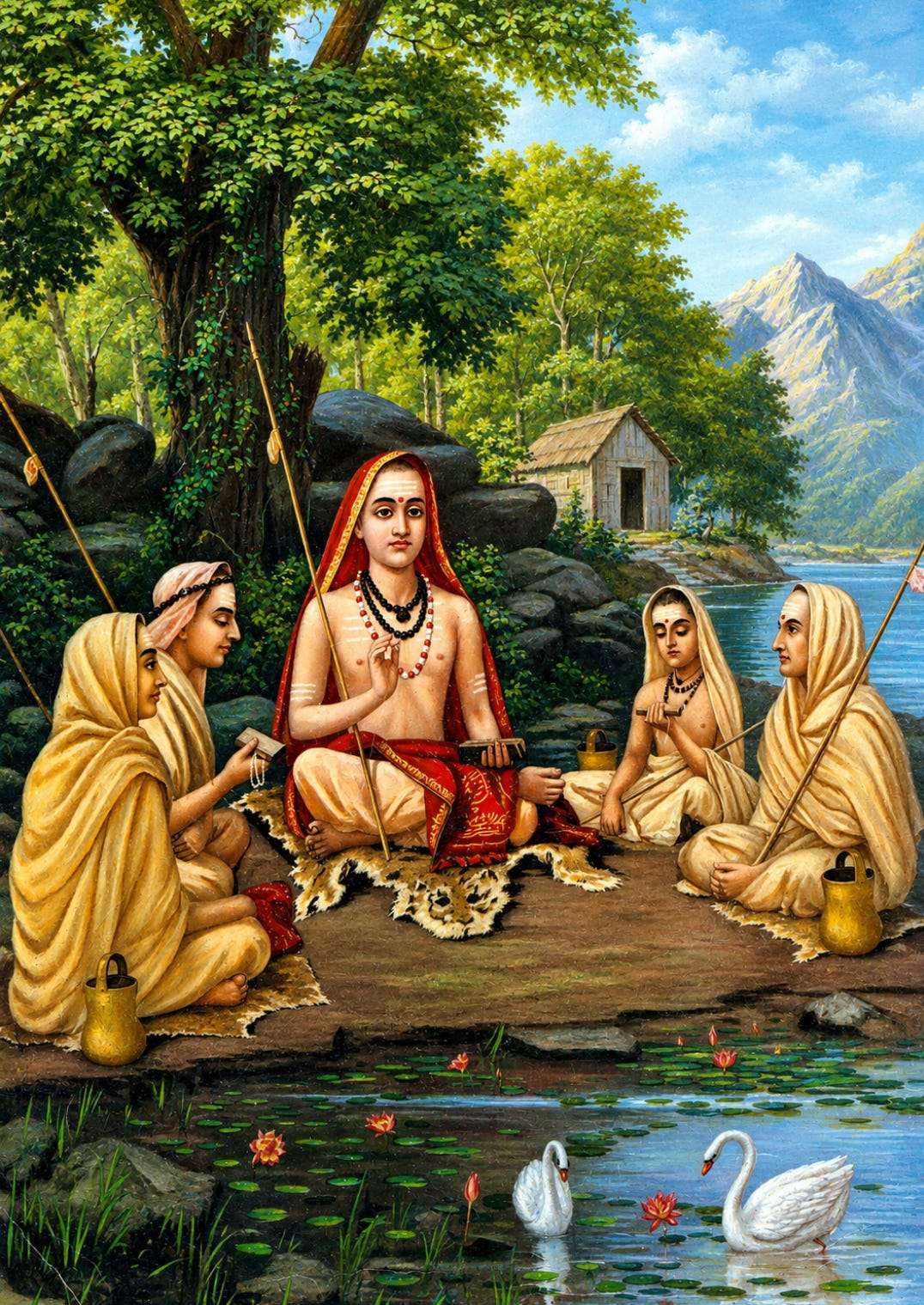
Śaṅkarācārya is an extremely well-known and revered figure in Indian philosophy. He is also honored by Vaiṣnavas as an incarnation of Lord Śiva and respected for his work in restoring the authority of the Vedas after they were obscured by Buddhism. In fact, the name “Śaṅkarācārya” is mostly used by Vaiṣnavas. His own followers usually call him “Ādi Śaṅkara.” Vaiṣnavas add the honorific ācārya.
However, Śaṅkarācārya is also accepted as the founder of the Māyāvāda school, which is massively criticized in Vaiṣnava circles. One may have a certain difficulty in reconciling both points.
First of all, what is the problem with Māyāvādis? There are many points, but the central issue is that they conclude that Kṛṣṇa’s form is material and His activities are performed under the material modes. In other words, they believe that Kṛṣṇa is covered by māyā, just like us. That’s why their doctrine is known as Māyāvāda.
The point, however, is that Śaṅkarācārya was not a Māyāvādī, although he incidentally became the founder of the school. He spoke certain things that were later distorted by his followers. He became the origin of it, but He did not agree with their interpretation of Kṛṣṇa falling under the influence of Māyā and having a material form.
We can see it clearly when we examine his commentary on the Bhagavad-gītā.
He opens his commentary with the words:
nārāyaṇaḥ paro ’vyaktād aṇḍam avyakta-sambhavam
aṇḍasyāntas tv ime lokāḥ sapta-dvīpā ca medinī
Avyaktād means pradhāna, the unmanifest material nature; “paro” means “beyond.” Nārāyaṇaḥ paro ’vyaktād means that Nārāyaṇa is beyond this cosmic manifestation. Who is this Nārāyaṇa? After a few sentences, he declares:
sa ādi-kartā nārāyaṇākhyo viṣṇur bhaumasya brahmaṇo brāhmaṇatvasya cābhirakṣaṇārthaṃ devakyāṃ vasudevād aṃśena kṛṣṇaḥ kila sambabhūva
That original creator, Viṣnu, known as Nārāyaṇa, desiring to protect the brāhmanas, appeared as Kṛṣṇa in Devakī through Vasudeva. Prabhupāda elaborates on this point in CC Ādi 5.132 and Madhya 20.359:
“Even Śaṅkarācārya, the most elevated impersonalist, says in the beginning of his commentary on the Bhagavad-gītā: nārāyaṇaḥ paro ’vyaktāt. When this material creation is not yet manifested from the mahat-tattva, it is called avyakta, and when it is demonstrated from that total energy, it is called vyakta. Nārāyaṇa, the Supreme Personality of Godhead, is beyond this vyakta-avyakta, manifested and unmanifested material nature. This is the chief qualification of the Supreme Personality of Godhead when He assumes a particular incarnation. Kṛṣṇa tells Arjuna that although they both took birth many, many times before, Kṛṣṇa remembers everything about His previous appearances but Arjuna does not remember. Since Kṛṣṇa is beyond the cosmic creation, He is in the exalted position of being able to remember everything in the past. Everything within the cosmic creation has a material body, but Kṛṣṇa, being beyond the material cosmic creation, always has a spiritual body.”
Māyāvādīs conclude that the impersonal Brahman is the ultimate reality, while Kṛṣṇa’s form is a temporary manifestation. Śaṅkarācārya, however, contradicts them by mentioning (still in the introduction) that:
paramārtha-tattvaṁ ca vāsudevākhyaṁ para-brahmābhidheya-bhūtam
The ultimate reality (paramārtha-tattva), called Vāsudeva, the Supreme Brahman (para-brahman).
Later, in his commentary on Bg 4.6, Śaṅkarācārya explains that Kṛṣṇa is unborn, imperishable, and the Lord of all beings, from Brahmā down to a blade of grass. He describes the material nature as Kṛṣṇa’s own Vaiṣṇavī māyā, composed of the three modes, and explicitly states that Kṛṣṇa keeps this māyā under His control. Therefore, Kṛṣṇa only appears “as if embodied” and “as if born”; He is not born like an ordinary conditioned soul. In Bg 4.9, he is even more explicit, describing Kṛṣṇa’s birth and activities as divyam aprākṛtam aiśvaram: transcendental, nonmaterial, and divine.
At first, Śaṅkara’s use of the expression māyā-rūpam in the passage may appear to suggest the opposite, but proper analysis of the text is essential here. Māyā-rūpam qualifies janma (the birth), and not Kṛṣṇa Himself or His body.
In the previous verse, he has already described Kṛṣṇa as unborn, imperishable, and the Lord of all beings who keeps His own Vaiṣṇavī māyā under control, and then he immediately qualifies His birth and activities as divyam aprākṛtam aiśvaram (divine, nonmaterial, and transcendental). Māyā-rūpam, thus, does not mean that Kṛṣṇa assumes an ordinary material body under the influence of ignorance. It means “an apparent birth manifested through His own māyā” or, in other words, Kṛṣṇa appearing in His original, transcendental, and eternal spiritual form “as if embodied.”
Then, we have Bg 7.24, the verse where Kṛṣṇa Himself is heavy on the Māyāvādīs:
avyaktaṁ vyaktim āpannaṁ, manyante mām abuddhayaḥ
paraṁ bhāvam ajānanto, mamāvyayam anuttamam“Unintelligent men, who do not know Me perfectly, think that I, the Supreme Personality of Godhead, Kṛṣṇa, was impersonal before and have now assumed this personality. Due to their small knowledge, they do not know My higher nature, which is imperishable and supreme.”
In his commentary, Śaṅkarācārya confirms the words of Kṛṣṇa, mentioning that,
nitya-prasiddham īśvaram api santam abuddhayo ‘vivekinaḥ paraṃ bhāvaṃ param ātma-svarūpam ajānanto ‘vivekinaḥ mamāvyayaṃ vyaya-rahitam anuttamaṃ niratiśayaṃ madīyaṃ bhāvam ajānanto manyanta ity arthaḥ
Kṛṣṇa is the eternally established Lord, but the unintelligent, devoid of proper discrimination, do not know His supreme nature, which is imperishable, unsurpassed, and absolutely supreme.
These are just a few passages among many. In summary, Śaṅkarācārya emphasized the impersonal aspect in his explanations, speaking according to the capacity of his audience, often in a very indirect way, but he was not a Māyāvādī; he did not agree with the conclusion that Kṛṣṇa has a material body or that He is a temporary manifestation of the impersonal Brahman. Śaṅkarācārya is Lord Śiva Himself, the greatest Vaiṣnava, who came with a specific mission of speaking about the Absolute Truth in a way that would bewilder the atheists.
He became thus the doctrinal source of the later Māyāvāda school as part of his divine mission, but his followers pushed conclusions that Śaṅkara himself explicitly did not accept. In his commentaries, he explicitly acknowledges Kṛṣṇa’s transcendental position. The vicious conclusions of the Māyāvāda doctrine as currently propagated appeared later, due to the influence of people who, as Kṛṣṇa puts it, are abuddhayaḥ, devoid of intelligence.
Even when Kṛṣṇa becomes personally visible, as He did 5,000 years ago, He remains covered to the ignorant. How? He remains covered by His internal potency. Pure devotees can perfectly understand Him as the Supreme Personality of Godhead, but the ignorant usually see Him as a common man.
Kṛṣṇa remains covered for the ignorant in the sense they cannot recognize Him, but in reality, Kṛṣṇa is not covered: they are. Just as a cloud cannot cover the sun, the illusory potency cannot cover Kṛṣṇa; it simply covers the vision of the conditioned soul, preventing one from understanding Kṛṣṇa and His opulences. How can this cover be removed? Only through an attitude of service. One has to hear from a self-realized soul, and by practicing devotional service according to this transcendental knowledge, one can come to the point of seeing Kṛṣṇa.
Māyāvādīs say that māyā covers Kṛṣṇa, but Kṛṣṇa turns it around in Bg 7.26: “O Arjuna, as the Supreme Personality of Godhead, I know everything that has happened in the past, all that is happening in the present, and all things that are yet to come. I also know all living entities; but Me no one knows.”
Māyā is not a problem for Him; He can perfectly see everything, past, present, and future; He can understand all the thoughts and desires of every single soul. It is the Māyāvādī’s knowledge that is covered.
You can see how these arguments develop further in our Vedānta-sūtra: Understanding the Govinda-bhāṣya of Baladeva Vidyābhūṣaṇa, Vol. I, especially sūtras 1.1.5 to 1.1.11:
Sutra 1.1.5 - īkṣater nāśabdam: The Lord is not indescribable
Sutra 1.1.7 - tan-niṣṭhasya mokṣopadeśāt: Descriptions of the transcendental Lord
Sutra 1.1.8 - (na) heyatva-vacanāc ca: There is nothing higher
Sutra 1.1.9 - (na) svāpyayāt: The source of all incarnations
Sutra 1.1.10 - (na) gati-sāmānyāt: The One and transcendental Brahman
Sutra 1.1.11 - śrutatvāc ca: Material qualities can’t touch the Lord
Or, if you would like to read more about Śaṅkarācārya and other ācāryas, check the introduction:
Read more:

This is a publication for thoughtful readers who want to go deeper into Kṛṣṇa consciousness. I publish daily, trying to offer high-quality spiritual content, and all posts are available to free subscribers. If you wish, you can support this work with a monthly contribution. When you subscribe, you can choose between a free subscription and a monthly contribution, and you can switch from a free subscriber to a supporter at any time.
You can also receive updates on WhatsApp or Telegram.
If you would like to contribute further, you can find the donation links here.
Please continue enlightening us…
Hare Krishna Prabhu
Pranam.
Thank you Prabhu
Beautiful service 🙏