

« The Song of God—Volume 1, chapters 1-6
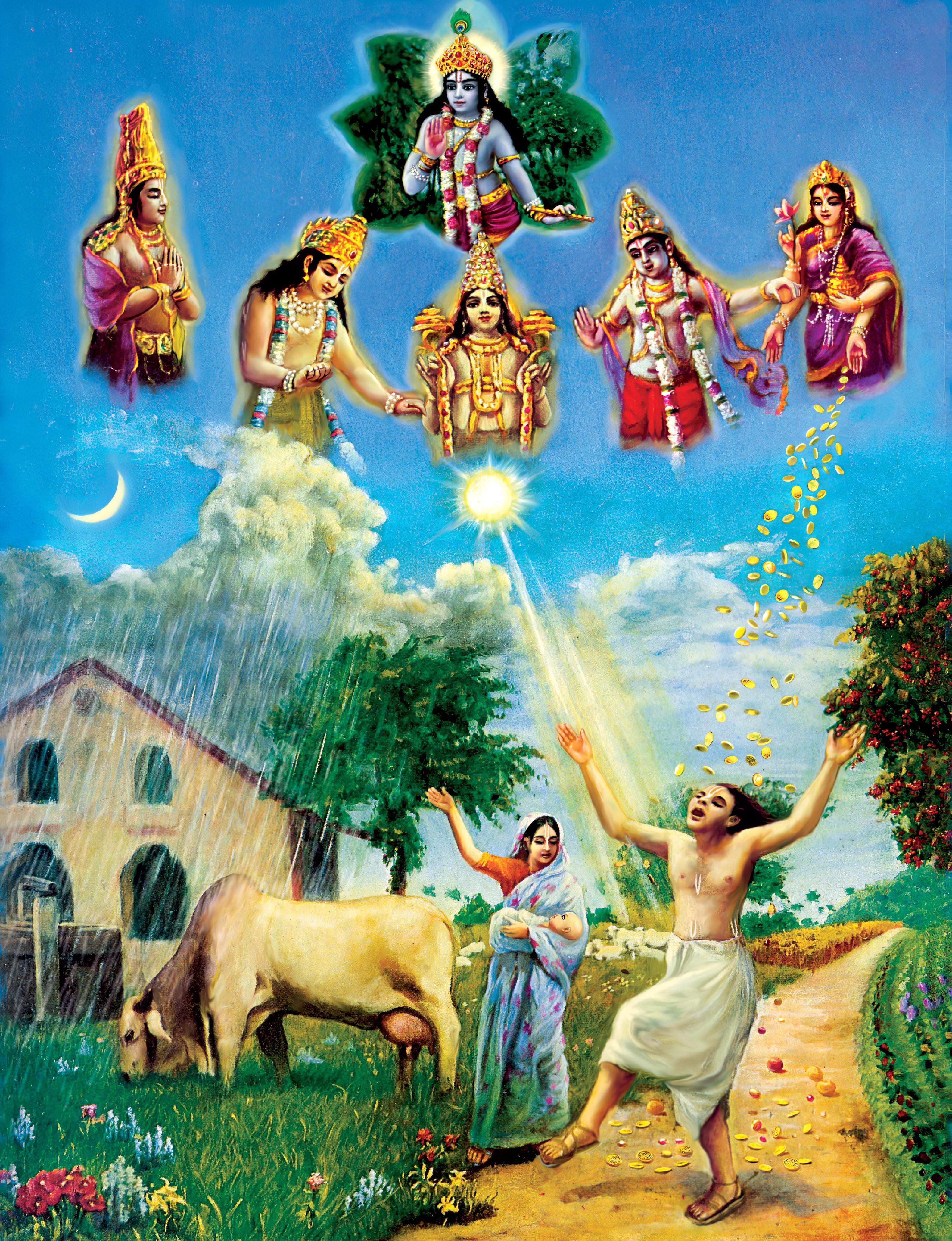
The cycle of sacrifices (Bg 3.10 to 3.16)
After hinting at the perfection of the platform of karma-yoga, work without attachment as an offering to Him, Kṛṣṇa now starts describing the ladder that leads to this standard. In this section, He describes the first step, the process of Vedic sacrifices (karma-kānda), that gradually elevates a common person. One starts in this process with the goal of obtaining the necessities of life and satisfying material desires, but gradually one comes to the platform of seeing Viṣṇu as the ultimate beneficiary of all sacrifices.
Text 10: saha-yajñāḥ prajāḥ sṛṣṭvā, purovāca prajāpatiḥ
anena prasaviṣyadhvam, eṣa vo ’stv iṣṭa-kāma-dhuk
In the beginning of creation, the Lord of all creatures sent forth generations of men and demigods, along with sacrifices for Viṣṇu, and blessed them by saying, “Be thou happy by this yajña [sacrifice] because its performance will bestow upon you everything desirable for living happily and achieving liberation.
Text 11: devān bhāvayatānena, te devā bhāvayantu vaḥ
parasparaṁ bhāvayantaḥ, śreyaḥ param avāpsyatha
The demigods, being pleased by sacrifices, will also please you, and thus, by cooperation between men and demigods, prosperity will reign for all.
Text 12: iṣṭān bhogān hi vo devā, dāsyante yajña-bhāvitāḥ
tair dattān apradāyaibhyo, yo bhuṅkte stena eva saḥ
In charge of the various necessities of life, the demigods, being satisfied by the performance of yajña [sacrifice], will supply all necessities to you. But he who enjoys such gifts without offering them to the demigods in return is certainly a thief.
Text 13: yajña-śiṣṭāśinaḥ santo, mucyante sarva-kilbiṣaiḥ
bhuñjate te tv aghaṁ pāpā, ye pacanty ātma-kāraṇāt
The devotees of the Lord are released from all kinds of sins because they eat food which is offered first for sacrifice. Others, who prepare food for personal sense enjoyment, verily eat only sin.
Text 14: annād bhavanti bhūtāni, parjanyād anna-sambhavaḥ
yajñād bhavati parjanyo, yajñaḥ karma-samudbhavaḥ
All living bodies subsist on food grains, which are produced from rains. Rains are produced by performance of yajña [sacrifice], and yajña is born of prescribed duties.
Text 15: karma brahmodbhavaṁ viddhi, brahmākṣara-samudbhavam
tasmāt sarva-gataṁ brahma, nityaṁ yajñe pratiṣṭhitam
Regulated activities are prescribed in the Vedas, and the Vedas are directly manifested from the Supreme Personality of Godhead. Consequently the all-pervading Transcendence is eternally situated in acts of sacrifice.
Text 16: evaṁ pravartitaṁ cakraṁ, nānuvartayatīha yaḥ
aghāyur indriyārāmo, moghaṁ pārtha sa jīvati
My dear Arjuna, one who does not follow in human life the cycle of sacrifice thus established by the Vedas certainly leads a life full of sin. Living only for the satisfaction of the senses, such a person lives in vain.
In the previous section, Kṛṣṇa revealed the ultimate goal of the process of karma-yoga: to reach the platform of niṣkāma, working for Kṛṣṇa without attachment to the results.
The Vedas offer two general paths of gradual progression for ordinary people: karma and jñāna. Karma means the path of pious, fruitive activities, karma-kāṇḍa, which is offered to ordinary materialists. The idea is that a conditioned soul wants to enjoy materially, and the Vedas offer a process to do it smartly. By following the cycle of sacrifices prescribed in the scriptures and obtaining material recompenses, a person gradually acquires faith in the scriptures and the brāhmanas. Eventually, by following this path, one is elevated to the celestial planets and has the opportunity to enjoy a much higher and subtler standard of sense enjoyment there, for a very long time. After his previous pious results are finished, one takes birth again on earth. However, having his material desires satisfied, one may this time start inquiring about spiritual realization.
One comes then to the parts of the scriptures that speak about ātma-tattva, knowledge about the soul, and starts the path of jñāna, the path of philosophical introspection and mental speculation that comes after one becomes frustrated with material existence.
The path of jñāna is considered superior to karma, but both are indirect processes that don’t necessarily include devotion to Kṛṣṇa. Demons are often very expert in performing fruitive activities to increase their power, even though they are inimical to God and His devotees. Similarly, Māyāvādīs believe they themselves are God, and ordinary materialists think about satisfying their interests. The only real benefit is that there is a chance that one may be gradually elevated to the platform of devotional service.
We come then to karma-yoga, the very start of the path of devotional service, where one accepts the supremacy of Kṛṣṇa and agrees to work as an offering to Him.
Because devotional service is so powerful, one can benefit even if working for Kṛṣṇa on a sentimental basis, but for better results, one should do it anchored in proper philosophical understanding.
The process of karma-yoga subdivides into two main branches: sakāma-karma-yoga and niṣkāma-karma-yoga.
Sakāma-karma-yoga means to work for Kṛṣṇa while still attached to the results of our activities (sa=with, kāma=desire). One may work and give only a percentage of the results to Kṛṣṇa, or one may desire to enjoy the results indirectly, by achieving fame or status, for example. In this level, the service is not pure, but because it is connected with Kṛṣṇa, it still brings gradual purification.
Niṣkāma-karma-yoga is the advanced platform, when the heart is cleansed of material desires (niṣ=without, kāma=desire). We can then offer our service to Kṛṣṇa without expecting any material result, working first as a matter of duty, and later as an offering of love. Niṣkāma-karma-yoga is already a very high platform. The only fault is that while there is no attachment to the result, there may be attachment to the activity itself. One may thus be still attached to acting like a brāhmana, for example, and refusing other types of service, even when they are necessary. By continuing our practice, we can get rid of even this last layer of hesitation and come to a platform where we simply desire to serve Kṛṣṇa, and are prepared to accept any kind of position.
Starting from text 3.10, Kṛṣṇa gives a gradual process by which we can reach this level. Texts 3.10 to 3.16 bring the first part of this explanation, describing the Vedic process of karma-kāṇḍa and its ultimate goal.
When Kṛṣṇa mentions, “In the beginning of creation, the Lord of all creatures sent forth generations of men and demigods, along with sacrifices for Viṣṇu”, the word used is “prajāpati” (the Lord of all creatures). Ordinarily, prajāpati means Brahmā, but Prabhupāda calls our attention to the higher meaning of the term, clarifying that the ultimate creator is Viṣṇu. He is the ultimate Lord of all creatures. Brahmā is simply empowered by Him to perform his functions.
In each cycle of creation, the Vedas are manifested, containing instructions for the performance of dharma. By following the path of dharma, one can live peacefully in this world and at the same time advance spiritually. Dharma is based on the performance of duties, and these duties can be divided into two broad categories: naimittika-dharma and nitya-dharma.
Naimittika-dharma means temporary duties connected with our material identity. One may be a brāhmana in this life and thus perform duties connected with this particular varna, but if in his next life he becomes a vaiśya or something else, the duties will be different. Nitya-dharma, on the other hand, is connected with our eternal loving relationship with the Lord as pure souls. The nitya-dharma is eternal and never changes, but it can be temporarily forgotten when we become absorbed in this material world. The temporary duties we perform here are a means to gradually reconnect with this eternal dharma, which is love for Kṛṣṇa.
As long as we identify with our current material identity, we have to perform the material duties connected with it, but when we reach the spiritual platform, we may simply serve Kṛṣṇa on a platform of love, serving Him according to pure spiritual sentiments.
In text 3.10, Kṛṣṇa speaks about the manifestation of the temporary duties connected with the material identity that applies to all conditioned souls. We should all perform yajña for the satisfaction of the Lord.
In previous ages, people would perform fire sacrifices, worshipping Lord Viṣṇu and then offering the prasādam to the different demigods. Only people who can’t at all understand the Supreme Personality of Godhead would be advised to directly worship demigods. In the age we live, however, the best form of yajña is the chanting of the holy names, where the Lord is directly worshipped. Other forms of yajña can’t be properly performed, and are thus rendered ineffective.
The performance of yajña pleases not only Lord Viṣṇu Himself, but also the demigods, who are His assistants. Just as we nourish a tree by watering the root, we satisfy all demigods by worshipping Kṛṣṇa. Being pleased and nourished by the performance of sacrifice, the demigods supply water, light, wind, and all necessities of life, leading to the progress of human society. None of these can be manufactured by us. One may open a factory to produce bread, but the factory can work only when supplied with grains, electricity, gas, and other natural resources. Eventually it all comes down to rain, wind, sun, oil, gas, coal, and other natural resources we can’t produce by ourselves.
The water, grains, milk, minerals, and other resources we receive from the demigods, however, should be offered back to the Lord, or at least used to perform sacrifices to the demigods, according to which level one is. We can then take the prasādam and use it to maintain our lives. Ultimately, our lives themselves should be lived in a spirit of sacrifice.
If, however, one takes things simply for sense satisfaction, without offering them back to the Lord, one becomes a thief. How is it so? It is just like when we work in a company. One may receive a car, air tickets, hotel rooms, and so on while at work, but these resources are meant to be used in the company’s service. If one takes the company’s car and goes to the beach, one becomes implicated. Similarly, in human life we receive many facilities, but all these material resources are meant to be used for a higher purpose. In the process, we are also maintained with everything we need, but this must be accepted in the context of the performance of our duties.
The Vedas offer different processes of sacrifice for different classes of persons. Even meat eaters have some process of sacrifice prescribed for them, sacrificing animals to Kālī before eating. As long as we are on the bodily platform, we should perform the process of sacrifice prescribed to us according to our position in life, but as we genuinely ascend to the spiritual platform, we come to the platform of nitya-dharma, performing our eternal occupation of loving service to the Lord. That’s why Kṛṣṇa later says that one who comes to the spiritual platform has no more material duties to perform.
Everyone who is practicing as a devotee, is already connected with his or her nitya-dharma to some extent by serving Kṛṣṇa, but at the same time we are advised to perform our material duties and regulate our activities according to devotional principles. This assures that we remain free from all kinds of sins. One of the greatest sources of sinful reactions is eating, because to eat, we need to kill so many living beings. Even one who is a vegetarian has to kill so many plants, seeds, etc. A devotee, however, automatically remains free from sin by always offering his food to Kṛṣṇa before eating. We may not see such a simple process as offering a sacrifice, but it is so powerful that it can immunize us against all material contamination. Similarly, by giving donations to Kṛṣṇa-conscious activities and maintaining a Kṛṣṇa-conscious family, one purifies his work, and so on. We may not be pure devotees, but by just following these general spiritual principles, we remain free from sins.
On the other hand, as Kṛṣṇa warns, one who prepares food for personal sense enjoyment, without caring about offering it to the Lord, eats only sin. In the previous verses, Kṛṣṇa already defined such persons as thieves. Prabhupāda then questions: “How can a person be happy if he is both a thief and sinful? It is not possible.” From this we can understand why people face so many difficulties in modern societies. The solution is bringing them to Kṛṣṇa consciousness, teaching them the process of saṅkīrtana-yajña. That’s how we can convert the world into a happy and peaceful place.
All types of eatables, including industrialized foods and meat, come from the rains, because without grass and vegetables, it is not possible to maintain animals. Rain comes from the performance of sacrifice, and thus, even if people are not at all interested in spiritual progression, they must at least perform saṅkīrtana-yajña to remain free from food scarcity.
Why is it that Kṛṣṇa creates such a system that forces us to live according to different sets of rules and regulations, instead of just allowing us to live peacefully the way we want? The point is that to maintain a materialistic life in this world, we have to inevitably cause suffering to many other living beings. We thus become implicated in the reactions for all of this. We then end up living a purposeless life, just working to satisfy our senses and the senses of others around us. By doing that, we waste our opportunity of human life.
The cycle of sacrifices offered in the Vedas is an opportunity to become free from these problems. Not only do the regulations of spiritual life keep us free from sinful reactions, but they guide us in the direction of a progressive life, back to the spiritual platform.
Text 3.15 reveals the divinity of the Vedic instructions. The Vedas manifest from the Supreme Lord, and thus He is eternally present in the instructions of the Vedas. All the acts of sacrifice are thus direct manifestations of God. It is thus not just about rules and regulations, but keeping ourselves in the association of the Lord, first indirectly, through the performance of rules and regulations that are manifestations of His will and compassion, and eventually personally through the practice of loving devotional service.
Main points in the purports of Śrīla Prabhupāda:
“In the beginning of creation, the Lord of all creatures sent forth generations of men and demigods, along with sacrifices for Viṣṇu, and blessed them by saying, “Be thou happy by this yajña [sacrifice] because its performance will bestow upon you everything desirable for living happily and achieving liberation.”
a) All souls are eternally connected with Kṛṣṇa, but when we forget this eternal relationship, we become conditioned by material nature. The material creation is an opportunity to revive this eternal relationship, and the Vedic principles are the guides in this journey.
b) The cycle of sacrifices is created by the Lord to allow us to live happily in this material world and at the same time gradually awaken to our original spiritual identity.
c) By performing yajña, we become godly in all respects. There are many types of yajñas described in the Vedas, but in our age the recommended process is saṅkīrtana-yajña, introduced by Śrī Caitanya Mahāprabhu. One can chant even without following other principles of spiritual life, but if one also follows the principles of Kṛṣṇa consciousness, the process is especially powerful.
“The demigods, being pleased by sacrifices, will also please you, and thus, by cooperation between men and demigods, prosperity will reign for all.”
a) The demigods are empowered assistants and parts of the universal body of the Lord, who are entrusted with maintaining all living entities. As such, they are not independent of the Lord.
b) Different yajñas are recommended in the Vedas to please different demigods, but the ultimate beneficiary of all these different sacrifices is Lord Viṣṇu. When He is satisfied by our performance of sacrifice, all demigods automatically become satisfied. There is thus no need to worship them separately.
c) One can obtain many material benefits from the performance of yajñas, but the real purpose is to purify our activities and ultimately attain liberation from material bondage. For example, by offering our food to Kṛṣṇa and eating prasādam, our existence becomes purified, and we gradually become Kṛṣṇa conscious.
“In charge of the various necessities of life, the demigods, being satisfied by the performance of yajña [sacrifice], will supply all necessities to you. But he who enjoys such gifts without offering them to the demigods in return is certainly a thief.”
a) One who cannot at all understand the Supreme Personality of Godhead is recommended to worship demigods according to their nature for gradual elevation. People in the mode of ignorance are advised to worship Kālī, for example. However, people in the mode of goodness who have proper knowledge are always recommended to worship Viṣṇu.
b) Our whole way of life is based on many types of natural resources that we can’t manufacture by ourselves. We can take minerals from the earth, but we can’t produce them. We can open a factory to produce bread, but the grains are produced from the sun and rain sent by God. Without the cooperation of the demigods and, ultimately, the supply from the Lord, no one can live.
c) The purpose of using all these resources should be to live a progressive life and cultivate our self-realization, not to just enjoy our senses and become implicated in the laws of nature. A society of thieves can never be happy.
“The devotees of the Lord are released from all kinds of sins because they eat food which is offered first for sacrifice. Others, who prepare food for personal sense enjoyment, verily eat only sin.”
a) Devotees of the Lord are always in touch with the divine energy. Because of their loving relationship, they cannot accept anything without first offering it to Him.
b) They constantly perform different types of yajñas for the satisfaction of the Lord, hearing about Him, chanting His names, remembering Him, worshipping Him, and so on. This keeps them always aloof from all kinds of material contamination and association.
“All living bodies subsist on food grains, which are produced from rains. Rains are produced by performance of yajña [sacrifice], and yajña is born of prescribed duties.”
a) The Vedas direct people who have this tendency to worship demigods like Indra and Candra, so they may be pleased to perform their universal functions. However, when the Lord is worshipped, the demigods are also worshipped. There is thus no necessity to worship them separately. This is just offered as a concession for less intelligent people.
b) Devotees thus worship Kṛṣṇa directly. One of the most important forms of this worship is to offer our food to Kṛṣṇa before eating. By eating His prasādam, we are nourished spiritually, becoming free from all sinful reactions and material attachment. Conversely, one who eats anything and everything without bothering to offer it, accumulates more sinful reactions and prepares another material body.
c) All food production, including meat, depends on agricultural production, which in turn depends on the rains, winds, the moon, etc., which are controlled by demigods, who become pleased when the Lord is satisfied. If nothing else, saṅkīrtana-yajña must be performed to save us from food scarcity.
“Regulated activities are prescribed in the Vedas, and the Vedas are directly manifested from the Supreme Personality of Godhead. Consequently the all-pervading Transcendence is eternally situated in acts of sacrifice.”
a) The Vedas offer many paths for the gradual progression of different classes of people. If we ignore the advice and act capriciously, we perform vikarma, sinful work, which entangles us in karmic reactions. We should thus always work according to the guidance of the scriptures, just as ordinary people work according to the laws of the state.
b) Why should we follow the Vedas? Because they are manifested directly from the Lord, containing His divine instructions for our deliverance out of material illusion.
c) All conditioned souls are anxious for material enjoyment. The instructions of the Vedas allow one to enjoy materially in a lawful way, and gradually become purified from this propensity. The principles of Kṛṣṇa consciousness are the conclusion of the Vedic injunctions; therefore, even one who is not able or willing to follow the Vedic injunctions may simply follow the process of Kṛṣṇa consciousness to achieve the same result.
“My dear Arjuna, one who does not follow in human life the cycle of sacrifice thus established by the Vedas certainly leads a life full of sin. Living only for the satisfaction of the senses, such a person lives in vain.”
a) For anyone who wants to be happy in this world, following this cycle of sacrifices is absolutely necessary. One who tries to enjoy life without following it follows a very risky path, just like a citizen who disregards the laws of the state.
b) A pure transcendentalist may not rigidly perform the path of sacrifices prescribed in the Vedas, because he has no more material desires, but anyone who is on the path of sense gratification has to follow the path of sacrifices for gradual purification. This is the very essence of human life.
c) Normally, sense gratification means sinful activities; this is what makes the materialistic path so dangerous. The pious path offered in the scriptures offers a way of satisfying material desires without becoming entangled in karmic reactions. This is thus the only viable path for one who is not practicing the devotional process.
d) The goal of the path of sacrifices prescribed in the Vedas is to gradually elevate one to the path of Kṛṣṇa consciousness. Without Kṛṣṇa consciousness, it is reduced to mere moral codes. We should thus not stagnate in the level of pious life; we should transcend it and come to the spiritual level.
Next: Whatever action a great man performs, common men follow (3.17 to 3.24)
Read the entire book:
« The Song of God—Volume 1, chapters 1-6

This is a publication for thoughtful readers who want to go deeper into Kṛṣṇa consciousness. I publish daily, trying to offer high-quality spiritual content, and all posts are available to free subscribers. If you wish, you can also choose a paid subscription to support this work.
You can also receive the updates on WhatsApp or Telegram.
If you would like to contribute further, you can find the donation links here.