

« The Song of God—Volume 1, chapters 1-6
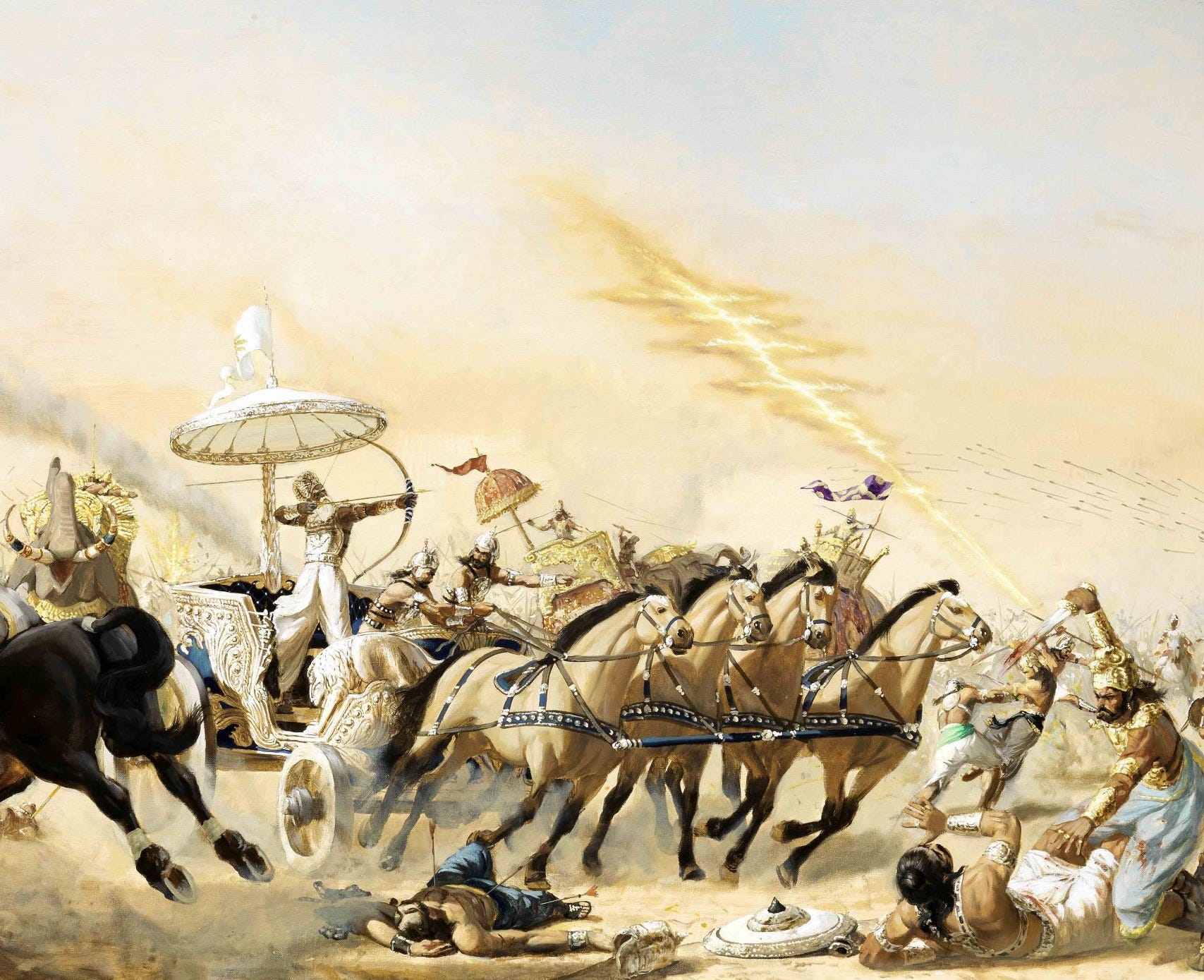
Whatever action a great man performs, common men follow (Bg 3.17 to 3.24)
After explaining the cycle of sacrifice, which is ultimately meant to elevate the common man to the platform of devotional service, Kṛṣṇa now clarifies the position of the self-realized soul. Advanced devotees have no material desires to satisfy and thus no duties to perform, but this does not mean they remain idle. They continue to perform duties on the platform of devotional service, acting without attachment, as an offering to the Lord, the very platform of niṣkāma-karma-yoga on which Kṛṣṇa recommends that Arjuna situate himself. By doing so, they also set the proper example for common people to follow, and thus advance towards the same platform.
Text 17: yas tv ātma-ratir eva syād, ātma-tṛptaś ca mānavaḥ
ātmany eva ca santuṣṭas, tasya kāryaṁ na vidyate
But for one who takes pleasure in the Self, whose human life is one of self-realization, and who is satisfied in the Self only, fully satiated – for him there is no duty.
Text 18: naiva tasya kṛtenārtho, nākṛteneha kaścana
na cāsya sarva-bhūteṣu, kaścid artha-vyapāśrayaḥ
A self-realized man has no purpose to fulfill in the discharge of his prescribed duties, nor has he any reason not to perform such work. Nor has he any need to depend on any other living being.
Text 19: tasmād asaktaḥ satataṁ, kāryaṁ karma samācara
asakto hy ācaran karma, param āpnoti pūruṣaḥ
Therefore, without being attached to the fruits of activities, one should act as a matter of duty, for by working without attachment one attains the Supreme.
Text 20: karmaṇaiva hi saṁsiddhim, āsthitā janakādayaḥ,
loka-saṅgraham evāpi, sampaśyan kartum arhasi
Kings such as Janaka attained perfection solely by performance of prescribed duties. Therefore, just for the sake of educating the people in general, you should perform your work.
Text 21: yad yad ācarati śreṣṭhas, tat tad evetaro janaḥ
sa yat pramāṇaṁ kurute, lokas tad anuvartate
Whatever action a great man performs, common men follow. And whatever standards he sets by exemplary acts, all the world pursues.
Text 22: na me pārthāsti kartavyaṁ, triṣu lokeṣu kiñcana
nānavāptam avāptavyaṁ, varta eva ca karmaṇi
O son of Pṛthā, there is no work prescribed for Me within all the three planetary systems. Nor am I in want of anything, nor have I a need to obtain anything – and yet I am engaged in prescribed duties.
Text 23: yadi hy ahaṁ na varteyaṁ, jātu karmaṇy atandritaḥ
mama vartmānuvartante, manuṣyāḥ pārtha sarvaśaḥ
For if I ever failed to engage in carefully performing prescribed duties, O Pārtha, certainly all men would follow My path.
Text 24: utsīdeyur ime lokā, na kuryāṁ karma ced aham
saṅkarasya ca kartā syām, upahanyām imāḥ prajāḥ
If I did not perform prescribed duties, all these worlds would be put to ruination. I would be the cause of creating unwanted population, and I would thereby destroy the peace of all living beings.
The path of pious life is necessary for everyone who has material desires, for it is the only way to satisfy these desires without becoming entangled in sinful reactions. This was already made clear in the previous section. What about an advanced devotee who became free from material desires? What are his or her duties? Should one immediately abandon everything and go to the forest?
In text 3.17, Kṛṣṇa confirms that once one becomes free from material desires, there are no more material duties to perform. At this stage, one starts performing his nitya-dharma, becoming fully confident in his eternal relationship with Kṛṣṇa and serving Him on the spiritual platform. However, Kṛṣṇa raises another point: even though a devotee without material desires has no need to perform material duties, because he is detached, he also has no need to discard them.
That’s a crucial point. To be truly detached means to be neutral. If I insist on a certain path, on one side or the other, it means I’m still attached to it. In the beginning of the Gītā, Arjuna posed as a renounced person, arguing that he was ready to leave everything and go to the forest. However, if he is truly renounced, then why not stay and fight?
This also applies to us. Often we use detachment as an excuse to neglect our duties, but this is just another side of material attachment: trying to avoid activities that are difficult or unpleasant. Real detachment means to just follow the order of Kṛṣṇa, performing our duties faithfully alongside our practice of Kṛṣṇa consciousness until the proper time for external renunciation comes. By following this process, we become truly free. Kṛṣṇa confirms this point in text 3.19, enjoining that one should work as a matter of duty, without attachment to the fruits of these activities, for working in this way, one attains the Supreme.
Arjuna wanted to avoid the fight because he didn’t find the idea of fighting his teachers very pleasant. He was also concerned about mundane morality. All of these, however, are signs of attachment. Kṛṣṇa thus argues that he should fight. From the material perspective, he should fight because this is his duty as a kṣatriya, his duty on the path of dharma, and that’s what will bring real benefit for society. From the spiritual perspective, he should also fight, because Kṛṣṇa personally desires him to fight.
The case of Arjuna, personally receiving instructions from Kṛṣṇa, is unique, but we have the same benefit when we have the opportunity to receive instructions from a self-realized spiritual master. If the spiritual master is connected with Kṛṣṇa, and the disciple has faith in him, then the process is as good as receiving direct instructions from Kṛṣṇa, for Kṛṣṇa will speak to the disciple through the mouth of the spiritual master.
To sustain this point of self-realized souls performing material duties, Kṛṣṇa mentions the example of great saintly kings of the past, such as King Janaka, the father of Sītā. Although a king and a householder, he was a great devotee and fully detached. He was so great that at the end of his life he was able to liberate all the souls living in hell by giving them his pious religious merits, as described in the Padma Purāṇa. Still, he was perfectly performing his duties as a king to give a good example to people in general. Similarly, Arjuna should perform his duty not only for his own sake but for the benefit of the whole society.
Why is it that pure devotees such as Janaka and Arjuna should still perform material duties, just like ordinary men? The point is that these duties are essential for ordinary people and devotees who are still battling their material desires. Everyone looks at the examples of great personalities for the path to follow, and thus pure devotees also perform their duties to give the proper example. A leader can’t teach people to stop smoking if he himself smokes. People will not hear what he says; they will follow what he does. If Arjuna were to leave the battlefield due to the difficulty in fighting his relatives, everyone who has problems at home would use his example as an excuse to also leave. If a pure devotee is seen not performing his duties, others will use it as an excuse to do the same.
We can see that even the Supreme Lord Himself performs duties when He comes as an incarnation, playing the role of a perfect king as Rāma, and a perfect sannyāsī as Śrī Caitanya Mahāprabhu. Certainly, the Lord has no material desire, and He is not under the influence of karma. Still, He performs duties to set a good example for others. As He mentions, “For if I ever failed to engage in carefully performing prescribed duties, O Pārtha, certainly all men would follow My path.”
We should, however, follow the example of the Lord without imitating Him. We can follow the path of dharma and morality, just as He did as Rāma, but we can’t imitate His superhuman activities, such as lifting Govardhana Hill. Following His example comes from humility, while imitating comes from envy. We should not confuse the two.
Out of envy, sahajiyās and Māyāvādīs try to imitate the amorous pastimes of Kṛṣṇa, without understanding that the gopīs are manifestations of His internal potency who met Him in their spiritual bodies. If a man wants to imitate Kṛṣṇa’s pastimes in marrying many wives, he should also be prepared to imitate His pastimes of giving a palace to each one, and being personally present with each of them simultaneously.
Main points in the purports of Śrīla Prabhupāda:
“But for one who takes pleasure in the Self, whose human life is one of self-realization, and who is satisfied in the Self only, fully satiated – for him there is no duty.”
a) A fully Kṛṣṇa-conscious devotee becomes fully aware of his eternal relationship with Kṛṣṇa and loses interest in material activities. Cleansed of all impiety and free from material desires, he no longer has any obligations to the Vedic injunctions. His duties are on the spiritual platform, connected with his service to Kṛṣṇa.
“A self-realized man has no purpose to fulfill in the discharge of his prescribed duties, nor has he any reason not to perform such work. Nor has he any need to depend on any other living being.”
a) Although a self-realized devotee has no obligation to perform material duties, he is not inactive, nor is he averse to the performance of duties ordained by the Lord. His performance of duties is, however, different from an ordinary person, for everything he does is exclusively for the satisfaction of the Lord.
“Therefore, without being attached to the fruits of activities, one should act as a matter of duty, for by working without attachment one attains the Supreme.”
a) The process of working for Kṛṣṇa without attachment to the result allows us to progress toward the supreme goal of life. This is the most perfect form of action. In the Gītā, Arjuna is advised on how to act by Kṛṣṇa Himself, and this is beyond mundane matters such as the idea of being a good man or a non-violent man.
b) Vedic rituals and sacrifices allow one to attain material results and purify himself of impious reactions. They are, however, still under the sphere of sense gratification. The goal is to be happy in this world, not to transcend it. Action in Kṛṣṇa consciousness, however, is transcendental and free from pious and impious results. A devotee thus remains unattached even while performing different activities. He does not work for himself, but for Kṛṣṇa.
“Kings such as Janaka attained perfection solely by performance of prescribed duties. Therefore, just for the sake of educating the people in general, you should perform your work.”
a) Although pure devotees such as Janaka have no material desires to satisfy, they are eager to cooperate in the mission of the Lord of saving the conditioned souls. They therefore perform their prescribed duties to set the proper standards that others can follow. In other words, even though they may not have any interest in the world, they still work to teach the public how to live and how to act.
“Whatever action a great man performs, common men follow. And whatever standards he sets by exemplary acts, all the world pursues.”
a) A teacher should behave properly before he begins teaching. To teach the common man, an ācārya must follow the principles of the scriptures. Even though a pure devotee is transcendental to mundane duties, common men are not, and they have to be properly guided.
b) Apart from spiritual masters, all types of other authorities, including a king, a father, a teacher, etc., have a great responsibility for their dependents, and must be well familiar with the principles of the scriptures.
“O son of Pṛthā, there is no work prescribed for Me within all the three planetary systems. Nor am I in want of anything, nor have I a need to obtain anything – and yet I am engaged in prescribed duties.”
a) Kṛṣṇa is the greatest; everyone is under His control. There is no other leader who can censure Him. In fact, He is the object of worship of all the great demigods and kings. Nor is He under the influence of karma or material qualities. On the contrary, His body is fully spiritual.
b) He also has no material desire, and nothing to obtain. He is thus, on all levels, completely free from any material duty. Still, He engages Himself in many activities, such as participating in the battle of Kurukṣetra to set the proper example. As the compiler of the Vedic scriptures, He does not do anything that contradicts their precepts.
“For if I ever failed to engage in carefully performing prescribed duties, O Pārtha, certainly all men would follow My path.”
a) Kṛṣṇa is the greatest authority. If He did not follow the injunctions of the scriptures, others would follow His actions. In the Śrīmad-Bhāgavatam we learn that while living as a householder in Dvārakā, Kṛṣṇa was perfectly performing all His religious duties.
“If I did not perform prescribed duties, all these worlds would be put to ruination. I would be the cause of creating unwanted population, and I would thereby destroy the peace of all living beings.”
a) The rules of the scriptures are formulated to allow people to live peacefully and progress spiritually. When Kṛṣṇa appears in this world, He follows these rules to maintain their prestige and emphasize their importance.
b) He does so because He is the father of all living entities, and thus He is indirectly responsible. When society deviates from the regulative principles, the Lord comes personally to correct it.
c) We should follow the example of the Lord in practicing religious principles, and not try to imitate His pastimes. Following is different from imitating. We can’t drink the ocean of poison like Lord Śiva. If we try to imitate, we just invite death.
Next: The learned guides others without disturbing them (3.25 and 3.29)
Read the entire book:
« The Song of God—Volume 1, chapters 1-6

This is a publication for thoughtful readers who want to go deeper into Kṛṣṇa consciousness. I publish daily, trying to offer high-quality spiritual content, and all posts are available to free subscribers. If you wish, you can also choose a paid subscription to support this work.
You can also receive the updates on WhatsApp or Telegram.
If you would like to contribute further, you can find the donation links here.