

« The Song of God—Volume 1, chapters 1-6
Different types of sacrifice (Bg 4.25 to 4.32)
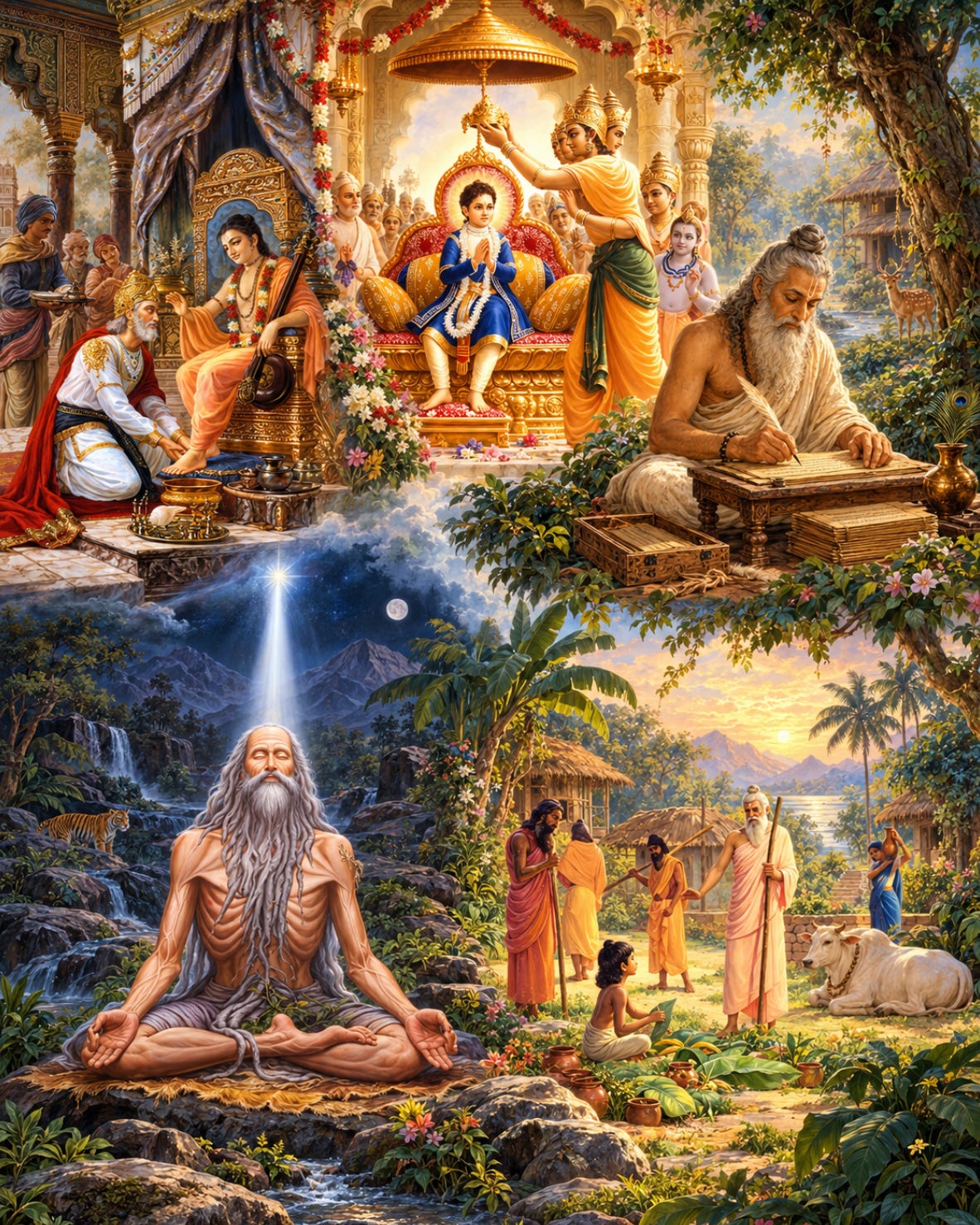
In the previous section, Kṛṣṇa described how the perfection of the process of work in Kṛṣṇa consciousness brings us to the transcendental platform. However, the Vedas prescribe many other processes and forms of sacrifice. How do they relate to what Kṛṣṇa is describing? Are they inferior, superior, or equal? In this section, Kṛṣṇa describes how these processes are stages of the broader process of devotional service. Different people may perform different forms of sacrifice according to their nature. Ordinarily, progress in these indirect processes is slow, but if they are connected with transcendental knowledge of our relationship with Kṛṣṇa and performed for His satisfaction, they quickly bring us to the platform of devotional service.
Text 25: daivam evāpare yajñaṁ, yoginaḥ paryupāsate
brahmāgnāv apare yajñaṁ, yajñenaivopajuhvati
Some yogīs perfectly worship the demigods by offering different sacrifices to them, and some offer sacrifices in the fire of the Supreme Brahman.
Text 26: śrotrādīnīndriyāṇy anye, saṁyamāgniṣu juhvati
śabdādīn viṣayān anya, indriyāgniṣu juhvati
Some [the unadulterated brahmacārīs] sacrifice the hearing process and the senses in the fire of mental control, and others [the regulated householders] sacrifice the objects of the senses in the fire of the senses.
Text 27: sarvāṇīndriya-karmāṇi, prāṇa-karmāṇi cāpare
ātma-saṁyama-yogāgnau, juhvati jñāna-dīpite
Others, who are interested in achieving self-realization through control of the mind and senses, offer the functions of all the senses, and of the life breath, as oblations into the fire of the controlled mind.
Text 28: dravya-yajñās tapo-yajñā, yoga-yajñās tathāpare
svādhyāya-jñāna-yajñāś ca, yatayaḥ saṁśita-vratāḥ
Having accepted strict vows, some become enlightened by sacrificing their possessions, and others by performing severe austerities, by practicing the yoga of eightfold mysticism, or by studying the Vedas to advance in transcendental knowledge.
Text 29: apāne juhvati prāṇaṁ, prāṇe ’pānaṁ tathāpare
prāṇāpāna-gatī ruddhvā, prāṇāyāma-parāyaṇāḥ
apare niyatāhārāḥ, prāṇān prāṇeṣu juhvati
Still others, who are inclined to the process of breath restraint to remain in trance, practice by offering the movement of the outgoing breath into the incoming, and the incoming breath into the outgoing, and thus at last remain in trance, stopping all breathing. Others, curtailing the eating process, offer the outgoing breath into itself as a sacrifice.
Text 30: sarve ’py ete yajña-vido, yajña-kṣapita-kalmaṣāḥ
yajña-śiṣṭāmṛta-bhujo, yānti brahma sanātanam
All these performers who know the meaning of sacrifice become cleansed of sinful reactions, and, having tasted the nectar of the results of sacrifices, they advance toward the supreme eternal atmosphere.
Text 31: nāyaṁ loko ’sty ayajñasya, kuto ’nyaḥ kuru-sattama
O best of the Kuru dynasty, without sacrifice one can never live happily on this planet or in this life: what then of the next?
Text 32: evaṁ bahu-vidhā yajñā, vitatā brahmaṇo mukhe
karma-jān viddhi tān sarvān, evaṁ jñātvā vimokṣyase
All these different types of sacrifice are approved by the Vedas, and all of them are born of different types of work. Knowing them as such, you will become liberated.
Text 4.24 described the principle of Kṛṣṇa consciousness in spiritualizing all activities. Now, Kṛṣṇa gives practical examples of different types of sacrifices and austerities performed by different classes of persons in Vedic culture with the purpose of advancing on the spiritual path. In other words, after describing the goal, Kṛṣṇa now describes different processes of sacrifice that lead to this goal. As this sequence describes, not all sacrifices are made by pouring ghee into the fire. Ghee and grain burning may be the most famous image of Vedic sacrifice, but the category is much broader, encompassing many types of fires and offerings.
As long as we remain conditioned, we are forced to perform material activities because of our mind and senses. As Kṛṣṇa explained in the first chapters of the Gītā, this process can’t be stopped by intention alone. The process is not to stop activity, but to connect these activities to Kṛṣṇa. This is the ultimate goal of different processes of sacrifice described in the Vedas. When these processes are combined with transcendental knowledge, they lead to the platform of devotional service.
Performers of fire sacrifices and jñānis: Text 4.25 describes two types of performers of sacrifices: the ones who worship demigods, and jñānis who aspire to merge into the Supreme Brahman. Demigod worshippers usually follow the Vedic process of Vedic sacrifices, sacrificing ghee and grains into the fire, while jñānis follow the path of philosophical introspection, sacrificing their material designations in the fire of this knowledge, and eventually their individual existences by merging into the Brahman effulgence.
Later, Kṛṣṇa will define demigod worshippers as less intelligent people who fail to understand the purpose of the Vedas, but not all fall into this category. Many great devotees, like King Janaka, and Bharata Mahārāja, performed Vedic sacrifices with offerings to demigods to set an example to ordinary people in following Vedic injunctions. However, they were not worshipping demigods as separate gods, but as agents of the Supreme Lord and parts of His universal body. They thus performed sacrifices in full knowledge, giving the example that can elevate ordinary people.
In his purport, Prabhupāda interprets 4.25 as a continuation of text 4.24, and interprets the words yoginaḥ paryupāsate in relation to the Kṛṣṇa-conscious devotee who works for Kṛṣṇa mentioned in the previous verse. With this, he adds a third category to the two categories directly mentioned in text 4.25 and classifies the other two classes of worshippers in relation to the self-realized devotee. As he mentions:
“Those who are interested in material benefits worship the demigods by various sacrifices according to the Vedic rituals. They are called bahv-īśvara-vādī, or believers in many gods. But others, who worship the impersonal feature of the Absolute Truth and regard the forms of the demigods as temporary, sacrifice their individual selves in the supreme fire and thus end their individual existences by merging into the existence of the Supreme. Such impersonalists sacrifice their time in philosophical speculation to understand the transcendental nature of the Supreme. In other words, the fruitive workers sacrifice their material possessions for material enjoyment, whereas the impersonalist sacrifices his material designations with a view to merging into the existence of the Supreme. For the impersonalist, the fire altar of sacrifice is the Supreme Brahman, and the offering is the self being consumed by the fire of Brahman. The Kṛṣṇa conscious person, like Arjuna, however, sacrifices everything for the satisfaction of Kṛṣṇa, and thus all his material possessions as well as his own self – everything – is sacrificed for Kṛṣṇa. Thus, he is the first-class yogī; but he does not lose his individual existence.”
Brahmacārīs and householders: These two classes appear to be opposites. Brahmacārīs restrict their senses, while householders engage them in various types of material work, begetting children, etc. However, both are equally engaged in the performance of sacrifice. This is the beauty of Vedic culture. Brahmacārīs engage their senses, especially their sense of hearing, in their studies and spiritual practice, instead of using them for material enjoyment. In this way, their mental control becomes the fire where the faculties of their senses are sacrificed. Householders, on the other hand, engage their senses in the process of regulated enjoyment created to purify us. In this way, their senses become the fire where different types of objects of the senses are sacrificed, with the goal of self-realization. As Kṛṣṇa will declare later, He is sex life that is performed according to the injunctions of the scriptures.
Mystic yogīs: In text 4.27, Kṛṣṇa describes the sacrifice performed by mystic yogīs who follow the system of Patañjali. They offer the activities of the senses and the functions of the life air (prāṇa) into the fire of the controlled mind, which is sustained by the desire for self-realization. Prabhupāda explains that as long as the soul is attached to sense enjoyment, it is called parāg-ātmā, or outward-facing. When the same soul becomes detached from sense enjoyment, it is called pratyag-ātmā, inward-facing. A conditioned soul lives absorbed in external activities through the senses, while the yogī tries to reverse this outward flow by controlling the senses and the life airs, purifying the soul from material attachment and focusing on the spiritual nature. By following this process, a yogī can achieve liberation.
Charity, austerity, yoga, and Vedic study: In text 4.28, Kṛṣṇa mentions four other classes of sacrifice, which are performed by enlightened persons under strict vows.
Dravya-yajña means charity, the sacrifice of one’s possessions. Tapaḥ-yajña means penances and austerities, such as rigidly following the regulations of the cāturmāsya period. Yoga-yajña means the practice of yoga for obtaining mystic perfections, following the processes of aṣṭāṅga-yoga, haṭha-yoga, etc. Jñāna-yajña means the sacrifice of studying the Vedas and developing transcendental knowledge.
Prāṇāyāma: Another class of yogīs becomes focused on the practice of prāṇāyāma, attaining trance through breath exercises, starting by the practice of sitting postures in the haṭha-yoga system. Even today this process is still popular, although the efficacy in the current age is questionable. Prabhupāda summarizes this process in his purport:
“This practice involves controlling the airs within the body so as to reverse the directions of their passage. The apāna air goes downward, and the prāṇa air goes up. The prāṇāyāma-yogī practices breathing the opposite way until the currents are neutralized into pūraka, equilibrium. Offering the exhaled breath into the inhaled breath is called recaka. When both air currents are completely stopped, one is said to be in kumbhaka-yoga. By practice of kumbhaka-yoga, one can increase the duration of life for perfection in spiritual realization. The intelligent yogī is interested in attaining perfection in one life, without waiting for the next. For by practicing kumbhaka-yoga, the yogīs increase the duration of life by many, many years.”
We can see that processes of mystic yoga are mentioned in three verses. This may appear repetitive at first, but it divides practitioners in three groups: the first, most directly related to the Pātañjala-yoga, aims to attain impersonal liberation. The second class has the goal of attaining mystic perfections, while the third focuses on controlling the vital air.
The correlation of the processes of mystic yoga and the devotional process is more directly stated by Lord Kapila in the final chapters of the third canto of Śrīmad-Bhāgavatam. As described in detail there, all the stages of the process of mystic yoga have an equivalent inside the process of devotional service. It is just that the devotional process is much easier, more practical, and more effective. While a yogī practices to see the Lord inside the heart as Paramātmā, a devotee sees Him directly, from day one, as the deity in the temple. While a yogī has to practice prāṇāyāma for years to control his mind, a devotee can focus it just by learning to chant attentively, and so on.
Another point is noted by Prabhupāda in his purport to text 4.28. All these different processes of sacrifice mentioned by Kṛṣṇa can help one to advance, but none of them can automatically bring one to the platform of devotional service. This can be achieved only through the association of devotees. As he mentions:
“Kṛṣṇa consciousness, however, is different from these because it is the direct service of the Supreme Lord. Kṛṣṇa consciousness cannot be attained by any one of the above-mentioned types of sacrifice but can be attained only by the mercy of the Lord and His bona fide devotees. Therefore, Kṛṣṇa consciousness is transcendental.”
The Jaiva Dharma, by Bhaktivinoda Ṭhākura, describes the story of Vaiṣṇava dāsa, who starts as a sannyāsī from the Māyāvādī school who was very learned in the Vedas and practiced great austerities. All of this practice didn’t bring him to the platform of devotional service, but purified him enough so he would become attracted when he met Vaiṣṇavas. This led him to the association of Premadāsa Bābājī, who trained him in the science of devotional service. Because he was already purified by study and austerity, Vaiṣṇava dāsa advanced rapidly, and soon realized his spiritual form.
The Vedas thus offer many processes of sacrifice to purify the common man, as described by Kṛṣṇa in this section, but the ultimate goal of all these processes is to bring one eventually to the process of Kṛṣṇa consciousness through the association of devotees.
The conclusion: After describing these different classes of performers of sacrifices, Kṛṣṇa concludes by stating that, “All these performers who know the meaning of sacrifice become cleansed of sinful reactions, and, having tasted the nectar of the results of sacrifices, they advance toward the supreme eternal atmosphere. O best of the Kuru dynasty, without sacrifice one can never live happily on this planet or in this life: what then of the next? All these different types of sacrifice are approved by the Vedas, and all of them are born of different types of work. Knowing them as such, you will become liberated.”
Different people come to perform different processes due to the particular combination of the three modes acting on them, and the impressions they carry from past lives. Some thus will be more attracted to fire sacrifices, charity, penances, meditation, etc. That’s precisely why the Vedas offer different paths. Ultimately, however, these different processes of sacrifice have the aim of elevating one to the same goal.
Nowadays, we put great effort into comfort and convenience. People in big cities generally live inside the conception that life should be easy, and money can solve all problems. Kṛṣṇa, however, disagrees with this idea, questioning, “without sacrifice one can never live happily on this planet or in this life: what then of the next?”
Human life is an opportunity for advancing spiritually. All kinds of advancement, both material and spiritual, demand effort. Without hard work, one can’t enter into a good university, find a good job, or even maintain a marriage. Instead of searching for ways of artificially making our lives comfortable, the Vedic path is about accepting the inherent challenges of human life and creating a better path for ourselves through the performance of sacrifices.
All the different processes of sacrifice described by Kṛṣṇa in this chapter, as well as other forms of sacrifice prescribed in the scriptures, are meant for purifying us. In text 3.9, He mentions that “Work done as a sacrifice for Viṣṇu has to be performed; otherwise work causes bondage in this material world.” Sacrifice is thus not optional if we desire to attain a better condition of life. This is the only path that allows us to enjoy materially to a certain extent without degradation. Refusing this path of sacrifice in this life leads us to the greatest austerity of all, which is a new birth in this material world, possibly in worse conditions than what we have in this life.
Main points in the purports of Śrīla Prabhupāda:
“Some yogīs perfectly worship the demigods by offering different sacrifices to them, and some offer sacrifices in the fire of the Supreme Brahman.”
a) There are different types of sacrifice performed by different classes of transcendentalists, but they are only superficially different, for the goal is the same: satisfy Yajña, Lord Viṣṇu. A devotee working for Kṛṣṇa is not inferior to any of them. On the contrary, he is a perfect yogī or a first-class mystic.
b) All these different types of sacrifice can be divided into two broader divisions: the sacrifice of material possessions and the cultivation of transcendental knowledge. These two are subdivided into others. For example, both a devotee and a worshipper of demigods sacrifice material possessions, but one does so for the satisfaction of Kṛṣṇa, while the other does so for obtaining temporary material happiness.
c) Who are the demigods? They are Kṛṣṇa’s assistants, empowered by him to perform their functions in the cosmos. Those who don’t understand this and worship the demigods as separate controllers are called bahv-īśvara-vādī, the ones who believe in many gods. Their knowledge is very limited.
d) Jñānis understand that demigods are temporary. They worship the transcendental force behind everything, the impersonal Brahman. They sacrifice their time and intelligence in philosophical inquiry to understand the difference between spirit and matter and eventually sacrifice their individual existence by merging there. Brahman is thus the fire where they sacrifice their own selves. Their knowledge is higher than that of demigod worshippers because they understand the difference of spirit and matter, but despite understanding that they are not part of this world, they fail to realize their true spiritual position.
e) Devotees sacrifice everything: their material possessions, talents, energy, thoughts, and their own selves. However, because they fully understand their eternal position of service, they don’t merge in Kṛṣṇa’s effulgence. Instead, they fully develop their spiritual identity and personally relate with Kṛṣṇa in one of the five transcendental rasas.
“Some [the unadulterated brahmacārīs] sacrifice the hearing process and the senses in the fire of mental control, and others [the regulated householders] sacrifice the objects of the senses in the fire of the senses.”
a) Ordinary people want to just enjoy their senses. In this sense they are considered no better than animals. The four divisions of the varṇāśrama system have the goal of creating the conditions for spiritual advancement.
b) The process of sacrifice for the brahmacārī is controlling his senses, hearing from the spiritual master, chanting the holy names, and abstaining from hearing mundane vibrations. The gṛhastha, on the other hand, performs sacrifice by engaging his senses in a controlled, detached way, following the injunctions of the scriptures. Both types of sacrifice are performed for spiritual advancement.
“Others, who are interested in achieving self-realization through control of the mind and senses, offer the functions of all the senses, and of the life breath, as oblations into the fire of the controlled mind.”
a) The goal of the Patañjali system of yoga is to elevate the soul from the parāg-ātmā platform, where one is turned outwardly and attached to sense gratification, to the pratyag-ātmā platform, where the attention is turned to the inside, and one becomes detached from the material situation.
b) Inside the body, the soul is subjected to the functions of the vital airs. By controlling them, the yogī creates a situation favorable for detachment. Once one becomes enlightened, the process continues, with the ultimate goal of self-realization.
“Having accepted strict vows, some become enlightened by sacrificing their possessions, and others by performing severe austerities, by practicing the yoga of eightfold mysticism, or by studying the Vedas to advance in transcendental knowledge.”
a) Kṛṣṇa mentions different types of performers of sacrifice. Some practice charity, offering food, education, and medical care to the needy. This is called dravyamaya-yajña. Others practice tapomaya-yajña, accepting different types of austerities, like cāturmāsya. Some practice different processes of yoga, with the goal of acquiring mystic powers (yoga-yajña), and others dedicate themselves to the study of the Vedānta-sūtra and Sāṅkhya (svādhyāya-yajña).
b) All of these bring advancement, but the results are still mainly material. Kṛṣṇa consciousness, however, brings transcendental results, because it is connected directly with the service of Kṛṣṇa. It is transcendental, and can’t be attained by mere pious results. To attain it, we need to come in contact with the mercy of devotees.
“Still others, who are inclined to the process of breath restraint to remain in trance, practice by offering the movement of the outgoing breath into the incoming, and the incoming breath into the outgoing, and thus at last remain in trance, stopping all breathing. Others, curtailing the eating process, offer the outgoing breath into itself as a sacrifice.”
a) The practice of sitting postures is called haṭha-yoga; the next stage is prāṇāyāma, the breathing process, practiced with the goal of controlling the senses. The yogī practices the breathing process until the inward and outward breaths reach a state of equilibrium, pūraka, which, when attained, allows one to remain in trance, kumbhaka-yoga. This allows him to increase his duration of life and attain perfection in this same life, without having to take a new birth.
b) A devotee, however, follows a much easier and more natural process. As soon as one is situated in Kṛṣṇa consciousness, the senses become automatically controlled, because they are fully engaged in the service of the Lord. Such a devotee also has no need to increase his lifespan, for his promotion to the spiritual world is already arranged. There is also no chance of falling down.
c) Reducing eating is very useful for controlling the senses, and without controlling the senses, there is no possibility of getting out of material entanglement. Both yogīs and devotees control their eating, but a devotee controls it by eating only prasādam and avoiding all other types of food.
“All these performers who know the meaning of sacrifice become cleansed of sinful reactions, and, having tasted the nectar of the results of sacrifices, they advance toward the supreme eternal atmosphere.”
a) Sense gratification is the root cause of material existence. The common aim of all processes of sacrifice is to control the senses and become cleansed of sinful reactions. This allows one to attain the transcendental platform.
“O best of the Kuru dynasty, without sacrifice one can never live happily on this planet or in this life: what then of the next?”
a) Ignorance is the cause of sinful life. Sinful life, in turn, creates karmic reactions, and these sinful reactions keep us bound to this material world, bound to ignorance. The human form is the only opportunity by which we can get out of this endless cycle, and the Vedas teach how to use it through the gradual path of religion, economic development due to pious life, and regulated sense gratification, culminating in liberation.
b) By following the path of sacrifice, all economic problems are solved, for we are supplied with enough food, milk, etc. Being properly nourished, one can then enjoy his senses following the path of regulated enjoyment prescribed in the Vedas, culminating with liberation. Without following this path of sacrifice, no one can expect a happy life, either in this body or in the next.
c) Material happiness, however, is not the real purpose of the process of sacrifice. The ultimate goal of the system is to promote us to the platform of Kṛṣṇa consciousness, through which we can reach the spiritual planets where we can personally associate with Kṛṣṇa.
“All these different types of sacrifice are approved by the Vedas, and all of them are born of different types of work. Knowing them as such, you will become liberated.”
a) Why do the Vedas prescribe different types of sacrifice? Why not just one type for everyone? The point is that different people have different inclinations, and thus different types of sacrifices are offered, allowing us to serve either with the body, mind or intelligence.
Read the entire book:
« The Song of God—Volume 1, chapters 1-6

This is a publication for thoughtful readers who want to go deeper into Kṛṣṇa consciousness. I publish daily, trying to offer high-quality spiritual content, and all posts are available to free subscribers. If you wish, you can also choose a paid subscription to support this work.
You can also receive the updates on WhatsApp or Telegram.
If you would like to contribute further, you can find the donation links here.