

« The Song of God—Volume 1, chapters 1-6
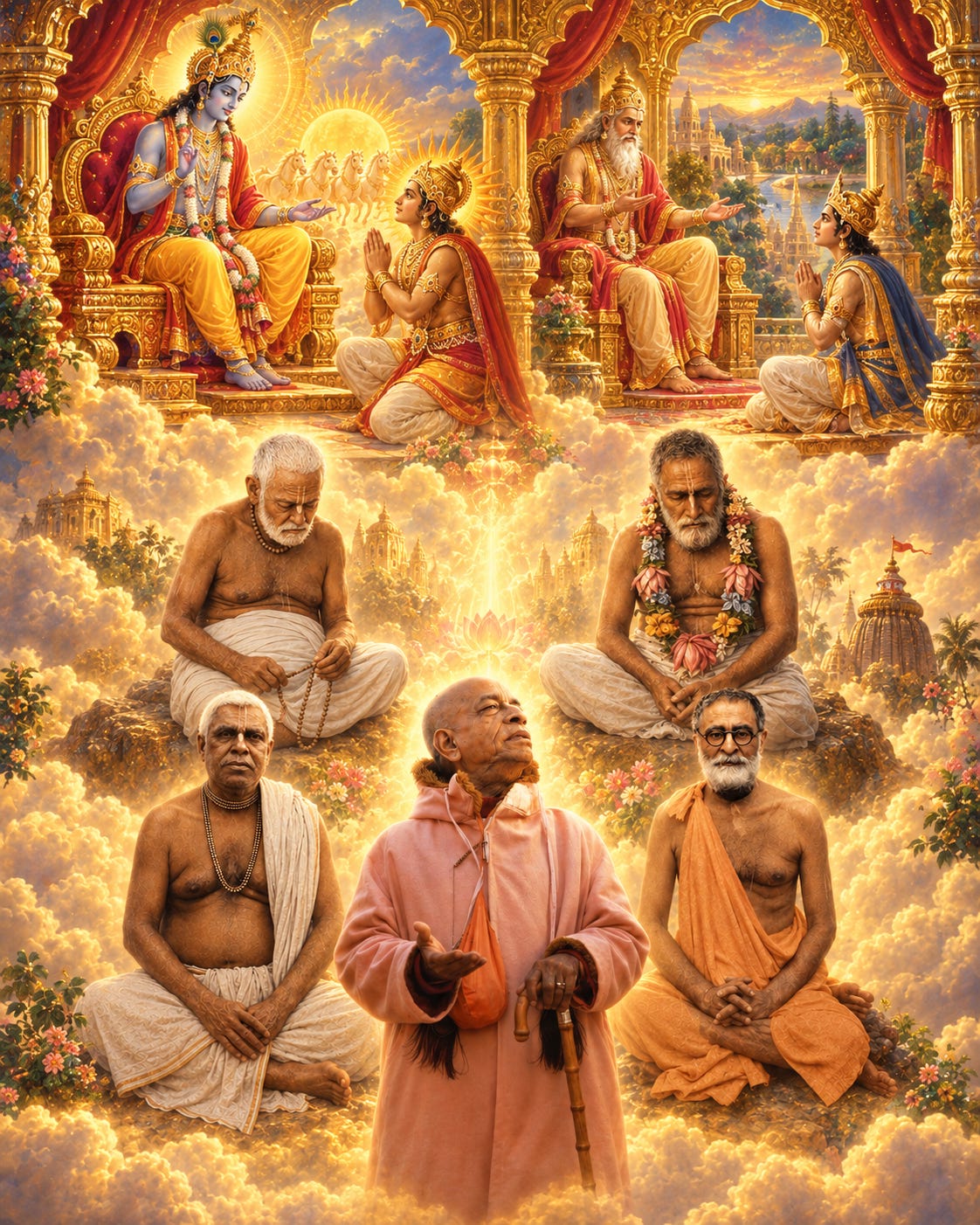
The disciplic succession (Bg 4.1 to 4.3)
Kṛṣṇa starts the chapter by explaining how transcendental knowledge is transmitted. The Bhagavad-gītā is not a new doctrine created for Arjuna; it is an eternal science transmitted long ago by Kṛṣṇa to the sun god, and carefully transmitted in disciplic succession. Arjuna was chosen as the recipient of a new disciplic succession because he is His devotee and friend. It was already established in the introduction that the Gītā can only be understood by one who accepts Kṛṣṇa as the Supreme Personality of Godhead. Now, another principle is established: it should be learned within the disciplic succession.
Text 1: śrī-bhagavān uvāca
imaṁ vivasvate yogaṁ, proktavān aham avyayam
vivasvān manave prāha, manur ikṣvākave ’bravīt
The Personality of Godhead, Lord Śrī Kṛṣṇa, said: I instructed this imperishable science of yoga to the sun-god, Vivasvān, and Vivasvān instructed it to Manu, the father of mankind, and Manu in turn instructed it to Ikṣvāku.
Text 2: evaṁ paramparā-prāptam, imaṁ rājarṣayo viduḥ
sa kāleneha mahatā, yogo naṣṭaḥ paran-tapa
This supreme science was thus received through the chain of disciplic succession, and the saintly kings understood it in that way. But in course of time the succession was broken, and therefore the science as it is appears to be lost.
Text 3: sa evāyaṁ mayā te ’dya, yogaḥ proktaḥ purātanaḥ
bhakto ’si me sakhā ceti, rahasyaṁ hy etad uttamam
That very ancient science of the relationship with the Supreme is today told by Me to you because you are My devotee as well as My friend and can therefore understand the transcendental mystery of this science.
As Kṛṣṇa will later reveal, our universe is repeatedly created and destroyed, following the days and nights of Brahmā. Each cycle of creation, a day of Brahmā, lasts for 4.32 billion years, a period divided into 14 manvantaras. The first manvantara was ruled by Svāyambhuva Manu, the grandfather of Dhruva Mahārāja, and the current manvantara, the 7th in the sequence, is ruled by Vaivasvata Manu, the son of Vivasvān, the current sun god.
Kṛṣṇa reveals that not only does He appear in different forms and in different places, but also that the Bhagavad-gītā itself is eternal, and is repeatedly transmitted again and again, whenever this transcendental science is lost.
Prabhupāda gives several rounded numbers in his purport to text 4.1, but you can find the exact numbers following the formulas he gives in other purports. The point we should pay attention to is the conclusions and the historical facts and their consequences. Anyone can find out exact numbers using a calculator; the important point is the conclusions of the text.
Chronologically, we are in the first day of the 51st year of Brahmā, in the reign of the 7th Manu. Each manvantara is composed of 71 sets of four ages (Satya-yuga, Tretā-yuga, Dvāpara-yuga, and Kali-yuga). Currently, we are in the beginning of the Kali-yuga of the 28th cycle.
Kali-yuga lasts for 432,000 years, of which just a little over 5,000 have passed. Dvāpara-yuga lasts for double the length of Kali-yuga, 864,000 years; Tretā-yuga three times, 1,296,000 years; and Satya-yuga four times, 1,728,000 years. Four ages together form a divya-yuga, which lasts for a total of 4.32 million years. The Bhagavad-gītā was transmitted by Vaivasvata Manu to Mahārāja Ikṣvāku in the beginning of the past Tretā-yuga, over two million years ago.
A manvantara lasts for a total of 306,720,000 years, which equals 71 complete divya-yugas. We are in the 28th cycle, so we have already gone through about 120 million years of the reign of the current Manu.
Kṛṣṇa personally spoke the Bhagavad-gītā to Vivasvān, the current demigod of the sun, at the start of the current manvantara, and he, in turn, later transmitted it to Vaivasvata Manu, who transmitted it to Ikṣvāku. That’s how this divine knowledge reached human society, instructing many generations of saintly kings.
The knowledge of the Bhagavad-gītā is special, even considering other transcendental knowledge in the Vedas, because it is especially relevant for saintly rulers and householders, who have to reconcile their material obligations with their spiritual practice. That’s why it is transmitted to saintly kings, like Ikṣvāku and Arjuna, who can rule according to this knowledge and teach its principles to the general population.
As Prabhupāda mentions, “Certainly Bhagavad-gītā was never meant for the demonic persons, who would dissipate its value for no one’s benefit and would devise all types of interpretations according to personal whims. As soon as the original purpose was scattered by the motives of the unscrupulous commentators, there arose the need to reestablish the disciplic succession.”
The point about the Gītā is that the true secret is not only in the verses, but in the conclusions of the text received through the disciplic succession. Any mental speculator can write a commentary on the Gītā, but only a devotee of Kṛṣṇa connected to the disciplic succession can enter into the mysteries of the text. That’s what makes the Bhagavad-gītā As It Is different from all the thousands of other commentaries available on the market. Five thousand years ago, when Kṛṣṇa was personally present, He detected that the disciplic succession of Mahārāja Ikṣvāku had been lost, and thus He decided to start a new disciplic succession, transmitting it again to Arjuna.
The science of the Gītā is described as purātanaḥ: ancient. In fact, this knowledge is so old that it existed before the creation of the universe. Just as Kṛṣṇa is eternal, the knowledge of the Gītā is eternal, and it is introduced again and again in different contexts whenever there is a need.
What are the qualifications of Arjuna for receiving it? Bhakto ’si me sakhā ceti: Arjuna is a devotee of Kṛṣṇa, as well as His friend. He is never envious of Him.
You may remember that in the introduction, Śrīla Prabhupāda mentioned:
“Therefore Bhagavad-gītā should be taken up in a spirit of devotion. One should not think that he is equal to Kṛṣṇa, nor should he think that Kṛṣṇa is an ordinary personality or even a very great personality. Lord Śrī Kṛṣṇa is the Supreme Personality of Godhead. So according to the statements of Bhagavad-gītā or the statements of Arjuna, the person who is trying to understand the Bhagavad-gītā, we should at least theoretically accept Śrī Kṛṣṇa as the Supreme Personality of Godhead, and with that submissive spirit we can understand the Bhagavad-gītā. Unless one reads the Bhagavad-gītā in a submissive spirit, it is very difficult to understand Bhagavad-gītā, because it is a great mystery.”
At first, it may appear that Śrīla Prabhupāda is asking the reader to accept blindly, but this just reveals an important secret of the text: It is not possible to enter into the mysteries of the Bhagavad-gītā without first accepting Kṛṣṇa as the Supreme Personality of Godhead. Without at least some preliminary faith, we will not take what He speaks seriously, and this knowledge will not enter our hearts. Therefore, Prabhupāda urges the reader right at the beginning to accept this point, that at least theoretically Kṛṣṇa should be accepted as God if one wants to benefit from the study. As initial proof, he offers that Arjuna accepted it, other great Vedic sages accepted it, and he himself accepted it, and then proceeds to elaborate on it in the rest of the introduction. This is not a capricious or unreasonable demand; it is just how the Gītā works.
In practically any body of knowledge, the proof comes only after we master the subject. For example, a scientist may prove through an experiment that an atom is not a solid ball of matter but is instead composed of smaller particles, protons, neutrons, etc. His research is then accepted as proof. However, no ordinary person can replicate the experiment to confirm it. Indeed, an ordinary person will probably not even fully comprehend it. The conclusion is accepted based on trust. The researcher is accepted as a respected person; his conclusion is accepted by other respected people; therefore, it is trusted as correct. Even if one desires to become a scientist to confirm the findings, he or she will have to accept these conclusions as part of their study, and only many years later, perhaps, be able to see the proof by repeating the experiment. Similarly, in the spiritual process, everything is confirmed with time. One can see Kṛṣṇa personally, face-to-face, just like Arjuna saw Him, but for that we need to first attain the necessary qualification. Without following the proper process, there will be no advancement, and we will remain perpetually in ignorance.
Main points in the purports of Śrīla Prabhupāda:
“The Personality of Godhead, Lord Śrī Kṛṣṇa, said: I instructed this imperishable science of yoga to the sun-god, Vivasvān, and Vivasvān instructed it to Manu, the father of mankind, and Manu in turn instructed it to Ikṣvāku.”
a) The Bhagavad-gītā is especially meant for kings, who should understand the spiritual science and guide the citizens, teaching them to avoid material lust.
b) The original disciplic succession of the Gītā was Vivasvān > Manu > Ikṣvāku > saintly kings. Kṛṣṇa transmitted it to Vivasvān 120 million years ago. Prabhupāda quotes a verse from the Mahābhārata to maintain that the transmission to Manu and then to Ikṣvāku happened in the beginning of the last Tretā-yuga, about two million years ago. Ikṣvāku is the forefather of the Raghu dynasty, in which Lord Rāmacandra appeared. This disciplic succession was later broken, leading the Lord to transmit it again to Arjuna, starting a new disciplic succession.
c) The knowledge of the Gītā is apauruṣeya, superhuman, and must be accepted without interpretation through the medium of the disciplic succession. Materialists may speculate, but their commentaries do not represent the Gītā as it is.
“This supreme science was thus received through the chain of disciplic succession, and the saintly kings understood it in that way. But in course of time the succession was broken, and therefore the science as it is appears to be lost.”
a) The text of the Gītā was never lost, but the meaning was lost, covered by the commentaries of unscrupulous persons. This created the need for a new disciplic succession 5,000 years ago. Similarly, when Prabhupāda came to the West, the real meaning of the Gītā was covered by many atheistic commentaries, creating the need for an edition of the Gītā as it was originally received.
b) When the Bhagavad-gītā is accepted as it is, it is a great boon to humanity, but if it is taken in a speculative spirit, it becomes just a waste of time.
“That very ancient science of the relationship with the Supreme is today told by Me to you because you are My devotee as well as My friend and can therefore understand the transcendental mystery of this science.”
a) Demons cannot understand at all the science of the Bhagavad-gītā. Arjuna was selected as the recipient for a new disciplic succession of the Gītā because he is a devotee. Similarly, the Gītā should be received from a devotee. Commentaries written by demons are useless.
b) Any commentator of the Gītā must accept Kṛṣṇa as the Supreme Personality of Godhead, just like Arjuna, and any commentary written in this spirit is a great service to the transcendental cause. The demoniac, on the other hand, just misled the readers. To benefit, we must receive it from the disciplic succession.
Read the entire book:
« The Song of God—Volume 1, chapters 1-6

This is a publication for thoughtful readers who want to go deeper into Kṛṣṇa consciousness. I publish daily, trying to offer high-quality spiritual content, and all posts are available to free subscribers. If you wish, you can also choose a paid subscription to support this work.
You can also receive the updates on WhatsApp or Telegram.
If you would like to contribute further, you can find the donation links here.