

« The Song of God—Volume 1, chapters 1-6
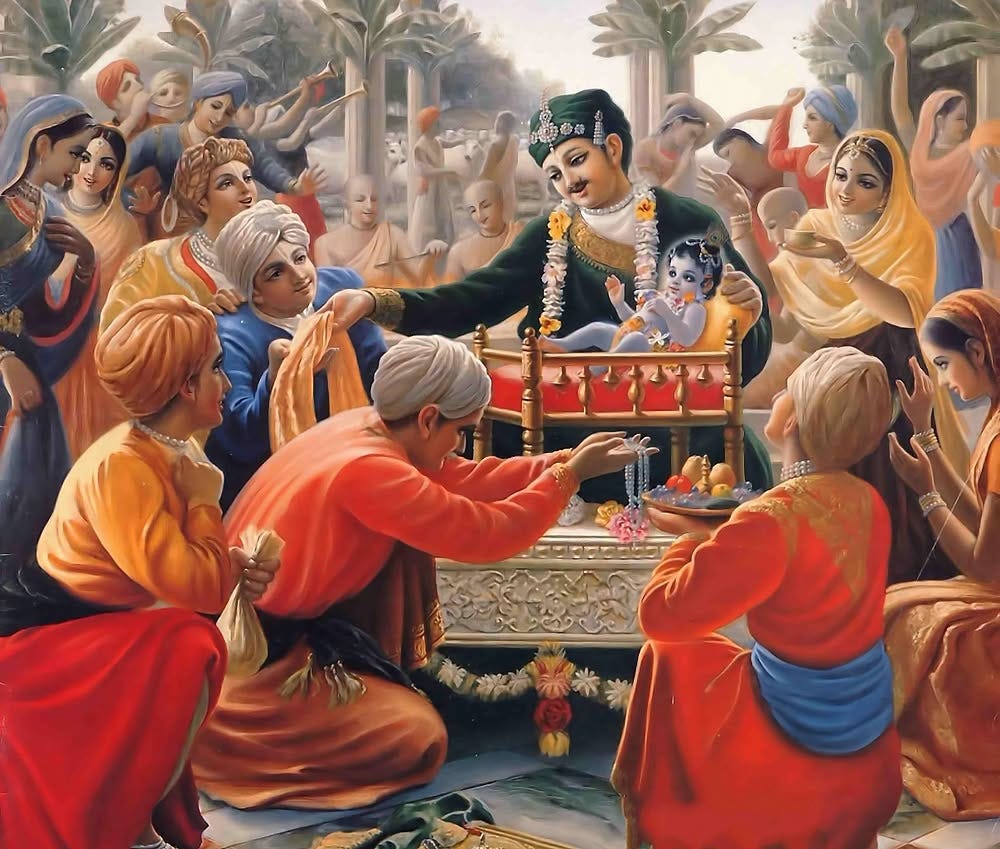
The mystery of Kṛṣṇa’s appearance and activities (Bg 4.4 to 4.10)
How could Kṛṣṇa have instructed the Bhagavad-gītā to the sun god millions of years ago? Kṛṣṇa is not just the friend of Arjuna; He is the Supreme Lord Himself, the same Supreme Person described throughout the Vedas, who descends into this world by His own potency. This essential point has to be made clear, because without understanding Kṛṣṇa’s position, we cannot understand the transcendental knowledge He is revealing.
Text 4: arjuna uvāca
aparaṁ bhavato janma, paraṁ janma vivasvataḥ
katham etad vijānīyāṁ, tvam ādau proktavān iti
Arjuna said: The sun-god Vivasvān is senior by birth to You. How am I to understand that in the beginning You instructed this science to him?
Text 5: śrī-bhagavān uvāca
bahūni me vyatītāni, janmāni tava cārjuna
tāny ahaṁ veda sarvāṇi, na tvaṁ vettha paran-tapa
The Personality of Godhead said: Many, many births both you and I have passed. I can remember all of them, but you cannot, O subduer of the enemy!
Text 6: ajo ’pi sann avyayātmā, bhūtānām īśvaro ’pi san
prakṛtiṁ svām adhiṣṭhāya, sambhavāmy ātma-māyayā
Although I am unborn and My transcendental body never deteriorates, and although I am the Lord of all living entities, by My internal energy I still appear in every millennium in My original transcendental form.
Text 7: yadā yadā hi dharmasya, glānir bhavati bhārata
abhyutthānam adharmasya, tadātmānaṁ sṛjāmy aham
Whenever and wherever there is a decline in religious practice, O descendant of Bharata, and a predominant rise of irreligion – at that time I descend Myself.
Text 8: paritrāṇāya sādhūnāṁ, vināśāya ca duṣkṛtām
dharma-saṁsthāpanārthāya, sambhavāmi yuge yuge
To deliver the pious and to annihilate the miscreants, as well as to reestablish the principles of religion, I Myself appear, millennium after millennium.
Text 9: janma karma ca me divyam, evaṁ yo vetti tattvataḥ
tyaktvā dehaṁ punar janma, naiti mām eti so ’rjuna
One who knows the transcendental nature of My appearance and activities does not, upon leaving the body, take his birth again in this material world, but attains My eternal abode, O Arjuna.
Text 10: vīta-rāga-bhaya-krodhā, man-mayā mām upāśritāḥ
bahavo jñāna-tapasā, pūtā mad-bhāvam āgatāḥ
Being freed from attachment, fear and anger, being fully absorbed in Me and taking refuge in Me, many, many persons in the past became purified by knowledge of Me – and thus they all attained transcendental love for Me.
Kṛṣṇa mentioned that He explained the science of the Bhagavad-gītā many millions of years ago to Vivasvān. A reader who is under the impression that Kṛṣṇa is just a historical personality may question this, since Vivasvān is much older, being born before the start of the current manvantara, over 120 million years ago. Kṛṣṇa appeared to Devakī just about 89 years before the battle of Kurukṣetra, so He is, in this sense, Arjuna’s contemporary. How could He be present at the start of the manvantara to teach the demigod of the sun?
Being a devotee, Arjuna knows Kṛṣṇa, but he asks this question so Kṛṣṇa can reveal His divinity and speak about the reasons of His transcendental appearance in this world. Materialists tend to believe that there is no God, or that God is some kind of transcendental, formless energy. Kṛṣṇa challenges this conception, appearing in a personal form, performing many wonderful activities, and teaching Arjuna. If God is eternal, how can He take birth? If He is free of material desires, how can He perform activities? If He is unlimited, how can He be contained in a human form?
Kṛṣṇa answers that not only He, but also Arjuna and all of us, have taken birth many times in the past. There is, however, a difference: He can remember all His previous births, but we can’t. How is it possible? This is answered in text six: Kṛṣṇa appears in His original, transcendental body, while we accept different material bodies. There is no difference between Kṛṣṇa and His body; He simply makes His transcendental form visible in this world to perform His pastimes. We, on the other hand, accept a material body that is different from our self, and forget the activities we perform in this life when we go to another body. Even a liberated soul like Arjuna forgets the activities of his previous births. Arjuna was present when Kṛṣṇa spoke the Gītā to Vivasvān, but he forgot. Kṛṣṇa, however, never forgets. There is thus an essential, intrinsic difference between Kṛṣṇa and the infinitesimal soul.
As explained in the Kaṭha Upaniṣad (2.2.13):
nityo nityānām cetanaś cetanānām
eko bahūnām yo vidadhāti kāmān
tam ātma-stham ye ’nupaśyanti dhīrās
teṣām śāntiḥ śāśvatī netareṣām“There is one eternal who is supreme among many eternals, the supreme conscious among all conscious beings. This one supreme eternal provides for all the subordinate eternals. He enters the body together with the soul and witnesses his activities. When one becomes sober and wise, he can notice the Lord inside his heart and again be connected with his original, spiritual nature, attaining the eternal peace that is unavailable for the ones who fail to do so.”
Living beings can be divided into different categories. Human beings are more intelligent and powerful than animals, while demigods are more powerful than human beings. These differences can be explained in terms of how much the soul is awakened. The more we become covered by lust, the more our natural qualities as souls are covered, and conversely, the closer we come to the spiritual platform, the more these qualities manifest. However, even in the liberated state, a soul is never as aware or as powerful as Kṛṣṇa. He is always in a different category, eternally. If even a great hero like Arjuna is eternally subordinate to Kṛṣṇa, what is to be said of a common man? This understanding of the eternal supremacy of Kṛṣṇa over all living entities, and His unique position as the creator and maintainer of everything is essential to understanding the Bhagavad-gītā.
Prabhupāda explains this point in his purport to text 4.5:
“Kṛṣṇa remembered acts which were performed by Him millions of years before, but Arjuna could not, despite the fact that both Kṛṣṇa and Arjuna are eternal in nature. We may also note herein that a living entity forgets everything due to his change of body, but the Lord remembers because He does not change His sac-cid-ānanda body. He is advaita, which means there is no distinction between His body and Himself. Everything in relation to Him is spirit – whereas the conditioned soul is different from his material body. And because the Lord’s body and self are identical, His position is always different from that of the ordinary living entity, even when He descends to the material platform. The demons cannot adjust themselves to this transcendental nature of the Lord, which the Lord Himself explains in the following verse.”
In text 4.6, Kṛṣṇa describes that He is unborn, because He always appears in His transcendental form. Kṛṣṇa appearing to take birth from Devakī is just like a theatrical performance. Because Vasudeva and Devakī desired to have Him as their son, Kṛṣṇa appeared to them in His form of Viṣṇu, with four arms, and after receiving their prayers, assumed the form of a human baby. His form as a baby is non-different from His form as Viṣṇu; it is just like an actor changing his dress during a performance.
He also mentions that His body never deteriorates. This can be understood in the light of what He mentions in text 2.16: nāsato vidyate bhāvo, nābhāvo vidyate sataḥ. For the non-existent, there is no endurance, and for the eternal, there is no change. The fact that Kṛṣṇa’s body never deteriorates, proves that He is fully transcendental. In other words, Kṛṣṇa doesn’t accept a material body at any level, different from us, who identify with a temporary material condition.
Kṛṣṇa also mentions that adhiṣṭhāya sambhavāmy ātma-māyayā: “Being so situated, I appear by My internal energy”. This again confirms that Kṛṣṇa’s appearance is purely transcendental. He manifests His eternal, spiritual potency in this world, in the form of His transcendental abode, associates, pastimes, etc., and reveals Himself inside this transcendental potency. He thus remains aloof, without coming into contact with the contamination of this material world, but at the same time offering the opportunity for the souls who are entrapped here to know about Him and start on their way back. Some can meet Him personally, while others can hear about Him by studying the Bhagavad-gītā and the Śrīmad-Bhāgavatam, just as in our case. Because Kṛṣṇa is absolute, ultimately there is no difference. Hearing about Him and chanting His name are as good as meeting Him in person. It just depends on our attention and faith.
The appearance and disappearance of Kṛṣṇa are compared to dawn and dusk. The sun is always around, but it becomes visible to us under certain circumstances. Similarly, Kṛṣṇa is always present, but sometimes He is visible in His transcendental form, and sometimes not. As soon as He concludes His pastimes in one universe, He immediately starts a new set of pastimes in a different universe. He appears thus sequentially in all material universes every day of Brahmā, without ever changing His body, and without ever forgetting any of His previous appearances.
Apart from His own free will, is there any reason for the appearance of the Lord? Yes, there are three, as He reveals in texts 4.7 and 4.8: “Whenever and wherever there is a decline in religious practice, O descendant of Bharata, and a predominant rise of irreligion – at that time I descend Myself. To deliver the pious and to annihilate the miscreants, as well as to reestablish the principles of religion, I Myself appear, millennium after millennium.”
The word “millennium” is used by Prabhupāda in different senses in different passages. Here it is used in the sense of every age (yuge yuge). Kṛṣṇa appears in every Satya-yuga, Tretā-yuga, Dvāpara-yuga, and Kali-yuga as a yuga-avatāra; He appears in each manvantara as a manvantara-avatāra; He appears to perform specific pastimes as a līlāvatāra; He empowers great devotees to perform superhuman activities as śaktyāveśa avatāras; He takes charge of the three modes of nature as the guṇāvatāras, and so on. He appears repeatedly at different times and under different circumstances in His different incarnations, and at the same time, He appears only once in His original form, in each day of Brahmā, at the end of the Dvāpara-yuga of the twenty-eighth divya-yuga of the seventh Manu.
One could insist that when Kṛṣṇa says tadātmānaṁ sṛjāmy aham (at that time I manifest Myself), it means that Kṛṣṇa is born, like an ordinary man, but this is an incorrect interpretation. The previous verse already established that Kṛṣṇa is unborn and His body is eternal. The word “sṛjāmy” must thus be interpreted as Kṛṣṇa revealing Himself personally in His transcendental form.
Why does He appear? Paritrāṇāya sādhūnāṁ, vināśāya ca duṣkṛtām, dharma-saṁsthāpanārthāya: To deliver the pious and to annihilate the miscreants, as well as to reestablish the principles of religion. When Kṛṣṇa comes, He always fights with many demons, killing them and thus removing the burden of the earth. Simultaneously, He protects His devotees, such as the Pāṇḍavas, and reestablishes the principles of dharma, transmitting the Bhagavad-gītā and other scriptures, and teaching by His personal example. He does that not only when He comes as Kṛṣṇa but also in all His incarnations.
Prabhupāda, however, makes the point that Kṛṣṇa doesn’t have to appear personally to kill demons. He has many powerful potencies that can take care of them without difficulty. The real reason the Lord appears is to give association to His devotees who are living in this material world, and bring them back home, back to Godhead. As Prabhupāda explains:
“The Lord has many agents who are quite competent to vanquish demons. But the Lord especially descends to appease His unalloyed devotees, who are always harassed by the demoniac. The demon harasses the devotee, even though the latter may happen to be his kin. Although Prahlāda Mahārāja was the son of Hiraṇyakaśipu, he was nonetheless persecuted by his father; although Devakī, the mother of Kṛṣṇa, was the sister of Kaṁsa, she and her husband Vasudeva were persecuted only because Kṛṣṇa was to be born of them. So Lord Kṛṣṇa appeared primarily to deliver Devakī rather than kill Kaṁsa, but both were performed simultaneously. Therefore it is said here that to deliver the devotee and vanquish the demon miscreants, the Lord appears in different incarnations.”
What exactly does it mean to annihilate the miscreants? Kṛṣṇa already explained that we are not the body; therefore, what is the point of killing? What does it change, if they can just take birth again and continue their activities? That’s precisely the point. When Kṛṣṇa kills a demon, He doesn’t just kill a body. What He does is to completely destroy all the layers of illusion that cover that particular soul, including the gross body, the subtle body, and the material ego.
The soul is always pure. What we call a “demon” is just a particular material identity that covers that particular soul. When Kṛṣṇa kills a demon, He destroys that particular material identity, freeing the soul, who thus returns back home, back to Godhead.
All the demons killed by Kṛṣṇa attain liberation. Kṛṣṇa is the supreme pure. Just like the sun can sterilize all kinds of unclean places, when demons come in contact with Kṛṣṇa and are killed by Him, they are purified of all contamination and return to their proper position as pure souls. Usually they go to the impersonal brahmajyoti, but in a few cases demons may be elevated to the spiritual planets, like in the case of Pūtanā. This happens in the case of demons who somehow or other develop an attitude of service. Pūtanā, for example, had fed Kṛṣṇa with her breast milk, even though intending to kill Him. Kṛṣṇa accepted this part of her and purified the rest. As a result, she attained the position of one of the assistants of Mother Yaśodā in Goloka Vṛndāvana.
Does Kṛṣṇa save only the demons? Of course not. The devotees are also saved through their contact with Kṛṣṇa, but through a loving relationship. One can speculate about Kṛṣṇa and create many theories about Him, but one who simply accepts the truth and focuses instead on learning about Kṛṣṇa and focusing his or her mind on Him can easily attain spiritual perfection. Normally, liberation from material bondage is very difficult, but when a devotee understands the truth about the personal form of the Lord, he becomes attracted to Him, and this spontaneous attraction makes him liberated even before leaving the material body. This simple fact, however, is incomprehensible to mundane scholars and philosophers.
There is, however, something that goes beyond liberation. Kṛṣṇa describes it in text ten, when He mentions that after becoming free from attachment, fear and anger by transcendental knowledge and taking shelter of Him, many in the past attained transcendental love for Him.
The key word is bhāva, transcendental love. Attachment, fear and anger are the three coverings of the soul. When transcendental knowledge is properly realized, it can free us from these coverings, and when we become free, we can become fully absorbed in Kṛṣṇa consciousness. By always thinking of Kṛṣṇa, we gradually attain the stage of transcendental love.
This process of devotional service based on spontaneous attraction was already hinted at in chapter two, and is now more directly indicated. It will be deepened from chapter seven onwards.
Main points in the purports of Śrīla Prabhupāda:
“Arjuna said: The sun-god Vivasvān is senior by birth to You. How am I to understand that in the beginning You instructed this science to him?”
a) Arjuna is a devotee. He knows perfectly well who Kṛṣṇa is. He inquires not for himself, but for the sake of skeptics and demons who believe there is no God, or object to Kṛṣṇa being accepted as God.
b) Demons always try to depict God in a distorted way. By asking this question, Arjuna gives Kṛṣṇa the opportunity to describe Himself. Kṛṣṇa is the supreme authority, and when He speaks about Himself, this is auspicious for everyone. By hearing these descriptions, even atheists may come to know that Kṛṣṇa is superhuman, the eternal form of bliss and knowledge, and that He is transcendental, above the influence of the three material modes.
“The Personality of Godhead said: Many, many births both you and I have passed. I can remember all of them, but you cannot, O subduer of the enemy!”
a) Just as some stones can change color when viewed from different angles or under different types of light, Kṛṣṇa appears in many incarnations, such as Rāma, Nṛsiṁha, etc. These incarnations don’t indicate that the Absolute Truth divides Himself; He is one, but appears as many.
b) Arjuna is one of the pure devotees who follow the Lord in His many appearances. When Kṛṣṇa spoke the Bhagavad-gītā to Vivasvān, Arjuna was also present, but he forgot it. This indicates that the living entity (even a great hero and personal associate of the Lord, like Arjuna) can never be equal to Him in all aspects.
c) Kṛṣṇa never forgets because He never changes His transcendental body, while the living entity forgets when the material body changes. Kṛṣṇa’s position is always different from the living entity’s, both here and on the spiritual platform.
d) Although a pure devotee can sometimes forget the nature of the Lord, because of his contact with Kṛṣṇa he can always be reminded, just as Arjuna understood after receiving the Gītā. A nondevotee, however, can’t understand His transcendental nature at any stage.
“Although I am unborn and My transcendental body never deteriorates, and although I am the Lord of all living entities, by My internal energy I still appear in every millennium in My original transcendental form.”
a) In the material world, we transmigrate from one body to the other. The body is different from the soul, and when the body changes, the soul forgets. Kṛṣṇa, however, always appears in His original, transcendental body through His internal potency. This means that not only does He never change His body, but He also never factually comes in contact with the material energy. Just as He appears in different forms, He appears to manifest first as a baby and then gradually grows. This, however, is mere appearance, a show designed to facilitate His pastimes. The proof is that although He goes from childhood to youth, He never becomes old, even though He performs His pastimes for 125 years.
b) The appearance and disappearance of Kṛṣṇa are compared to the rising and setting of the sun. The sun is always shining in the sky, but due to the changes in orbits, it is sometimes visible and sometimes not. It is only due to our limited senses that we see the sun appearing and disappearing. Similarly, Kṛṣṇa’s appearance and disappearance are completely different in nature, but due to insufficient knowledge, we think Kṛṣṇa is born and dies.
c) The Vedas confirm that Kṛṣṇa is unborn, even though He appears to take birth, and that He comes without changing His body. He is free to go anywhere, and He appears in this material world to give a chance to the conditioned souls to know about His form and fix their meditation on Him.
“Whenever and wherever there is a decline in religious practice, O descendant of Bharata, and a predominant rise of irreligion – at that time I descend Myself.”
a) The word sṛjāmi in the verse indicates that Kṛṣṇa manifests Himself as He is, in His transcendental form. It can’t be used in the sense of His body being born or created at some stage.
b) Why does Kṛṣṇa appear? Is there some obligation or schedule He has to follow? No, He accepts a certain schedule He himself defines, but He has no obligation to adhere to rules and regulations. He is completely free to act as He desires. He appears for the benefit of the conditioned souls.
c) The highest principle of religion is to surrender to Kṛṣṇa, and other principles described in the Vedas aim to gradually elevate one to this goal. When the performance of this gradual process is disturbed by the demoniac, Kṛṣṇa appears. For example, when people started killing animals indiscriminately using the authority of the Vedas, the Lord appeared as Buddha to re-establish the principle of non-violence.
d) Sometimes the Lord appears personally, sometimes He appears disguised, and sometimes He sends His pure devotee as a representative. In any case, the mission is the same: to lead people to God consciousness.
e) Each incarnation speaks according to the level of understanding of the people at the time, as much as they can understand. Arjuna was highly qualified, and thus Kṛṣṇa spoke the Gītā for him and other similarly advanced people, describing the highest principles.
“To deliver the pious and to annihilate the miscreants, as well as to reestablish the principles of religion, I Myself appear, millennium after millennium.”
a) The main difference between a sādhu and duṣkṛtām, or miscreant, is that a sādhu is situated in Kṛṣṇa consciousness, while the duṣkṛtām rejects it. This simple distinction puts them in different categories and pushes them in very different paths. Even if an atheist may appear to be better in terms of mundane qualifications, if a person shows to be Kṛṣṇa conscious, he or she should be accepted as a sādhu.
b) Kṛṣṇa mentions that He appears to vanquish the demons, but there is no real need to do so, because they can be destroyed simply by the agency of the Lord’s different energies. In reality, the Lord descends to appease His pure devotees, who are harassed by the demoniac, and anxious for His association.
c) Prahlāda Mahārāja was persecuted by Hiraṇyakaśipu, and Devakī was harassed by Kamsa. Kṛṣṇa appeared in both situations and killed the demon while simultaneously saving His devotee, but the primary reason was to save the devotee. Killing the demon is secondary.
d) There are different categories of avatāras, such as the puruṣāvatāras, guṇāvatāras, līlāvatāras, śakty-āveśa avatāras, manvantara-avatāras, and yugāvatāras, but Kṛṣṇa is the source of all incarnations.
e) He appears in every millennium, and this includes the age of Kali, when He appears as Śrī Caitanya Mahāprabhu to spread the saṅkīrtana movement. In this incarnation, He delivers the miscreants instead of killing them.
“One who knows the transcendental nature of My appearance and activities does not, upon leaving the body, take his birth again in this material world, but attains My eternal abode, O Arjuna.”
a) The transcendental nature of Kṛṣṇa’s advent was already described in text six. A devotee who can understand the truth about it is already liberated. Such a devotee returns home, back to Godhead, after quitting his present body, and never comes back. This type of complete liberation is not easy to achieve. Even great yogīs usually attain only the impersonal brahmajyoti, from where there is a risk of returning.
b) The Supreme Lord is one, but He appears in many forms. Why? To cultivate personal relationships with His devotees. This truth of the transcendental relationship with the Lord can’t be understood by philosophical speculation. However, a devotee who understands it based on the authority of the Vedas and the statement of the Lord, attains the highest perfectional stage of liberation, entering into the transcendental association of the Lord.
c) Conversely, one who doesn’t understand Kṛṣṇa as the Supreme Personality of Godhead is in ignorance and can’t attain liberation by simply interpreting the Gītā according to his mundane scholarship. The only hope for such speculators is to be elevated by the mercy of a devotee.
“Being freed from attachment, fear and anger, being fully absorbed in Me and taking refuge in Me, many, many persons in the past became purified by knowledge of Me – and thus they all attained transcendental love for Me.”
a) When one becomes too affected by materialism, his world becomes smaller, and he can’t see what is beyond it. Because material life means accepting a body that is perishable and full of misery, a materialist keeps the same idea in mind when he is informed about the personal form of Kṛṣṇa. Materialists are thus more inclined to see the Absolute Truth as impersonal, or as the cosmic manifestation itself.
b) Another side of not seeing anything beyond the current material experience is that such persons become frightened by the idea of a spiritual existence that is individual and personal, seeing it as a repetition of the same material struggles. They are thus more inclined to the idea of merging into the impersonal void. This is a kind of fearful stage of life, devoid of perfect knowledge of spiritual existence.
c) Some become frustrated and confused by so many contradictory theories, and conclude that there is no spiritual existence at all. Others are too distracted and materially attached to give attention to spiritual life, and another category simply disbelieves everything and takes to intoxication out of hopelessness.
d) All these categories taken together represent the three stages of material consciousness: 1) attachment to material life, 2) fear of a spiritual personal identity, 3) the conception of void that arises from frustration in life. To become free from these three concepts and come to the platform of bhāva, love of Godhead, one has to take shelter of Kṛṣṇa, under the instructions of the spiritual master.
e) What are the stages that lead to this bhāva? 1) A preliminary desire for self-realization; 2) association of devotees; 3) being initiated by the spiritual master and practicing under his guidance; 4) becoming free from material attachment and attaining steadiness in spiritual practice; 5) acquiring a genuine taste for hearing about Kṛṣṇa; 6) developing this taste into attachment for Kṛṣṇa consciousness, which is matured in the stage of bhāva, the preliminary stage of love of Godhead.
f) Still higher is prema, fully developed love of Godhead, the highest perfection. In this stage, one becomes constantly engaged in loving devotional service.
Read the entire book:
« The Song of God—Volume 1, chapters 1-6

This is a publication for thoughtful readers who want to go deeper into Kṛṣṇa consciousness. I publish daily, trying to offer high-quality spiritual content, and all posts are available to free subscribers. If you wish, you can also choose a paid subscription to support this work.
You can also receive the updates on WhatsApp or Telegram.
If you would like to contribute further, you can find the donation links here.