


« The Friend Who Never Left: A Dialog on the “Fall” of the Jīva

You can receive new articles directly in your inbox. Subscription is free; donations are welcome.
Preface
When we come to Kṛṣṇa consciousness starting with one of Prabhupāda’s books, we quickly learn that we are not these material bodies but eternal souls, parts and parcels of Kṛṣṇa. Next, we learn that our constitutional position is to be His eternal servants and that, indeed, love for Him is eternally established in the heart. This love is covered by material association and has simply to be uncovered. The process of devotional service is then presented as the way to revive this original Kṛṣṇa consciousness and return to Him, back home, back to Godhead. These teachings are simple enough even for a complete beginner. Anyone can easily understand and apply them in practice.
Behind these simple explanations, however, there are extraordinarily deep philosophical details involving the nature of the soul, the potencies of the Lord, the spiritual and material realms, the material time contrasted with spiritual eternity, and so on.
In some parts of his teachings, Prabhupāda gives us the simple version, while in others he explains all the details. Both those who can stick with the original simplicity and those who can study his works thoroughly have no difficulty in understanding the path and going forward. Between the two extremes, however, there is a dangerous middle, where we realize the complexity of the problem but haven’t yet developed the tools for finding the conclusion. That’s the point where one comes in contact with different ideas that can undermine the very foundations of one’s spiritual life.
In a sense, the so-called “fall” of the jīva is not an important subject. The important question is not how I fell into the water, but how I can be rescued. The difficulty is that when we start asking this question, we come in contact with all kinds of ideas and speculations, and that is where the dangers lie. Some even have attempted to resolve this question by accepting certain statements as the final siddhānta and trying to justify others as preaching strategies. This book approaches the question from a different angle, showing how different statements are reconciled and how they collectively reveal the truth of our eternal relationship with Kṛṣṇa.
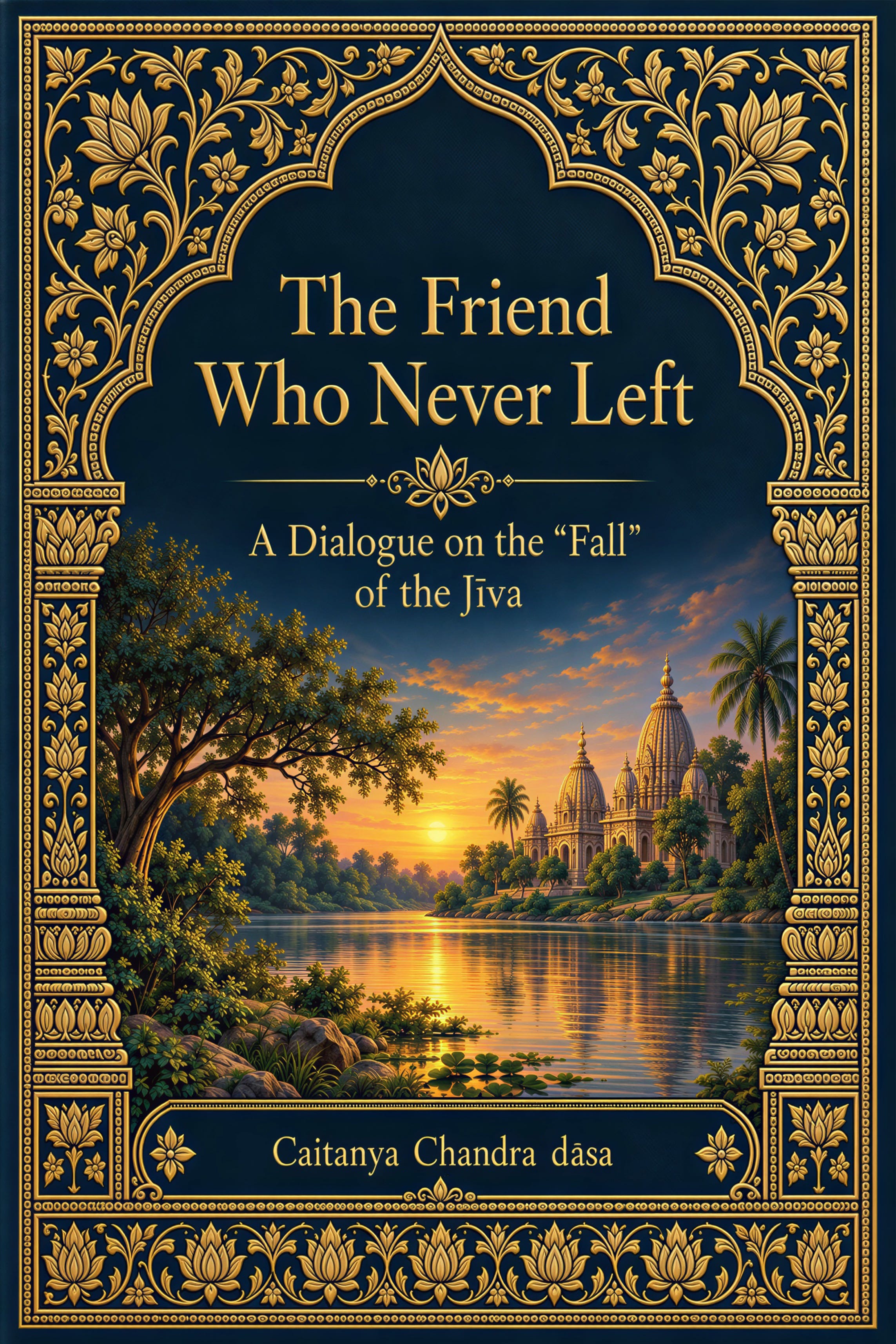
The story follows Mādhava Dāsa, a young devotee whose confidence is shaken after reading a scholarly book that challenges his understanding of the original position of the soul. Confused, he approaches Gaurāṅga Dāsa, an elderly devotee who has been helping him in his spiritual journey. Through a series of conversations, Gaurāṅga helps him to examine different passages from Prabhupāda’s books, other scriptures and the works of the previous ācāryas, not only helping him find the answers but also teaching him how to study the scriptures systematically, reconcile apparent contradictions, and distinguish the conclusions of the ācāryas from assumptions and interpretations.
The “fall” of the jīva, however, is not the main topic in this book. It is used as a background to present two other topics that are essential in the times we live:
The first is hermeneutics: how to understand Prabhupāda’s instructions in the context of the works of the previous ācāryas and other scriptures we have access to nowadays. What should we do when contradictions appear? Whom should we follow in such cases?
The second topic is the relationship of guru and disciple in our society. Often we may get the impression that the guru is simply a ceremonial figure. The reason is that often disciples have little opportunity to have personal association with their gurus, apart from a few minutes during the initiation ceremony. Diksa or siksa, the reality is that we need to have someone we can learn from and whom we can approach when we face difficulties. In the story, this role is played by Gaurāṅga Dāsa, from whom Mādhava Dāsa learns regularly, and whom he approaches when he faces a crisis. Through a series of meetings over multiple days, Gaurāṅga Dāsa guides him out of it and helps him to grow in his philosophical understanding and spiritual practice.
Read the entire book:
The Friend Who Never Left, A Dialog on the “Fall” of the Jīva
This is a publication for thoughtful readers who want to go deeper into Kṛṣṇa consciousness. I publish daily, trying to offer high-quality spiritual content, and all posts are available to free subscribers. If you wish, you can support this work with a monthly contribution. When you subscribe, you can choose between a free subscription and a monthly contribution, and you can switch from a free subscriber to a supporter at any time.
You can also receive updates on WhatsApp or Telegram.
If you would like to contribute further, you can find the donation links here.