


You can receive new articles directly in your inbox. Subscription is free; donations are welcome.
All the teachings of Kṛṣṇa in the Bhagavad-gītā orbit around the development of devotional service. All the processes of yoga that He describes are supposed to ultimately bring us to Him.
Here is another version of the diagram of the yoga ladder from the previous article that shows the parts that are accessible only through the presence of at least a glance of devotional service:
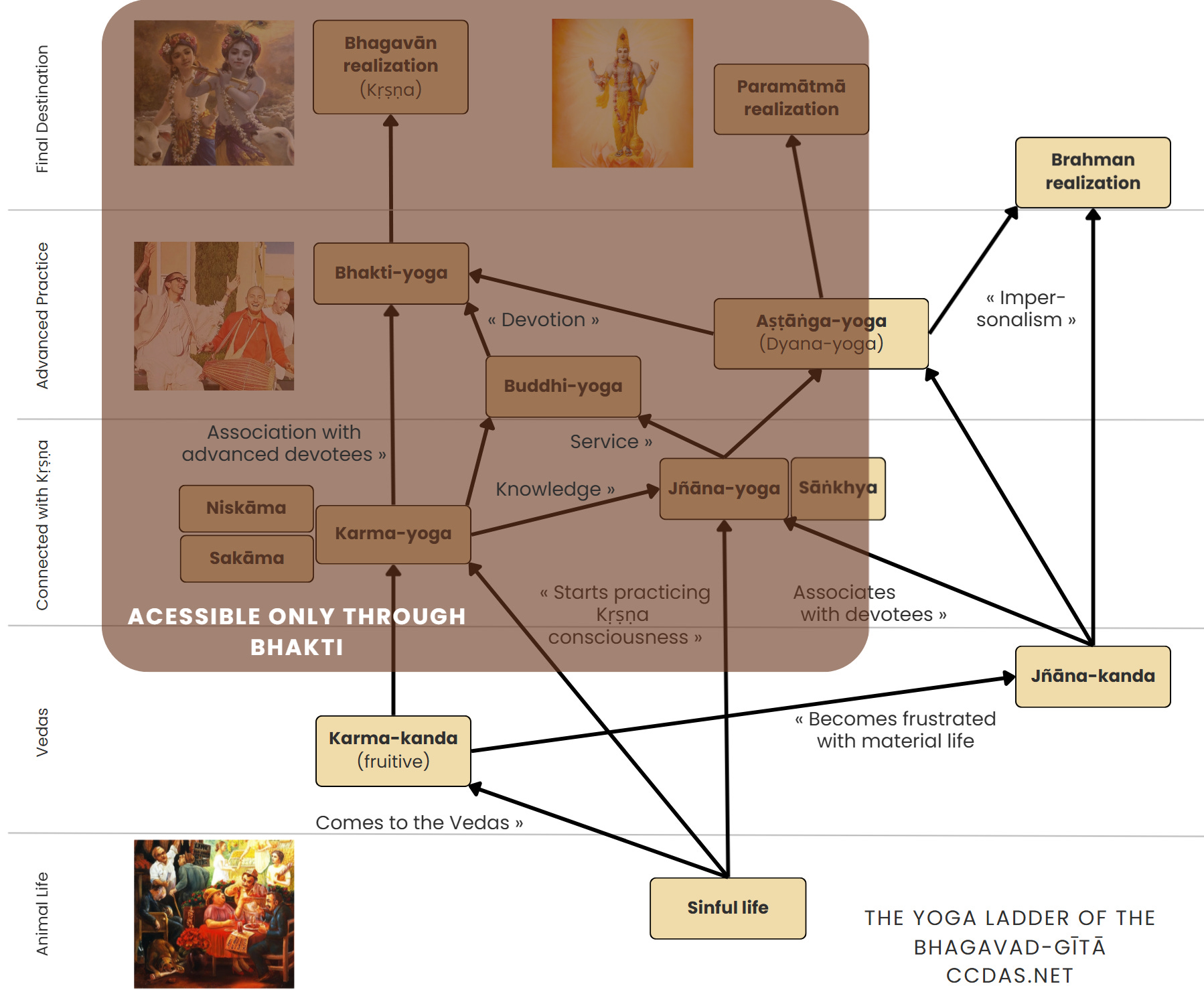
Yoga means to reestablish one’s eternal connection with Kṛṣṇa, and real success is measured by the extent to which we can reawaken our eternal connection with Him. A soul who persistently refuses the understanding of his eternal position of service to Kṛṣṇa can progress only through a very narrow path, through the paths of karma and jñāna, the very beginnings of the Sānkhya system and aṣṭanga-yoga, practiced with just superficial realization. One may attain the impersonal brahmajyoti through this process, but without at least a semblance of devotional service, even this will ultimately be temporary, and one will return to the material world.
Kṛṣṇa Himself mentions this point in text 9.3, where He mentions:
“Those who are not faithful in this devotional service cannot attain Me, O conqueror of enemies. Therefore they return to the path of birth and death in this material world.”
It is also confirmed on SB 10.2.32:
“[Someone may say that aside from devotees, who always seek shelter at the Lord’s lotus feet, there are those who are not devotees but who have accepted different processes for attaining salvation. What happens to them? In answer to this question, Lord Brahmā and the other demigods said:] O lotus-eyed Lord, although nondevotees who accept severe austerities and penances to achieve the highest position may think themselves liberated, their intelligence is impure. They fall down from their position of imagined superiority because they have no regard for Your lotus feet.”
Prabhupāda gives an in-depth explanation of the causes in his purport to SB 4.23.15. A soul can become fully satisfied only in a position of service to Kṛṣṇa. If one attains the impersonal brahmajyoti and has some information about the spiritual planets and some latent devotion, one may desire to serve the Lord and thus be promoted there; otherwise, one becomes gradually attracted again to material enjoyment and falls back to the material world.
“When a living entity gives up the material coverings, he remains a spirit soul. This spirit soul must enter into the spiritual sky to merge into the Brahman effulgence. Unfortunately, unless the living entity has information of the spiritual world and the Vaikuṇṭhas, there is a 99.9 percent chance of his falling down again into material existence. There is, however, a small chance of being promoted to a spiritual planet from the Brahman effulgence, or the brahmajyoti. This brahmajyoti is considered by impersonalists to be without variety, and the Buddhists consider it to be void. In either case, whether one accepts the spiritual sky as being without variety or void, there is none of the spiritual bliss which is enjoyed in the spiritual planets, the Vaikuṇṭhas or Kṛṣṇaloka. In the absence of varieties of enjoyment, the spirit soul gradually feels an attraction to enjoy a life of bliss, and not having any information of Kṛṣṇaloka or Vaikuṇṭhaloka, he naturally falls down to material activities in order to enjoy material varieties.”
Devotional service is thus the only real goal, and as our devotional attitude increases, we gain access to the higher steps of the yoga ladder, coming closer to Kṛṣṇa. This natural devotion to Kṛṣṇa is awakened by associating with devotees; therefore, association with advanced devotees is ultimately the key to ascending the ladder.
Studying the Śrīmad-Bhāgavatam, we can notice that even great transcendentalists such as Nārada Muni and Śukadeva Gosvāmī come to a mature realization of Kṛṣṇa only after hearing about Him from other self-realized souls. Nārada Muni heard about Kṛṣṇa from the Bhaktivedantas in his previous life and then heard the Śrīmad-Bhāgavatam from Brahmā in his current life. Śukadeva Gosvāmī was initially more attracted to the impersonal concept, but he was attracted to the path of devotion after studying the Śrīmad-Bhāgavatam from his father, Śrīla Vyāsadeva, and thus achieved ultimate perfection.
All of this reinforces the ultimate conclusion of the sixth chapter of the Gītā (Bg 6.46-47), where Kṛṣṇa defines bhakti as the supreme process of yoga and instructs all of us to advance on the path and gradually come to the position of perfect devotees.
In short, according to the method adopted, the process is named differently: karma-yoga, jñāna-yoga, or bhakti-yoga, but yoga means linking our consciousness with Kṛṣṇa. Among all processes, Kṛṣṇa consciousness, or bhakti-yoga, is the supreme perfection. Bhakti-yoga means full knowledge and realization; therefore, there is nothing that can exceed it. As Prabhupada mentions, without bringing us to bhakti, all other processes are more or less useless.
In text 6.47, Kṛṣṇa mentions the word bhajate. This indicates Kṛṣṇa specifically refers to service with love and faith directed to Him, and not just ordinary worship of great personalities. This reinforces the idea that service to Him is the eternal, constitutional position of every soul, which is reestablished through yoga practice. One who rejects service to Kṛṣṇa falls down. Avajānanti māṁ mūḍhāḥ: fools and rascals deride Kṛṣṇa. Not only do they personally refuse His service, but they also write commentaries on the Gītā to mislead others.
The conclusion is that bhakti-yoga is the culmination of all methods of yoga practice. All other forms of yoga serve only to bring one to bhakti. In reality, yoga means bhakti-yoga; all others are just preliminary stages.
Karma-yoga is the beginning of this path. When one increases in knowledge and renunciation, it is called jñana-yoga, and when meditation on the Supersoul becomes prominent, it is called aṣṭānga-yoga. When one finally fixes his meditation on Kṛṣṇa, one comes to the culmination, bhakti-yoga. One who becomes stuck in one of the preliminary levels is called a karma-yogī, jñāna-yogī, etc., but one who is fortunate continues to progress all the way to bhakti, Kṛṣṇa consciousness.
An ordinary follower of the Vedas sees God as the giver of pious results; the jñāni sees the Absolute Truth, the yogī as Paramātma, etc. These are all partial conceptions. Only the perfect bhakti-yogī can understand God in truth, as the beautiful cowherd boy whose effulgence is the unlimited impersonal Brahmajyoti, who is the source of all incarnations and who reciprocates with His unalloyed devotees in all kinds of blissful transcendental relationships. Thus, the highest perfection in yoga is available only to the devotee.
Read also:


This is a publication for thoughtful readers who want to go deeper into Kṛṣṇa consciousness. I publish daily, trying to offer high-quality spiritual content, and all posts are available to free subscribers. If you wish, you can also choose a paid subscription to support this work.
You can also receive the updates on WhatsApp or Telegram.
If you would like to contribute further, you can find the donation links here.
Beautiful, clear and simple. Thank you 🙏🏼😄