

« The Song of God—Volume 1, chapters 1-6
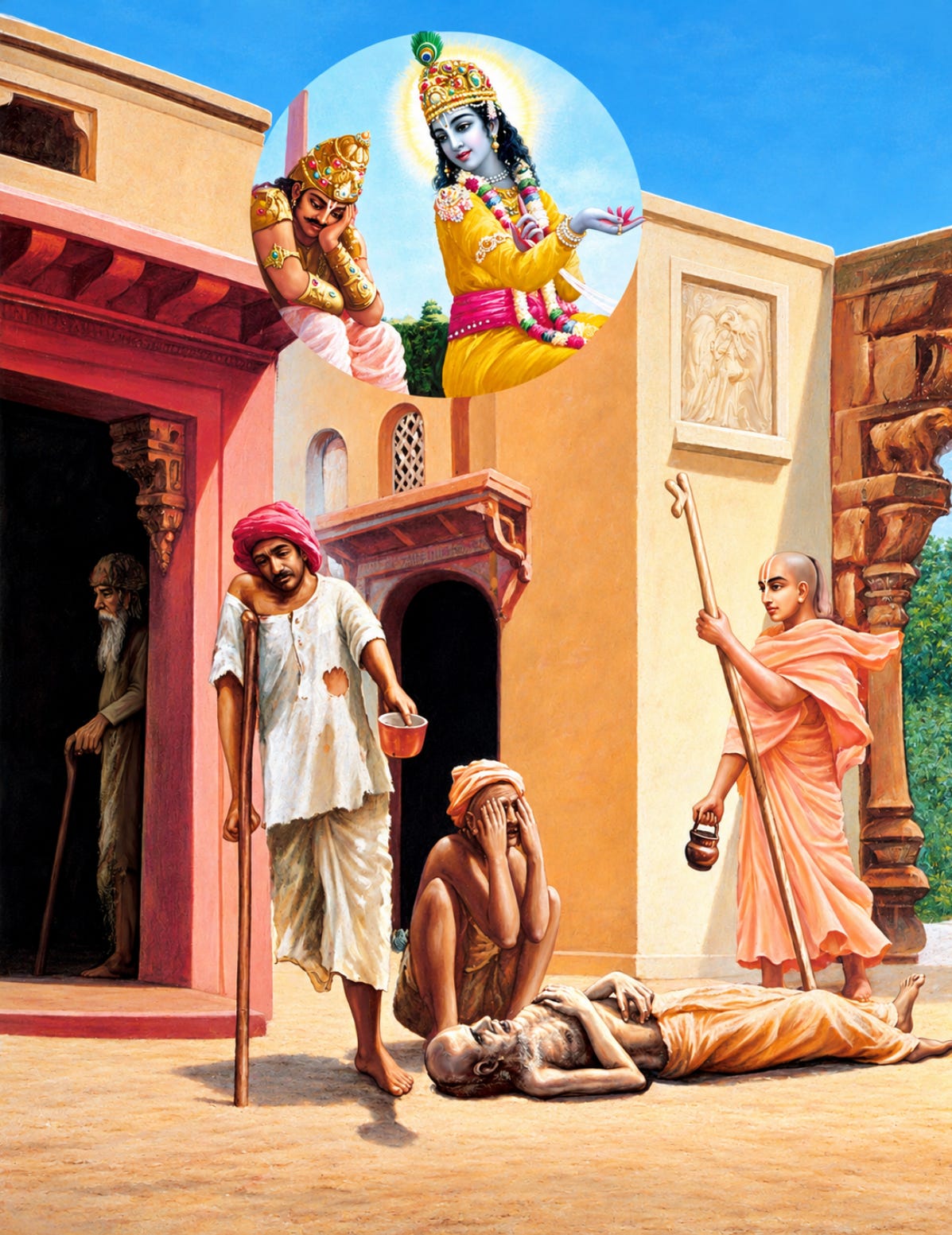
The vision of the self-realized (Bg 5.17 to 5.21)
In the previous section, Kṛṣṇa described the results of perfect knowledge: we acquire firm faith, Kṛṣṇa becomes our shelter, and, as a result, we become fixed in Kṛṣṇa consciousness. This produces peace and freedom from all miseries, as we become liberated from material duality. Now, Kṛṣṇa describes in more detail the symptoms of a person situated in such transcendental consciousness. He becomes fixed on the spiritual platform, and his happiness no longer depends on material sense pleasure. He sees all living beings with equal spiritual vision and remains steady amid pleasant and unpleasant circumstances. This vision, however, does not come from mere sentiment; it comes from factual spiritual realization.
Text 17: tad-buddhayas tad-ātmānas, tan-niṣṭhās tat-parāyaṇāḥ
gacchanty apunar-āvṛttiṁ, jñāna-nirdhūta-kalmaṣāḥ
“When one’s intelligence, mind, faith and refuge are all fixed in the Supreme, then one becomes fully cleansed of misgivings through complete knowledge and thus proceeds straight on the path of liberation.”
Text 18: vidyā-vinaya-sampanne, brāhmaṇe gavi hastini
śuni caiva śva-pāke ca, paṇḍitāḥ sama-darśinaḥ
“The humble sages, by virtue of true knowledge, see with equal vision a learned and gentle brāhmaṇa, a cow, an elephant, a dog and a dog-eater [outcaste].”
Text 19: ihaiva tair jitaḥ sargo, yeṣāṁ sāmye sthitaṁ manaḥ
nirdoṣaṁ hi samaṁ brahma, tasmād brahmaṇi te sthitāḥ
“Those whose minds are established in sameness and equanimity have already conquered the conditions of birth and death. They are flawless like Brahman, and thus they are already situated in Brahman.”
Text 20: na prahṛṣyet priyaṁ prāpya, nodvijet prāpya cāpriyam
sthira-buddhir asammūḍho, brahma-vid brahmaṇi sthitaḥ
“A person who neither rejoices upon achieving something pleasant nor laments upon obtaining something unpleasant, who is self-intelligent, who is unbewildered, and who knows the science of God is already situated in transcendence.”
Text 21: bāhya-sparśeṣv asaktātmā, vindaty ātmani yat sukham
sa brahma-yoga-yuktātmā, sukham akṣayam aśnute
“Such a liberated person is not attracted to material sense pleasure but is always in trance, enjoying the pleasure within. In this way the self-realized person enjoys unlimited happiness, for he concentrates on the Supreme.”
The first verse, 5.17, describes four components of absorption of a devotee on the transcendental platform: buddhayaḥ (the intelligence), ātmānaḥ (the mind) niṣṭhāḥ (faith) and parāyaṇāḥ (refuge). When these four are fully focused on Kṛṣṇa, a devotee becomes free from all misgivings.
There are three levels of understanding of the Absolute Truth: Brahman, Paramātmā, and Bhagavān. One may become fixed in any of these three levels, but ultimately, the spiritual nature of the soul is fully realized only through absorption in the personal form of Kṛṣṇa. The main difference is the realization of the Bhagavān aspect, Kṛṣṇa as a person, which brings us to the platform of service, while Brahman and Paramātmā imply the realization of our spiritual nature without engagement in direct service.
Why is that important? Prabhupāda elaborates in his purport:
“Bhagavān, or the Supreme Personality of Godhead, is the last word in the Absolute. There is nothing more than that. The Lord says, mattaḥ parataraṁ nānyat kiñcid asti dhanañ-jaya. Impersonal Brahman is also supported by Kṛṣṇa: brahmaṇo hi pratiṣṭhāham. Therefore in all ways Kṛṣṇa is the Supreme Reality. One whose mind, intelligence, faith and refuge are always in Kṛṣṇa, or, in other words, one who is fully in Kṛṣṇa consciousness, is undoubtedly washed clean of all misgivings and is in perfect knowledge in everything concerning transcendence. A Kṛṣṇa conscious person can thoroughly understand that there is duality (simultaneous identity and individuality) in Kṛṣṇa, and, equipped with such transcendental knowledge, one can make steady progress on the path of liberation.”
As mentioned by Prabhupāda, another characteristic of the self-realized devotee is that he is free of all doubts and misconceptions due to being firmly established in transcendental knowledge. One thus has no doubts about Kṛṣṇa’s supremacy, about the individuality of the soul, the soul’s constitutional position in devotional service and the goal of life. Once one is well fixed in knowledge, one progresses fast on the spiritual path.
We have then the famous verse 5.18: “The humble sages, by virtue of true knowledge, see with equal vision a learned and gentle brāhmaṇa, a cow, an elephant, a dog and a dog-eater [outcaste].”
The basic meaning is that a self-realized soul sees on the spiritual platform; therefore, he sees the soul present in the body. He sees that different individual souls of the same nature are present in different bodies, but they are all the same in terms of spiritual quality. He also sees the Supreme Soul, Paramātmā, present simultaneously in all bodies. It does not mean a self-realized soul will not make distinctions in the practical sense; the point is that he can see the spiritual reality behind everything, and he treats everyone as a friend, acting in ways that are beneficial to all, not hating or despising anyone based on the body.
One common misinterpretation of this verse is to presume that since the soul and the Supersoul inhabit the same body, they are the same. That’s a serious misinterpretation Prabhupāda warns us about in his purport. Another misinterpretation is to take the verse sentimentally and try to imitate this platform artificially, without the necessary practical distinctions. The soul in the heart of the tiger is the same in quality as in the heart of a cow, but this does not mean both can be treated in the same way.
Kṛṣṇa continues in text 5.19, explaining that devotees who have attained this level of equal vision are already situated on the spiritual platform. They have already attained liberation, even in this life, and revived their eternal spiritual nature, becoming pure and flawless, just like Kṛṣṇa Himself. In other words, just as Kṛṣṇa is pure and perfect, a self-realized soul is also pure and perfect. In terms of spiritual quality, both are the same, but they are separated as individuals, and Kṛṣṇa is very big, while the infinitesimal soul is very small. This simultaneous equality and difference is just like the relation of a big fire and the sparks emanating from the fire.
More symptoms of a self-realized person are that just as he sees everyone with equal eyes, he also sees pleasant and unpleasant situations with equanimity and understands that they are connected only with the body. This is an elaboration of something Kṛṣṇa already explained in 2.14:
“O son of Kuntī, the nonpermanent appearance of happiness and distress, and their disappearance in due course, are like the appearance and disappearance of winter and summer seasons. They arise from sense perception, O scion of Bharata, and one must learn to tolerate them without being disturbed.”
The mind perceives a certain situation as pleasant and another unpleasant, but the self-realized understand that both situations do not affect the soul, and thus continue to perform their duties without being disturbed. This steadiness is defined as sthira-buddhiḥ, self-intelligence, indicating that the intelligence becomes steady, being anchored in the soul, and not in the body.
This self-centered, or soul-centered intelligence, in turn, leads to the other two symptoms: he is unbewildered by the changing material conditions, and knows the science of God. Such a devotee is already situated on the spiritual platform.
We can see that these are all symptoms we try to develop as part of our spiritual practice, but they become fully manifest in a perfect devotee (siddha), who is not at all entangled in matter. The main trap here is impersonalism. Many of these symptoms can be developed by an impersonalist, or yogī, but full realization is attained by a devotee who realizes the three aspects: Brahman, Paramātmā, and Bhagavān. The first two levels of realization are incomplete, while Bhagavān realization includes all the three aspects. This point is reinforced by Kṛṣṇa in 18.54.
All of this culminates in the symptoms described in text 5.21: “Such a liberated person is not attracted to material sense pleasure but is always in trance, enjoying the pleasure within. In this way the self-realized person enjoys unlimited happiness, for he concentrates on the Supreme.”
Spiritual realization can be measured by the degree to which sensual desire is replaced by love of Godhead. Prabhupāda quotes Śrī Yāmunācārya to reveal the mind of such a pure devotee: “Since I have been engaged in the transcendental loving service of Kṛṣṇa, realizing ever-new pleasure in Him, whenever I think of sex pleasure I spit at the thought, and my lips curl with distaste.”
Sexual desire is the root cause of material desire. We can practically see that even transcendentalists who are able to renounce all material possessions often fall because of sexual attraction. It may be repressed for some time, but it eventually comes out. Śrī Yāmunācārya, however, speaks of a level of realization when this sexual attraction is replaced by a more powerful force that completely eclipses it. That’s love of Godhead. This love of Godhead is like a powerful sun that immediately dissipates all darkness of material ignorance. A devotee who attains this platform always lives in unlimited happiness, fully aware of his eternal relationship with Kṛṣṇa.
Main points in the purports of Śrīla Prabhupāda:
“When one’s intelligence, mind, faith and refuge are all fixed in the Supreme, then one becomes fully cleansed of misgivings through complete knowledge and thus proceeds straight on the path of liberation.”
a) The Absolute Truth is known as Brahman, Paramātmā, and Bhagavān. The Bhagavān aspect is the last word, Kṛṣṇa Himself. The whole Gītā is centered around this declaration. There is nothing beyond Kṛṣṇa. The impersonal Brahman is also supported by Him.
b) Since Kṛṣṇa is the last word, the highest aspect, when one is situated in full Kṛṣṇa consciousness, one reaches perfect knowledge of everything connected with transcendence. He can understand he is simultaneously one and different from Kṛṣṇa, escaping the calamity of monism and quickly advancing toward liberation.
“The humble sages, by virtue of true knowledge, see with equal vision a learned and gentle brāhmaṇa, a cow, an elephant, a dog and a dog-eater [outcaste].”
a) A learned transcendentalist sees the individual soul, together with Paramātmā, living in all bodies. This is real knowledge. Because of this spiritual vision, he does not make distinctions based on species or castes.
b) The bodies of a brāhmana and a dog-eater are not the same, being the product of different combinations of the material modes. However, the Lord is equally kind to all, treating everyone as a friend and inhabiting all bodies as Paramātmā, regardless of the material situation of each individual soul.
c) Just as different souls are equal in quality, the individual soul and Paramātmā are also of the same spiritual quality. They are, however, very different in quantity. The individual soul is present just in a particular body, while the Supersoul is present simultaneously in all bodies. A Kṛṣṇa conscious person has full knowledge of all of this.
“Those whose minds are established in sameness and equanimity have already conquered the conditions of birth and death. They are flawless like Brahman, and thus they are already situated in Brahman.”
a) The equanimity of mind mentioned in this verse is the sign of self-realization. It shows one has conquered birth and death, as well as other material conditions. Different from conditioned souls, who identify with the body, he identifies with his real self.
b) Kṛṣṇa is perfect because He is always free of material contamination. When the individual soul also frees himself from material contamination, becoming free from attraction and hatred, he also becomes flawless and eligible to enter the spiritual world. Even while living here, he is already liberated.
“A person who neither rejoices upon achieving something pleasant nor laments upon obtaining something unpleasant, who is self-intelligent, who is unbewildered, and who knows the science of God is already situated in transcendence.”
a) The symptoms of a self-realized soul are that he is not under the illusion of identification with the body, understanding perfectly that he is part and parcel of Kṛṣṇa. He does not desire or lament in relation to the body. This steadiness of mind is called sthira-buddhi, or self-intelligence.
b) Because of this sthira-buddhi, he does not mistake the body for the self, nor accept the body as permanent. This knowledge elevates him to the knowledge of the three aspects of the Absolute Truth, and allows him to properly understand his constitutional position in relation to Kṛṣṇa.
“Such a liberated person is not attracted to material sense pleasure but is always in trance, enjoying the pleasure within. In this way the self-realized person enjoys unlimited happiness, for he concentrates on the Supreme.”
a) A person situated in Kṛṣṇa consciousness loses the taste for material sense enjoyment. Spiritual realization and sexual pleasure are opposites; therefore, one replaces the other. The whole world moves around sexual attraction; a materialist cannot work without this motivation. A pure devotee, however, can work for Kṛṣṇa with greater vigor than a materialist, without seeking sexual pleasure. This is the test of spiritual realization.
Read the entire book:
« The Song of God—Volume 1, chapters 1-6

This is a publication for thoughtful readers who want to go deeper into Kṛṣṇa consciousness. I publish daily, trying to offer high-quality spiritual content, and all posts are available to free subscribers. If you wish, you can also choose a paid subscription to support this work.
You can also receive the updates on WhatsApp or Telegram.
If you would like to contribute further, you can find the donation links here.