

« The Song of God—Volume 1, chapters 1-6
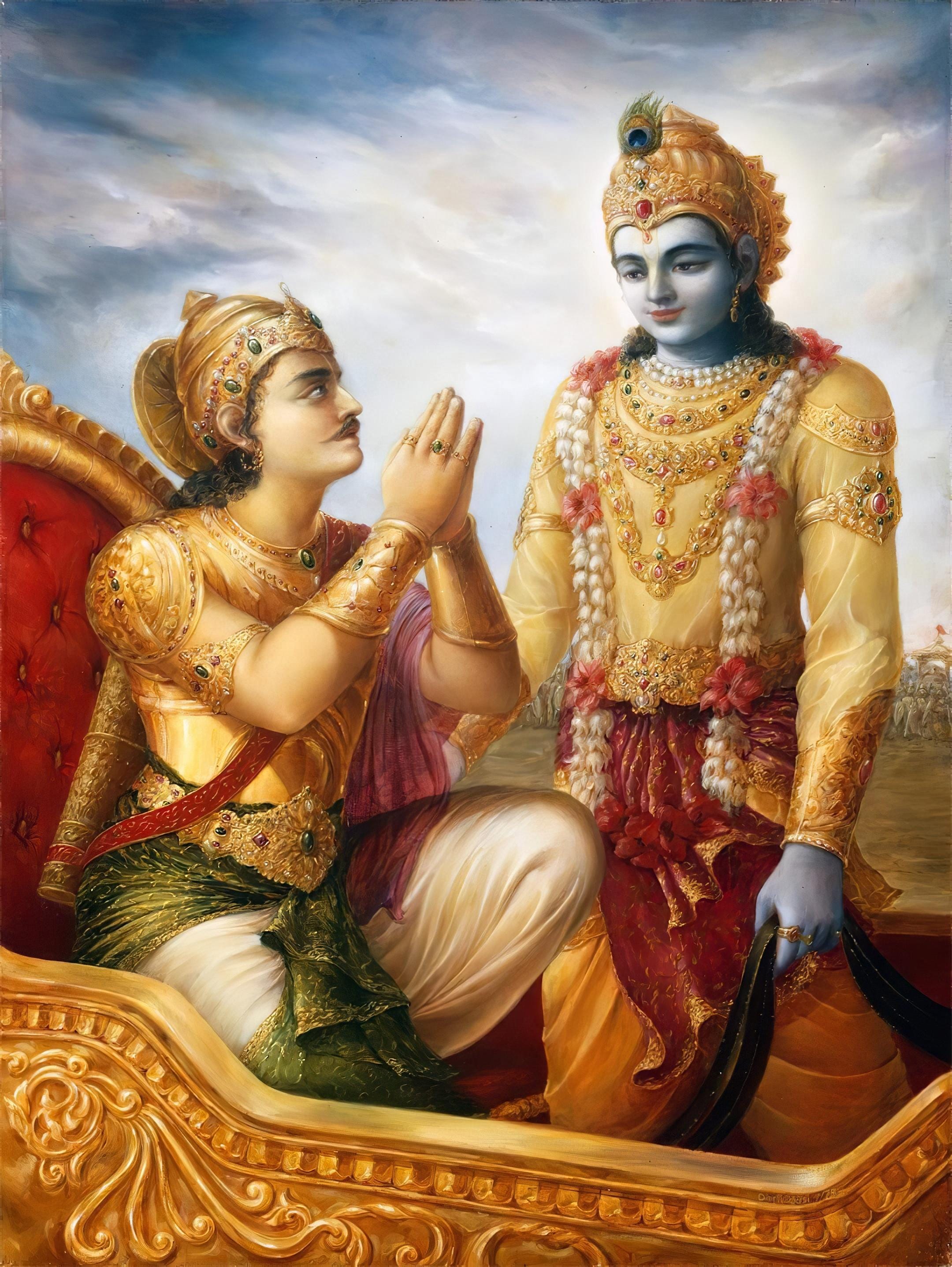
The perfectional state of yoga meditation (Bg 6.16 to 6.23)
A yogī must regulate his habits so the mind becomes peaceful and fit for spiritual realization. When the mind becomes fully controlled, it becomes steady like a lamp in a windless place. Free from material desire, the yogī finally becomes fixed in his meditation on the Supreme Lord, who is personally present in his heart as Paramātmā. This steadiness culminates in samādhi, the state of full absorption, where one experiences transcendental happiness beyond the senses and remains unshaken even in the greatest difficulties. This, however, is not mere voidism, but a state of full Kṛṣṇa consciousness. Aṣṭāṅga-yogīs may reach any of the three stages of realization—Brahman, Paramātmā, or Bhagavān—according to their understanding, but the real goal of the process is to reach personal realization.
Text 16: nāty-aśnatas tu yogo ’sti, na caikāntam anaśnataḥ
na cāti-svapna-śīlasya, jāgrato naiva cārjuna
There is no possibility of one’s becoming a yogī, O Arjuna, if one eats too much or eats too little, sleeps too much or does not sleep enough.
Text 17: yuktāhāra-vihārasya, yukta-ceṣṭasya karmasu
yukta-svapnāvabodhasya, yogo bhavati duḥkha-hā
He who is regulated in his habits of eating, sleeping, recreation and work can mitigate all material pains by practicing the yoga system.
Text 18: yadā viniyataṁ cittam, ātmany evāvatiṣṭhate
nispṛhaḥ sarva-kāmebhyo, yukta ity ucyate tadā
When the yogī, by practice of yoga, disciplines his mental activities and becomes situated in transcendence – devoid of all material desires – he is said to be well established in yoga.
Text 19: yathā dīpo nivāta-stho, neṅgate sopamā smṛtā
yogino yata-cittasya, yuñjato yogam ātmanaḥ
As a lamp in a windless place does not waver, so the transcendentalist, whose mind is controlled, remains always steady in his meditation on the transcendent Self.
Texts 20-23: yatroparamate cittaṁ, niruddhaṁ yoga-sevayā
yatra caivātmanātmānaṁ, paśyann ātmani tuṣyati
sukham ātyantikaṁ yat tad, buddhi-grāhyam atīndriyam
vetti yatra na caivāyaṁ, sthitaś calati tattvataḥ
yaṁ labdhvā cāparaṁ lābhaṁ, manyate nādhikaṁ tataḥ
yasmin sthito na duḥkhena, guruṇāpi vicālyate
taṁ vidyād duḥkha-saṁyoga-viyogaṁ yoga-saṁjñitam
In the stage of perfection called trance, or samādhi, one’s mind is completely restrained from material mental activities by practice of yoga. This perfection is characterized by one’s ability to see the Self by the pure mind and to relish and rejoice in the Self. In that joyous state, one is situated in boundless transcendental happiness, realized through transcendental senses. Established thus, one never departs from the truth, and upon gaining this he thinks there is no greater gain. Being situated in such a position, one is never shaken, even in the midst of greatest difficulty. This indeed is actual freedom from all miseries arising from material contact.
In the previous section, Kṛṣṇa described the external discipline of the practice of dhyāna-yoga. One should sit in a solitary place, practice full celibacy, fix the vision on the tip of the nose, and so on. In his purports, Prabhupāda adds the deeper meaning of the verses, showing their true meaning and the connection between aṣṭāṅga-yoga and Kṛṣṇa consciousness. It’s not possible to practice yoga in a city or while enjoying our senses, and the true goal is Kṛṣṇa, not mystical perfections. The pure devotee is the topmost yogī, because he has already attained the goal of the process.
Mitigating all material pains
Texts 6.16 and 6.17 introduce a broader lifestyle principle for the practice of yoga, which is also extremely beneficial for the practice of devotional service: “There is no possibility of one’s becoming a yogī, O Arjuna, if one eats too much or eats too little, sleeps too much or does not sleep enough. He who is regulated in his habits of eating, sleeping, recreation and work can mitigate all material pains by practicing the yoga system.”
Here, Kṛṣṇa gives us five factors that should be regulated: āhāra (eating), vihāra (recreation), ceṣṭā (work for maintenance), svapna (sleep), and avabodha (wakefulness). A yogī has to be regulated in his habits, because he tries to maintain a very delicate stage of concentration that requires the mind to be placid, just as the waters of a lake when there is no vibration. There are many examples of demons performing yoga in anger, with the goal of acquiring supernatural powers, but this is yoga practiced with mundane intent. In real yoga practice, the goal is to situate oneself in the mode of goodness and, from there, practice meditation on the Supreme Lord with the goal of transcending. Regulated life is a prerequisite for this.
The path of bhakti-yoga is much more forgiving, but the same principle of balance is necessary, with enough sleep, enough eating, etc., but nothing in excess. This is an essential point, because most of the difficulties we face in spiritual practice, come from either the excess or lack of something. Sometimes we chant the whole day, and sometimes we don’t chant at all. In the name of prasāda, we eat too much, and of the wrong foods, which makes it hard to control the senses. We often sleep too little, or too much, and so on. As Kṛṣṇa explains, one of the greatest secrets to keeping the mind under control is to learn the art of doing everything in moderation. This is a characteristic of the mode of goodness, which serves as a foundation of our spiritual practice.
The fact that Kṛṣṇa speaks these two verses after completing the description of the preliminary process of meditation is also significant. This equilibrium He mentions is not just a preparation, but it is, in itself, already a preliminary result of the process of yoga, because equilibrium comes as a result of self-control. As He explains, yogo bhavati duḥkha-hā: through this process, we can mitigate all material miseries.
In his purport to text 6.16, Prabhupāda calls our attention to the importance of eating only Kṛṣṇa prasāda, and doing so within moderation. This is an aspect of spiritual practice we often overlook. There is nothing special in being vegetarian. Sheep are vegetarian; this does not mean they are self-realized. When we offer our food to Kṛṣṇa with devotion, following all the proper regulations, our eating becomes regulated, because we will automatically avoid all types of ingredients that are harmful to our practice. Eating only what is offered to Kṛṣṇa solves the problem of eating prohibited ingredients (which are unofferable), as well as food cooked by non-devotees, such as food from restaurants, bakeries, etc., which are also unofferable. Suddenly, we start eating only at home or in temples, and the frequency is also controlled.
As Prabhupāda explains in his purport to text 6.17:
“Extravagance in the matter of eating, sleeping, defending and mating – which are demands of the body – can block advancement in the practice of yoga. As far as eating is concerned, it can be regulated only when one is practiced to take and accept prasādam, sanctified food. Lord Kṛṣṇa is offered, according to the Bhagavad-gītā (9.26), vegetables, flowers, fruits, grains, milk, etc. In this way, a person in Kṛṣṇa consciousness becomes automatically trained not to accept food not meant for human consumption, or not in the category of goodness.”
Eating only prasādam is a very important step in our practice, because eating is not only a biological act. It affects our consciousness. Prasādam purifies the consciousness and stabilizes the mind, while non-offered food, especially food cooked by materialistic people, contaminates the mind and entangles us further into the karmic system at every morsel.
The problem with prasādam is that there is still the possibility of overeating, a topic that is discussed in the first verse of the Śrī Upadeśāmṛta: vāco vegaṁ manasaḥ krodha-vegaṁ, jihvā-vegam udaropastha-vegam, etān vegān yo viṣaheta dhīraḥ, sarvām apīmāṁ pṛthivīṁ sa śiṣyāt.
Eating too much makes one prone to sense enjoyment, sleep, excessive talking, anger, and so on. It creates a cascade of reactions that makes our spiritual progress much harder. Trying to control our senses in this situation is like trying to fight a war against a powerful enemy, when half of our army was already destroyed in a disastrous first attack. Eating is necessary to maintain our life, but it should not be used as an escape valve for all the hankerings and frustrations of the mind.
Similarly, the other four factors can be regulated when we seriously follow the process of Kṛṣṇa consciousness. Sleeping is regulated because the devotee understands the value of time, especially the importance of waking up early for performing his spiritual practice. Work is regulated because he works only according to what is necessary and favorable to his service to Kṛṣṇa, avoiding the passionate rush common in materialists. Recreation is also regulated, because an advanced devotee does not seek separate gratification. We can see that advanced practice of Kṛṣṇa consciousness fulfills the purpose of the yoga practice more completely than the mechanical repression of the aṣṭāṅga system.
We can divide our spiritual journey in four phases. The first is the preliminary stage, when we hear, chant, associate with devotees, etc., without serious commitment. The second stage starts when we accept discipline, accepting a spiritual master, and learning to follow the regulated spiritual process. This gradually leads to the third stage, when we learn to control our senses, starting with regulating our eating. Regulated eating leads to regulated sleeping, because we sleep more deeply and thus need less sleep. This allows us to wake up earlier, which makes us fixed in spiritual practice. This leads to the stage of advanced practice, where our minds become peaceful, and we can advance faster.
Without disciplining our eating and other habits, we will continue to struggle in the lower levels. When we attain moderation, our advancement becomes much faster. This moderation is thus the result of graduating from the primary levels, and is the door to the advanced levels of spiritual practice.
There is also another side that is emphasized by Prabhupāda later in the same purport:
“Avyartha-kālatvam: a Kṛṣṇa conscious person cannot bear to pass a minute of his life without being engaged in the service of the Lord. Therefore, his sleeping is kept to a minimum. His ideal in this respect is Śrīla Rūpa Gosvāmī, who was always engaged in the service of Kṛṣṇa and who could not sleep more than two hours a day, and sometimes not even that. Ṭhākura Haridāsa would not even accept prasādam nor even sleep for a moment without finishing his daily routine of chanting with his beads three hundred thousand names.”
What is enough in terms of eating and sleeping varies according to one’s level of advancement. What is “enough” for a pure devotee is usually unbalanced for a neophyte. For example, six hours of sleep is generally considered enough if one is not eating excessively. However, we have examples of ācāryas sleeping less than two hours and eating absurdly little. That was enough for them, at their level of realization, but a neophyte trying to imitate could end in disaster. This shows that this point needs to be considered individually, considering all these factors. Austerity also works best when it is voluntary. A certain level of austerity is always necessary as part of a disciplinary process, but too much austerity imposed too early can be disastrous.
Mental equilibrium
This foundation leads to the stage of mental equilibrium reached by the advanced yogī or devotee, which is described in texts 6.18 and 6.19: “When the yogī, by practice of yoga, disciplines his mental activities and becomes situated in transcendence – devoid of all material desires – he is said to be well established in yoga. As a lamp in a windless place does not waver, so the transcendentalist, whose mind is controlled, remains always steady in his meditation on the transcendent Self.”
Being established in yoga is not so much about an external process; it means becoming free from material desire. Material desire is the force that keeps us bound to this material world. When material desire is given up, we become connected with Paramātmā inside the heart. A person may sit and control his breath, but if this state is not reached, he is not established in yoga.
Here we come to the essential difference between aṣṭāṅga-yoga and bhakti-yoga. In the eightfold process, mental equilibrium is obtained by restraining the senses from material objects. If one can retire from practical life and maintain his meditation long enough, the mind again becomes placid, just like the waters of a lake when there is no agitation, or a flame in a windless place. The difficulty is that this process is not possible in modern life. Bhakti-yoga, on the other hand, is based on engaging the senses in Kṛṣṇa’s service. It still demands a lot of work, but it is a much easier and much more powerful process that works directly in awakening the spiritual nature of the soul and, from there, eliminating material attraction through the experience of a higher taste.
Prabhupāda reinforces this point in his purport to text 6.18 by quoting SB 9.4.18–20, where the absorption of King Ambarīṣa is described. He was able to attain self-realization even while engaging in managing the state by engaging all his senses and activities in the service of the Lord. In this way, he was spending most of his time engaged in worshipping, cleaning the temple, hearing and speaking about Kṛṣṇa, offering obeisances, and so on. Even the time he was managing the state affairs was spent in Kṛṣṇa consciousness, because he saw it as part of the mission of the Lord.
This example shows the progression from karma-yoga to bhakti-yoga. One can start the process by giving the results of his work to Kṛṣṇa (sakāma-karma-yoga), then directly working for Kṛṣṇa, without attachment (niṣkāma-karma-yoga), and eventually reaching the level of complete absorption in the Lord (pure bhakti-yoga), like in the example of Ambarīṣa Mahārāja.
There are many examples of devotees who left an active life of service to practice meditation in order to fully fix their thoughts on the Supreme Lord, like in the case of Mahārāja Pṛthu, described in the Fourth Canto of Śrīmad-Bhāgavatam. Prabhupāda, however, emphasizes that the path of achieving absorption by being engaged in the devotional process is easier, especially in the age we live in. As he mentions:
“This transcendental stage may be inexpressible subjectively by the followers of the impersonalist path, but it becomes very easy and practical for a person in Kṛṣṇa consciousness, as is apparent in the above description of the engagements of Mahārāja Ambarīṣa. Unless the mind is fixed on the lotus feet of the Lord by constant remembrance, such transcendental engagements are not practical. In the devotional service of the Lord, therefore, these prescribed activities are called arcana, or engaging all the senses in the service of the Lord. The senses and the mind require engagements. Simple abnegation is not practical. Therefore, for people in general – especially those who are not in the renounced order of life – transcendental engagement of the senses and the mind as described above is the perfect process for transcendental achievement, which is called yukta in the Bhagavad-gītā.”
This, in turn, leads to the stage of samādhi, or trance in Kṛṣṇa consciousness, described in texts 6.20 to 6.23.
Samādhi
Impersonalists also attain a form of trance, absorbed in the concept of being one with Brahman, but Prabhupāda calls our attention to the fact that real samādhi means to become aware of our constitutional position in relation to Kṛṣṇa. This begins from Paramātmā realization and fully blossoms in Bhagavān realization, full Kṛṣṇa consciousness. As he explains, “By practice of yoga one becomes gradually detached from material concepts. This is the primary characteristic of the yoga principle. And after this, one becomes situated in trance, or samādhi, which means that the yogī realizes the Supersoul through transcendental mind and intelligence, without any of the misgivings of identifying the self with the Superself.”
The whole message of the Gītā is based on this principle of yoga as the process that connects us with Kṛṣṇa, not as an impersonal force, but as the Supreme Personality of Godhead, Bhagavān. Some, however, may refer to Patañjali and argue that the ultimate goal of yoga is to merge into the Supersoul. Prabhupāda counters this argument in his purport, explaining that even in the Patañjali system, the goal is to realize the Supersoul, not to merge into Him. The idea of merging is an interpretation that was introduced later, by modern commentators.
The Yoga-sūtras of Patañjali describe the existence of transcendental pleasure. This is also emphasized in the Vedānta-sūtras (ānanda-mayo ’bhyāsāt). If there is transcendental pleasure, then there is spiritual experience, and spiritual experience means that the self is not annihilated after liberation. The soul continues to exist as an individual, and in this individual position, experiences spiritual bliss. This bliss is present in all the three levels of realization: Brahman, Paramātmā, and Bhagavān; therefore, there is no merging at any stage. Even if one attains the impersonal brahmajyoti, one remains an individual, and this explains how Māyāvādīs can fall back into the material world.
This is supported by the text itself. The Yoga-sūtras (4.33) mention:
puruṣārtha-śūnyānāṁ guṇānāṁ pratiprasavaḥ kaivalyaṁ
svarūpa-pratiṣṭhā vā citi-śaktir iti
This verse is generally translated by scholars as meaning that kaivalya (liberation) appears when the three modes of nature become latent, or the power of consciousness becomes established in its own nature. As in other examples, it captures a few of the details mentioned in the text, but misses others, giving an incomplete meaning. The main problem, however, is that the conclusion is incorrect, for they imply that the soul merges into the Absolute Truth after liberation.
Prabhupāda gives us a more comprehensive study of the verse.
Puruṣārtha-śūnyānām indicates a person who abandons all selfish pursuits, including dharma, artha, kāma, and even impersonal liberation.
Kaivalyam doesn’t mean impersonal liberation, but the state in which the soul becomes free from all coverings and realizes his true spiritual identity.
Svarūpa is the eternal nature of the soul, jīvera ‘svarūpa’ haya — kṛṣṇera ‘nitya-dāsa’ (It is the living entity’s constitutional position to be an eternal servant of Kṛṣṇa), and pratiṣṭhā means established or abiding. Svarūpa-pratiṣṭhā thus means that the soul becomes again established in one’s original position as an eternal servant of Kṛṣṇa.
This meaning is confirmed by the last word, citi-śakti, the internal potency of Kṛṣṇa, under whose care all spiritual activities are manifested.
Following the conclusions given by Śrīla Prabhupāda, the verse can thus be translated as:
When one abandons all selfish pursuits, including the desire for material development, sensual enjoyment, and impersonal liberation, one becomes free from the influence of the three material modes. In this state, one becomes free from all coverings and realizes his true spiritual identity as a pure soul, an eternal servant of Kṛṣṇa. One thus comes under the care of the internal potency of the Lord and serves Him in full Kṛṣṇa consciousness.
As Prabhupāda explains, unauthorized commentators do not understand the real purpose of the Patañjali system of yoga. Because they are influenced by the monist concept, they become biased in their translations and commentaries, distorting the meaning of the verses. Just as unauthorized commentators cannot enter into the real meaning of the Bhagavad-gītā, they also cannot properly understand other books from Vedic literature. They thus do a great disservice by misrepresenting their meaning, interpreting them according to Māyāvādī conclusions. To properly understand these texts, we have to receive the conclusions from a self-realized soul. Just being a Sanskrit scholar is not sufficient.
Prabhupāda also connects this verse from the Yoga-sūtras with the teachings of Śrī Caitanya Mahāprabhu: ceto-darpaṇa-mārjanaḿ bhava-mahā-dāvāgni-nirvāpaṇaḿ (Siksatakam 1).
What Patañjali calls Kaivalya (liberation) is mentioned by Mahāprabhu as bhava-mahā-dāvāgni-nirvāpaṇaḿ, the extinguishment of the fire of conditional life, which is achieved by the process of ceto-darpaṇa-mārjanaḿ, the process of clearing the mirror of the mind, that leads one to see oneself in one’s original identity as an eternal servant of Kṛṣṇa. As He mentions, “O son of Mahārāja Nanda (Kṛṣṇa), I am Your eternal servitor, yet somehow or other I have fallen into the ocean of birth and death. Please pick me up from this ocean of death and place me as one of the atoms at Your lotus feet.”
Prabhupāda also mentions two types of samādhi: samprajñāta-samādhi, and asamprajñāta-samādhi. The first is the transcendental understanding that one is not the body, but the transcendental soul, while the second is the deeper, factual realization. When a yogī becomes firmly situated in the second level, he becomes firm on the transcendental platform. This is real success in the practice of the yoga system. Compared to that, modern yogīs perform quite poorly. Pseudo-yogīs, practicing in the cities while involved in sensual habits, are a mockery of the process, and even real yogīs, who may attain mystical perfections, are not properly situated.
Kṛṣṇa consciousness is thus the best process of yoga for the age we live in. As Prabhupāda concludes in his commentary:
“As long as the material body exists, one has to meet the demands of the body, namely eating, sleeping, defending and mating. But a person who is in pure bhakti-yoga, or in Kṛṣṇa consciousness, does not arouse the senses while meeting the demands of the body. Rather, he accepts the bare necessities of life, making the best use of a bad bargain, and enjoys transcendental happiness in Kṛṣṇa consciousness. He is callous toward incidental occurrences – such as accidents, disease, scarcity and even the death of a most dear relative – but he is always alert to execute his duties in Kṛṣṇa consciousness, or bhakti-yoga. Accidents never deviate him from his duty. As stated in the Bhagavad-gītā (2.14), āgamāpāyino ’nityās tāṁs titikṣasva bhārata. He endures all such incidental occurrences because he knows that they come and go and do not affect his duties. In this way he achieves the highest perfection in yoga practice.”
Main points in the purports of Śrīla Prabhupāda:
“There is no possibility of one’s becoming a yogī, O Arjuna, if one eats too much or eats too little, sleeps too much or does not sleep enough.”
a) One who eats more than necessary cannot execute perfect yoga. Eating should be enough to just keep the body and soul together. There is also no need to eat animals, which will entangle one in sinful reactions. Simple, natural foods, like grains, vegetables, fruits, and milk, are food in the mode of goodness.
b) However, simple vegetarianism is not enough. Anyone who eats for sense pleasure, or cooks for himself, not offering his food to Kṛṣṇa, eats only sin. A person cannot attain perfection eating prohibited things, nor by inventing a personal process of fasting. A person in Kṛṣṇa consciousness eats only Kṛṣṇa prasādam, no more than necessary, and fasts on the right days, as recommended in the scriptures. Therefore, the devotee is the only one who can attain perfection in yoga practice.
c) Excessive eating is also connected with excessive sleeping. Eating more than necessary also makes one sleep more, which increases the influence of the mode of ignorance. Such a person also cannot perform yoga.
“He who is regulated in his habits of eating, sleeping, recreation and work can mitigate all material pains by practicing the yoga system.”
a) Eating, sleeping, defending and mating are necessities of the body, but too much of it can block our advancement. Eating can be regulated by eating only prasāda, sleeping becomes regulated when we are attentive to our service, work is regulated when we don’t do anything not connected with Kṛṣṇa’s interest, and leisure is regulated when we give up the desire for sense gratification. When one becomes regulated in all activities, there is no more material misery.
b) A truly Kṛṣṇa conscious person cannot tolerate even one minute not engaged in the service of Kṛṣṇa. Śrīla Rūpa Gosvāmī could not sleep more than two hours a day, and Haridāsa Ṭhākura would not sleep or accept prasādam without finishing chanting three hundred thousand names. These are examples of perfection in this art.
“When the yogī, by practice of yoga, disciplines his mental activities and becomes situated in transcendence – devoid of all material desires – he is said to be well established in yoga.”
a) A yogī abandons all kinds of material desires by disciplining the mind. This makes his activities different from an ordinary person. This state, however, can be automatically attained when we become Kṛṣṇa conscious. The perfect example is King Ambarīṣa.
b) The impersonalist may speak of the transcendental stage in a vague or subjective way, but a devotee attains it in practice. Activity on the transcendental platform is only possible when the mind becomes fixed in the service of the Lord by constant remembrance.
c) Simply denying the senses, repressing desires, and trying to give up all activity is not practical and even if achieved, does not bring one to the transcendental platform. Instead, we should engage the senses transcendentally in the service of Kṛṣṇa, as in the case of King Ambarīṣa. This is the perfect process for elevating ourselves.
“As a lamp in a windless place does not waver, so the transcendentalist, whose mind is controlled, remains always steady in his meditation on the transcendent Self.”
a) A devotee can pacify the mind and become steady in the spiritual process by becoming absorbed in constant meditation on Kṛṣṇa.
“In the stage of perfection called trance, or samādhi, one’s mind is completely restrained from material mental activities by practice of yoga. This perfection is characterized by one’s ability to see the Self by the pure mind and to relish and rejoice in the Self. In that joyous state, one is situated in boundless transcendental happiness, realized through transcendental senses. Established thus, one never departs from the truth, and upon gaining this he thinks there is no greater gain. Being situated in such a position, one is never shaken, even in the midst of greatest difficulty. This indeed is actual freedom from all miseries arising from material contact.”
a) The first step in the yoga process is to become detached from material concepts of I and mine. After attaining this liberated stage, the yogī can use his purified mind and intelligence to realize the Supersoul, free of the misconception of seeing himself as one with Him.
b) The process of yoga is explained by Patañjali in his Yoga-sūtras. Modern commentators try to attribute to him the idea of the soul and Supersoul being one, but this is a misrepresentation of the text. Patañjali speaks about transcendental pleasure, and Kṛṣṇa speaks of this transcendental pleasure being realized through transcendental senses. Pleasure, senses, and sensory experience on the transcendental platform make sure one maintains his individuality, even after attaining liberation.
c) Puruṣārtha-śūnyānāṁ guṇānāṁ pratiprasavaḥ kaivalyaṁ svarūpa-pratiṣṭhā vā citi-śaktir iti. Citi-śakti means the internal potency of Kṛṣṇa. Puruṣārtha means religion, economic development, sense gratification, and impersonal liberation. Kaivalyam is taken by the impersonalist as merging in the Supreme, but Patañjali defines it as the transcendental potency by which the living entity becomes aware of his constitutional position. This is confirmed in SB 2.10.6 and in the current verse.
d) Nirvāna is a preliminary stage of material cessation. After this stage, there is the manifestation of spiritual activities in Kṛṣṇa consciousness. This is the real life of the living entity.
e) Māyā means the transcendental spirit soul under the material infection. Liberation means curing this infection, and not destroying the original spiritual position of the soul. Kaivalyaṁ svarūpa-pratiṣṭhā vā citi-śaktir iti: when the soul is liberated from the material infection, one is reestablished in the citi-śakti, the real life of the soul in transcendental pleasure, in Kṛṣṇa consciousness. Ānanda-mayo ’bhyāsāt: Kṛṣṇa, the Supreme Personality of Godhead, is the source of transcendental bliss, which is experienced by the liberated soul using transcendental senses.
f) Samprajñāta-samādhi means firm philosophical understanding of one’s eternal position as a soul, while asamprajñāta-samādhi means factual transcendental realization, from which one is never shaken. This is the ultimate goal of the yoga process.
g) Nowadays people try to practice yoga while engaged in sensual pleasure. This is contradictory. Some yogīs are more serious and are attracted by siddhis, mystical perfections, but they also cannot attain perfection. In both cases, the aim of the process is lost.
h) The real process of yoga for our age is Kṛṣṇa consciousness, practiced as karma-yoga or bhakti-yoga. There are many impediments for other processes, but Kṛṣṇa consciousness can be practiced without such obstacles. This is the process to achieve real happiness.
i) Accepting a material body is a bad bargain, because we have to work incessantly to satisfy the needs of the body. A devotee, however, satisfies these demands only as much as necessary, and without deviating from his transcendental service. In this way, one enjoys transcendental happiness.
j) Due to transcendental realization, a devotee remains callous when faced with material difficulties, understanding that these situations are temporary. He focuses instead on his eternal duties in Kṛṣṇa consciousness. In this way, a devotee attains the highest perfection in yoga practice.
Read the entire book:
« The Song of God—Volume 1, chapters 1-6

This is a publication for thoughtful readers who want to go deeper into Kṛṣṇa consciousness. I publish daily, trying to offer high-quality spiritual content, and all posts are available to free subscribers. If you wish, you can also choose a paid subscription to support this work.
You can also receive the updates on WhatsApp or Telegram.
If you would like to contribute further, you can find the donation links here.