


You can receive new articles directly in your inbox. Subscription is free; donations are welcome.
The third part of the novel. New? Start from the beginning.
Chapter Three: When the Ācārya Is Put on Trial
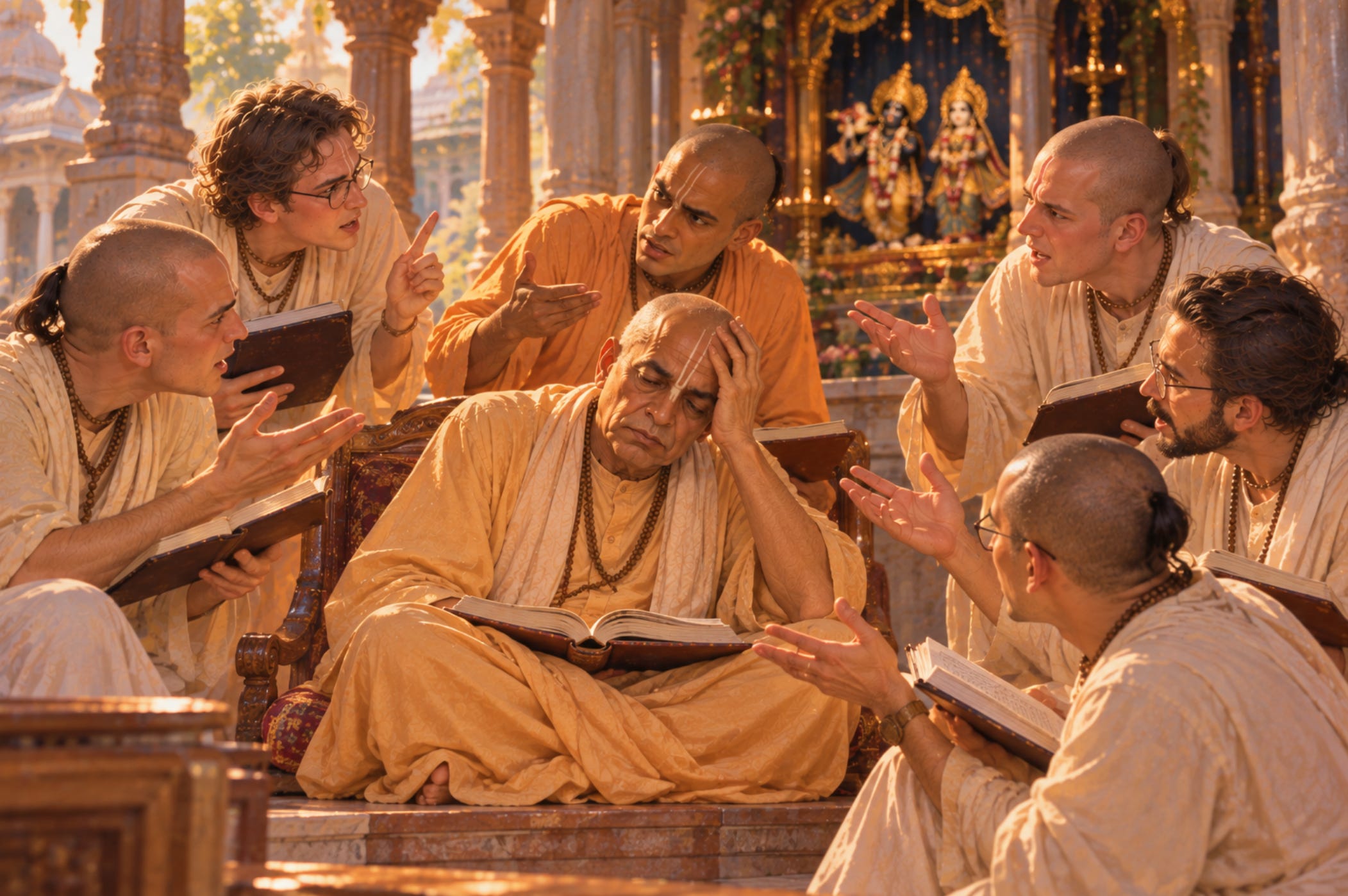
Gaurāṅga Dāsa: Tell me something, Mādhava. When you received your first Bhagavad-gītā from Sarasvatī Prabhu, what did you know about Kṛṣṇa consciousness?
Mādhava Dāsa: Practically nothing. I had heard about the soul and reincarnation, but I didn’t know anything about our relationship with God. Only after reading Prabhupāda’s books did things start to make sense. I understood I’m not this body. I’m an eternal soul, Kṛṣṇa is the Supreme Personality of Godhead, and the purpose of life is to revive our eternal relationship with Him. From there, I started chanting, following the principles and learning from you.
Gaurāṅga Dāsa: Not many people come to these conclusions. Even after studying for so many years, most of your teachers still think they are the body. In this sense, you are already light-years ahead of them.
The question is, where did this knowledge come from? Did you discover these truths by studying different authors and philosophies and comparing their arguments until you arrived at the correct conclusions?
Mādhava Dāsa: No. I received it from Prabhupāda.
Gaurāṅga Dāsa: Exactly. That’s what paramparā is. Do you remember how Prabhupāda explains the difference between ascending and descending knowledge in the introduction to Śrī Īśopaniṣad?
Mādhava Dāsa: He says that if you receive the right conclusion from the right authority, you save much time; otherwise, you have to research everything by yourself and even after a long time may still reach the wrong conclusion.
Gaurāṅga Dāsa: Yes, you have studied well. That’s the meaning of paramparā. That’s how we receive the Bhagavad-gītā: evaṁ paramparā-prāptam, imaṁ rājarṣayo viduḥ. Transcendental knowledge is received through disciplic succession.
Kṛṣṇa is perfect, and He transmits perfect knowledge to His devotees. They, in turn, transmit it to their disciples. This material world is by nature an imperfect place. No perfect knowledge can be manufactured here. Perfect knowledge has to come from the outside, and it has to be carefully maintained, because if it is lost at some point, it cannot be replaced. Someone has to come from the spiritual world to transmit it again.
Do you remember text 4.34, that we were studying another day?
Mādhava Dāsa: tad viddhi praṇipātena paripraśnena... Something like this.
Gaurāṅga Dāsa: Yes, this one.
“Just try to learn the truth by approaching a spiritual master. Inquire from him submissively and render service unto him. The self-realized souls can impart knowledge unto you because they have seen the truth.”
There is a special word there: tattva-darśinaḥ. Pure devotees like Śrīla Prabhupāda are seers of the truth. They can see the spiritual reality and describe it. We are like the blind men trying to understand what an elephant is. Whatever part we touch, we think that this is the totality of the animal, and thus we conclude that the elephant is like a fan, a snake, a spear, or a column. We can understand it if we accept the explanations of a person who can see. Independently, we will reach incorrect conclusions.
When Prabhupāda came to the United States, there were hundreds of different commentaries on the Bhagavad-gītā, each commentator interpreting it in his own way. No one was becoming a devotee; no one was understanding that they should surrender to Kṛṣṇa. Then, when Prabhupāda published his, immediately thousands of devotees started appearing, just like you. We accept Prabhupāda because he faithfully represents this disciplic succession and teaches the conclusions of the scriptures. Through him, we become connected with the previous ācāryas and ultimately with Kṛṣṇa Himself.
Mādhava Dāsa: But devotees from my generation are not Prabhupāda’s direct disciples. We receive guidance from other devotees, like you. How do we fit into this process?
Gaurāṅga Dāsa: That’s exactly the point. The paramparā did not stop with Prabhupāda. His disciples and grand-disciples have the responsibility of transmitting the knowledge he taught, without changing its meaning.
We need the guidance of experienced devotees who can answer our questions, correct our mistakes, and help us to understand and apply the philosophy in our daily lives. This is essential, as Kṛṣṇa Himself tells us. At the same time, however, their duty is to teach us Prabhupāda’s conclusions, not to replace them with their own ideas. As long as the blind man follows the one who can see, he can find his way home. If he thinks he knows better, he falls into the pit.
Mādhava Dāsa: I understand the principle. But how can we be sure we are understanding everything correctly? The previous ācāryas give many explanations that are not directly present in Prabhupāda’s books.
Gaurāṅga Dāsa: Yes, of course, and that is why their commentaries are so valuable. There is, however, a difference between expanding an argument and replacing the conclusion.
Prabhupāda frequently gives us the conclusion of very elaborate philosophical discussions in simple sentences, or even slogans. You can see how he condenses many of the arguments of the Govinda-bhāṣya of Baladeva Vidyābhūṣaṇa in his introduction to the Bhagavad-gītā, for example. He condenses the whole discussion of the fall of the jīva into “Back to Godhead,” and so on.
Take, for example, his statement that the soul is the eternal servant of Kṛṣṇa, who is the Supreme Personality of Godhead. Looks simple; even a beginner can understand this and start practicing devotional service from day one. However, this apparently simple conclusion encapsulates the whole philosophy of the soul, the nature of the Absolute Truth, Kṛṣṇa’s different potencies and their eternal relationships, and so on. Our previous ācāryas debated with opponents of different schools for hundreds of years to establish these conclusions, and still, if you go to India nowadays, most people do not know.
If you study Sanskrit and go to the commentaries of Jīva Gosvāmī and Baladeva Vidyābhūṣaṇa, you can find many arguments and additional details, but still, the conclusion remains the same. This is how advanced study should work. We go deep into the philosophy, but we maintain the conclusions we already received. Two plus two equals four from the first grade all the way up to PhD. E=mc² also does not change, no matter how deep you go into physics.
Mādhava Dāsa: Now I see. The purpose of studying the previous ācāryas is to understand more deeply what Prabhupāda has already taught…
Gaurāṅga Dāsa: Yes, exactly. We should not think that Prabhupāda gave us some form of elementary philosophy and that real siddhānta must be found elsewhere. He gave us the conclusions of the paramparā in a form that is useful for both the beginner, who can catch the basic concepts and apply them immediately, and the advanced student, who has a much more refined understanding of the philosophy and thus can go deeper into his purports and see what they really contain. This is not incomplete knowledge, but condensed knowledge.
Mādhava thought about the book he had been reading. The technical language had impressed him, but now he began to see that complexity is not necessarily a sign of a higher truth. Still, another question came to his mind.
Mādhava Dāsa: How can I understand if a particular teacher is expanding Prabhupāda’s teachings or replacing them? A scholar may quote from previous ācāryas and claim that he is transmitting the real conclusions. How can I judge these arguments?
Gaurāṅga Dāsa: You already have a foundation in Prabhupāda’s teachings. You know the basic conclusions. When you encounter a new explanation, first consider whether it agrees with these conclusions. See if the author is helping you to better understand points that Prabhupāda makes in his books, or if he is simply trying to replace him.
There is another point you should be aware of. Not everyone writes simply out of pure desire to help others. Ego often plays a role, and the path of independent thinking is often seen as more prestigious. One who says that Prabhupāda already gave the conclusions and he is just trying to explain them puts himself in a subordinate position, while another who claims to have studied Jīva Gosvāmī and found the real meaning of the text puts himself in the position of a higher authority. This can be considerably more rewarding for the ego, for one places himself in the position of judging whether Prabhupāda was correct or not. Some do not contradict Prabhupāda accidentally; they deliberately make it a point, so they can show how they know better. Such disagreements thus become a badge of sophistication, evidence that one has progressed beyond the supposedly elementary level of his books. Some even build careers around that.
Mādhava felt uncomfortable as he considered these points. He, too, had taken the authors’ willingness to question Prabhupāda as a sign of learning and independence, without considering what it implied. He could not judge what there was in their hearts, but he could judge how their presentation affected his own practice. While he considered these points, however, his mind pushed back strongly:
But what if the scholar’s reasoning is very convincing? Shouldn’t we follow the strongest argument, regardless of who presents it?
Gaurāṅga Dāsa: We should always consider the arguments carefully, but you should remember that transcendental knowledge is not established in the same way as the scientific theories you study in the university. It is not about being clever but about faithfully following the ācārya. Even Māyāvādīs follow the conclusions of their school. The greatest scholar is the one who can better understand the philosophy of his own school, not the one who can create revolutionary theories.
A conditioned person may reason cleverly but still reach the wrong conclusion because his reasoning started from a wrong assumption. You have already seen an example of this in the two verses of the Bhāgavatam. If you had studied the second verse just based on Sanskrit grammar, without considering the governing conclusion of the text, you could very well have concluded that Kṛṣṇa is an expansion of Nārāyaṇa. The logic could appear sound, but the conclusion would still be incorrect.
Mādhava Dāsa: So the danger is that we may begin with our own assumptions, interpret the passages according to them, and eventually come to the conclusion that they are the true teachings?
Gaurāṅga Dāsa: Precisely. The more learned a person becomes, the more convincing these arguments can appear, because he has more information and arguments to sustain his theories. Material intelligence is a material opulence, just like beauty or money. If we use it properly, it can help us in devotional service, but if misused, it can create havoc.
Scholarship is valuable, but it cannot replace the process of receiving transcendental knowledge from the proper source. Prabhupāda himself uses reasoning constantly in his books; there is no need to reject logic. The point is in understanding the difference between logic that helps us to understand the conclusions we receive through paramparā and independent reasoning that wants to judge what those conclusions should be.
Mādhava Dāsa: But is it not blind following to just accept Prabhupāda’s conclusions before examining the arguments? At the university, we are taught to question everything.
Gaurāṅga Dāsa: There is a difference between blind following and receiving knowledge from a perfect authority. In Bhagavad-gītā 4.34, Kṛṣṇa tells us to approach a spiritual master, inquire submissively, and render service. To question is part of the process. A disciple is supposed to ask questions and develop a clear understanding. Prabhupāda explains in his purport that both blind following and absurd inquiries are condemned. We should not accept things blindly, without trying to understand.
Do you remember what Maharaja Parīkṣit answered to Śukadeva Gosvāmi when he recommended the process of atonement as a way to become free from sinful reactions?
Mādhava smiled. He remembered the passage but could not remember the words.
Gaurāṅga Dāsa got the right volume from his shelf: Be careful with this one. It’s sharp. Mādhava could barely suppress a laugh.
Mādhava Dāsa:
“Mahārāja Parīkṣit said: One may know that sinful activity is injurious for him because he actually sees that a criminal is punished by the government and rebuked by people in general and because he hears from scriptures and learned scholars that one is thrown into hellish conditions in the next life for committing sinful acts. Nevertheless, in spite of such knowledge, one is forced to commit sins again and again, even after performing acts of atonement. Therefore, what is the value of such atonement?
Sometimes one who is very alert so as not to commit sinful acts is victimized by sinful life again. I therefore consider this process of repeated sinning and atoning to be useless. It is like the bathing of an elephant, for an elephant cleanses itself by taking a full bath, but then throws dust over its head and body as soon as it returns to the land.”
Gaurāṅga Dāsa: Just see… The guru gave him an instruction, and he said it is useless…
Mādhava laughs heartily this time. Gaurāṅga Dāsa also smiles.
Gaurāṅga Dāsa: But seriously. Śukadeva Gosvāmi tested him, because what he was about to explain was very confidential. He wanted to be certain that Parīkṣit was not just a blind follower. He passed, showing that he was not just listening like a piece of furniture; he noticed that the proposed solution did not resolve the problem, and he said so.
On the other hand, we should not judge that our material intelligence can independently judge the transcendental reality. The process is that we receive the conclusion from the proper authority and then use our intelligence to understand it. The more we understand, the stronger our faith becomes.
Kṛṣṇadāsa Kavirāja says in Caitanya-caritāmṛta: siddhānta baliyā citte nā kara alasa, ihā ha-ite kṛṣṇe lāge sudṛḍha mānasa. We should not be lazy about discussing philosophical conclusions, because these discussions make the mind attached to Kṛṣṇa. Sometimes a difficult question may disturb us until we understand the answer. We should work through it carefully, so our faith can become firmly grounded.
Mādhava remembered how his chanting had become mechanical. He had spent his time studying different arguments, but instead of becoming more enthusiastic, he had started doubting the very relationship that inspired him to practice devotional service in the first place.
Mādhava Dāsa: I think I can understand this from my own experience. When I started reading Prabhupāda’s books, it was not just about learning new things but also about becoming enthusiastic about practicing Kṛṣṇa consciousness. With this other book, I was also learning many things, but in the end I became confused. This morning I could barely chant my rounds.
Gaurāṅga Dāsa: This is something you should take seriously. If you feel unwell after eating, you should consider both what you are eating and whether you can digest it. Your disturbance shows that there are things you have not yet resolved, but you do not have to force yourself to solve them alone.
You should distinguish what the scriptures and previous ācāryas actually say from the interpretations introduced by others. Then, we should examine these interpretations carefully, accepting what is correct, and questioning what does not fit the conclusions we receive through the paramparā. If we find an apparent contradiction between Prabhupāda and Jīva Gosvāmi or any other ācārya, we should try to resolve it, instead of concluding that one of them was mistaken.
You should also remember that Prabhupāda studied all these commentaries himself and wrote his purports based on them. He knew Sanskrit, and Bengali was his native language. He had a much deeper understanding of the commentaries of the previous ācāryas than any of us can imagine. When you see a passage from another ācārya, you should keep in mind that Prabhupāda most probably studied it, interpreted it within a context more complete than what we have, and gave a conclusion based on it, often already considering passages of other ācāryas that appear to contradict the first.
Mādhava felt his confidence starting to return. His doubts about the origin of the soul were still there, but he no longer felt compelled to choose between Prabhupāda and the previous ācāryas. He could study everything carefully while remaining faithful to the process of disciplic succession through which he had received Kṛṣṇa consciousness.
Gaurāṅga Dāsa: Now that we have established the process for resolving these questions, we can start examining the arguments. The book places great importance on the word anādi. We can start from there.
Before coming back, read Bhagavad-gītā 13.20 and Prabhupāda’s purport carefully. Consider what Kṛṣṇa actually says there, and what Prabhupāda explains.
Mādhava Dāsa: I will do that, Prabhu. Thank you. I think I was trying to understand everything at once, without realizing that there are many separate arguments. Now I have a better idea about how to study.
Mādhava was already getting late for his classes at the university. He offered his obeisances and thanked Gaurāṅga Dāsa for taking the time to speak with him. As he rode away, he reflected on what he had learned. His questions were still unanswered, but he understood that the purpose of studying the previous ācāryas is not to replace or supersede what he received from Prabhupāda, but to understand him more deeply.
« Previous: Contradictory Teachings
Soon the next part…
If you want to study the philosophical basis of this story, here is the book:

This is a publication for thoughtful readers who want to go deeper into Kṛṣṇa consciousness. I publish daily, trying to offer high-quality spiritual content, and all posts are available to free subscribers. If you wish, you can support this work with a monthly contribution. When you subscribe, you can choose between a free subscription and a monthly contribution, and you can switch from a free subscriber to a supporter at any time.
You can also receive updates on WhatsApp or Telegram.
If you would like to contribute further, you can find the donation links here.