


« The Friend Who Never Left: A Dialog on the “Fall” of the Jīva
You can receive new articles directly in your inbox. Subscription is free; donations are welcome.
Chapter Eleven: Where Do the Souls Come From?
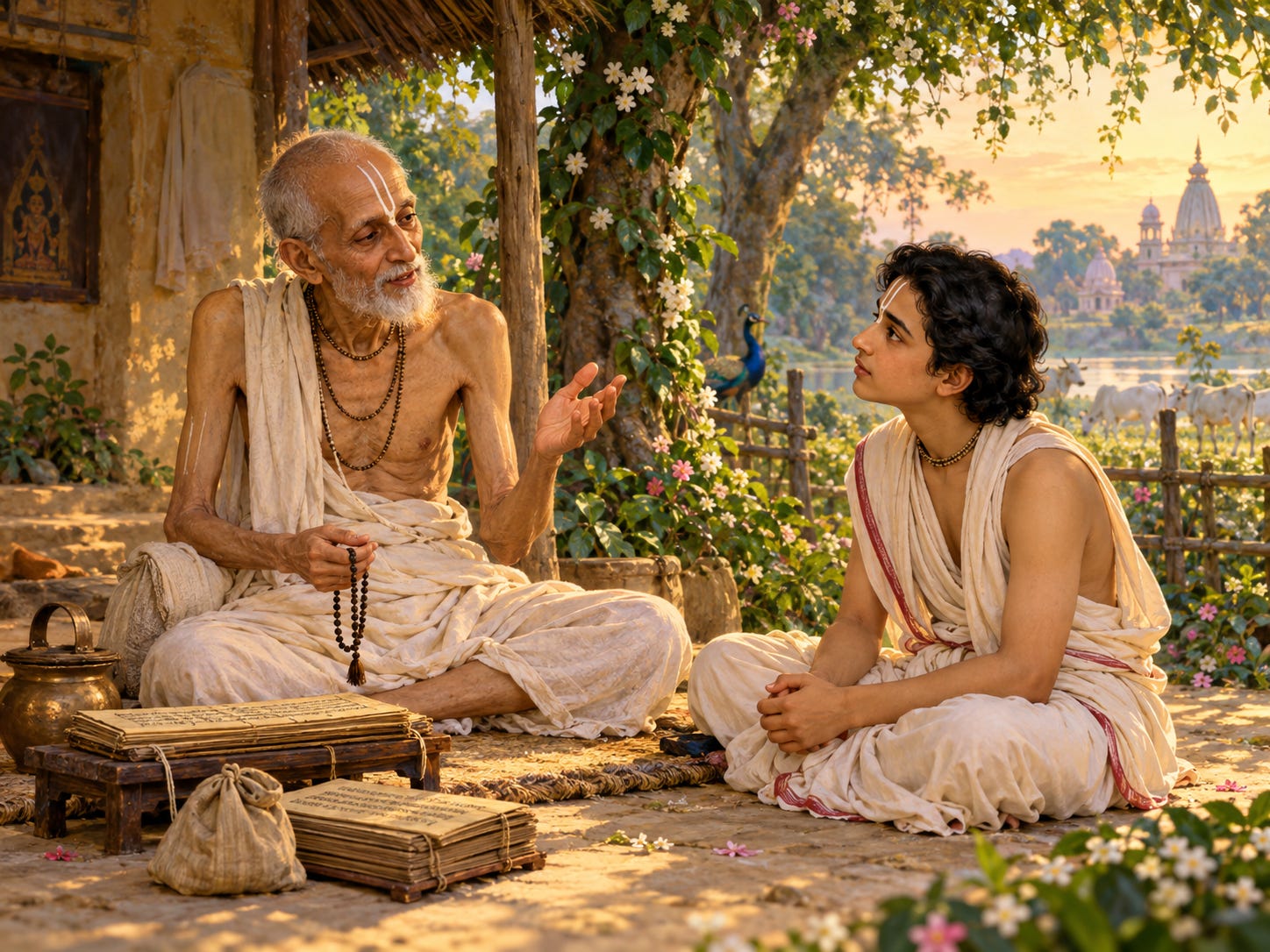
Mādhava had spent much of the previous evening studying Mahāprabhu’s instructions to Sanātana Gosvāmī and the fifteenth chapter of Jaiva-dharma. The more he studied, the more he realized that the question of where the souls come from was more complicated than he had previously imagined.
Gaurāṅga Dāsa: You came early today! Did you find the answer to the question?
Mādhava Dāsa: That’s what I wanted to ask you. After reading everything, I’m no longer sure even what the question means.
We have already established that the soul is eternal and was never created. Therefore, there cannot be a first moment when the soul began to exist. But the scriptures still speak about the souls emanating from the Lord, and Bhaktivinoda Ṭhākura describes different expansions of Kṛṣṇa manifesting different categories of souls.
If the souls are eternal, what exactly does this manifestation mean?
Gaurāṅga Dāsa: The first point to keep in mind when you study a new book is that you need to reconcile the points it discusses with all the previous points you studied before. All the points should be understood together; you should not start thinking that one book contradicts the other.
The ācāryas who wrote these books are perfect. They often appear to disagree in their explanations, but we should understand the nature of their apparent disagreement. Instead of jumping to the conclusion that one is right and the other is wrong, we should understand that they describe separate points of view and that they must be simultaneously correct, addressing different aspects of the same truth. We should thus try to understand what exactly each ācārya is describing, from what perspective, and in response to which question. We need to take both together and see how they complement each other.
Another point we need to be mindful of is the quality of the translations. Many problems are introduced by bad translations or by assumptions added by later commentators.
Mādhava Dāsa: The intelligence should not be flat.
Gaurāṅga Dāsa: Yes. Flatness is a symptom of our intelligence working under material duality. Black or white. Under material duality, we have trouble understanding that there are unlimited colors between the two extremes.
Consider two persons who can see. One says that the car is red, and another that it has four wheels. Understanding that both are perfect sources of knowledge, how do we reconcile their apparent disagreement?
Mādhava Dāsa: The disagreement is only apparent. The car may be red or blue; this doesn’t prevent it from having four wheels. One is emphasizing the color; the other is emphasizing the practical structure. Both are correct.
Gaurāṅga Dāsa: And what do you do if one describes the car as red and the other as black? And if one describes it as having four wheels and another as having five?
Mādhava Dāsa: It means some parts of the car are red, and other parts are black, or one side could be red and another black. It would demand more careful consideration and consulting other sources. And about the car having five wheels, every car has five if we count the spare, so one may say four or five according to what he is emphasizing.
Gaurāṅga Dāsa beamed. Mādhava had understood the principle and was now applying it on his own.
Gaurāṅga Dāsa: Yes! Now let’s go to a little more difficult example. We studied the example of the sun being reflected in the pot of water in the teachings of Lord Kapila. We studied that this example applies both to Mahā-Viṣnu and to the individual soul itself. In the case of the individual soul, the reflection is the material identity.
But we can see that right at the beginning of the 15th chapter, it appears that the Jaiva Dharma contradicts this example, classifying it as impersonalism. Did you notice that?
Mādhava Dāsa: Yes, that is one of the points that confused me. I even marked it:
“Vrajanatha: At another time another teacher said that the individual spirit soul is a reflection of Brahman. As the sun is reflected on the water, so the Supreme Brahman, reflected on maya, becomes the individual soul. What does that mean?
Raghunātha Dāsa Bābājī: That is also impersonalism. Brahman has no limit. Something that is unlimited cannot be reflected anywhere. The Vedas do not teach that Brahman is limited. This reflection theory should be rejected.”
Gaurāṅga Dāsa: And how do you understand it in relation to the teachings of Lord Kapila?
Mādhava Dāsa: It seems to directly contradict it. But if we follow the principle that both passages must be accepted as correct, then they must be describing two different ideas.
Gaurāṅga Dāsa: You got it! Let’s first see the context. This is very early in the discussion. Raghunātha Dāsa Bābājī is dismissing different incorrect assumptions made by Māyāvādīs. All of them have something in common: we are one, and individuality appears only due to illusion.
Some philosophers believe that Brahman is divided, and pieces are captured by Māyā, as air is closed inside a pot. Others believe that the individual soul appears only due to avidyā, ignorance. The soul does not really exist, they say; it only appears so due to the influence of Māyā. Others think that Brahman dreams that He becomes separated into many individual souls, and so on. All of these ideas are absurd and find no support in the scriptures.
Then we have the example of the sun being reflected in water. Is this the same example that Lord Kapila gives?
Mādhava Dāsa: There is sun, and there is water. The question is, what is the idea represented by the analogy?
Gaurāṅga Dāsa’s eyes brightened again. Mādhava was no longer merely repeating the principle; he was beginning to think inside of it.
Gaurāṅga Dāsa: Yes, precisely! Impersonalists use the image to illustrate a very different concept. Lord Kapila says that both the Supreme Brahman and the individual souls exist eternally as individuals. Both never mix with matter. When the individual soul is reflected in matter, an illusory material identity is created, and the soul identifies with it.
Māyāvādīs use this example to sustain a very different point. According to them, only Brahman exists. Brahman is one, without qualities or activities. There are no separate individual souls. When this Supreme Brahman is reflected on Māyā, it becomes the individual souls.
Mādhava Dāsa: Now I see!
There is no contradiction; these are two different examples. One is the genuine philosophical point made by Kapila, separating the transcendental soul from the reflection, and the other is the Māyāvādī claim that the individual souls appear when Brahman is reflected in Māyā.
Gaurāṅga Dāsa: Yes, these are almost opposite claims. Kapila tells us we should reject the reflection and identify with our eternal spiritual identity as servants of Kṛṣṇa, while the Māyāvādī tells us we are God. Kapila’s analogy is accepted, and the Māyāvādī’s analogy is rejected.
The material mind has this propensity to rush to find contradictions, even where they don’t exist. That’s why people, and even devotees, quarrel so much about everything. We need to learn to first step back and analyze it carefully according to the hermeneutical principles we have been practicing.
Mādhava Dāsa: This reminds me of something I studied in physics. Light can be described as a wave, but in other experiments, it behaves as particles, photons. If we insist that it must be one or the other, it appears contradictory, but if we understand that both are descriptions of the same reality, we see how both fit together.
So when I see statements from the ācāryas that appear contradictory, instead of immediately presuming that one must be wrong, my first question should be, “What exactly is each one describing?” and also “What question is each one answering?”
Gaurāṅga Dāsa: Now you are beginning to understand hermeneutics!
Mādhava Dāsa became a little embarrassed.
Mādhava Dāsa: I think I am just beginning to understand it. Before, if I found two statements that appeared contradictory, I would immediately try to judge which should be accepted. Now I see that I should first try to understand what each statement actually explains.
Gaurāṅga Dāsa: Now, let’s go back to the point of the souls being eternal, but at the same time being described as manifesting from a source.
Before examining Bhaktivinoda Ṭhākura’s explanation, let’s go back to Mahāprabhu. What does He say about the constitutional position of the soul?
Mādhava Dāsa: Jīvera ‘svarūpa’ haya — kṛṣṇera ‘nitya-dāsa’, kṛṣṇera ‘taṭasthā-śakti’, ‘bhedābheda-prakāśa’.
The constitutional position of the soul is to be an eternal servant of Kṛṣṇa. We are manifestations of His marginal potency, and we are simultaneously one and different.
Gaurāṅga Dāsa: Exactly. Now, pay attention to the order inside the verse. Mahāprabhu first establishes the eternal constitutional position of the soul, and then He explains the potency to which we belong. He doesn’t begin by describing where the soul was first created, because there was no such creation. Instead, He describes what the soul eternally is.
Mādhava Dāsa: Kṛṣṇa’s servant.
Gaurāṅga Dāsa: Yes. And what does taṭasthā-śakti mean?
Mādhava Dāsa: The soul is spiritual but has a minute independence. Because of this independence, the soul is capable of staying under the shelter of either the internal or external potency. The soul is thus the marginal potency. Marginal in the sense of a margin or border.
Gaurāṅga Dāsa: Very good. But this is a point that has to be understood carefully.
Some imagine the marginal potency as something that resides at a particular geographical location between the spiritual and material worlds. According to them, we appear on this border and from there decide where to go.
However, taṭasthā-śakti is given as the name of the potency. The word describes the constitutional nature of the souls; it is not a mere geographical description. One thing thus is the description; another is the geographical meaning we impose on top of it.
Mādhava Dāsa: So, if marginal is the description of the potency, the soul doesn’t cease to be marginal when we enter the material creation or attain liberation.
Gaurāṅga Dāsa: Exactly. If marginal meant an initial geographical location, then we would stop being marginal as soon as we entered either the material or spiritual side. Instead, we see the soul being described as marginal in both circumstances. This means marginal is the soul’s constitutional nature.
Kṛṣṇa is śaktimān, the possessor of the potencies. Nārāyaṇa is viṣṇu-tattva, expansion of Kṛṣṇa. Śrīmatī Rādhārāṇī and the Lakṣmīs are śakti-tattva; they belong to the Lord’s internal spiritual potency. Lord Śiva is śiva-tattva. We, the souls, are taṭasthā-śakti; we belong to the marginal potency.
This is why Mahāprabhu compares the souls to particles of sunshine and sparks of a fire. The particle shares the nature of its source, but it is very small. This illustrates the principle of simultaneous oneness and difference He was teaching. We can see that this example of the fire is also given in the Jaiva Dharma.
Mādhava Dāsa: Then marginal doesn’t mean that the soul is a different type of potency, that is neither spiritual nor material, or that is a combination of the two.
Gaurāṅga Dāsa: Certainly not. Read text 112.
Mādhava opened the passage.
Mādhava Dāsa: Viṣṇu-śaktiḥ parā proktā, kṣetrajñākhyā tathā parā, avidyā-karma-saṁjñānyā, tṛtīyā śaktir iṣyate.
“The original potency of Lord Viṣṇu is superior, or spiritual, and the living entity actually belongs to that superior energy. But there is another energy, called the material energy, and this third energy is full of ignorance.”
This is a quotation from the Viṣṇu Purāṇa. It explains that the Lord’s energy is spiritual and that the potency consisting of the living entities is also spiritual. The third potency is avidyā, or ignorance, which is connected with material activities. This one is different.
Gaurāṅga Dāsa: Notice that the word parā is used for both the Lord’s superior spiritual potency and the living entities. We are fully spiritual. “Marginal” simply indicates our free will and the possibility of us becoming attracted to matter.
This is also what Kṛṣṇa explains in Bhagavad-gītā 7.5. There He also mentions that the living entities are part of the superior energy and distinguishes them from the inferior material potency.
Therefore, the marginal potency is spiritual in nature, although it is distinguished from the internal potency because of the minute independence and limited power of the individual souls. Again we have the distinction between parā and aparā.
Mādhava Dāsa: Then both the internal potency and the marginal potency are spiritual, while the external potency is material. Being marginal doesn’t mean that we are something between spirit and matter.
Gaurāṅga Dāsa: Exactly. That’s the main point, but we should keep in mind that having the same spiritual nature does not mean that the souls and the internal potency are exactly the same or have the same function. They are distinct potencies. The internal potency manifests the spiritual planets, spiritual paraphernalia, etc., while the marginal potency consists of the innumerable individual spiritual souls, who are infinitesimal parts and parcels of the Lord and are meant to serve Him.
Mādhava Dāsa: Then what about the causal ocean? Bhaktivinoda Ṭhākura uses the analogy of a border between land and water to explain the marginal position. He also describes the souls as situated near the causal ocean.
Gaurāṅga Dāsa: Yes. And that’s an important point. The causal ocean is not symbolic. It is a real transcendental manifestation associated with Mahā-Viṣṇu. It represents the boundary between the material creation and the spiritual realm. Bhaktivinoda Thākura uses the analogy of a riverbank to illustrate the nature of the marginal potency, the possibility of choice. He is not telling us to imagine that the eternal nature of the soul is to remain seated at a thin line between the two realms.
The point is simply to illustrate the soul’s ability to come under the shelter of the spiritual potency, or the influence of the material potency.
Also, you should notice that this chapter of Jaiva Dharma mainly deals with concepts we already discussed. The context of the discussion is exactly Vrajanātha coming to Raghunātha Dāsa Bābājī to ask basic questions about the nature of the soul. The language is different, but these are mainly points we also study in the Śrīmad-Bhāgavatam.
There is, however, a point that is genuinely new.
You can see it here. Raghunātha Dāsa Bābājī mentions:
“The individual spirit souls are not eternally perfect. By engaging in the activities of devotional service (sadhana) they may become perfect (sadhana-siddha) and thus enjoy spiritual bliss exactly like that enjoyed by the eternally perfect (nitya-siddha) beings.”
We already established that the souls are fully spiritual. They can come in contact with Māyā, but there is no Māyā in them. Considering that everything that is spiritual is perfect, how can the souls be imperfect?
Mādhava Dāsa: He must be speaking of a different type of perfection. Not imperfect in the sense of not being spiritual, but imperfect in the sense of lacking something that the eternal associates of Kṛṣṇa have.
Gaurāṅga Dāsa: You are getting good at it!
If we analyze the passage, we see that he is comparing the eternal associates of Kṛṣṇa with us. The eternal associates are called eternally perfect (nitya-siddha). This means that they are eternally fully developed in prema. They have pure love for Kṛṣṇa and are completely fixed in this love.
In this way, when he mentions that the individual spirit souls are not eternally perfect, it means we are not perfect like them, not that we are material. The perfection in question is having a fully developed personal relationship with Kṛṣṇa, in prema.
This brings us back to the point that our constitutional position is to be servants of Kṛṣṇa. We are parts and parcels of Him; we are eternally connected to Him, and love for Him is our eternal nature. We are dear to Him, and He is dear to us, and this relationship is not destroyed even when we fall into the material world. The point is that we are not gopīs.
However, “by engaging in the activities of devotional service (sadhana) they may become perfect (sadhana-siddha) and thus enjoy spiritual bliss exactly like that enjoyed by the eternally perfect (nitya-siddha) beings.”
By coming in contact with pure devotees and practicing devotional service under them, we can awaken our natural love for Kṛṣṇa to the fullest extent and become just like the nitya-siddhas. In this case, we are called sadhana-siddhas, for we attained perfection through devotional practice, but in both cases, the perfection is the same.
We can see this depicted in the Bṛhad-bhāgavatāmṛta. Gopa-kumāra takes his birth in Vṛndāvana as a cowherd boy. This means he must have been practicing devotional service in his previous lives. Although just a boy, he was not really a newcomer. What happens then? He meets with his spiritual master and is initiated by him. His guru gives him the Gopāla mantra, and by chanting it, Gopa-kumāra quickly attains prema and becomes fully situated in love of Godhead, desiring Kṛṣṇa’s association as a friend.
Then, the whole adventure happens: Gopa-kumāra travels all over the material and spiritual skies and is never satisfied until He attains Goloka Vṛndāvana and Kṛṣṇa personally embraces him. The point is that when Kṛṣṇa sees him, he recognizes him as His dear friend. Doesn’t this bring you the passage of Vaidarbhī to memory?
Mādhava Dāsa: Exactly! Kṛṣṇa got Him back, and He is showing His satisfaction. His dear friend has found his way back home.
Gaurāṅga Dāsa: So you can see the point. The other inhabitants of Vṛndāvana do not recognize him; they think he may be a servant of Kaṁsa.
Mādhava laughs; Gaurāṅga also.
Gaurāṅga Dāsa: So you can see the dichotomy. Kṛṣṇa recognizes him immediately. Others question who he is. Kṛṣṇa then reveals that he is Sarūpa, and he is part of Śrīdāmā’s group. This means this identity is eternally existent. At the same time, however, at this point we have just gone through the whole saga of Gopa-kumāra until reaching Goloka. Once he reaches, however, he simply joins the eternal lila; here there is no past or future, just the eternal present of bliss in Kṛṣṇa’s association. This is part of what makes the topic so difficult to understand.
The point is that when we finally reach there, we understand that this is the ultimate reality. Everything else, all the discussion on the “fall” of the jīva looks very foolish in retrospect.
Mādhava Dāsa: Perhaps I was asking the wrong question all along. I was trying to understand from where I came, while the scriptures describe something eternal that cannot be understood in terms of a timeline. This brings back the idea of the philosophers arguing about the crow while the tāl fruit remained in the mud.
Gaurāṅga Dāsa: That’s the point Prabhupāda makes. While we discuss the “fall” of the jīva, we remain in the material world.
This brings us to the final point in Bhaktivinoda Ṭhākura’s explanation. What does he say about the manifestation of the different categories of souls?
Mādhava Dāsa: He explains that Lord Balarāma manifests Kṛṣṇa’s eternal associates in Vṛndāvana, Saṅkarṣaṇa manifests the eternal associates of Lord Nārāyaṇa in Vaikuṇṭha, and Mahā-Viṣṇu manifests the marginal souls who are susceptible to the influence of māyā. This brings us back to the point of creation. If the souls are manifested from Mahā-Viṣṇu, how can they be eternal?
Gaurāṅga Dāsa: That’s the same question Vrajanātha asks Raghunātha Dāsa Bābājī immediately afterward. And what is the answer?
Mādhava Dāsa: “The time and space present in the spiritual world is different from the time and space you experience now in the material world. In the material world time has three phases: past, present and future. In the spiritual world time is not broken in that way. There time is an eternal present. In the spiritual world things do not come into being. Everything exists in an eternal present. When we who are living in the world of material time and space try to describe the spiritual world, we tend to say things like, “The individual souls were created,” “the individual souls were imprisoned by Maya”, “the spiritual world was manifested”, and “the individual souls are spiritual and were not created by Maya.” When we talk in these ways we certainly show how much we are influenced by staying in this world of material time. As long as we stay in Maya’s prison we cannot avoid talking in this way. That is why when we describe the individual souls or the nature of spirit we cannot avoid speaking in terms of material time. Therefore we tend to speak in terms of past and future. Therefore a person who tries to understand the spiritual world properly tries to speak in terms of an eternal present. Baba, logic cannot help us understand these things. Here logic should be rejected. Then you will be able to see the nature of spirit. When he forgets that he is eternally a servant of Lord Krishna, the individual soul enters Maya’s prison.”
Gaurāṅga Dāsa: You see how it comes back to misconceptions we apply to the text. When we hear the word “manifested,” we immediately imagine something that didn’t exist before and came into existence at a particular time. But this is not what the word “manifestation” means when we use the word to describe eternal aspects of the spiritual reality.
All these manifestations are eternal; therefore, when Bhaktivinoda Ṭhākura describes their manifestation through different expansions of Kṛṣṇa, we should understand he is describing the eternal relationships between the Lord and His eternal potencies.
There is another point. We should remember that Mahā-Viṣṇu is Himself an expansion of Saṅkarṣaṇa, and ultimately of Kṛṣṇa. All these expansions are manifestations of the same Supreme Personality of Godhead.
Prabhupāda explains in his purport to Ādi-līlā, 2.36, that Saṅkarṣaṇa is the original source of all living entities, because they are expansions of His marginal potency. He then distinguishes those who are conditioned from those who remain under the shelter of the spiritual nature. Those who come in contact with the material energy do so through the process of creation of Mahā-Viṣnu.
Mādhava Dāsa: So we have to distinguish between the eternal source of the soul, our constitutional position, and the process by which we enter material creation. They are different subjects.
Gaurāṅga Dāsa: Eternal source is a good way to describe it, because we are speaking about the source of something that is eternal. We don’t have this concept here in the material world; therefore, it is easy to misunderstand. It is not about creation but about an eternal relationship.
Now you can understand why Mahāprabhu begins His explanation by saying that the constitutional position of the soul is to be Kṛṣṇa’s eternal servant. This is the conclusion that governs everything else. We start with it, and then add other details on top of it, without contradicting the governing principle. If at some point one starts thinking that the soul is not an eternal servant of Kṛṣṇa because we join the material creation through Mahā-Viṣnu, it means he is misunderstanding.
Mādhava Dāsa: And by practicing devotional service, we can attain the full perfection of that relationship, just as Gopa-kumāra did.
Gaurāṅga Dāsa: That’s the spirit. This is why Bhaktivinoda Ṭhākura distinguishes between the nitya-siddhas, who are eternally established in perfected devotional service, and the sādhana-siddhas, who attain that perfection through devotional practice. This makes the goal clear.
Mādhava Dāsa: I see that the story of Gopa-kumāra illustrates this point of eternal relationship. From the perspective of his journey, there is a process of progression until he reaches Goloka, but when he finally meets Kṛṣṇa, he discovers that his relationship with Him is eternal.
Gaurāṅga Dāsa: Yes. There is the temporal journey, and there is the eternal nature of the perfected relationship. These are two different perspectives. Both are there, but we cannot fully understand their relationship by trying to impose our limited concept of material time.
Mādhava Dāsa: That’s why trying to reconstruct a chronological history of the conditioning of the soul leads to so many difficulties. We are trying to place an eternal spiritual reality inside our material understanding of past, present, and future.
Gaurāṅga Dāsa: Exactly. We need to understand what the scriptures say, without speculating conclusions they don’t give, and without imposing our material concepts.
Mādhava Dāsa: With this, I think the main points are coming together. The soul is eternal; there is no beginning or creation. Kṛṣṇa is our eternal source, which means we are eternally connected with Him. In terms of constitutional category, we are marginal, and our perfection is to be fully established in loving service to the Lord.
Gaurāṅga Dāsa: You are already speaking like a philosopher! A few days ago you came here confused, and now you look like someone who has decided to go back home, back to Godhead.
Mādhava Dāsa: I guess that’s why Bhaktivinoda Thākura was putting so much emphasis on sambandha, abhidheya, and prayojana. When the philosophical basis is not correct, the practice is undermined, and the ultimate goal is not attained.
The book I first read attacked two foundations of my spiritual life: my faith in my eternal relationship with Kṛṣṇa and my faith in the ācārya who guides me in this understanding. With these two bases compromised, I saw that my whole spiritual life was under threat. I guess other devotees also go through this.
Gaurāṅga Dāsa: More than you can imagine.
After a few moments of silence, Mādhava Dāsa offered his obeisances and went home. Gaurāṅga Dāsa offered him his praṇāmas and remained seated, deep in thought.
Next: “No One Falls from Vaikuṇṭha” »
Read the entire book:
The Friend Who Never Left, A Dialog on the “Fall” of the Jīva

This is a publication for thoughtful readers who want to go deeper into Kṛṣṇa consciousness. I publish daily, trying to offer high-quality spiritual content, and all posts are available to free subscribers. If you wish, you can support this work with a monthly contribution. When you subscribe, you can choose between a free subscription and a monthly contribution, and you can switch from a free subscriber to a supporter at any time.
You can also receive updates on WhatsApp or Telegram.
If you would like to contribute further, you can find the donation links here.