


You can receive new articles directly in your inbox. Subscription is free; donations are welcome.
Constitutionally, the soul is not meant to exist alone. Each soul has an eternal relationship with Kṛṣṇa, and in the spiritual world there are also many other relationships with other souls centered around this relationship with the Supreme Person.
This explains why human beings are social by nature. People have friends and families, and if everything else fails, people get a dog or a cat to get company. Apart from self-realized souls, it is extremely rare to find someone who, voluntarily, would choose to remain completely alone. This usually comes after other possibilities are frustrated. Somehow, that’s precisely the point where many are nowadays.
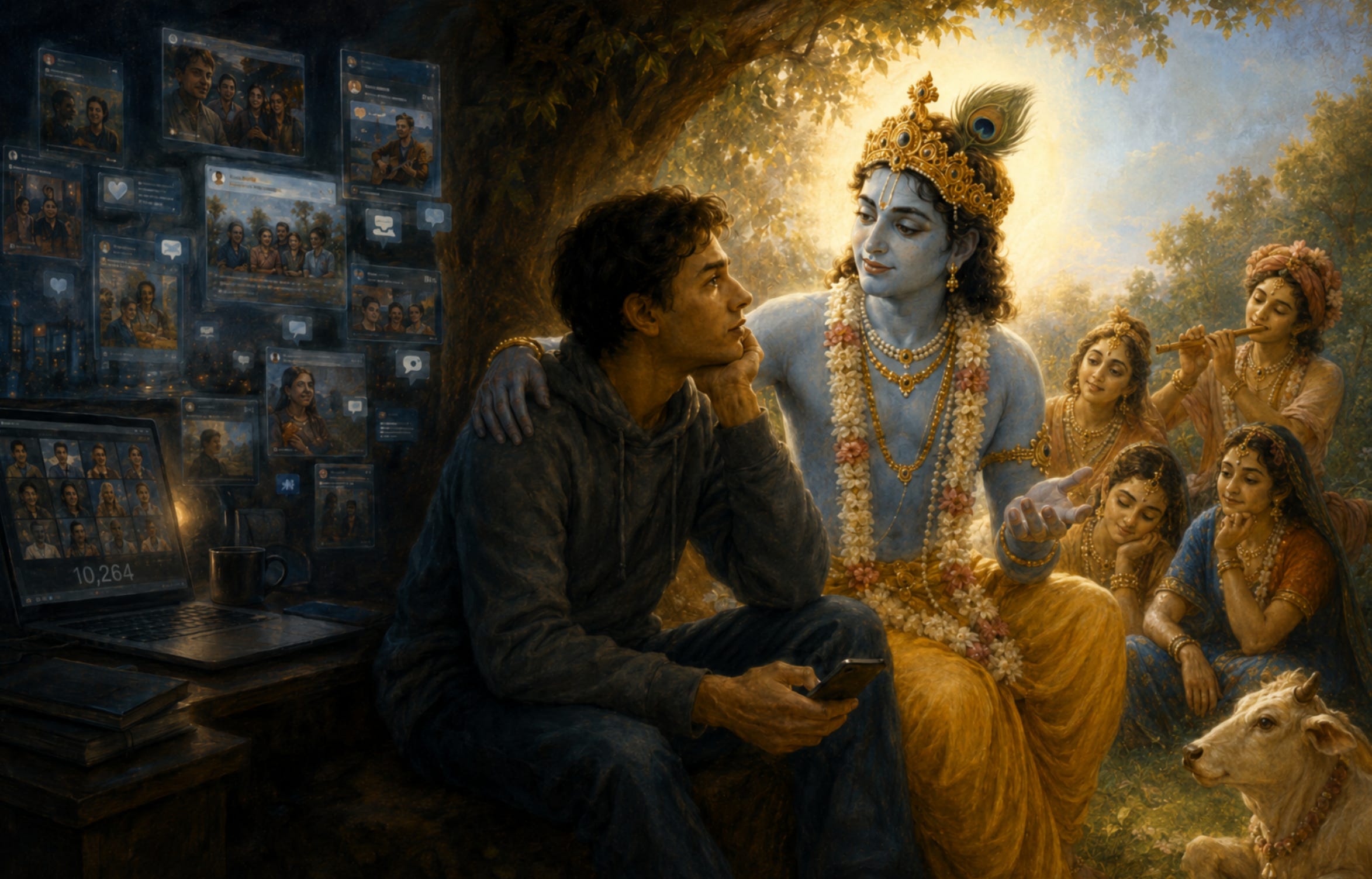
Here, however, we have a paradox. Never before in recent history have people been able to communicate so easily. Nowadays we can follow the lives of thousands of people, communicate with people on the other side of the globe, participate in groups, attend courses, etc. Still, people feel more lonely than ever. A person can have thousands upon thousands of contacts and still feel that no one truly knows or understands him or her.
Here, we have a two-layered problem. The first layer is that online communication tends to be very superficial. We may follow or be followed by thousands of people and still have no relationship with them. This brings us to digital impersonalism.
What is it? It starts when we start seeing other people as merely a category: a customer, a follower, a boss, or an employee, a supporter, etc. This makes us interact impersonally with them, treating them as commodities instead of people. People become then an asset, or a currency, reduced to merely a function instead of an individual. When one sees the other like this, we bring the old feeling of being treated like an object to a new level.
This is not exactly a new phenomenon. People have been doing it for millennia. Politicians see people as votes, businessmen see them as walking wallets, and so on. However, digital life makes it especially easy. A person is reduced to a profile, or a number. We can follow, unfollow, block, mute, etc. with just a click. We are exposed to people, but there is no real relationship; it’s just about immediate gratification.
In direct relationships, our actions have consequences. If we treat someone harshly, we see their expression, we notice the change in behavior, etc. We cannot make people just disappear. We live with them, and interactions have long-term consequences. We can’t block our boss or mute our children. Social media replaces these for superficial, disposable relationships that have very little value.
There is a second layer, however. Just as we are not sites or profiles, we are also not the body or even the ego. We are souls behind these layers, and as souls, we have needs that are very different from the body or ego. What makes the body satisfied? Food, shelter, and other basic necessities. What makes the ego satisfied? Praise, recognition, etc. There is also the mind, which hankers for affection, intimacy, etc., and the intelligence, which hankers for intellectual stimulation. All of these are considered human necessities, and a person can be considered materially happy to the extent these are satisfied.
However, what are our necessities as a soul? That’s the point many will hesitate to answer. We often don’t know.
That’s the center of the issue. Prabhupāda gave a simple example: what happens if a man starts to identify with the car, keeping it fueled, clean, changing the oil frequently, etc? He may feel a certain satisfaction in seeing his car shining, but forgetting to eat and sleep, he will never be happy. This brings us to the second problem.
Finding proper, nourishing material relationships improves our position, but it doesn’t solve the problem. A lonely person who suddenly finds an affectionate spouse or partner will feel happy for a time, but eventually the feeling of dissatisfaction or incompleteness will return.
This point has been observed in a number of studies. A classic study (Lucas, Clark, Georgellis & Diener, 2003) followed more than 24,000 people for 15 years. Their central finding is that people would feel happier after finding a partner but return close to their baseline level of happiness after some time. Another study (Zimmermann & Easterlin, 2006) found that happiness increased substantially when people started living together as couples, and this rise continued for about a year but then declined closer to the original baseline. If there was divorce later, then happiness would decline from this level. These studies indicate that material relationships and marriages are not worthless; they bring an increase in subjective happiness, but they don’t eliminate this deeper sense of incompleteness. When one gets married or finds new friends, the initial feeling of completeness fades, but eventually we discover that something is still missing.
Ultimately, we feel lonely because our intrinsic needs as a soul are not being fulfilled. We are taking care of the car, so to say, but forgetting about ourselves.
When we become conscious of this point, we start the philosophical path of finding what these needs are. This path eventually brings us to this eternal relationship with Kṛṣṇa we somehow forget. Material relationships can help by giving us a foundation in which to stand on, to keep our mind in order in order to pursue higher goals instead of hankering for basic necessities, but it is the development of these original relationships that brings us to happiness.
Kṛṣṇa already knows us fully. We don’t need to create a new identity to come to Him, He already knows our true self that lies beneath the body, mind and ego. It is thus not about becoming something else, but about finding the real “me”.
He has been following us since time immemorial, always present inside our hearts as Paramātmā as we transmigrate through different bodies, life after life. He knows us, because He is always with us and sees all our actions and thoughts. Not only that, but He is eternally responsible for us. Every life He organizes for us to receive parents, find shelter and food, etc. He witnesses our struggles, mistakes, etc., but He rarely interferes, because we rarely ask Him to do so. People forget that He is there or openly say that there is no God, and thus He becomes absent from their lives. He is like a friend who follows us from a distance because we have become hostile to him.
However, when we desire to know Him and come back to Him, He deeply appreciates it and gives us all facilities for doing so, putting us in contact with devotees who can teach us about Him and give us the knowledge for doing so.
Some try to reconnect with themselves through meditation or philosophical speculations. These are valid paths, but they are very difficult, especially in the age we live in. Kṛṣṇa consciousness is a much more natural process because it is based on reinforcing the spiritual identity, instead of negating the material identity. In fact, in the Gītā, Kṛṣṇa encourages us to continue to fulfill our material duties towards family, etc., while at the same time coming to know Him. By coming closer to Kṛṣṇa, we gradually become purified, and this purification makes us progressively less attracted to the material and more attracted to Him. This also brings us to the point about service.
Loneliness is often described as the absence of someone who cares for us, but there is also another side: loneliness is also the absence of someone we care for.
In material life, we think that happiness comes from being served, followed, admired, etc. When we focus too much on this part, we miss the main point: as souls, we are active by nature and meant to serve. This service is the basis of real relationships, both with others and with Kṛṣṇa.
This attitude of service is the very foundation of Vaiṣnava philosophy and the real center of our happiness. The spiritual process is based on hearing, chanting, serving, cooking, distributing prasādam, worshiping, traveling, cooperating, etc. All of this, however, is not simply done for others, like in ordinary philanthropy, but done for others in relationship with Kṛṣṇa. This is essential, because without Kṛṣṇa we cultivate relationships with the material identity and not the soul. If I feed the poor, I see only their bodies and their identities as poor people, but when I distribute prasādam, I see and interact with their real identity as souls, eternally connected with Kṛṣṇa. This makes the interaction not only uplifting for us but also for them.
Simply being surrounded by devotees, however, does not automatically eliminate loneliness. There is also another level; we need to develop relationships with them. Rūpa Gosvāmī describes loving exchanges among devotees: giving and receiving gifts, revealing one’s mind confidentially, inquiring confidentially, and giving and accepting prasādam. By following these steps and keeping Kṛṣṇa at the center, we can finally come to true spiritual relationships we hanker for.
Ultimately, loneliness is not solved by having millions of followers. The real point is becoming situated in our eternal relationship with Kṛṣṇa and forming genuine relationships with those connected to Him.
Meaningful association requires time. It also requires constancy. We cannot know someone deeply just by seeing their occasional posts. We need to find our sanga, our group of like-minded persons, and stay close long enough to develop meaningful relationships with them. This association will not always be pleasant. Real people interrupt us, misunderstand us, and sometimes disappoint us. But these are precisely the difficulties that make relationships real. These relationships become valuable exactly because we don’t give them up at the first inconvenience. In this context, digital communication can become useful, helping us to maintain these ties, even when we become physically distant. The solution, thus, is not simply more connection, but the right relationships, cultivated with the right mentality and centered on our eternal relationship with the Supreme Person.
Read more:


This is a publication for thoughtful readers who want to go deeper into Kṛṣṇa consciousness. I publish daily, trying to offer high-quality spiritual content, and all posts are available to free subscribers. If you wish, you can support this work with a monthly contribution. When you subscribe, you can choose between a free subscription and a monthly contribution, and you can switch from a free subscriber to a supporter at any time.
You can also receive updates on WhatsApp or Telegram.
If you would like to contribute further, you can find the donation links here.