


⤴️ There is a narration of the article in my voice. You have the option of hearing instead of reading.
You can receive new articles directly in your inbox. Subscription is free; donations are welcome.
This article is about a small philosophical problem that will bring us very deep into the history of the universe. Are you ready?
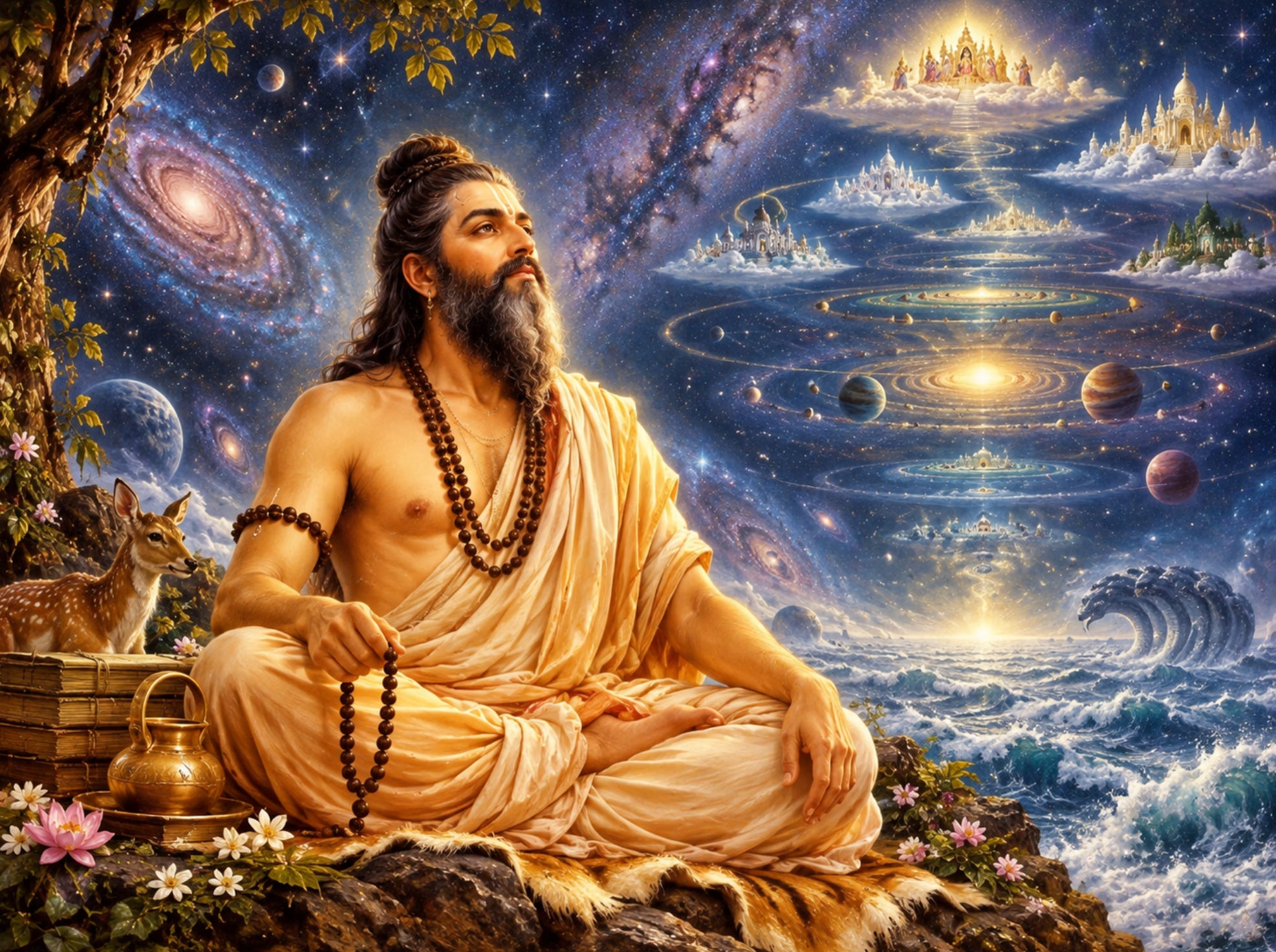
The initial question appears simple: In the Third Canto of the Śrīmad-Bhāgavatam, it is described that Kaśyapa Muni was the father of Hiranyākṣa and Hiraṇyakaśipu, which happened much earlier in the history of the universe, about half a billion years ago. However, the Eighth Canto describes Kaśyapa as one of the seven great sages. In other words, as still alive.
The first question is: how can someone, even a great sage, live for such a long period? Even the idea that people may live for 1,000 years in Dvāpara-yuga may already sound hard to believe; now we are speaking about hundreds of millions of years! The point is that when we speak of life expectancy, we imagine people like us, with similar types of bodies, made of flesh and bones. Great sages like Kaśyapa are very different in this regard. Because of their great level of spiritual advancement, they acquire very subtle types of bodies that can live for very long periods of time. They, however, are not like ghosts; they can act in the physical plane when they desire so, performing austerities, begetting children, etc., but they are not imprisoned in the physical plane like us. They are like a free person who can visit the prison and then leave it, and not like a prisoner who is forced to stay there.
This brings us to an important function performed by them: to act as prajāpatis and populate the universe. Kaśyapa was one of the main prajāpatis in the 6th manvantara, marrying thirteen of the daughters of Dakṣa (as the son of the Pracetās) and producing much of the initial population of the universe. Just like him, these are not ordinary women; they are also great sages advanced in austerity and mystic perfections.
The Prajāpatis produce children in association with their wives, but because they are much more powerful, they can generate offspring comprising different species and in huge numbers, and not just a couple of human babies like us. This may appear strange at first, but it is explained within the Vedic concept of higher beings being able to produce lower beings, but not the opposite. In essence, a demigod can produce a human being, but a human being cannot produce a demigod.
We come then to the chronological part. That’s even more astonishing.
The history of the universe is divided into 14 manvantaras, each one presided over by one of the fourteen Manus. We are currently in the 28th divya-yuga of the 7th manvantara. This process of population of the universe attributed to Kaśyapa happened at the beginning of the previous manvantara (Cākṣuṣa), which was about 429 million years ago.
So, based on that, Kaśyapa should have died a long time ago, right? No. That’s the point. He is still alive. He is currently one of the seven great sages (SB 8.13.5), responsible for propagating religious principles all over the universe.
What is even more astonishing is how far back in history his birth is. At the very beginning, Brahmā had his ten mental sons (Marīci, Atri, Aṅgirā, Pulastya, Pulaha, Kratu, Bhṛgu, Vasiṣṭha, Dakṣa (first birth) and Nārada), and Kaśyapa appeared as the son of Marīci in the first manvantara. In other words, he has been alive since the close of the beginning of creation. How can this at all be possible?
To explain this, we need to remember that our universe is composed of 14 planetary systems, which represent 14 levels of consciousness. We live in the 7th planetary system. On our planet, the life expectancy changes according to the age (as humanity goes through the process of degradation from Satya-yuga to Kali-yuga), but on most of the planets of our system, people live for 10,000 years. If we go to the next level, however, Svargaloka, we will find people living for 10,000 celestial years (which correspond to 3.6 million years of our time), with the chief demigods living up to 306.72 million years (a full manvantara). This is possible because demigods have bodies that are fundamentally different from ours, composed of more refined types of matter.
If we go one step further, to Maharloka, we reach a realm where the inhabitants live for up to 4.32 billion years, up to the end of the day of Brahmā, and if we go still higher, to Janaloka, Tapoloka and Satyaloka, we will find inhabitants who are essentially immortal, living until the end of the final devastation. This is possible because they have very subtle types of bodies that are not based on chemical reactions and don’t age like ours. As long as the universe exists, they exist within it. That’s the level where great sages like Kaśyapa live.
From this level, they can come down to Maharloka, Svargaloka, Bhuvarloka or Bhūrloka (our level) and act on these planes, but this doesn’t limit their lifespans.
This brings us back to Kaśyapa.
After being born from Marīci, Kaśyapa dedicated himself to meditation and austerities for a very long period, up to the beginning of the 6th manvantara, when he married the 13 daughters of Dakṣa and performed his function as one of the Prajāpatis of the 6th manvantara. Then, at the beginning of the 7th manvantara (the current one), he assumed the post of one of the seven great sages (saptarṣi), which he continues to perform to this day.
As a saptarṣi, he had one more son, this time a divine one: Vāmanadeva, who performed the pastime of taking the three planetary systems from the demons and giving them back to the rule of the demigods, and also giving shelter to Bali Maharaja when he surrendered to Him, giving Bali the planetary system of Sutala and remaining there to protect him as his doorman. This event also shows that not only Kaśyapa but also his wife Aditi was still present at the time, becoming afflicted when the demons defeated her sons (Aditi is the mother of the lineage of demigods which continues to this day) and begging her great husband to intervene.
Positions such as a prajāpati and a saptarṣi are offices, or posts. One may take to the post and later become something else, just as one may become a governor and later a president and later again a common citizen. It doesn’t mean one has to die and take a new birth. Similarly, Kaśyapa lived for a long time as an ascetic, then married and became a prajāpati, and later assumed the office of a saptarṣi, which he maintains to this day. Two other great ancient sages who are also holding offices among the saptarṣi are Atri and Vasiṣṭha. These are two of the original sons of Brahmā, who have also been alive since the beginning of the current cycle of creation.
At the end of the current manvantara, their posts as saptarṣi will be transmitted to another team of great sages, and Kaśyapa, together with Atri, Vasiṣṭha, and the others, may return to his life of meditation, or something else. One example is Kaśyapa’s father, Marīci, who held the position of a saptarṣi in the first manvantara (SB 4.1.8), and later returned to his life of meditation in the higher planetary systems. Later in the history of the universe, he may come down again to perform some other function if it becomes necessary.
At the beginning of each day of Brahmā, most of the universe (up to Maharloka) has to be repopulated after the devastation at the end of the previous day. Brahmā generates his mental sons at the beginning of creation (as described in the Third Canto), but the work of repopulating the universe at the beginning of the subsequent days is performed mainly by his sons and their descendants.
The Vāyu Purāṇa 1.7.7, describes:
pratyāhṛte pūrvakalpe pratisaṃdhiṃ ca tatra vai
anyaḥ pravarttate kalpo janāllokāt punaḥ punaḥ“First, the kalpa ends and, subsequently, the pratisaṃdhi ends. Then, the next kalpa begins with life imported from Janaloka. This process occurs again and again.”
At the beginning of the next day of Brahmā, when the lower planets are created again, these great sages go down to populate the universe, becoming the prajāpatis, the progenitors of the next generations of living beings.
Brahmā is currently 50 years old. The reason the Śrīmad-Bhāgavatam describes Brahmā creating the universe from zero at the beginning of his current day is that the current day is the first day of the second parārdha, the second half of his life. There is a process of complete destruction that happens at the end of the first half of the life of Brahmā, resulting in the universe starting fresh. There are thus two complete processes of creation in the history of the universe: at the beginning of Brahmā’s life, and in the first day of the second half of his life. The Śrīmad-Bhāgavatam describes both in different passages, and this explains some apparent contradictions in the text. In one passage, it is mentioned that he meditates for 1,000 years, and in another for 100 years, for example, because they describe two different events.
Back to Kaśyapa, for how long may he continue living? Essentially, for as long as he wants, potentially until the end of the universe. The Vāyu Purāṇa (1.8.23–26) gives us more detail on the long-term goals of such great sages:
aprāptā yās tapolokaṃ janalokaṃ samāśritāḥ
pravartanti punaḥ sarge bījārthaṃ tā bhavanti hi ॥23॥
bījārthena sthitās tatra punaḥ sargasya kāraṇāt
tatas tāḥ sṛjyamānās tu santānārthaṃ bhavanti hi ॥24॥
dharmārthakāmamokṣāṇām iha tāḥ sādhakāḥ smṛtāḥ
devāś ca pitaraś caiva ṛṣayo manavas tathā ॥25॥
tatas te tapasā yuktāḥ sthānāny āpūrayanti hi
brahmaṇo mānasās te vai siddhātmāno bhavanti hi ॥26॥
It can be translated as:
[At the time of dissolution] these great sages who did not attain Tapoloka took shelter in Janaloka. At the next creation, they become active again, serving as the seeds of creation. In this way, they remain there as seeds for the subsequent creation, and when creation again begins they come to generate progeny. Assuming the roles of devas, Pitṛs, ṛṣis and Manus, they also function as agents for the progress of all living beings, guiding them in dharma, artha, kāma, and mokṣa. In this way, endowed with great austerity, these perfected beings who are mind-born descendants of Brahmā again fill their respective positions.
Ordinary human history tends to be short-lived, traced back up to just a few millennia, because we have very short lives. Purāṇic cosmic history, however, is very different, because it deals with great cosmic personalities who remain active for astonishing periods of time. Many civilizations come and go, and even entire cycles of creation happen under their watch. That is why the same names repeatedly appear in different narrations, related to events that happened over spans of billions of years, making our ordinary historical assumptions obsolete.
It is possible that people living billions of years from now, in future cycles of creation, may still be studying how Kaśyapa populated the universe in the 6th manvantara of the first day of the second life of Brahmā and later became one of the seven sages and the father of the Supreme Lord.
If you would like to study more about Vedic cosmology, check the first chapter of the book:
+ Chapter 1: The Vedic Universe

This is a publication for thoughtful readers who want to go deeper into Kṛṣṇa consciousness. I publish daily, trying to offer high-quality spiritual content, and all posts are available to free subscribers. If you wish, you can support this work with a monthly contribution. When you subscribe, you can choose between a free subscription and a monthly contribution, and you can switch from a free subscriber to a supporter at any time.
You can also receive updates on WhatsApp or Telegram.
If you would like to contribute further, you can find the donation links here.