


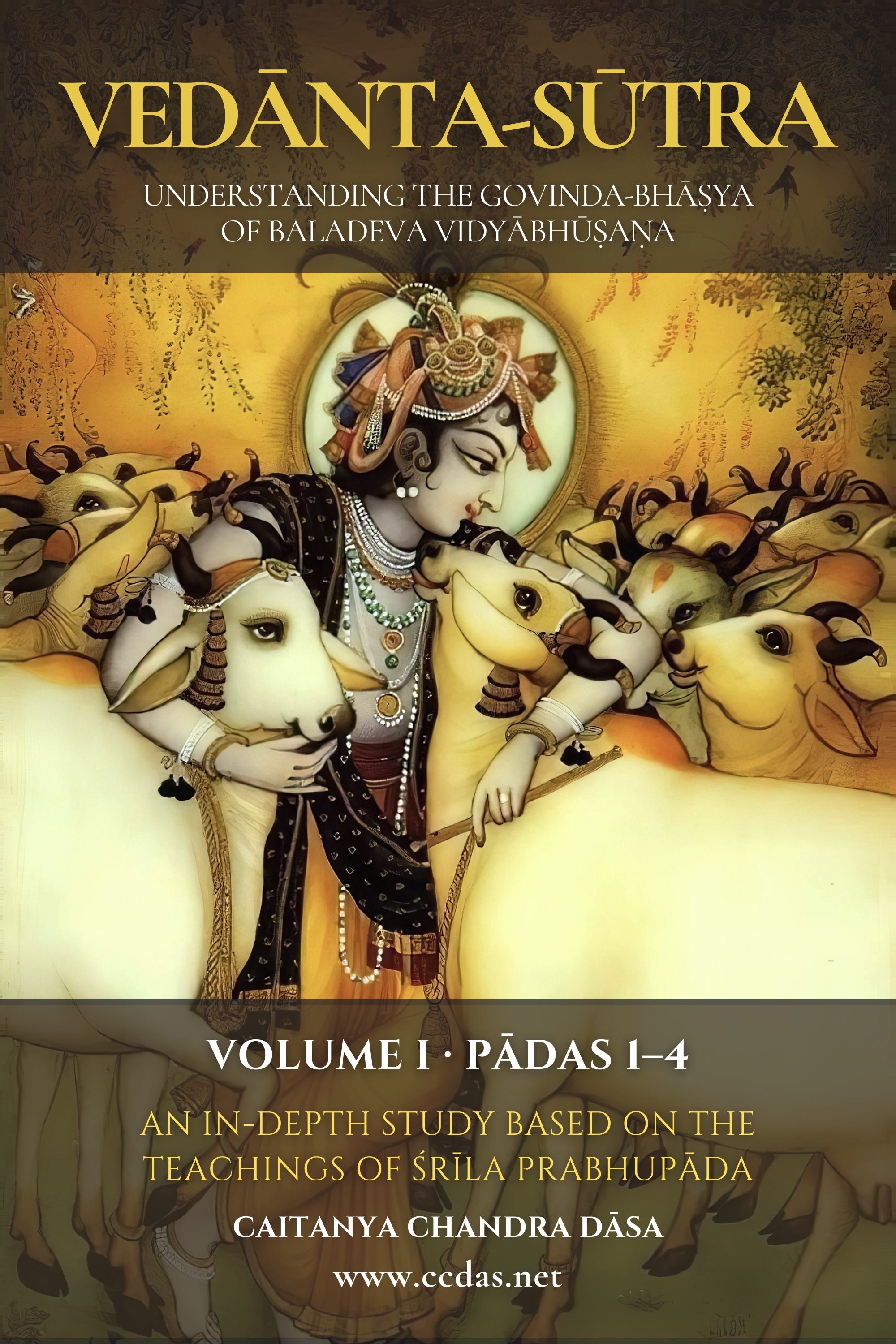
The Brahma-sūtra, or Vedānta-sūtra, is a short treatise written by Srila Vyāsadeva to transmit the ultimate conclusions of the Vedas. As Srila Prabhupada explains, “The Vedānta-sūtra, which consists of aphorisms revealing the method of understanding Vedic knowledge, is the concise form of all Vedic knowledge.”
It is called nyāya-prasthāna because it was written to allow one to understand the absolute truth through logic and argument, and this infallible logic becomes even more apparent in the commentary of Srila Baladeva Vidyābhūṣaṇa. Nowadays, more than ever, we often base our convictions on emotion rather than logic, and this can lead to many misconceptions that are very difficult to extirpate. The profound and delicate arguments presented in the Govinda Bhāṣya can help us rewire our brains in this direction, which can be invaluable in all spheres of life.
This book is an attempt to provide an extensive but at the same time easy-to-understand explanation of the Govinda Bhāṣya commentary of Srila Baladeva Vidyābhūṣaṇa, based on the explanations of Srila Prabhupada, as a humble offering to the devotees who are interested in studying this important masterpiece in the light of Srila Prabhupada’s teachings.
⤵️ Download the ebook
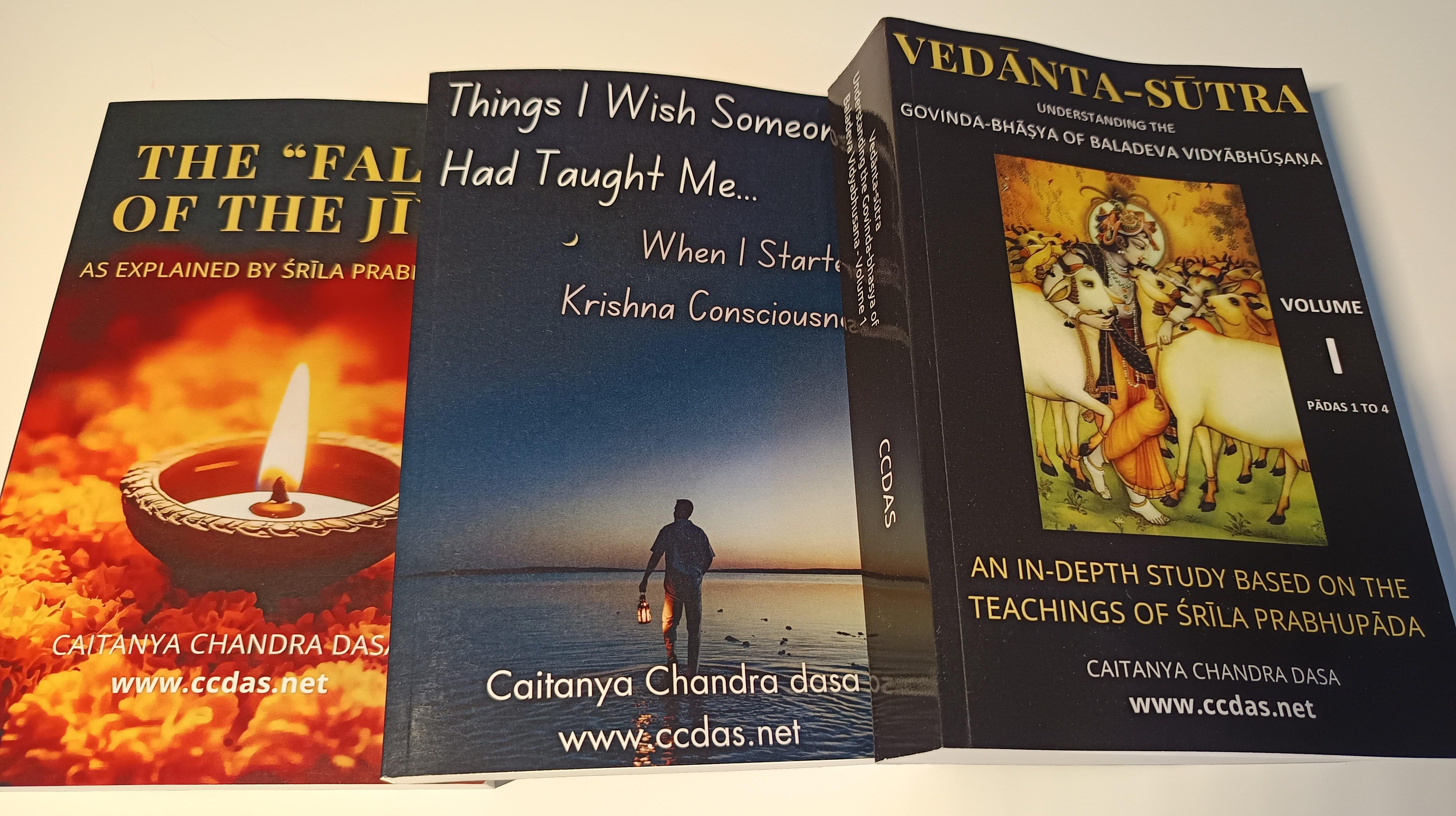
📚 Do you prefer a printed copy?
My books are available in printed form on Amazon. They are available in most of the world. Here are the direct links to the Amazon stores for my books:
US , UK , DE , FR , ES , IT , NL , JP , CA , AU
➡️ Read the book online:
+ Srila Prabhupada explains the Vedānta-sūtra
+ Introduction: The evolution of spiritual understanding
+ The conclusions of the Vedanta-sutra
+ The First Pada
+ Topic 1: Brahma-jijñāsādhikaraṇam - Inquiry into Brahman
+ Topic 2: Janmādyādhikaranam - Definition of Brahman
+ Topic 3: Śāstra-yonitvādhikaraṇam - The scriptures are the source of knowledge
+ Topic 4: Samanvyādhikaraṇam - Harmonizing the conclusions of the Vedas
+ Topic 5: Īkṣater-adhikaranām - Brahman is knowable
Sutra 1.1.5 - īkṣater nāśabdam: The Lord is not indescribable
Sutra 1.1.7 - tan-niṣṭhasya mokṣopadeśāt: Descriptions of the transcendental Lord
Sutra 1.1.8 - (na) heyatva-vacanāc ca: There is nothing higher
Sutra 1.1.9 - (na) svāpyayāt: The source of all incarnations
Sutra 1.1.10 - (na) gati-sāmānyāt: The One and transcendental Brahman
Sutra 1.1.11 - śrutatvāc ca: Material qualities can’t touch the Lord
+ Topic 6: Ānandamayādhikaraṇam - The Lord is full of bliss
+ Topic 7: Antar-adhikaraṇam - The person within the Sun
+ Topic 8: Ākāsādhikaraṇam - The section discussing the ether
+ Topic 9: Prāṇādhikaraṇam - The section concerning Prāṇa
+ Topic 10: Jyotiścaraṇādhikaraṇam - The light that has feet
+ Topic 11: Pādānta-prāṇādhikaraṇam - A final discussion on prāna
Sūtra 1.1.30 - Indra’s declaration is in accordance with scripture
The passage of Patardana and Indra from the Kauṣītaki Upanisad
+ All the sūtras of the first pāda in prose
+ The Second Pada
+ Topic 1: Sarvatra-prasiddhādhikaraṇam - The Lord is mentioned everywhere in the scriptures
Sūtra 1.2.3 - The qualities mentioned can’t be attributed to the jīva
Sūtra 1.2.7 - The Lord is greater than the sky, but fits inside the heart
Sūtra 1.2.8 - The difference between the two souls in the heart
+ Topic 2: Attādhikaraṇam - The Eater mentioned in the Kaṭha Upaniṣad is the Lord
+ Topic 3: Guhādhikaraṇam - The person in the heart
+ Topic 4: Antarādhikaraṇam - The person in the eye
+ Topic 5: Antaryāmy-adhikaraṇam - The antaryāmī
+ Topic 6: Adṛśyādhikaraṇam - The unseen person
+ Topic 7: Vaiśvānarādhikaraṇam – The meaning of Vaiśvānara
Sūtra 1.2.25 - The qualities are appropriate for the Lord only
Sūtra 1.2.28 - Vaiśvānara is not the demigod, nor the material element
Sūtra 1.2.30 - The Lord manifests in a small form for His devotee
+ All the sūtras of the second pāda in prose
+ The Third Pada
+ Topic 1: Dyu-bhv-ādy-adhikaraṇam - The abode of heaven, earth, and other things
+ Topic 2: Bhūmādhikaraṇam - Bhūmā, the infinite
Sūtra 1.3.8 - Bhūmā in the Chāndogya Upaniṣad refers to the Lord
Sūtra 1.3.9 - Qualities that can be applied only to the Lord
+ Topic 3: Akṣarādhikaraṇam - Akṣara, the imperishable
+ Topic 4: Īkṣati-karmādhikaraṇam - The person seen
+ Topic 5: Daharādhikaraṇam - Dahara, the “small sky” inside the heart
Sūtra 1.3.14 - The dahara is the abode of Paramātmā inside the heart
The passage describing the dahara from the Chāndogya Upaniṣad
Sūtra 1.3.18 - There is a great gap between the qualities of the jīva and the Lord
Sūtra 1.3.19 - We can develop spiritual qualities only through sādhana
Sūtra 1.3.21 - The Lord can be unlimitedly big, or inconceivably small
Sūtra 1.3.22 - The jīva is never as great as the Lord, even in the liberated stage
+ Topic 6: Pramitādhikaraṇam - The Person the Size of a Thumb is the Lord
Sūtra 1.3.24 - Passages describing the Lord and the jīva within the heart
Sūtra 1.3.25 - He becomes small to facilitate one’s meditation on Him
+ Topic 7: Devatādhikaraṇam - The devas also meditate on the Lord
Sūtra 1.3.27 - The demigods manifest in many forms to attend sacrifices
Sūtra 1.3.28 - The temporality of the demigods does not contradict the eternality of the Vedas
Sūtra 1.3.29 - The manifestation of the Vedas in human society
Sūtra 1.3.30 - How the Vedas survive the universal cycles of creation and destruction
+ Topic 8: Apaśūdrādhikaraṇam - The śūdra’s lack of qualification
+ Topic 9: Kampanādhikaraṇam - The cause of trembling
+ Topic 10: Arthāntarādhikaraṇam - Ākāśa refers to the Lord, who is different from the jīva
+ All the sūtras of the third pāda in prose
+ The Fourth Pāda
+ The six philosophical systems
+ The atheistic Sānkhya
+ Topic 1: Anumānādhikaraṇam - The limits of inference in obtaining knowledge
Sūtra 1.4.1 - Avyakta refers to the subtle body, and not to Pradhāna
The conversation of Yamaraja and Nāciketa from the Kaṭha Upaniṣad
+ Topic 2: Camasādhikaraṇam - The cup
+ Topic 3: Sankhyopasangrahādhikaraṇam - The five pañca-janās
Sūtra 1.4.12 - Five pañca-janās doesn’t mean five groups of five
Sūtra 1.4.13 - The two recensions of the Bṛhad-āraṇyaka Upaniṣad
+ Topic 4: Kāraṇatvādhikaraṇam - The cause of everything
+ Topic 5: Jagad-vācitvādhikaraṇam - The creator of the world
Sūtra 1.4.16 - The word karma means the universe, composed of matter and souls
Sūtra 1.4.18 - The jīva merges into prāna and again emerges from there
The instructions of King Ajātaśatru to Bālākī from the Kauṣītaki Upaniṣad
+ Topic 6: Vākyānyādhikaraṇam - By context, the Lord is understood
Sūtra 1.4.20 - By knowledge of the Self, everything becomes known
Sūtra 1.4.21 - The pure soul develops the qualities of the Lord
Sūtra 1.4.22 - The Lord in the heart is great and full of knowledge
Yājñavalkya teaches Maitreyī: The passage from the Bṛhad-āraṇyaka Upanisad
+ Topic 7: Prakṛty-adhikaraṇam - Arguments against prakṛti as the material cause
Sūtra 1.4.23 - Material nature is not separated from the Lord
Sūtra 1.4.25 - Brahman created from Himself, standing upon Himself
+ Topic 8: Sarva-vyākyātādhikaraṇam - All names are names of the Lord
+ All the sūtras of the fourth pāda in prose
⤵️ Download the ebook:
My books are available for free on most platforms, and you can contribute with donations according to your means.
Google Play Books: If this platform is available in your country, you should see the “Books” tab at the bottom of the screen when you open Google Play on your phone or tablet. Just search for the names of the books, or open the link for the series.
This is very practical for reading on a phone or tablet because it is formatted to fit the screen perfectly, unlike PDFs, which can be very uncomfortable to read on a small screen.
My books are also available on Amazon Kindle, but Amazon charges a fee.
You can also just download the PDF file directly here and leave a donation of any amount that is suitable for you.
Donate on PayPal | Stripe | Wise | Revolut | Other ways (UPI, PIX, etc.)

There are three options of files:
a) The regular version, with margins for printing.
b) A version without borders (more convenient for on-screen viewing).
c) An EPUB file compatible with most e-readers.
Feel free to download what is convenient for you.
📖 Do you prefer a printed book?
My books are available in printed form on Amazon. They are available in most of the world. They print and sell the books and give me a few euros for each copy.
Here are the direct links to the Amazon stores for my books:
US , UK , DE , FR , ES , IT , NL , JP , CA , AU
In India, they are available through Pothi. They also send to a few other countries. Here is the link to buy.
Hare Krishna Prabhuji
Dandavat Pranaam
Which original book are you referring for govinda bhasya ?
Can you please share pdf online link if publicaly accessible?